
Microlearning on rotations means studying in short, focused bursts of under 15 minutes, built around the patients and topics you see that week. Make each burst active, with questions and flashcards instead of rereading. Fit the bursts into gaps you already have: before rounds, between patients, at lunch. Keep one longer block for topics that need real depth. Below you'll find what the research says, how to build a daily rhythm, and how to make every short session count toward both your clerkship exam and your boards.
TL;DR
- Microlearning is learning in seconds or minutes, with activities lasting under 15 minutes. On rotations, that means using downtime you already have.
- Make each burst active: practice questions, flashcards and short recall beat rereading and highlighting.
- Divide your question bank by the days left on the rotation to set a daily target, then fill it in small pieces.
- Micro sessions work best inside a bigger plan, so keep a longer block for complex topics.
- Tools that generate questions and flashcards from your own lecture material remove the setup time that kills short sessions.
Table of Contents
- What microlearning means when you're on the wards
- Why short sessions fit clinical training
- What the evidence says about results
- Make every burst count: what to do in the minutes
- Build a daily framework from your rotation
- When micro is not enough
- Class exams and boards from the same minutes
- Perspective: why we built around your own material
- Put it to work with BoardMaster
- Common mistakes to avoid
- FAQ
- Sources
What microlearning means when you're on the wards
In education research, microlearning uses small lesson modules and short activities to teach and reinforce course objectives. A scoping review of health professions education describes learning that takes place in seconds or minutes, with activities of less than 15 minutes.
On a rotation, that definition is concrete. Your day is not a lecture hall schedule. It is pre-rounding, rounds, clinic, notes, a resident pulling you into a procedure, and then a tired evening. Large uninterrupted study blocks become rare, and the guilt about that is real.
Microlearning changes the question. Instead of asking "when will I get two free hours?", you ask "what can I learn well in eight minutes?" A few examples:
- Ten questions on the condition of the patient you just admitted.
- A set of flashcards on the drug class your attending mentioned on rounds.
- A two-minute written recap of what one case taught you.
- A short audio review on the commute home.
None of these replace deep study. They keep knowledge moving while the day is full.
Why short sessions fit clinical training
Time is the main obstacle. In a 2021 multi-institutional study of clerkship students, students named time as the main barrier to reading. They recommended using small windows of downtime during rotations to review, read or complete questions.
Medical schools give similar advice. UC San Diego's study skills guidance suggests using small bits of time, such as waiting for laundry or eating lunch, for active studying instead of waiting for a big block. Hofstra's academic success materials recommend "study bursts": brief, targeted sessions completed periodically through the week, in this case for Step 1 preparation.
There is also a generational angle. Authors of a 2023 otolaryngology rotation study argue that for Generation Z students, microlearning should be tech-enhanced and personalized, so limited time is used well and short, on-the-job learning is supported.
What the evidence says about results
The research is encouraging, with honest limits.
Knowledge and performance. In the 2023 study of final-year students on an otolaryngology rotation, combined microlearning and task-based learning improved knowledge scores and observed task performance compared with the control groups. A 2026 study of otolaryngology interns found that short task-based videos, such as ear examinations, were positively perceived when paired with watching experts at work in clinical settings.
Confidence and retention. The scoping review reports that microlearning has shown positive effects on health professions students' knowledge and confidence in performing procedures, retaining knowledge, studying and collaborative learning.
Spacing. In a multi-institutional randomized trial, U.S. medical students received spaced-education emails on urology. Both topic groups showed significant topic-specific pre-test increases, and long-term retention improved for prostate cancer and PSA screening, though not for BPH and erectile dysfunction.
Brief, practical formats. In a 2019 German study, students who got a 15-minute crew resource management intervention (three 5-minute parts: video, simulation and debriefing) retained more two weeks later when they watched a practical example video than when they watched a lecture video.
The scoping review's authors also note that future work needs to move beyond learner reactions and knowledge gains to outcomes like patient care. Much of the evidence is on knowledge and confidence, so treat microlearning as a strong tool for building and holding knowledge, not a guarantee of any score.

Make every burst count: what to do in the minutes
The format matters less than what you do inside it. A review of learning techniques for clinical anatomy points to practice testing, distributed practice and successive relearning as effective, and favors active retrieval over rereading or highlighting. The same paper urges students to move away from all-nighter cramming toward spacing, which supports long-term retention.

A 2018 BEME systematic review found that test-enhanced learning (short answer questions, multiple-choice questions, simulation and standardized patients) has robust effects across health professions for learning, retention and transfer compared with passive study.
In practice, that gives you a menu of 5 to 15 minute tasks:
| Time available | Best-fit task | Why it works |
|---|---|---|
| 3 to 5 minutes | Flashcard review of due cards | Spaced, active recall |
| 5 to 10 minutes | 5 to 10 board-style questions on today's patient topics | Practice testing with feedback |
| 10 to 15 minutes | Questions plus a written explanation of each miss | Retrieval plus error analysis |
| 2 to 5 minutes | Short written reflection on a case | Daily reflection helped third-years in a 2016 exploratory study |
| Commute | Audio review of a lecture topic | Uses time that cannot hold other tasks |
One caution from Case Western's study rules: don't try to learn material through flashcards alone. Mix in mnemonics, diagrams and teaching peers. The same guidance suggests roughly 75% of study time on deep conceptual understanding and 25% on active review and rehearsal, using time-boxing or the Pomodoro method. Short bursts are your 25%. Protect some time for the 75%.
For more on why answering beats rereading, see our piece on retrieval practice for med students, and on flashcards versus questions for choosing between the two.
Build a daily framework from your rotation
Start with a number, not a mood. The 2023 clerkship study strategies paper suggests using self-assessment to find knowledge gaps, then dividing the questions in a question-bank category by the number of days on the rotation. That gives you a daily target you can chip away at.
Here is a worked example. Say you have 6 weeks on internal medicine, with about 40 workdays, and you want to complete 400 questions in the relevant category. That is 10 questions a day. You can do them as two sets of five, one before rounds and one at lunch, or as one ten-question set in the evening.
A sample day
- Before rounds (10 minutes): review due flashcards, then skim the one or two diagnoses on your list for the day.
- Between tasks (5 minutes each): five questions, or a recap of a case in two sentences.
- Lunch (10 minutes): the second question set, with a quick look at every explanation.
- Evening (30 to 60 minutes): one deeper block on the topic you missed most that day. This is where complex material gets the longer treatment it needs.
- Last minute: write down the one thing you want to see again tomorrow.
If you want a fuller calendar, our rotation study plan for MS3s lays out a 1.5 to 3 hour daily structure that these bursts sit inside.
Turn objectives and lectures into bursts
Rotation objectives, clerkship lectures and clinical cases are your raw material. The trick is to convert each into a question or card before you try to learn it, because a burst only works if you can start instantly. Two habits help:
- After each lecture, write down three things the speaker stressed. Those become your first questions.
- After each patient, write one "why" question: why this drug, why this test, why now.
If you take structured notes, our guide to Cornell notes for medical school shows how to shape them so questions fall out naturally.
When micro is not enough
Microlearning shines for facts, associations, and pattern recognition. It is not a standalone strategy for complex, multifactorial topics. The 2023 otolaryngology study recommends integrating micro-units into a broader learning ecosystem for subjects that need depth.
So use a simple test. If you can state the answer in a sentence, it belongs in a burst. If you need to draw a mechanism, connect three systems, or explain why a patient's presentation changed, give it a longer block, then break the result into cards and questions afterward. That cycle, deep first and micro to retain, is how short sessions and long ones support each other.
Our lean study workflow guide covers how to arrange those blocks without adding hours.
Class exams and boards from the same minutes
The quiet problem on rotations is double duty. You need to pass the clerkship exam and also build toward USMLE or COMLEX. If your short sessions are random, you pay twice. If they are built from the material your course actually emphasizes and written in board style, the same ten minutes serve both.
That is also why practice questions are the backbone. We've written about how practice questions accelerate learning, how they support retention, and why practice tests predict exam performance. For spacing your reviews, see the week 1 spaced repetition plan.
Perspective: why we built around your own material
Most of the time students lose on rotations is not spent studying. It is spent deciding what to study, hunting for questions that match the course, and building cards by hand. A ten-minute window disappears before you have started.
We designed BoardMaster so that window is usable. You upload your lecture materials, and the platform generates USMLE-style practice questions that follow the concepts your professors emphasize. Flashcards with spaced repetition and medical images come from the same material, so reviews stay tied to what your course tests. A bank of 5,000+ physician-written board-style questions sits alongside, so class prep and board prep feed each other instead of competing for your evening.
Our view is that short sessions should be effortless to start and demanding once they begin. That means the question is already written, the explanation is one tap away, and the topic matches your week. Generic banks are valuable, but they cannot know what your professor stressed. We think aligning to the course is the biggest lever for students who are short on time.
Dr. Ahmed Abuzoor
Put it to work with BoardMaster
If you want your lecture notes to turn into ready-to-use bursts, BoardMaster is built for exactly that. Upload your material and get practice questions in USMLE, COMLEX or class-exam style, plus flashcards with spaced repetition, AI OSCE practice for clinical skills, lecture-based study podcasts for the commute, and the Cortex AI study assistant for instant explanations. The QBank adds 5,000+ physician-written board-style questions.
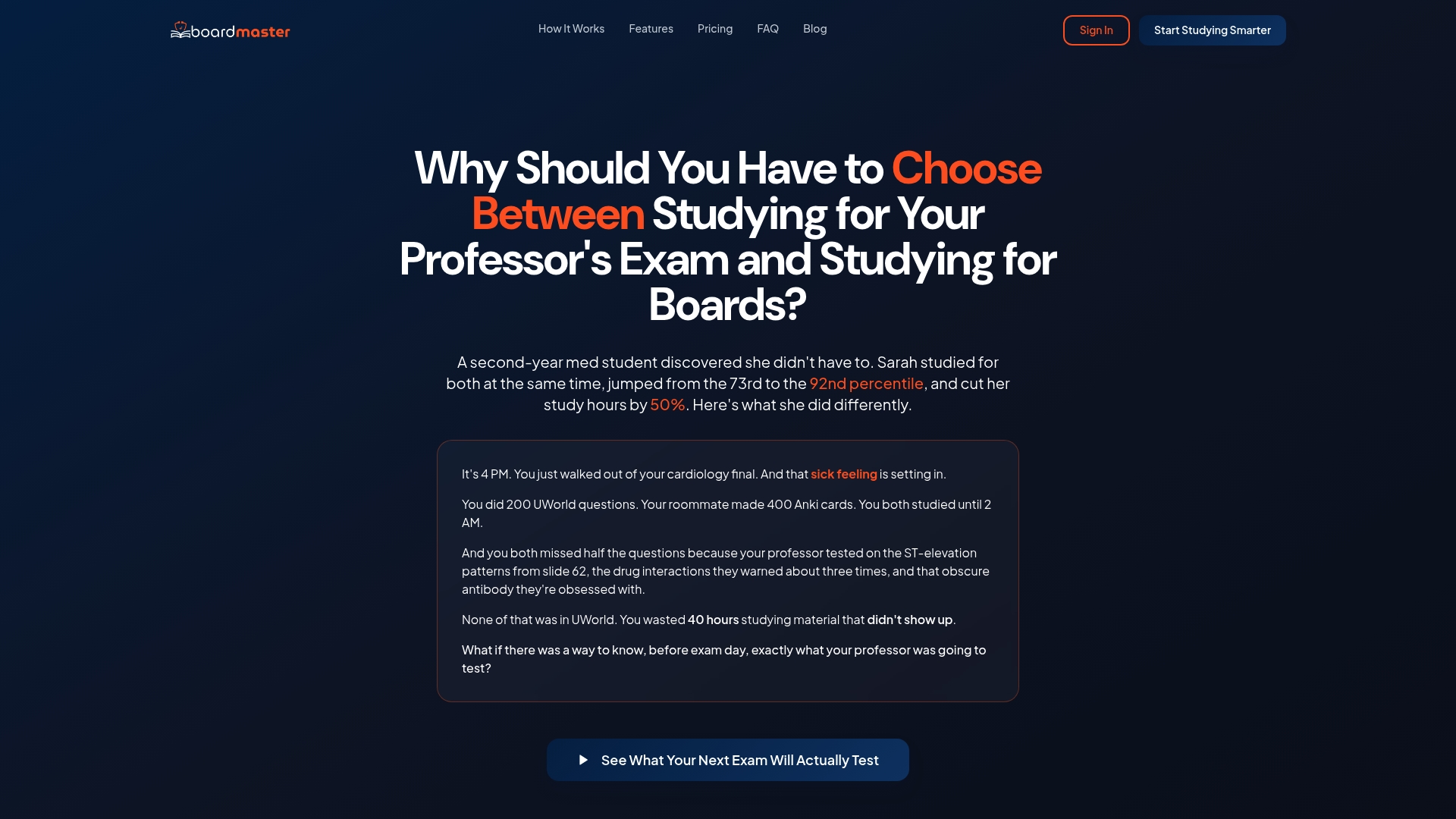
There is a free plan at $0 per month with limited use, so you can try it on a real rotation week. Paid plans are $39.99 per month or $399.96 per year, and credit packs are available for extra OSCE and podcast access. See the options on the BoardMaster homepage, or watch the question generator demo first.
Common mistakes to avoid
- Passive bursts. Scrolling notes for five minutes feels productive but is the rereading the evidence warns against. Answer something every time.
- No plan for misses. A wrong answer is the most valuable thing in a session. Write one line on why you missed it, and let it resurface in your spaced review.
- Only micro. Without a deeper block each day or week, you get scattered recall and weak understanding.
- Studying unrelated topics. Tie bursts to the patients and objectives of your current rotation first, then to boards.
- Waiting for perfect conditions. The 2021 student data shows that time is the barrier. The fix is to lower the cost of starting, not to find more time.
FAQ
How long should a microlearning session on rotations be?
Aim for under 15 minutes, and often 5 to 10. The research on microlearning defines activities as lasting less than 15 minutes. Pick a length you can finish before you are pulled away, so the session is never left half done.
Does microlearning work for clerkship exams and Step exams?
It supports both when the bursts are active and spaced. Practice testing and distributed practice are recommended over passive review, and brief "study bursts" are suggested for Step 1 preparation. Pair them with longer blocks for harder topics.
How many questions should I do per day on a rotation?
Divide the questions in your category by the days on the rotation, as the clerkship study strategies paper suggests. For example, 400 questions over 40 days is 10 a day. Split them across two or three short sets.
Can I use flashcards alone?
It is better not to. Case Western's guidance warns against learning through flashcards alone and recommends adding mnemonics, diagrams and teaching peers. Use cards for retention, and questions and deeper study for understanding.
What should I do during downtime if I'm too tired to study?
Pick the smallest active task: five due flashcards or three questions. Even a short written reflection on one case counts, since third-year students in a 2016 study felt daily reflections helped their learning and recall. Stop after that, and keep your deeper work for when you have energy.
Sources
- Microlearning in Health Professions Education: Scoping Review
- Practical and customizable study strategies for clerkship exams
- Reading and Study Habits of Medical Students on Clerkships
- UC San Diego: Study Skills and Exam Strategies
- Hofstra: Active Learning Study Bursts
- Enhancing Medical Students' Knowledge and Performance in Otolaryngology
- Online spaced education to teach urology to medical students
- Microlearning for patient safety: Crew resource management
- An evidence-based approach to learning clinical anatomy
- Test-enhanced learning in health professions education
- Case Western: The SD 10 Rules for Success
- Using reflection to influence practice: student perceptions