
Flashcards drill atomic recall: names, values, single facts you need to retrieve instantly. Practice questions test whether you can actually use those facts under exam pressure, when they're buried in a clinical vignette or a multi-step problem. If your exam is two months out, load up on flashcards first. If it's two weeks out, or the test is heavy on application, shift almost entirely to practice questions. A tool like BoardMaster can generate both directly from your own lecture notes, which keeps the whole sequence aligned to what you'll actually be tested on.
TL;DR:
- Flashcards are best for memorizing discrete facts like drug names, lab values, and anatomical relationships early in your study timeline, especially two to six weeks before the exam.
- Practice questions are more effective closer to the test date because they simulate exam scenarios, force application, and develop clinical reasoning skills.
- A hybrid approach, involving pretests, converting mistakes into targeted flashcards, and doing timed questions, improves long-term retention and exam performance.
- Flashcards with added personal examples and rephrasing, along with regular self-testing, lead to deeper learning compared to simple flip-and-check cards.
- Using automated tools like BoardMaster can streamline this cycle by generating questions from lecture notes and automatically turning errors into optimized flashcards.
Table of Contents
- Flashcards vs Questions: What Each Method Actually Trains
- When to Use Flashcards or Practice Questions During Your Study Timeline
- A Hybrid Workflow: Pretest, Convert, Practice, Prune
- What the Research Says About Flashcards and Practice Questions
- How I Recommend Students Structure Their Study
- Put This Workflow on Autopilot With BoardMaster
- Sources
- FAQ
Flashcards vs Questions: What Each Method Actually Trains
The core difference isn't format. It's cognitive demand. Flashcards are built for high-volume atomic recall: a drug name paired with its mechanism, a muscle paired with its innervation, a formula paired with its variables. Practice questions do something harder. They force you to pull that fact out of storage and apply it inside a scenario you haven't seen before, which is exactly what a board exam or a clinical vignette demands.
Think of flashcards as building your vocabulary and practice questions as making you write the essay. You need the vocabulary first, but nobody passes an exam by reciting definitions.
Flashcards work well for:
- Single-step facts: lab values, drug classes, anatomical relationships
- Vocabulary and terminology in any subject, from foreign languages to biochemistry
- Formulas and constants you need to recall instantly, not derive
Practice questions work well for:
- Clinical vignettes that bury a diagnosis inside a paragraph of distracting detail
- Multi-step problems where you have to combine two or three facts to get an answer
- Anything that tests judgment: which test to order next, which answer is "most likely" versus merely possible
The risk with flashcards is what researchers call the illusion of competence. You flip a card, recognize the answer, and feel like you know it. Recognition is not recall, and it definitely isn't application. Practice questions expose that gap fast, sometimes brutally, because a well written distractor will catch you every time you've only half learned something. The tradeoff is speed. You can burn through 100 flashcards in the time it takes to work through 15 questions, so flashcards remain the more efficient tool for pure content coverage early on.
When to Use Flashcards or Practice Questions During Your Study Timeline
The right method depends less on the subject and more on how many days you have left before the exam.
- Early phase (three to six weeks out): Convert your lecture notes into flashcards as you go. This is encoding work, not testing work. Keep sessions to 20 to 30 minutes so you're not just skimming. This is also when turning notes into flashcards pays off most, since you're building the raw material you'll drill for weeks.
- Middle phase (two to three weeks out): Mix flashcard review with short, low-stakes quizzes on each topic block. The goal here isn't mastery, it's diagnosis. Short quizzes reveal which connections between facts are still shaky before you've sunk more hours into content you already know.
- Final two weeks: Shift the bulk of your time to timed practice questions. This is where practice questions accelerate learning the most, because timed conditions mimic the actual exam and force speed alongside accuracy. Keep flashcards in rotation, but only for last-minute facts and anything you keep missing.
Subject matters here too. Anatomy, pharmacology, and language vocabulary lean flashcard-heavy because the content is genuinely atomic: names, terms, discrete facts with no reasoning chain attached. Math, physics, and clinical diagnosis lean question-heavy from the start, since the whole point is combining facts into a solution, not just remembering the pieces.
A Hybrid Workflow: Pretest, Convert, Practice, Prune
Here's a sequence you can start using this week, no new tools required beyond whatever you already study with.
- Pretest first. Before you study a new topic in depth, take a short 10 to 15 question quiz on it. You'll get several wrong, and that's the point. Pretesting before deep study tells you exactly where to spend your time instead of rereading everything equally.
- Convert your misses, differently. If you missed a pure fact (wrong drug, wrong value), turn it into a flashcard. If you missed something because you couldn't connect two ideas, write a new practice question that forces that same connection again.
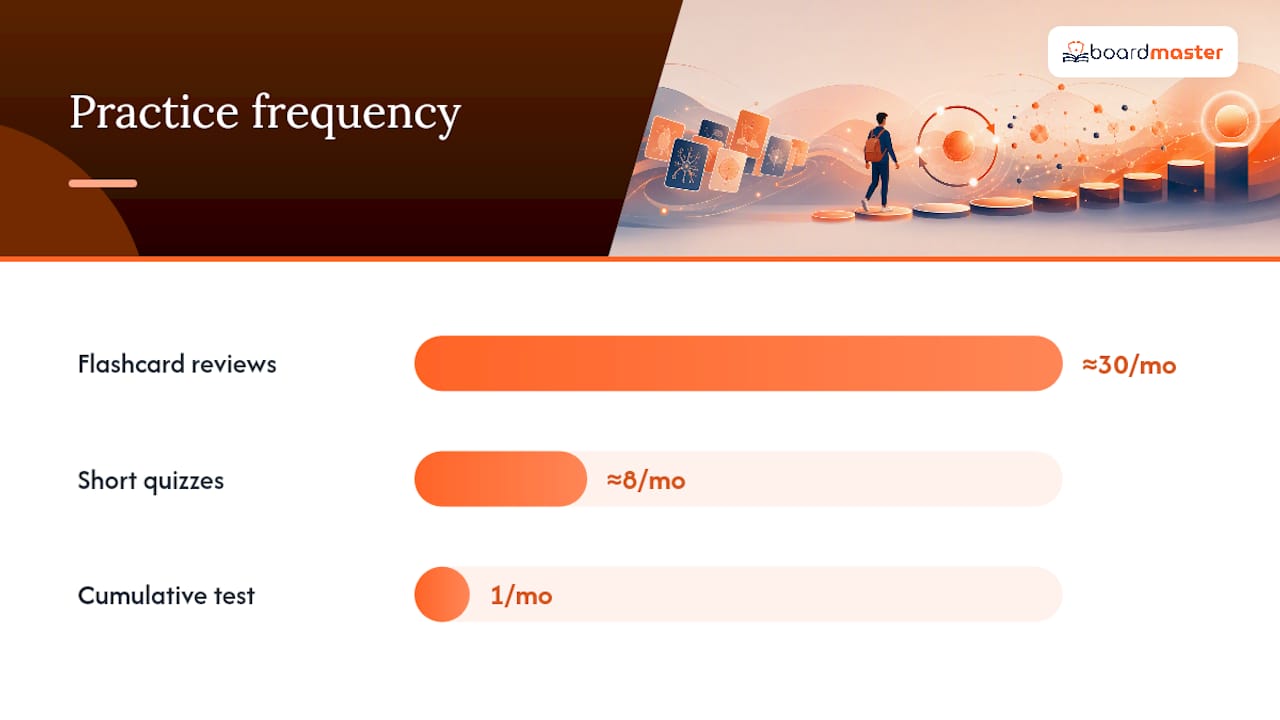
- Run a weekly cycle. Daily flashcard review, two short quizzes a week per active topic, and one cumulative practice test a month that mixes everything you've covered so far.
- Prune your deck constantly. Cards you get right five times in a row should be retired or pushed to a long interval. A 2,000 card deck you never finish reviewing is worse than a tight 400 card deck you actually complete daily.
Pro Tip: Don't write a flashcard with more than one fact on it. "Card asks two things" is the number one reason decks get abandoned, because you can never tell if you actually knew the answer or just got half of it right.
Simple cards also work better with a technique researchers call Flashcards-Plus, where you rephrase the concept in your own words and attach a personal example instead of just flipping between question and answer.
What the Research Says About Flashcards and Practice Questions
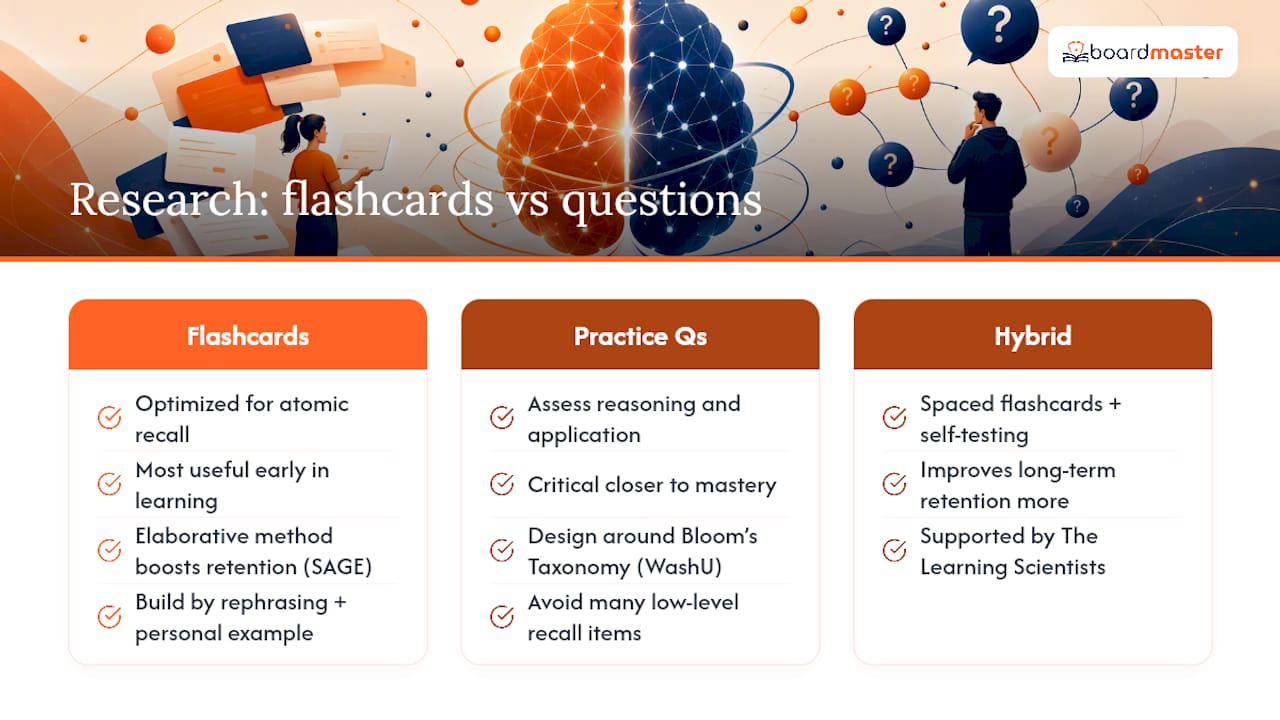
The split isn't just intuition. Osmosis's research summary states flashcards are optimized for atomic recall, while practice questions assess reasoning and application, with flashcards doing the heavy lifting early and questions becoming critical closer to mastery.
A SAGE Journals study on elaborative flashcard techniques found that students using the Flashcards-Plus method, rephrasing each card and adding a personal example, retained material more deeply than students using plain flip-and-check cards. That's a real gap in how much a flashcard actually teaches you, depending on how you build it.
On the question side, WashU's Center for Teaching and Learning recommends designing questions around Bloom's Taxonomy, moving deliberately from simple recall up through analysis and evaluation, rather than writing another dozen questions that all test the same low-level fact. The Learning Scientists back the hybrid cycle directly: combining spaced flashcard review with regular self-testing improves long-term retention more than either method alone.
How I Recommend Students Structure Their Study
Sequence beats intensity. Students who pretest, convert their specific misses into the right format, and then drill under timed conditions outperform students who just grind flashcards or just grind question banks. BoardMaster was built around that exact loop: it generates questions from your actual lecture material, then turns your wrong answers into targeted flashcards automatically. One caveat worth repeating: more cards and more questions isn't the goal. A tight, current deck beats a bloated one every time, and burnout kills more study plans than bad technique does.
— Dr. Ahmed Abuzoor
Put This Workflow on Autopilot With BoardMaster
Building this sequence by hand, pretest, convert misses, drill, prune, takes real discipline. BoardMaster removes the manual labor by generating both halves of the workflow directly from your uploaded lecture notes, matched to what your specific professor actually emphasizes rather than a generic national question bank.
Upload a lecture, and the AI Question Generator builds a pretest instantly. Miss a question, and AI Flashcards with built in spaced repetition turns that gap into a card automatically, so you never manually rebuild a deck from your mistakes. Miss something conceptual instead of factual, and the QBank of 5,000+ physician-written questions gives you more reps on that exact reasoning pattern. One student reported improved percentile ranking while reducing study hours using this exact loop. You can start with the free tier or the monthly subscription plan at BoardMaster and run your next lecture through it before your next quiz.
Sources
- Flashcards vs. Questions | Osmosis (Elsevier support)
- SAGE Journals article on elaborative flashcard techniques
- Asking questions to improve learning | WashU CTL
- The Learning Scientists — strategies for using flashcards and self-testing
FAQ
Are flashcards actually effective for studying?
Yes, for what they're built to do. Research shows flashcards excel at atomic recall of facts, terms, and formulas, but they don't reliably build the reasoning skills that practice questions test.
What are some good topics for flashcards?
Anything with a discrete, one-to-one answer works best: drug names and mechanisms, vocabulary, anatomical terms, formulas, and lab values. Multi-step reasoning or diagnostic decisions belong in practice questions instead.
Can ChatGPT make flashcards?
General AI tools can generate basic flashcards from text, but they typically need manual review for accuracy and plausible wrong answers. Purpose-built tools like BoardMaster generate flashcards directly from your own lecture material, which keeps them aligned with what your professor actually tests.
Are flashcards good for ADHD?
Flashcards suit short, focused review bursts, which can work well with shorter attention spans, though pairing them with active self-testing rather than passive flipping tends to hold attention better and reduces the illusion of competence.
Should I use flashcards or practice questions first?
Use flashcards first to encode new material, then shift to practice questions as your exam approaches to test whether you can actually apply what you memorized.