
TL;DR:
- Practice questions promote durable learning by forcing active retrieval, which strengthens neural pathways essential for exams. Medical students see score improvements and better long-term retention when they prioritize retrieval practice over passive review.
Practice questions accelerate learning by forcing your brain to actively retrieve information, which is itself the learning process, not just a measure of what you already know. Learning scientist Pooja Agarwal describes retrieval practice as the mechanism that builds durable memory, not a post-study checkpoint. For medical students preparing for block exams and USMLE Step exams, this distinction changes everything about how you should study. Passive rereading feels productive but produces weak retention. Active retrieval through practice questions builds the neural pathways that hold up under real exam pressure.
How practice questions accelerate learning through retrieval
Retrieval practice is the act of pulling information from memory without looking at your notes. That effort, not the act of reading, is what strengthens neural pathways and slows memory decay. Every time you struggle to recall a fact, your brain reinforces the route to that memory, making it faster and more reliable the next time.
Passive study methods like rereading and highlighting do not create this effect. When you reread a page, your brain recognizes the words as familiar and signals comprehension. That signal is misleading. Recognition is not the same as recall, and exams test recall. Retrieval practice forces effortful reconstruction, which is a fundamentally different cognitive process.
Cognitive scientists call this "desirable difficulty." The harder the retrieval, the more durable the memory. Retrieval difficulty inversely correlates with how fast you forget. A question that makes you work is doing more for your retention than ten minutes of comfortable rereading.
For medical students, this plays out in concrete ways. A question about the mechanism of action of beta-blockers forces you to reconstruct the pharmacology from scratch. That reconstruction is the learning event. The question is not testing whether you learned it. The question is how you learn it.

Pro Tip: After finishing a lecture, close your notes and write down every concept you can recall before opening any study material. This "brain dump" activates retrieval practice immediately and reveals your actual knowledge gaps before you waste time reviewing what you already know.
What evidence shows practice questions improve exam performance?
The research on practice questions and exam scores is direct and measurable. Students using chapter-by-chapter practice questions increased their exam scores by nearly 2%. That gain is not uniform across the class. It is largest for students who need it most.
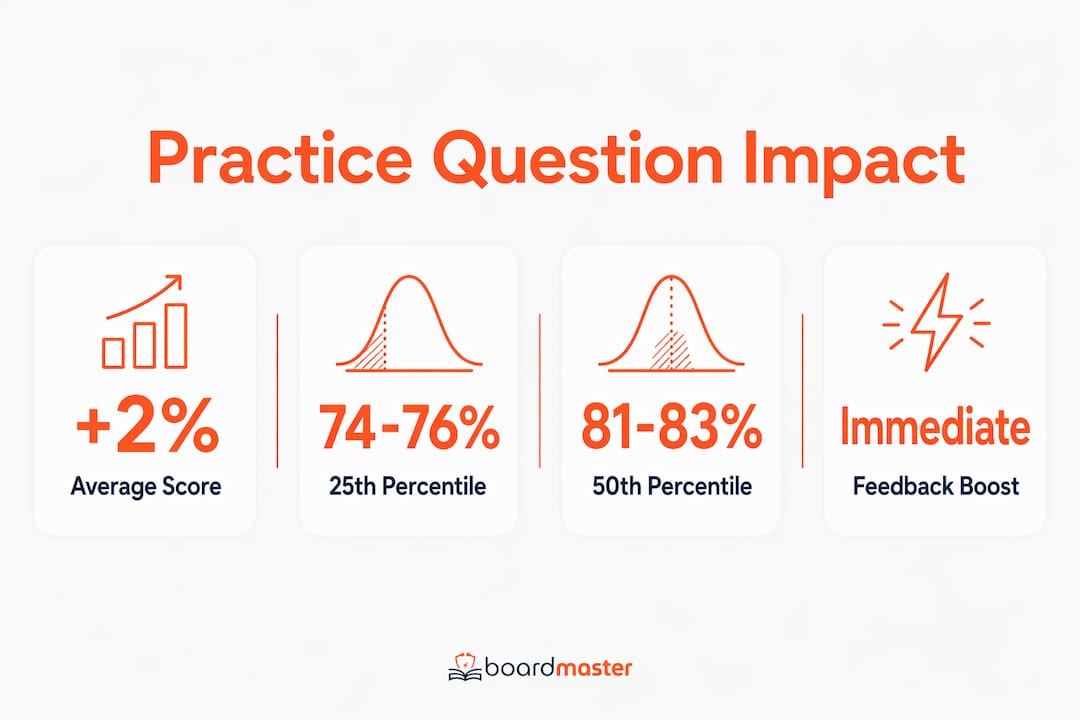
Students at the 25th percentile moved from scores in the 71–72% range to 74–76%. Students at the 50th percentile rose from 78% to 80%. These are grade-bracket shifts, not marginal improvements. For a medical student sitting near a pass/fail cutoff, a 3–4 point gain is the difference between advancing and repeating a course.
| Student percentile | Baseline score | Score with practice questions |
|---|---|---|
| 25th percentile | 71–72% | 74–76% |
| 50th percentile | 78% | 80% |
Immediate feedback amplifies this effect. When you answer a question incorrectly and immediately see the correct answer with an explanation, your brain encodes the correction more deeply than if you had simply read the fact the first time. The error creates a memory hook. The correction fills it with durable information.
Testing enhances learning through increased effort and motivation, not just exposure to content. Students who test themselves regularly are more engaged with the material and more accurate in judging what they actually know.
How should medical students use practice questions to maximize learning?
The sequence and method of practice question use matters as much as the volume. Follow these steps to get the most from every question session.
- Study the material first. Retrieval practice works best after initial exposure. Attempting retrieval on completely unknown material causes frustration and does not produce the same memory gains. Read your lecture notes or watch the lecture before opening a question bank.
- Answer without your notes open. Close everything. Commit to an answer before checking. The effort of retrieval is the mechanism. Looking up answers before committing defeats the purpose.
- Check your answer immediately. Review the explanation right after answering, whether you were right or wrong. Immediate feedback is what converts a practice attempt into a learning event.
- Treat wrong answers as the most valuable data. A wrong answer tells you exactly where your memory pathway is weak. Spend more time on explanations for missed questions than for correct ones.
- Space your practice sessions. Returning to the same topic across multiple sessions, rather than cramming it into one block, produces stronger long-term retention. Spaced retrieval compounds the memory gains from each session.
- Generate your own questions. Information you generate yourself is retained more durably than information you passively receive. After studying a topic, write two or three questions from the material before moving on.
Pro Tip: When you get a question wrong, do not just read the explanation and move on. Write the correct concept in your own words, then create a follow-up question that tests the same idea from a different angle. This double retrieval locks the correction into long-term memory.
What common misconceptions about practice questions hinder learning?
Medical students hold several beliefs about practice questions that actively reduce their effectiveness. Recognizing these misconceptions is the first step toward correcting them.
- "Practice questions are only for measuring progress." This is the most damaging misconception. Practice testing is the learning process itself, not a diagnostic tool. Students who save questions for "after I've learned the material" are delaying their most effective study method.
- "Struggling with a question means I'm not ready." Struggle is the signal that learning is happening. Dr. Nikolai Lee notes that cognitive dissonance from difficult questions signals effective memory consolidation, not failure. Discomfort during practice is the mechanism, not a warning sign.
- "I know this material because I can follow along when I read it." This is the fluency illusion. Students often misjudge mastery based on how smoothly they can read their notes. Fluency during passive review does not predict recall under exam conditions.
- "Cramming with questions the night before works just as well." Frequent, spaced testing outperforms concentrated cramming. The memory gains from retrieval practice accumulate across sessions. A single high-volume session does not replicate that effect.
- "Getting questions right means I'm done with that topic." Correct answers on the first attempt produce weaker memory than failed attempts followed by correction. Failing to recall and then receiving the correct answer primes stronger memory encoding than success on the first try.
These misconceptions share a common root: students equate comfort with learning. Effective study is uncomfortable by design. The common exam prep misconceptions that derail medical students almost always involve choosing the method that feels easier over the method that works.
How can integrating practice questions improve medical exam preparation?
Practice questions work best when they are woven into a broader study system, not treated as a standalone activity. The most effective medical exam preparation combines retrieval practice with content review, spaced repetition, and targeted question selection.
Prof. Marcia Linn notes that practice questions encourage mental rumination, which organizes and structures information for easier exam recall. This means practice questions do not just test isolated facts. They build the conceptual map that lets you navigate complex clinical scenarios on the USMLE.
The table below compares two common study approaches for medical exam preparation.
| Study approach | Strengths | Limitations |
|---|---|---|
| Content review only | Broad coverage, builds foundational knowledge | Weak recall under exam conditions, fluency illusion risk |
| Practice questions integrated with review | Active retrieval, immediate feedback, gap identification | Requires initial content exposure to be effective |
AI-generated question tools change the calculus for time-pressed medical students. Instead of spending hours searching for relevant questions, you can generate questions directly from your lecture notes. BoardMaster does exactly this: upload your notes, and the platform produces USMLE-style questions targeting the concepts your professor emphasized. That specificity matters because generic question banks cover broad content, while your block exam tests what your professor taught. BoardMaster's AI question generator closes that gap directly.
Monitoring your performance by topic lets you adapt your focus in real time. If your cardiology scores are consistently lower than your pulmonology scores, that data tells you where to direct your next retrieval session. Progress tracking turns practice questions from a study activity into a study system. For a full breakdown of how to select the right resources for Step exams, the 2026 USMLE study resources guide ranks the most effective options available this year.
Key Takeaways
Practice questions accelerate learning because active retrieval builds durable memory pathways that passive study cannot replicate, and this effect is measurable in real exam score gains.
| Point | Details |
|---|---|
| Retrieval is the learning event | Answering questions without notes builds memory; rereading only creates recognition, not recall. |
| Score gains are real and grade-shifting | Students at the 25th percentile gained 3–4 points, enough to shift grade brackets in medical courses. |
| Struggle signals progress | Cognitive dissonance during hard questions indicates effective memory consolidation, not a knowledge gap to fear. |
| Sequence and feedback matter | Study first, then retrieve without notes, then check answers immediately for maximum retention. |
| Targeted questions outperform generic banks | Questions aligned to your professor's content produce faster, more relevant exam preparation gains. |
Why I think most medical students are using practice questions backward
Medical students tend to treat practice questions as the finish line of a study session, something you do after you feel ready. That instinct is understandable and almost entirely wrong. The research is clear: the question is the study method, not the reward for completing it.
I have watched students spend three hours rereading a pharmacology chapter and then open a question bank expecting to perform well. When they miss questions, they conclude they need to reread more. The actual problem is that they have never practiced retrieving the information. More passive review will not fix a retrieval deficit.
The students who improve fastest are the ones willing to sit with discomfort. They open questions early, get things wrong, and treat every missed answer as a specific instruction about where to focus next. That mindset shift, from "I need to feel ready before I test myself" to "testing myself is how I get ready," is the single biggest lever available to a medical student.
AI-powered tools like BoardMaster make this shift easier because they remove the friction of finding relevant questions. When your questions come directly from your lecture notes, you have no excuse to delay retrieval practice. The question bank is already calibrated to what you need to know. The only variable left is whether you are willing to do the hard work of retrieving before you feel ready.
— Dr. Ahmed Abuzoor
BoardMaster puts retrieval practice where it belongs: at the center of your prep
Medical students who integrate practice questions from day one consistently outperform those who save them for the final stretch before an exam. BoardMaster is built around that principle.
Upload your lecture notes and BoardMaster generates USMLE-style questions targeting exactly what your professor emphasized. Sarah, a BoardMaster student, moved from the 73rd to the 92nd percentile while cutting her study hours in half. That result comes from studying the right material with the right method. BoardMaster's block exam prep tools and USMLE prep platform give you both a targeted question bank and an AI-powered system that adapts to your course content. Stop reviewing. Start retrieving.
FAQ
What is retrieval practice in medical education?
Retrieval practice is the act of recalling information from memory without notes, which strengthens neural pathways and builds durable long-term retention. It is the core mechanism behind why practice questions accelerate learning.
How many points can practice questions add to my exam score?
Students using chapter-by-chapter practice questions gained nearly 2% on exam scores, with students at the 25th percentile moving from 71–72% to 74–76%. The gains are largest for students near grade-bracket cutoffs.
Should I do practice questions before or after studying the material?
Practice questions work best after initial study exposure. Attempting retrieval on completely unknown material produces frustration rather than learning gains.
Why do I learn more from wrong answers than right ones?
Failing to recall an answer and then receiving the correct one, a process called "productive failure," primes stronger memory encoding than getting the answer right on the first attempt.
How are AI-generated questions different from standard question banks?
AI-generated tools like BoardMaster create questions from your specific lecture notes, targeting the concepts your professor emphasized rather than broad content. That specificity reduces wasted study time and aligns your retrieval practice directly with your actual exam.