
TL;DR:
- A lean study workflow for medical students combines active recall, spaced repetition, and focused study blocks to maximize retention and efficiency. It emphasizes high-yield content, scheduled review, and adaptive planning to prevent burnout and improve exam performance. Uploading lecture notes into AI tools like BoardMaster helps generate practice questions quickly, streamlining study time.
A lean study workflow for medical students is a structured system that maximizes retention and productivity by combining active recall, spaced repetition, and focused study blocks. The term "lean" borrows from manufacturing: cut waste, keep only what produces results. For medical students juggling lectures, clinical duties, and USMLE Step 1 prep, this approach is not optional. It is the difference between studying harder and studying right. This guide breaks down exactly how to build and maintain a lean study workflow, from daily scheduling to exam-phase adjustments, using evidence-backed methods that actually hold up under pressure.
What makes a lean study workflow for medical students work?
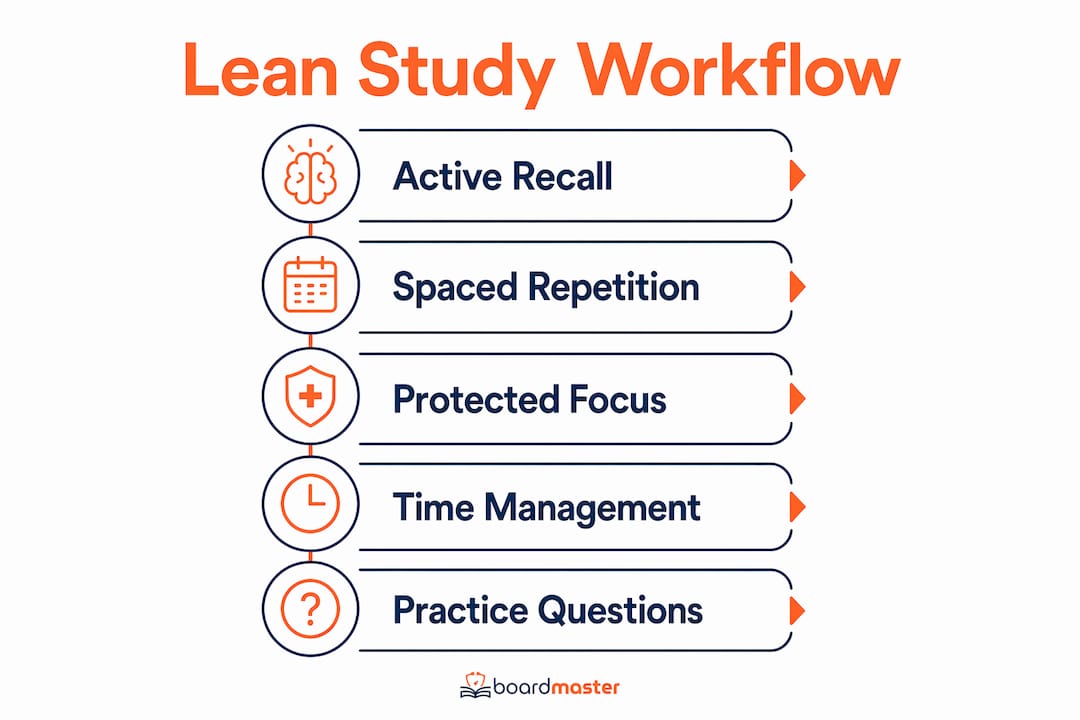
A lean study workflow rests on three scientific pillars: active recall, spaced repetition, and protected focus time. Each one targets a specific failure point in how most medical students study. Together, they form a system that produces measurable gains in retention and exam performance.
Active self-testing improves retention by roughly 50% over passive rereading in the week following a study session. That single finding should change how you spend every study hour. Rereading notes feels productive. It is not. Testing yourself on the same material forces your brain to retrieve information, which is the actual mechanism of long-term memory.
Spaced repetition distributes review sessions over time so you revisit material just before you would forget it. USMLE Step 1 prep typically requires 6–12 weeks of dedicated study, with a daily Anki card target of 100–200 cards to maintain retention without creating a backlog. Going above that ceiling creates review debt that compounds quickly.
Focus blocks of 60–90 minutes optimize concentration before mental fatigue sets in. Each block should open with 20–30 minutes of review and goal-setting before new material begins. Shorter blocks waste warm-up time. Longer blocks produce diminishing returns.
A practical daily lean workflow looks like this:
- Morning (25 min): Spaced repetition card review
- Post-lecture (15 min): Closed-book recall of the day's key concepts
- Evening (30 min): Targeted review of weak topics
- Three times per week: 20–40 practice questions with full error review
Pro Tip: Set a hard stop on your evening review at 30 minutes. Fatigue-driven study produces shallow encoding. Stop, sleep, and let consolidation do its work.
How to plan and schedule your study time efficiently
Efficient time management for medical students starts with working backward from your exam date. Set the exam date as a fixed anchor, then map out weekly milestones for each subject. This prevents the common mistake of spending three weeks on cardiology and two days on renal.

Color-coded calendar blocks for fixed commitments like lectures and clinics versus flexible study sessions give you an honest picture of available time. Most medical students overestimate free time by several hours per week. A color-coded calendar makes that gap visible and forces realistic planning.
Here is a structured approach to building your weekly schedule:
- Block fixed commitments first. Add lectures, labs, and clinical shifts before any study time.
- Assign study blocks to remaining slots. Prioritize mornings for spaced repetition and evenings for practice questions.
- Apply the 80/20 rule. Spend 80% of study time on high-yield topics that appear repeatedly on exams.
- Add buffer blocks. Reserve at least two 30-minute slots per week for overruns and unexpected review needs.
- Schedule a weekly review. Every Sunday, assess what you covered, what you missed, and adjust the next week's plan.
Rigid schedules without buffer time cause burnout. Buffer blocks are not wasted time. They absorb the inevitable overruns that come with clinical training and prevent one bad week from derailing your entire schedule.
The Pomodoro technique, 25-minute focused work intervals followed by 5-minute breaks, works well for administrative tasks like organizing notes. For deep learning, the 60–90 minute focus block is more appropriate because it allows enough time to work through complex clinical reasoning problems.
Pro Tip: Track your actual study hours for two weeks before adjusting your schedule. Most students discover they study less than they think, which explains why the schedule always feels behind.
How to convert lecture notes into practice questions
Passive notes are a liability. The moment you close your laptop after a lecture, the forgetting curve begins. Converting notes into testable questions within 24 hours of a lecture is one of the highest-yield study hacks for med students.
The process is straightforward:
- Isolate one concept per question. "What is the mechanism of action of metformin?" beats a paragraph summary every time.
- Focus on testable ideas. If a professor emphasizes a drug interaction, a diagnostic criterion, or a pathophysiology mechanism, that is exam material.
- Avoid over-notetaking. Transcribing slides verbatim produces passive content. Write only what you would need to answer a question.
- Use closed-book recall sessions. Cover your notes and answer your own questions from memory before checking.
- Discuss with peers. Explaining a concept to a classmate exposes gaps faster than rereading your own notes.
Technology that automates question creation from lecture notes removes the biggest bottleneck in this process: time. Manually writing quality questions for every lecture is slow. AI-powered tools that generate USMLE-style questions directly from uploaded notes collapse that process from hours to minutes.
BoardMaster does exactly this. You upload your lecture notes, and the platform generates practice questions aligned to what your professor emphasized, not generic board content. A student named Sarah used this approach and moved from the 73rd to the 92nd percentile while cutting her study hours in half.
Pro Tip: Write questions in the format you will see on your exam. For USMLE Step 1, that means clinical vignettes with a single best answer. Anatomy, pathology, and pharmacology all translate well into this format.
What common pitfalls should medical students avoid?
Most lean study workflows fail not because the method is wrong but because execution breaks down in predictable ways. Recognizing these failure points before they hit is the fastest way to protect your study efficiency.
- Multitasking during study sessions. Attention residue from task-switching degrades recall accuracy significantly. Every time you check your phone mid-session, your brain carries cognitive residue into the next task. Phone in another room, notifications off, no exceptions.
- Skipping error review. Practice questions without error analysis are almost useless. The question you got wrong is the one most likely to appear again.
- Relying on a single method. High-performing students layer multiple techniques, including active recall, spaced repetition, and interleaving, adjusting based on material type and exam phase.
- Ignoring weak areas. Students naturally gravitate toward topics they already know. Weak areas require deliberate, scheduled attention, not avoidance.
- Failing to adjust during exam phases. The workflow that works in week three of a block is not the same one that works in the final two weeks before an exam.
"Time management isn't about controlling every second. It's about making seconds count, with structured flexibility and recovery treated as a requirement, not a distraction." Protecting your recovery time is as important as protecting your study time.
Reviewing your common exam prep misconceptions periodically keeps your workflow honest. Most students carry at least one false belief about how they learn best.
How to adapt your workflow as exams approach and during rotations
The lean workflow you use in the first month of a block looks different from the one you use two weeks before an exam. Adapting the system to the academic phase is what separates students who peak at the right time from those who burn out early.
Here is how to shift your workflow across phases:
- Weeks 6–12 before an exam: Maintain balanced coverage. Equal time on new material and spaced repetition review.
- Weeks 3–5 before an exam: Increase practice question volume. Shift toward 40–60 questions per session with full error review.
- Final two weeks: Stop adding new Anki cards. Focus entirely on weak areas and timed question blocks.
- During clinical rotations: Reduce daily card volume to 50–75 to maintain retention without overwhelming your schedule.
- Weekend consolidation blocks: Use Saturday or Sunday mornings for a 90-minute review of the week's weak areas.
Case-based learning and clinical vignettes replace rote memorization as the primary method during rotations. Applying knowledge to patient scenarios builds the clinical reasoning that exams and residency both demand.
| Phase | Primary focus | Daily question volume |
|---|---|---|
| Early block | New content + spaced repetition | 20–40 |
| Mid-block | Weak area review + interleaving | 40–60 |
| Pre-exam (final 2 weeks) | Timed blocks + error review | 60–80 |
| Clinical rotations | Vignette-based review | 20–30 |
Sustainability matters more than intensity. A schedule that prevents burnout through built-in recovery time outperforms an aggressive schedule that collapses in week four. Adjust your weekly study balance every Sunday based on what actually happened, not what you planned.
Key Takeaways
A lean study workflow succeeds when active recall, spaced repetition, and protected focus time work together as a single system, not as isolated techniques applied randomly.
| Point | Details |
|---|---|
| Active recall over passive review | Self-testing improves retention by roughly 50% compared to rereading the same material. |
| Daily workflow structure | A 25-min morning review, 15-min post-lecture recall, and 30-min evening weak-topic session builds consistent retention. |
| Buffer blocks prevent burnout | Schedule at least two 30-minute buffer slots per week to absorb overruns and protect recovery time. |
| Adapt by exam phase | Shift from new content to timed question blocks in the final two weeks before any major exam. |
| Convert notes to questions fast | Turning lecture notes into testable questions within 24 hours closes the gap between passive learning and exam performance. |
What I've learned from watching students work lean
After years of working with medical students on exam preparation, the pattern I see most often is this: students who struggle are not lazy. They are busy in the wrong direction. They spend hours on material that will not appear on their exam, then wonder why their scores do not reflect their effort.
The lean workflow concept fixes this, but only if you treat it as a living system. The students who improve fastest are the ones who review their own data weekly. They track which topics they got wrong, which sessions felt productive, and which habits drifted. They adjust without guilt and without drama.
The hardest part of adopting an efficient study approach is accepting that less can produce more. Cutting your daily Anki cards from 300 to 150 feels like falling behind. It is not. It is the difference between reviewing cards you already know and spending that time on the questions that will actually move your score.
My honest advice: build the workflow in week one of your block, not week six. Students who wait until they feel behind are already behind. Start with the daily structure, protect your focus blocks, and let the system compound over time.
— Dr. Ahmed Abuzoor
BoardMaster puts your lecture notes to work
Medical students who follow a lean workflow still face one stubborn bottleneck: converting lecture notes into quality practice questions takes time they do not have.

BoardMaster solves this directly. You upload your lecture notes, and the platform generates USMLE-style practice questions built around what your professor emphasized, not generic board content. That means your block exam prep and your board prep happen at the same time, from the same material. BoardMaster's AI question generator removes the manual work of question creation so you can spend your time on the part that actually builds retention: answering and reviewing. If you are preparing for Step 1 or Step 2, the USMLE prep tools integrate spaced repetition and physician-written questions into a single workflow built for your schedule.
FAQ
What is a lean study workflow in medical school?
A lean study workflow is a structured daily system that combines active recall, spaced repetition, and focused study blocks to maximize retention while cutting wasted study time. It prioritizes high-yield content over volume.
How many hours should medical students study per day?
Daily study time varies by phase, but a lean workflow typically requires 1.5–3 hours of structured, focused study outside of lectures. Quality of attention matters more than total hours logged.
Does active recall actually improve exam scores?
Active self-testing improves long-term retention by roughly 50% compared to passive rereading. Medical students who replace rereading with practice questions and closed-book recall consistently outperform those who do not.
How should I change my study workflow before a big exam?
In the final two weeks before an exam, stop adding new Anki cards and shift to timed question blocks with full error review. Focus entirely on weak areas identified during earlier study sessions.
Can I maintain a lean workflow during clinical rotations?
Yes. Reduce your daily card volume to a manageable level, shift toward case-based learning and clinical vignettes, and use weekend blocks for consolidation. The structure stays the same; the intensity scales down to fit your clinical schedule.