
TL;DR:
- Practice tests improve exam performance by actively strengthening memory through retrieval under exam-like conditions.
- Consistently scheduled, well-designed practice exams that mirror real test difficulty and timing best predict actual success.
Practice tests predict exam performance because they force your brain to retrieve information under pressure, which is the same cognitive demand a real board exam places on you. This mechanism, known in cognitive psychology as the testing effect or retrieval practice, does more than measure what you know. It actively changes how durably you know it. Meta-analyses show an effect size of 0.67 in classroom settings, equating to roughly one letter grade improvement over peers using passive review. For medical students preparing for the USMLE or block exams, understanding why practice tests predict exam performance is not optional. It is the foundation of any study plan that actually works.
Why practice tests predict exam performance: the testing effect explained
The testing effect is the single most replicated finding in educational psychology. Retrieving a memory strengthens the neural pathway to that memory. Every time you pull an answer from your brain rather than reading it off a page, you make that answer easier to access the next time, especially under stress.

Retrieval practice alters neurological memory traces, making recall faster during high-stakes exams. This matters enormously for board exams, where time pressure and anxiety can block access to knowledge you genuinely have. Practice tests build multiple contextual hooks around each fact, so your brain has more than one route to the answer.
The contrast with passive study is stark. Retrieval practice produces roughly 80% knowledge retention after one week, compared to 36% for repeated studying of the same material. That is more than twice the retention in the same study time. Rereading your notes feels productive because the material looks familiar. That feeling is a lie your brain tells you.
A 2006 study made this concrete: testing students three times produced 61% retention one week later, versus 40% for re-reading. Re-readers actually scored higher on immediate tests, which explains why so many students keep rereading. The short-term payoff is real. The long-term cost is severe.
Here is the sequence that makes retrieval practice work:
- Attempt retrieval. Try to answer without looking. The effort itself is the mechanism.
- Encounter difficulty. Struggling to recall primes your brain to encode the correct answer more deeply when you finally see it.
- Check the answer. Corrective feedback locks in accurate memory traces and erases the wrong ones.
- Space the repetition. Returning to the same material after a delay forces retrieval again, compounding retention.
- Repeat under timed conditions. Simulating exam pressure trains your brain to retrieve under the same stress it will face on test day.
Pro Tip: Do not wait until you feel ready to take practice tests. The discomfort of not knowing an answer is the mechanism. Feeling uncomfortable means the testing effect is working.
What makes a practice test actually predictive?
Not every practice test predicts your real exam score. A poorly designed one can give you false confidence or unnecessary panic. Predictive validity depends on how closely the practice test mirrors the real exam.
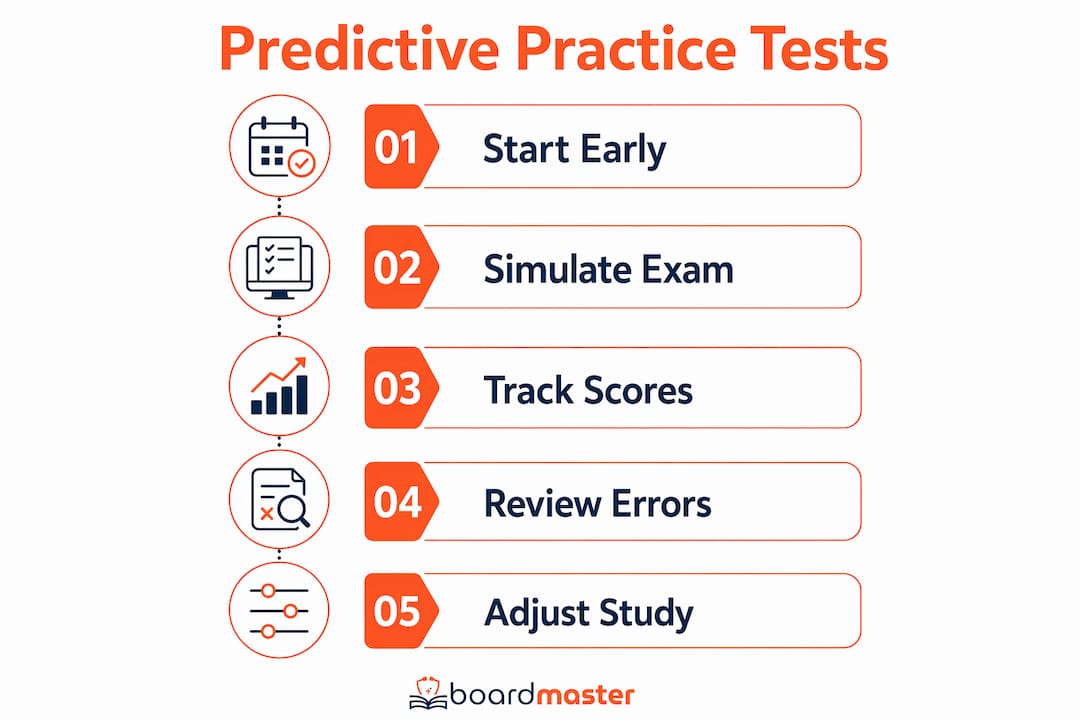
A predictive practice exam acts like a dress rehearsal, indicating readiness through patterns rather than single scores. Three factors determine whether a practice test earns that predictive power.
Alignment with real exam difficulty and question style
USMLE Step 1 and Step 2 questions test clinical reasoning, not memorization. A practice test built from simple recall questions will not predict your performance on vignette-based items. The question style must match. Difficulty distribution must match. If your practice test is easier than the real exam, your score will be inflated and misleading.
BoardMaster addresses this directly by generating USMLE-style questions from your own lecture notes, so the difficulty and format align with both your professor's expectations and board exam standards. That dual alignment is what makes the practice predictive rather than decorative.
Realistic timing and test conditions
Sitting down to answer 40 questions with no time limit is not a practice test. It is a slow-motion review session. Predictive practice requires the same time pressure as the real exam. Structured practice testing correlates with higher recall accuracy, better time management, and higher pass rates on first attempts. Time pressure is not just a logistical detail. It is a core variable in the prediction.
Cumulative patterns, not single scores
One practice test score tells you almost nothing. A series of scores tells you everything. Look for the direction of movement, the topics where you consistently underperform, and the question types that trip you up repeatedly. A single high score can reflect a lucky topic distribution. Consistent scores above a threshold reflect genuine mastery.
Pro Tip: Track your practice test scores in a simple spreadsheet. Log the date, score, and the top three topic areas where you lost points. After four or five tests, the pattern will tell you exactly where to study next.
Understanding how exam blueprints shape preparation also sharpens the predictive value of your practice tests, because you can weight your review toward the content domains that carry the most exam weight.
Why consistent practice test performance signals exam readiness
A single strong practice test score is encouraging. Consistent strong scores across multiple attempts are the actual signal that you are ready.
Repeated practice test attempts and pattern tracking reveal whether a learner has crossed competency thresholds. Consistent progress on higher-order questions predicts strong upcoming exam performance. This is the difference between knowing material on a good day and owning it under any conditions.
Consistent practice testing builds several capacities that a single test cannot:
- Endurance. Practice tests train pacing and endurance for long multi-hour medical exams. Repeated exposure to test-like conditions reduces fatigue and improves focus on exam day. Your brain needs to practice running a marathon, not just a sprint.
- Topic-level self-awareness. Patterns across multiple tests show you which subjects are genuinely solid and which ones only feel solid. This distinction is critical for allocating study time.
- Confidence calibration. Anxiety on exam day drops when you have already sat through dozens of timed practice sessions. The real exam feels familiar rather than foreign.
- Strategy refinement. You learn how to pace yourself, when to skip and return, and how to approach question stems you have never seen before. These are skills, and they require repetition to develop.
BoardMaster's approach supports this iterative process by generating new questions from the same lecture material each time, so you are not memorizing a fixed question set. You are practicing genuine retrieval from the same knowledge base, which is exactly what the real exam demands. Students who use BoardMaster's professor-specific question banks report that repeated practice on high-yield content accelerates both score improvement and confidence.
Common misconceptions about practice test scores
The biggest mistake medical students make with practice tests is treating a single score as a verdict. It is not. A score is a data point. It only becomes meaningful in context.
Students misjudge their learning due to the feeling of fluency from rereading. Practice tests disrupt that illusion by revealing what you actually cannot retrieve under pressure. This is uncomfortable, but it is the most accurate feedback you will ever get before the real exam.
Several misconceptions consistently derail students:
- Overvaluing a high score on an easy test. If the questions were below board exam difficulty, the score predicts nothing. Calibrate your expectations to the test's rigor.
- Treating a low score as failure. A low score on a hard, well-designed practice test is productive data. It shows you exactly where your knowledge breaks down before it matters.
- Ignoring wrong answers. The review session after a practice test is where most of the learning happens. Students who skip review lose the majority of the benefit.
- Stopping practice tests when scores plateau. A plateau often means you have mastered the easy material and are now encountering your real knowledge gaps. That is when practice tests become most valuable, not least.
Failing productively during retrieval enhances long-term retention by priming correct encoding when you finally encounter the right answer. Getting a question wrong and then reviewing the explanation is one of the most efficient learning events in medicine. Treat it that way.
Reviewing common exam prep misconceptions alongside your practice test data helps you avoid the traps that derail even hard-working students.
Pro Tip: After every practice test, spend at least as much time reviewing wrong answers as you spent taking the test. Write a one-sentence explanation of why you got each question wrong. That act of articulation is itself a retrieval event.
Key takeaways
Practice tests predict exam performance because retrieval practice strengthens memory durably, and consistent scores across well-designed tests reveal whether you have crossed the competency thresholds required for board exam success.
| Point | Details |
|---|---|
| Retrieval beats rereading | Practice tests produce roughly 80% retention after one week versus 36% for repeated study. |
| Design determines predictive power | Only practice tests that match real exam difficulty, question style, and timing produce accurate forecasts. |
| Patterns matter more than single scores | Consistent performance across multiple tests signals genuine mastery, not a lucky result. |
| Productive failure accelerates learning | Getting questions wrong and reviewing explanations encodes correct answers more deeply than easy recall. |
| Endurance and pacing are trainable | Repeated timed practice reduces fatigue and builds the focus needed for long board exams. |
What I have learned about practice tests after years of working with med students
Most students treat practice tests as checkpoints. They study, then test, then study more. That sequence gets the causality backwards. Practice tests are not a measurement tool you use after learning. They are the primary learning mechanism.
The students I have seen improve the most share one habit: they take practice tests early, often, and under real time pressure, even when they feel unprepared. The discomfort of not knowing an answer is not a sign to study more before testing. It is the signal that the testing effect is doing its job.
There is also a timing trap worth naming. Students who wait until two weeks before a board exam to start heavy practice testing are leaving most of the benefit on the table. The neurological strengthening from retrieval practice compounds over time. Starting early and spacing tests across weeks produces far better outcomes than cramming tests into a short window.
One more thing: do not confuse a good review session with a good practice test. Reviewing your Anki deck or rereading a First Aid chapter feels like active study. It is not retrieval practice. The key variable is whether your brain has to work to produce the answer before seeing it. If the answer is visible, the mechanism is off.
BoardMaster's approach of generating fresh questions from your own notes every session removes the temptation to memorize a fixed question set. That keeps the retrieval genuine, which keeps the prediction accurate.
— Dr. Ahmed Abuzoor
How BoardMaster prepares you to predict and pass your board exams
Medical students who understand the science of retrieval practice still need a tool that puts it into action efficiently.
BoardMaster generates USMLE-style questions directly from your lecture notes, so every practice session targets the exact content your professors emphasize. That alignment makes your scores genuinely predictive of both block exam and board exam performance. The platform tracks your performance patterns across sessions, showing you where your knowledge is solid and where it breaks down. Students like Sarah moved from the 73rd to the 92nd percentile while cutting study hours in half by focusing on high-yield, targeted questions. Explore BoardMaster's USMLE prep tools or see how block exam preparation works with AI-driven practice testing built around your actual coursework.
FAQ
Why do practice tests predict exam scores better than studying?
Practice tests force active retrieval, which strengthens memory more durably than passive review. Meta-analyses show students who use regular practice testing score about one letter grade higher than peers who rely on rereading.
How many practice tests should I take before a board exam?
No single number applies universally, but consistent performance across multiple spaced sessions is the goal. Patterns across at least four to five tests give you reliable data on your readiness and knowledge gaps.
Do practice test scores directly predict USMLE performance?
Practice tests predict USMLE performance when they closely replicate the exam's difficulty, question style, and timing. A single score from an easy or poorly designed test has low predictive value.
What should I do when my practice test scores stop improving?
A plateau signals that you have exhausted easy gains and are now facing genuine knowledge gaps. Shift your review toward the specific topics and question types where you consistently lose points.
Is it worth taking practice tests before I finish studying a topic?
Yes. Attempting retrieval before you feel ready is more effective than waiting. Productive failure primes your brain to encode the correct answer more deeply when you encounter it during review.