
TL;DR:
- Practice questions activate retrieval practice, which significantly improves long-term memory retention for medical exam content. Using explanatory feedback and aligning questions with exam formats enhance score gains and conceptual understanding. Regular, spaced practice combined with high-quality explanations is key to maximizing learning outcomes.
Practice questions are defined as active retrieval tools that force your brain to reconstruct knowledge from memory, and research confirms they outperform passive study for long-term retention. The role of practice questions in retention is not a matter of debate. Retrieval practice strengthens memory pathways each time you attempt an answer, even when you get it wrong. For medical students preparing for USMLE Step 1, shelf exams, or block exams, this mechanism is the difference between recognizing a fact and actually recalling it under pressure. The research is clear: students who practice retrieval consistently score higher on standardized exams than those who rely on re-reading or passive review.
How do practice questions improve retention?
Retrieval practice works by forcing your brain to actively reconstruct a memory rather than passively recognize it. Each attempt strengthens retrieval pathways by binding the memory to new contextual cues, making future recall faster and more reliable. This effect holds even when you answer incorrectly. A failed retrieval attempt followed by corrective feedback creates a stronger memory trace than never attempting the question at all.

Feedback is the multiplier in this process. Practice with corrective feedback boosts memory retention more than passive study or lecture review. That finding comes from a meta-analytic synthesis of retrieval-driven learning research. The implication for medical students is direct: answering a question and then reading the explanation is more valuable than reading the explanation first.
The benefits split into two categories worth understanding. Retrieval practice reliably improves memory for the specific content you practiced. Generalization to new clinical contexts, what researchers call far-transfer, requires explanatory feedback and enough prior knowledge to connect new information to existing frameworks. This distinction matters when you choose question types for different stages of your study schedule.
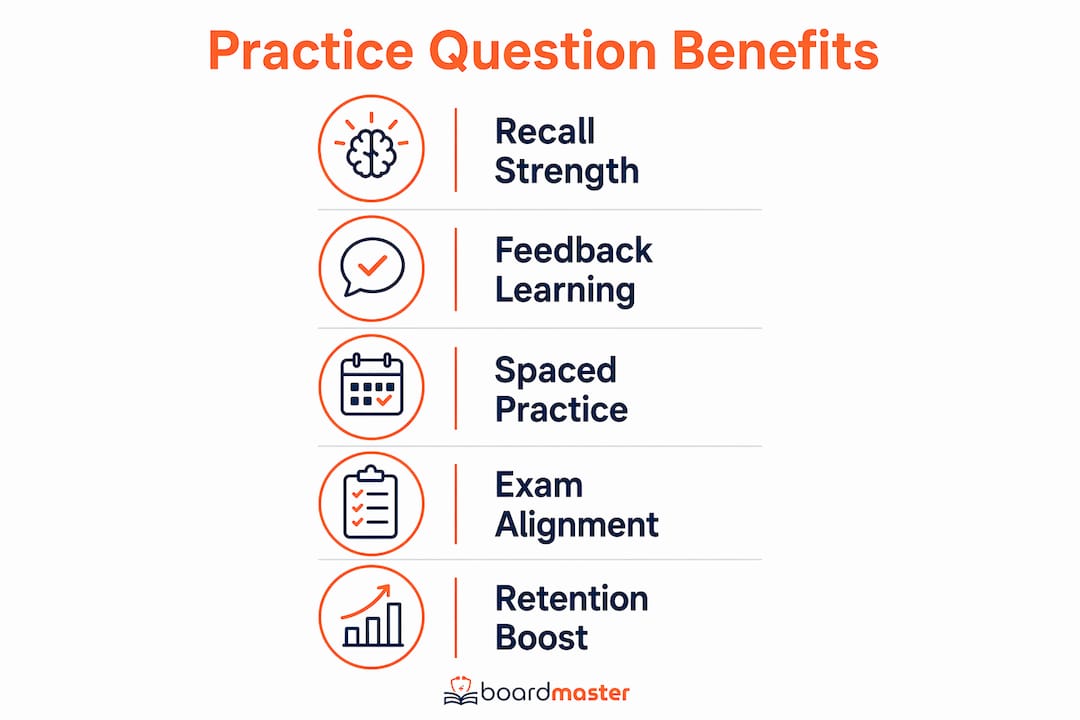
- Retrieval strengthening: Every attempt, right or wrong, reinforces the memory trace for that concept.
- Metacognitive calibration: Answering questions reveals exactly where your knowledge gaps are, which passive review cannot do.
- Feedback amplification: Explanatory feedback after each question accelerates both memorization and conceptual understanding.
- Spacing effect: Distributing practice across days compounds retention gains beyond what a single study session produces.
Pro Tip: Read the full explanation for every question you answer, not just the ones you get wrong. Correct answers can be reached through faulty reasoning, and the explanation catches that.
What does the research say about practice questions in medical education?
The empirical record on the impact of practice questions in medical education is strong and growing. A pilot study with 64 medical students found that those who used AI-generated practice quizzes scored approximately 3.7 percentage points higher on Exam 1 than the control group. Students in that study also sought continued access to the quizzes after the study ended, which signals genuine perceived value beyond the grade bump.
Spaced retrieval produces even larger gains when paired with elaborative interrogation. A pilot intervention with emergency medicine residents showed that a brief spaced retrieval program improved MCQ scores from 53% to 77% in the short term, with long-term scores holding at 69%. That is a 16-point short-term gain from a structured but brief intervention. The long-term score of 69% still represents a meaningful improvement over the 53% baseline.
Anki, the spaced repetition flashcard tool, shows consistent correlation with higher performance on USMLE Step 1, CBSE, and NBME exams. A systematic review confirmed Anki correlates with higher scores, though the evidence is observational and effect sizes vary based on deck quality and how well the cards align with your curriculum. A cross-sectional survey of 318 medical students found that about 25% use Anki, with daily users reporting the strongest perceived gains in long-term retention.
| Study | Population | Intervention | Key Outcome |
|---|---|---|---|
| AI quiz pilot study | 64 university students | AI-generated practice quizzes | +3.7 percentage points on Exam 1 |
| Spaced retrieval pilot | Emergency medicine residents | Spaced retrieval + elaborative interrogation | MCQ scores improved from 53% to 77% |
| Retrieval practice cohort study | 1,500+ higher education students | Weekly online retrieval practice | +8 percentage points on final exam |
| Anki systematic review | Medical students (multiple studies) | Spaced repetition with Anki | Correlated with higher USMLE Step 1, CBSE, NBME scores |
A large cohort study with over 1,500 higher education students found that weekly retrieval practice improved quiz scores by 4–5 percentage points and final exam scores by 8 percentage points. Those gains were strongest for near-transfer problems, meaning questions that closely matched the format of the practice material.
Common misconceptions about using practice questions effectively
The biggest misconception is that any practice question produces the same benefit. Question format, feedback quality, and your existing knowledge level all determine how much you actually retain. Not all question formats yield the same retention. Retrieval with reflective feedback consistently outperforms question-only or discussion-based approaches that lack structured feedback loops.
A second misconception is that simple correct-answer feedback is enough for applied exam questions. Correct-answer feedback works well for memorization tasks. For applied clinical reasoning questions, the kind you see on USMLE Step 1, you need explanatory feedback that walks through the reasoning. Without that explanation, you may memorize the right answer without understanding why it is right, which fails you on novel question stems.
Domain knowledge also shapes how much you gain from practice questions. If you attempt questions on a topic before you have any foundational understanding, you risk cognitive overload rather than learning. The research on near-transfer vs. far-transfer effects shows that premature exposure to complex, far-transfer questions can actually limit your gains. Build the foundation first, then test it.
- Misconception 1: More questions always means more learning. Volume without reflection produces diminishing returns.
- Misconception 2: Getting the right answer means you understood the concept. Always read the explanation.
- Misconception 3: Practice questions replace conceptual learning. They work best as a test of knowledge you have already built.
- Misconception 4: Peer discussion without feedback is equivalent to retrieval practice. Research on peer instruction shows limited long-term retention without effective retrieval-feedback loops.
Pro Tip: Before starting a new question block, spend 10 minutes reviewing core concepts for that topic. You will get more from the questions and avoid the frustration of guessing on every stem.
Practical strategies for using practice questions in your study routine
A structured approach to practice questions produces far better results than random question sessions. The following sequence works for most medical students preparing for block exams and boards simultaneously.
Start with lower-difficulty questions on new topics. Match question difficulty to your current knowledge level. Attempting high-difficulty questions before you understand the basics creates confusion, not learning. Use foundational question sets when you first cover a system or organ block.
Increase question variability gradually. Once you score consistently above 60% on a topic, introduce mixed-format and higher-difficulty questions. This gradual increase in variability prevents performance plateaus and prepares you for the unpredictable question stems on standardized exams.
Integrate Anki for high-yield facts alongside question banks. Anki handles rote memorization efficiently through spaced repetition. Use it for pharmacology, microbiology, and anatomy facts. Use question banks for clinical reasoning and applied concepts. Anki functions best as an adjunct to concept formation, not a standalone strategy.
Practice daily, even in small blocks. Consistency matters more than session length. Thirty questions per day with full explanation review outperforms 200 questions crammed into a weekend. Daily practice also takes advantage of the spacing effect, which compounds retention over time. A daily practice habit is one of the highest-yield changes you can make to your study routine.
Reflect after every block. After finishing a set of questions, spend five minutes identifying patterns in your errors. Are you missing questions on pathophysiology? Pharmacology mechanisms? Metacognitive reflection turns a practice session into a targeted study plan for the next day.
Align question format with your upcoming exam. If your block exam uses single-best-answer MCQs, practice primarily with that format. Format alignment drives the near-transfer gains that show up most reliably in the research. Use USMLE-style questions when your block exam and board prep overlap.
Key Takeaways
Practice questions improve retention through active retrieval, and the effect is largest when questions match exam format and include explanatory feedback.
| Point | Details |
|---|---|
| Retrieval beats passive review | Answering questions strengthens memory more reliably than re-reading or highlighting notes. |
| Feedback quality determines transfer | Explanatory feedback is required for applied clinical reasoning; correct-answer feedback alone is insufficient. |
| Format alignment drives gains | Near-transfer questions that match your exam format produce the most consistent score improvements. |
| Spaced repetition compounds retention | Daily practice with tools like Anki, combined with question banks, produces stronger long-term retention than massed study. |
| Reflection turns practice into strategy | Reviewing error patterns after each block converts practice sessions into targeted study plans. |
What I have learned from watching medical students use practice questions
My honest observation after years in medical education is that most students use practice questions the wrong way. They treat question banks as a content source rather than a testing tool. They read through questions without covering the answer, or they jump straight to the explanation without attempting a genuine retrieval effort. That approach eliminates the mechanism that makes practice questions work.
The students who improve the most share one habit: they treat every question as a real test, commit to an answer before reading anything, and then study the explanation regardless of whether they were right. That sequence, attempt, commit, review, is what activates retrieval practice. Skipping the commitment step turns a practice question into passive reading with extra steps.
I have also seen students over-rely on spaced repetition tools without building conceptual frameworks first. Anki is genuinely useful, but a deck of isolated facts does not teach you how to reason through a clinical vignette. The students who combine daily Anki review with structured question practice, and who understand why practice tests predict performance, consistently outperform those who use either tool alone.
The last thing I will say is this: feedback quality is the variable most students underestimate. A well-written explanation that walks through the reasoning, eliminates wrong answers, and connects the concept to a broader framework is worth more than five additional questions with no explanation. Prioritize question sources that invest in explanation quality, not just question volume.
— Dr. Ahmed Abuzoor
BoardMaster puts practice questions to work for your exams
Medical students who use practice questions aligned with their actual course material retain more and score higher. BoardMaster takes that principle further by generating USMLE-style questions directly from your uploaded lecture notes, so every question targets what your professor emphasized, not generic content from a mass-market question bank.
In a pilot study, students using AI-generated practice quizzes scored measurably higher on their exams and actively sought continued access to the tool. BoardMaster's Block Exam Prep platform applies that same AI-driven approach to your specific curriculum. One student, Sarah, moved from the 73rd to the 92nd percentile while cutting her study hours in half. If you want practice questions that actually match your exams, the AI question generator is the place to start.
FAQ
What is the role of practice questions in retention?
Practice questions improve retention by activating retrieval practice, which strengthens memory pathways each time you reconstruct an answer from memory. Research confirms this effect holds even for incorrect attempts, provided corrective feedback follows.
How many practice questions should a medical student do per day?
No universal number applies to every student, but daily consistency matters more than volume. Thirty questions per day with full explanation review produces stronger retention than infrequent high-volume sessions due to the spacing effect.
Does feedback type affect how much you retain from practice questions?
Yes. Simple correct-answer feedback improves memorization, but explanatory feedback is required for applied clinical reasoning questions. Without explanation, students often memorize answers without understanding the underlying reasoning.
Is Anki a substitute for traditional practice question banks?
Anki is not a substitute for question banks. Spaced repetition tools handle fact memorization efficiently, but clinical reasoning requires applied question practice. The two tools work best together, not as replacements for each other.
Do AI-generated practice questions actually improve exam scores?
A pilot study with 64 students found that AI-generated practice quizzes produced approximately 3.7 percentage points higher scores on the first exam compared to the control group, with participants requesting continued access after the study ended.
Recommended
- How Practice Questions Accelerate Learning for Med Students | BoardMaster Blog
- The Role of Custom Practice Questions in Med Exam Prep | BoardMaster Blog
- Why Practice Tests Predict Exam Performance for Med Students | BoardMaster Blog
- Consistent Daily Board Exam Practice: A Med Student Guide | BoardMaster Blog