
TL;DR:
- AI tools generate personalized USMLE questions from your lecture notes, aligning practice with your specific syllabus. Combining tailored questions with traditional question banks enhances exam readiness by identifying gaps and providing clinical depth. Using both methods within a structured study plan improves retention and exam performance.
Tailored USMLE question generation is the process of using AI tools to create personalized practice questions directly from your own lecture notes and study materials, designed to mirror board exam formats and target your specific knowledge gaps. Unlike pulling from a fixed question bank, this method builds clinical vignettes around the content your professors actually emphasize. The result is practice that prepares you for both your block exams and the USMLE at the same time. BoardMaster is the leading platform applying this approach, letting students upload lectures and receive USMLE-style questions within minutes.
How does tailored USMLE question generation work?
Tailored USMLE question generation uses a two-phase pipeline to produce clinically valid questions. The first phase extracts structured clinical data from your materials: lab thresholds, drug contraindications, ECG findings, and diagnostic criteria. The second phase feeds that structured data into a large language model, which writes the clinical vignette and answer choices. This sequence matters because two-phase pipelines reduce hallucinations and prevent the AI from inventing false clinical values.

The distinction between these two phases is not just technical. It is what separates a trustworthy question from a dangerous one. A model that writes vignettes without first grounding itself in extracted clinical facts will invent plausible-sounding but incorrect lab cutoffs or fabricate trial names. The two-phase approach forces the model to work from verified data before it writes a single sentence of the question stem.
Question components generated through this method include:
- Clinical vignettes: A patient scenario with age, sex, chief complaint, history, and physical findings
- Lab values and imaging findings: Drawn from extracted thresholds in your source material
- Diagnosis clues: Pathognomonic features or classic presentations tied to your lecture content
- One-best-answer format: Four or five choices with one clearly correct answer and plausible distractors
- Evidence-grounded explanations: Rationales that cite guidelines or reference levels rather than generic summaries
Pro Tip: Choose tools that include traceable references in their answer explanations. If a question tells you the correct antibiotic choice but cannot cite a guideline, you cannot trust the clinical reasoning behind it.
BoardMaster generates clinical vignettes directly from uploaded lectures, including images and tables, making it one of the few platforms that handles visual source material in addition to text.
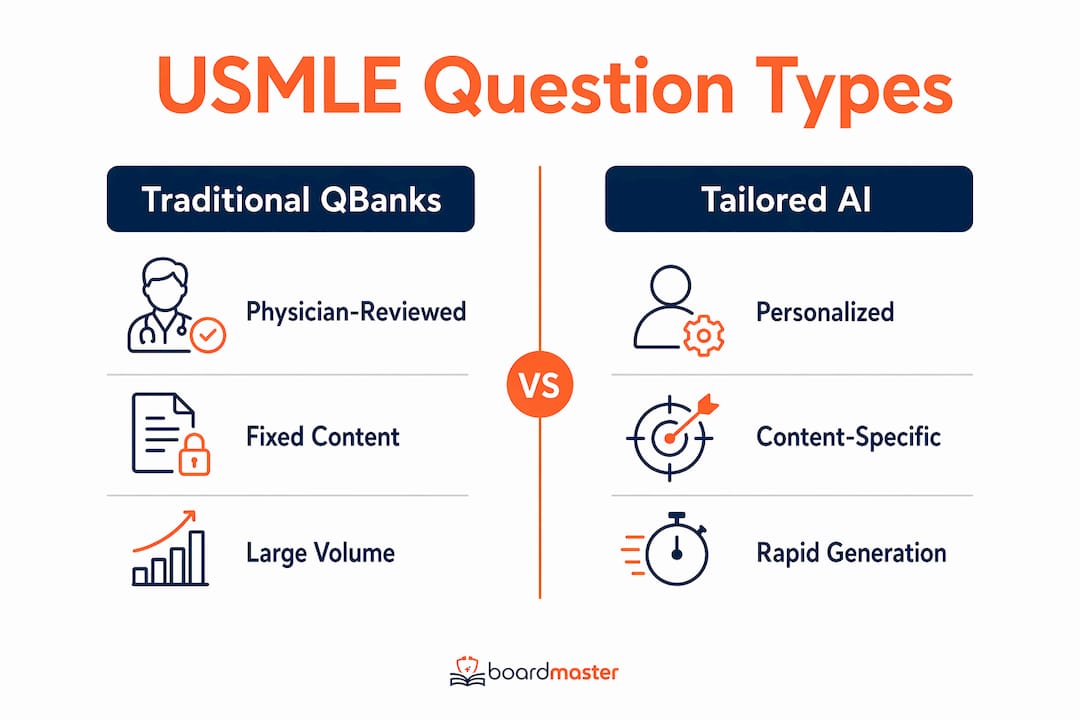
What are the benefits of tailored questions versus traditional QBanks?
Traditional question banks contain thousands of physician-reviewed questions built and refined over years. Primary QBanks typically contain 4,000 to 5,000 or more physician-reviewed questions. That volume and clinical rigor make them the foundation of any serious USMLE prep plan.
Tailored question generation does something different. It builds questions around the content your specific professor tested last semester. That alignment means you are not studying cardiology broadly. You are studying the exact cardiology concepts your course director emphasized, in a format that mirrors the USMLE. That specificity closes the gap between class performance and board performance.
The table below compares the two approaches across the features that matter most to medical students.
| Feature | Traditional QBanks | Tailored AI generation |
|---|---|---|
| Question volume | 4,000–5,000+ physician-reviewed | Unlimited, based on your materials |
| Clinical validity | High, iteratively reviewed | Depends on pipeline quality |
| Customization to syllabus | None | Direct alignment to your lectures |
| Professor-specific focus | None | Core strength |
| Cost to generate new questions | Fixed subscription | Scales with uploads |
| Best use case | Broad board prep | Gap identification and course alignment |
The right answer is to use both. Tailored generation identifies individual knowledge gaps efficiently by forcing you to confront what you actually understand versus what you only skimmed. Traditional banks then give you the volume and clinical polish to perform on exam day. Treating tailored generation as a replacement for expert-curated banks is the most common mistake students make. For a direct comparison of how these approaches stack up, the BoardMaster vs. traditional QBank breakdown covers the tradeoffs in detail.
How to integrate tailored question generation into your USMLE study plan
A structured approach to using AI-generated questions produces better results than ad hoc practice. Follow these steps to build tailored question generation into your weekly study routine.
Upload your source materials. Add lecture notes, PDFs, and any images or tables your professor used. The more specific the input, the more targeted the output. BoardMaster accepts images and tables alongside text, which matters when your professor's slides are heavy on visuals.
Set your simulation parameters. Standard USMLE blocks contain 50 questions with approximately 1–2 minutes per question. Match those parameters when you practice. Shorter, untimed sessions are fine for learning new material, but timed blocks build the pacing you need on exam day.
Use Tutor Mode first, then Timed Mode. Tutor Mode lets you see explanations after each question, which builds understanding. Timed Mode simulates real exam pressure. Rotating between them gives you both comprehension and stamina.
Track your incorrect answers by topic. Custom exams built from incorrect questions let you drill your weakest areas without wasting time on content you already know. Most platforms let you filter by subject, question mode, and review status.
Review every explanation, not just the correct answer. The distractor rationales tell you why the wrong answers are wrong. That reasoning is often more valuable than confirming what you already knew.
Schedule a weekly review block. Set aside one session per week to run through flagged questions and re-test topics where your accuracy was below 70%.
Pro Tip: Combine AI-generated questions with audio study podcasts and spaced-repetition flashcards. Multi-modal learning encodes information through multiple channels, which improves long-term retention compared to question practice alone.
BoardMaster's AI-driven study tools include OSCE practice, lecture-to-podcast conversion, and rapid review PDFs alongside question generation, making it possible to cover all learning modalities from a single platform.
What quality problems should you watch for in AI-generated USMLE questions?
AI-generated questions carry specific quality risks that physician-reviewed questions do not. Knowing what to look for protects you from practicing with bad information.
The most serious risk is hallucination of clinical data. A model that skips the extraction phase may invent a drug dosage cutoff, cite a fictional clinical trial, or assign a lab value that does not match any established guideline. Practicing with that question does not just waste your time. It encodes incorrect information.
Watch for these quality indicators when evaluating any AI-generated question:
- Cited evidence: Does the explanation reference a specific guideline, DOI, or evidence level? Questions with cited guidelines are far more trustworthy than those with generic rationales.
- Plausible distractors: Each wrong answer should represent a real diagnostic or management error, not an obviously absurd choice. Weak distractors make questions too easy and fail to train clinical reasoning.
- Answer choice distribution: A well-designed question set should not cluster correct answers in position A or B. Systematic bias in answer placement is a sign of low-quality generation.
- Clinical validity self-check: The best platforms run an internal review step that flags questions where the vignette data contradicts the correct answer.
- No invented proper nouns: If an explanation cites a trial you cannot find with a quick search, treat the question as unreliable.
- Consistent lab value ranges: Values like sodium, creatinine, and hemoglobin should fall within standard reference ranges unless the vignette explicitly describes an abnormal result.
The one-best-answer format with a clinical validity self-check and cited evidence is the current standard for high-quality AI-generated medical questions. If a platform cannot describe its quality control process, assume it lacks one.
Key Takeaways
Tailored USMLE question generation works best when it supplements expert-curated question banks, uses a two-phase extraction pipeline, and is integrated into a structured weekly study plan.
| Point | Details |
|---|---|
| Two-phase pipeline is non-negotiable | Extraction of clinical data before vignette writing prevents hallucinated lab values and false trial names. |
| Tailored questions fill a gap QBanks cannot | AI-generated questions align to your professor's syllabus, closing the distance between class and board performance. |
| Simulate real exam conditions | Practice in 50-question timed blocks at 1–2 minutes per question to build the pacing USMLE requires. |
| Quality indicators matter | Prioritize questions with cited guidelines, plausible distractors, and a clinical validity self-check. |
| Use both methods together | Tailored generation identifies gaps; traditional QBanks provide the clinical volume and rigor to close them. |
Why I think most students use AI questions the wrong way
Medical students tend to treat AI-generated questions as a shortcut. They generate a set, check the answers, and move on. That approach misses the entire point.
The real value of personalized USMLE practice questions is not the questions themselves. It is the discomfort of realizing you cannot answer a question about material you just read. That moment of failure is the learning event. Passive reading creates an illusion of understanding. A well-constructed question destroys that illusion in 90 seconds.
I have seen students jump percentile rankings not because they studied more hours, but because they studied differently. Sarah, a BoardMaster user, moved from the 73rd to the 92nd percentile while cutting her study hours in half. That result is not about the AI. It is about what active engagement with targeted questions does to retention and recall under pressure.
The balance I recommend is this: use tailored generation early in each study block to map your gaps, then use a physician-reviewed QBank to build clinical depth across those gaps. Do not wait until two weeks before your exam to generate questions from your lectures. Start in week one, when the feedback still has time to change your study plan.
AI tools for USMLE prep are evolving fast. The platforms that will matter in 2026 are the ones that maintain clinical relevance, cite their sources, and give you feedback that changes your behavior. Experiment early, adjust often, and never confuse question volume with question quality.
— Dr. Ahmed Abuzoor
BoardMaster brings tailored question generation to your lectures
BoardMaster generates USMLE-style clinical vignettes directly from your uploaded lecture notes, including images and tables, so your practice questions reflect exactly what your professor emphasized.

The platform pairs AI-generated questions with a 5,000+ physician-written QBank for comprehensive board prep. Tutor Mode, Timed Mode, and Rapid Review PDF downloads support every phase of your study plan, from early gap identification to final exam simulation. BoardMaster covers both Step 1 and Step 2 CK preparation. Students who want to see how the question generation works before committing can explore the USMLE prep tools and run a sample session with their own lecture materials.
FAQ
What is tailored USMLE question generation?
Tailored USMLE question generation is the AI-assisted process of creating personalized practice questions from your own lecture notes and study materials, formatted to match board exam clinical vignette style.
How is this different from a standard question bank?
Standard question banks offer fixed, physician-reviewed questions with no connection to your specific course. Tailored generation builds questions around your professor's syllabus and the concepts your class actually covers.
Can AI-generated questions replace physician-reviewed QBanks?
No. AI-generated questions supplement expert-curated banks rather than replace them. Use tailored questions to identify gaps and align with your course, then use a physician-reviewed bank for clinical depth and volume.
How do I know if an AI-generated question is clinically accurate?
Look for questions that cite specific guidelines or DOIs in their explanations, use plausible distractors, and are produced by a two-phase pipeline that extracts clinical data before writing vignettes.
How many questions should I practice per session?
Match USMLE exam conditions: 50 questions per block at 1–2 minutes per question. Use shorter untimed sessions only when learning new material in Tutor Mode.