
TL;DR:
- Custom practice questions target each student's knowledge gaps and improve exam scores by 20–30 percent. They prevent practice ceiling effects by generating unlimited, personalized questions that adapt to performance, especially benefiting weaker students. AI-enabled platforms like BoardMaster create course-specific, exam-aligned practice from lecture notes, making targeted study more effective and efficient.
Custom practice questions are defined as exam-style items generated or selected specifically to match a student's current knowledge gaps, course material, and target exam format. The role of custom practice questions in medical education is to replace one-size-fits-all drilling with targeted retrieval practice that adapts to what each student actually needs. Adaptive personalized practice can improve scores by 20–30% compared to static study methods. That gap is not a rounding error. It represents the difference between passing and failing a board exam. BoardMaster and the broader field of adaptive learning have built entire platforms around this principle, and the research behind it is now strong enough to treat personalized quizzes as a clinical-grade study intervention, not just a study hack.
What evidence supports the effectiveness of custom practice questions?
The science behind personalized quizzes is grounded in cognitive psychology, not marketing. Learning gains from personalized practice are roughly 1.5 times greater than fixed, equivalent-length practice sequences. That means a student who spends one hour on targeted custom questions retains more than a student who spends 90 minutes on a generic question bank.
Distributed practice compounds this advantage. Targeted, distributed practice produces retention advantages of 10–30% over massed, unfocused practice across academic and professional domains. For medical students juggling pharmacology, pathophysiology, and clinical reasoning simultaneously, that retention edge is decisive.
One underappreciated problem with static question banks is the practice ceiling effect. Once you have worked through a finite pool of questions, you start recognizing items rather than retrieving knowledge. Custom question generation provides an effectively unlimited supply of novel retrieval opportunities, preventing this ceiling from forming. Every new question forces genuine recall rather than pattern recognition.
"Students required to complete chapter-by-chapter AI-generated practice questions improved exam scores by nearly two percentage points, with higher gains for lower-performing students. Chunked formative practice improves focus on relevant material and drives better learning outcomes."
That finding matters because it shows custom practice questions do not just help strong students get stronger. They disproportionately lift students who are most at risk of failing. The mechanism is straightforward: weaker students have larger and more specific knowledge gaps, and targeted questions close those gaps faster than broad review.
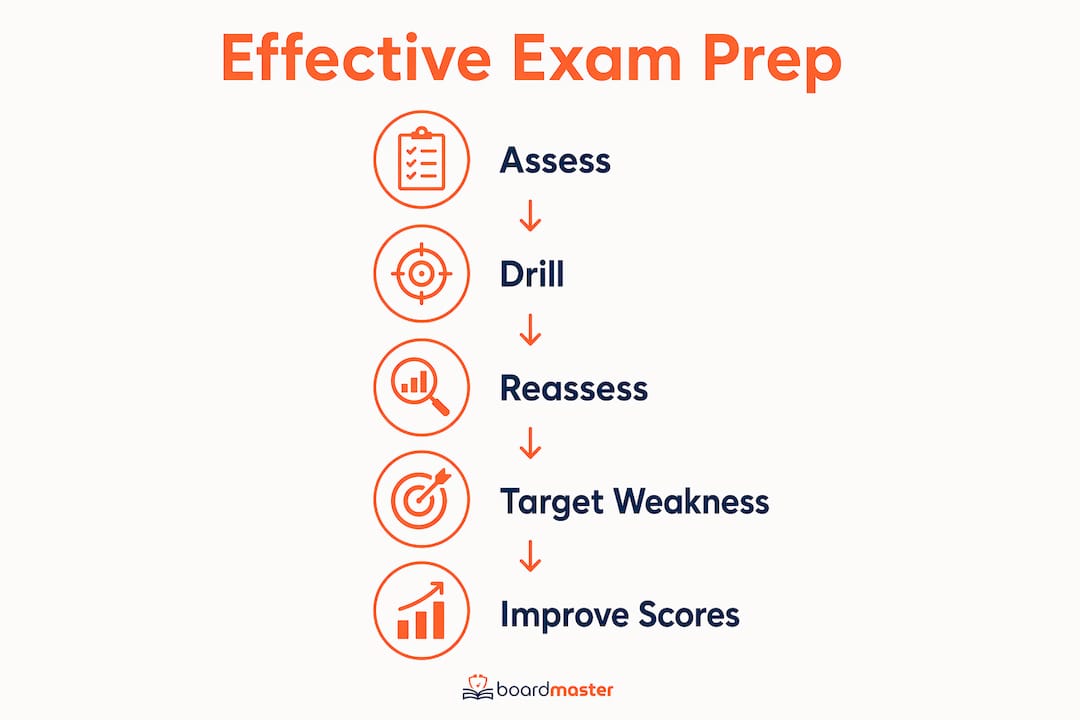
The assess-drill-reassess cycle is the most efficient exam preparation method. A mock test identifies weaknesses. Custom quizzes target those weaknesses. A follow-up mock test confirms mastery. This cycle outperforms both passive reading and undirected question drilling because it ties every practice session to a measurable outcome.
How do custom practice questions differ from traditional study methods?
Traditional static question banks give every student the same questions in the same order regardless of skill level. A student who already scores 85% on renal physiology gets the same renal questions as a student who scores 45%. That is not preparation. That is repetition.
Custom practice systems solve this by adapting to individual performance. Adaptive practice mimics computer adaptive testing methodology, rehearsing the cognitive experience of real exams. The USMLE Step 1 itself is not a static test. Practicing with a static bank is practicing for the wrong exam format.
The differences between static and custom approaches break down clearly across four dimensions:
| Feature | Static question banks | Custom practice systems |
|---|---|---|
| Question pool | Fixed and finite | Dynamic and continuously generated |
| Difficulty adjustment | None | Adapts to individual performance |
| Topic targeting | Broad and uniform | Specific to identified weak areas |
| Diagnostic feedback | Basic score reporting | Granular gap analysis by topic |
Beyond the structural differences, the pedagogical purpose shifts entirely. Custom question banks empower students to self-diagnose their understanding and engage in formative, demand-driven preparation. Static banks position students as passive consumers of pre-set content.
Key advantages of custom practice over traditional methods include:
- Skill-specific targeting: Questions focus on your weakest topics, not the publisher's syllabus.
- Diagnostic depth: Performance data reveals not just what you got wrong, but why.
- Exam format alignment: Questions mirror the style and difficulty of your actual target exam.
- Reduced study waste: You spend time on material that moves your score, not material you already know.
The professor-specific question banks approach taken by BoardMaster extends this further. By generating questions directly from uploaded lecture notes, the system aligns practice with what your professor actually emphasizes, not what a generic publisher decided was high-yield five years ago.
How can medical students use custom practice questions to maximize exam success?
The most effective approach follows a structured workflow rather than ad hoc drilling. Start every study block with a short diagnostic session. Then drill the gaps. Then verify closure.

Session structure matters more than total question count. Focused sessions of 20–30 questions target specific weak spots effectively. Sessions of 50 or more questions work better for comprehensive subject review before a major exam. Mixing both formats in the same week gives you depth on weak areas and breadth across the full subject.
Spacing is not optional. Custom quiz sessions spaced 2–3 days apart optimize long-term retention and allow you to verify that learning has actually consolidated. Drilling the same topic every day produces diminishing returns after the first session.
Here is the workflow that produces the best results:
- Take a mock test covering the full subject to establish your baseline and identify weak topics.
- Run a 20–30 question custom session targeting your two or three lowest-scoring areas.
- Review every wrong answer immediately after the session. Write a one-sentence explanation of why the correct answer is right.
- Wait 2–3 days, then run a second custom session on the same weak topics to test retention.
- Retake a mock test to confirm that your scores on the targeted topics have improved before moving on.
- Repeat the cycle for the next set of weak areas until all topics reach your target accuracy.
Pro Tip: Track your accuracy on each topic across sessions, not just your total score. A student who improves from 40% to 70% on cardiac pharmacology in two sessions has closed a real gap. A student who scores 65% overall but never revisits their weakest topics is building false confidence.
Performance analytics are the engine of this system. Without data on where you are losing points, custom questions are just questions. With data, they become a targeted intervention. The personalized exam prep approach used by BoardMaster builds this analytics layer directly into the platform, so you always know which topics to drill next.
What common pitfalls should medical students avoid?
The biggest mistake is treating question volume as a proxy for preparation quality. Running through 200 questions in a single sitting feels productive. It rarely is. Fatigue degrades answer quality, and passive clicking through questions without genuine retrieval effort produces almost no learning benefit.
The second most common error is skipping error review. Getting a question wrong is the most valuable learning event in a practice session. Custom question banks serve as formative tools that promote active learning, but only if students engage with the feedback. A student who marks an answer wrong and moves on has wasted the most important moment of that session.
Watch for these specific pitfalls:
- Drilling topics you already know well. Comfort is not progress. If you score above 80% on a topic, move to the next weak area.
- Using questions misaligned with your exam format. USMLE-style clinical vignettes require different reasoning than short-answer recall questions. Practice in the format you will be tested in.
- Ignoring your professor's emphasis. A generic question bank does not know that your pharmacology professor tests drug mechanisms over clinical indications. Your custom questions should reflect your actual course.
- Treating practice as performance. The goal of a practice session is to find what you do not know, not to feel good about what you do know.
Pro Tip: After each session, write down the single concept that surprised you most. That concept is almost certainly going to appear on your exam. Reviewing your surprise list the night before a test is one of the highest-yield activities you can do.
How is AI shaping the future role of custom practice questions?
AI has changed what is possible in customized test preparation. Generating high-quality, exam-aligned questions used to require a team of faculty and months of development. AI can now automate high-quality question creation from lecture notes and course materials, delivering immediate feedback and large volumes of exam-style questions tailored to a student's specific materials.
The implications for medical students are direct:
- On-demand question generation: Upload today's lecture notes and practice on that material tonight, before the content fades.
- Continuous novelty: AI generates new items continuously, so the practice ceiling effect never forms.
- Analytics integration: AI platforms track performance across every session and adjust future question selection automatically.
- Accessibility: Students at smaller programs with fewer faculty resources get the same quality of targeted practice as students at top-ranked schools.
BoardMaster's AI question generator applies this directly to medical education. A student uploads lecture slides, and the platform produces USMLE-style questions focused on the concepts their professor emphasized. The result is practice that is simultaneously board-relevant and course-specific, which is a combination no static question bank can offer.
Key Takeaways
Custom practice questions outperform static study methods because they target individual knowledge gaps, prevent practice ceiling effects, and align with the actual format and content of your target exam.
| Point | Details |
|---|---|
| Score improvement potential | Personalized practice can improve scores by 20–30% compared to static, non-personalized methods. |
| Optimal session structure | Use 20–30 question sessions for weak-spot targeting and 50+ question sessions for comprehensive review. |
| Spacing for retention | Space custom quiz sessions 2–3 days apart to consolidate memory and verify learning. |
| Error review is non-negotiable | Reviewing wrong answers immediately after each session is the highest-yield activity in any practice session. |
| AI alignment with coursework | AI-generated questions from your own lecture notes combine board relevance with professor-specific content emphasis. |
Why I think most medical students are practicing wrong
I have watched hundreds of medical students prepare for board exams, and the pattern is almost always the same. They find a large question bank, set a daily question target, and grind through it for weeks. They feel busy. They feel productive. And then they sit for the exam and discover that feeling busy is not the same as learning.
The research on this is unambiguous. Distributed, targeted practice beats massed, unfocused practice every time. But the deeper issue is that most students are not practicing at all in the meaningful sense. They are performing. They want to see a high score on a practice session, so they gravitate toward topics they already know. They skip error review because it is uncomfortable. They avoid the weak areas that actually need work.
Custom practice questions fix this only if you use them honestly. The adaptive exam prep approach works because it removes the choice. The system shows you what you do not know and makes you practice it. That is uncomfortable. It is also the only thing that actually moves your score.
My advice is simple. Stop measuring your preparation by how many questions you have completed. Start measuring it by how many weak topics you have closed. A student who drills 500 questions across topics they already know will score worse than a student who drills 150 questions targeted precisely at their gaps. The number on the screen is not the point. The knowledge in your head on exam day is the point.
Technology like BoardMaster makes this easier, but the discipline still has to come from you. Use the analytics. Follow the cycle. Review every wrong answer. The students who do this consistently are the ones who show up on exam day with real confidence, not just a high question count.
— Dr. Ahmed Abuzoor
How BoardMaster builds custom practice into your exam prep
Medical students who want to put this approach into practice immediately have a direct path forward with BoardMaster.
BoardMaster generates USMLE-style practice questions directly from your uploaded lecture notes, targeting the concepts your professors actually emphasize. The platform's USMLE prep tools combine a physician-written question bank with AI-generated custom questions, so you get both breadth and course-specific depth. Built-in analytics track your accuracy by topic across every session, showing you exactly where to drill next. For block exams, BoardMaster's block exam prep tools apply the same targeted approach to your specific coursework. Students like Sarah have moved from the 73rd to the 92nd percentile while cutting their study hours in half. The method works. The platform makes it repeatable.
FAQ
What is the role of custom practice questions in medical exam prep?
Custom practice questions target individual knowledge gaps with exam-aligned items, replacing broad review with focused retrieval practice. Research shows this approach can improve scores by 20–30% compared to static study methods.
How many custom practice questions should I do per session?
Sessions of 20–30 questions work best for targeting specific weak areas. Use sessions of 50 or more questions when you need comprehensive review before a major exam.
How often should I repeat custom practice on the same topic?
Space sessions on the same topic 2–3 days apart. This spacing allows memory consolidation and lets you verify that learning has actually stuck before moving on.
Why are AI-generated questions better than static question banks?
AI-generated questions adapt to your performance level, prevent the practice ceiling effect by generating novel items continuously, and can be tailored to your specific lecture content and exam format.
How does BoardMaster differ from a standard question bank?
BoardMaster generates USMLE-style questions from your own uploaded lecture notes, aligning practice with both board exam standards and your professor's specific course emphasis. Standard question banks provide the same fixed content to every student regardless of their individual gaps or coursework.