
TL;DR:
- Consistent daily practice using spaced repetition, active recall, and timed testing enhances USMLE exam retention. Building small, regular study blocks around existing routines prevents burnout and improves long-term performance. Practicing under exam-like conditions reduces anxiety and improves pacing on test day.
Consistent daily board exam practice is the most effective strategy for mastering USMLE material and building the kind of retention that holds up under exam pressure. Medical students who rely on last-minute cramming face a well-documented disadvantage: distributed practice produces a meta-analytic effect size of approximately 0.60 over massed study, meaning spaced review consistently outperforms cramming across studies. The core methods behind this advantage are spaced repetition, active retrieval, and timed practice testing. Building these into a daily routine is not optional for top scores. It is the structure that makes everything else work.
What tools and strategies form the foundation of consistent daily board exam practice?
Three methods form the backbone of any effective daily study routine: spaced repetition, active recall, and timed practice testing. Each targets a different weakness in how medical students typically study.
Spaced repetition schedules reviews at the exact moment memory starts to fade. Spaced repetition maximizes memory durability while minimizing total study time by placing each review near the forgetting curve threshold. That means you spend less time on material you already know and more time on what you are about to forget.
Active recall forces your brain to retrieve information rather than recognize it. Retrieval practice yields better conceptual gains and long-term board exam performance than passive reading. Flashcards, self-quizzing, and practice questions all count. Highlighting a textbook does not.
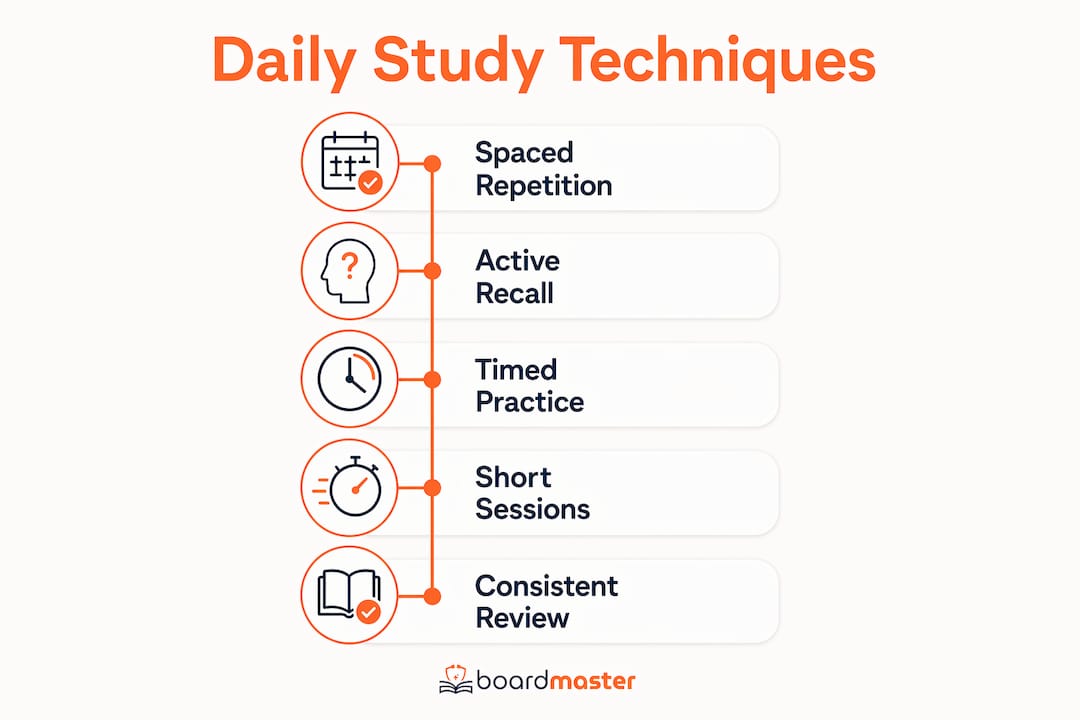
Timed practice testing trains pacing and recreates exam pressure. Practice exams under realistic conditions predict exam performance and build confidence. Running a 45-minute timed block on weekdays calibrates your speed and reduces anxiety on test day.
| Method | Primary benefit | Best daily format |
|---|---|---|
| Spaced repetition | Long-term retention | Flashcard review (10 min) |
| Active recall | Conceptual understanding | Self-quizzing (20 min) |
| Timed practice testing | Pacing and confidence | Timed question blocks (45 min) |
| Error review | Targeted gap closure | Post-session review (5 min) |
- Use spaced repetition software or spaced flashcards to automate review intervals.
- Replace passive re-reading with self-generated questions after each topic.
- Run at least two timed blocks per week to maintain exam pacing.
- Review every wrong answer immediately, not the next day.
Pro Tip: Study sessions of 15–25 minutes daily improve sustainability and prevent the skipped days that degrade spacing effects. Shorter, repeatable blocks beat long, infrequent sessions every time.
How can medical students design a sustainable board exam study schedule?
A sustainable board exam study schedule is built around small, repeatable daily blocks rather than marathon sessions. The goal is consistency, not volume.

A proven daily baseline looks like this: 20 minutes of active recall on new material, 10 minutes of flashcard review using spaced repetition, and 5 minutes reviewing the previous day's errors. This 35-minute structure is an effective baseline for daily board exam preparation. On weekdays with lighter clinical loads, add a 45-minute timed practice block to simulate exam conditions.
Here is a step-by-step approach to building your schedule:
- Audit your week. Map out rotations, lectures, and mandatory commitments before scheduling study time. Identify two or three fixed daily windows, even 20 minutes each.
- Anchor study to existing habits. Habit stacking links new behaviors to routines you already perform, which boosts daily follow-through. Study after morning coffee or before dinner, not "whenever you have time."
- Assign topics by day, not by mood. Rotating subjects daily prevents over-studying one system while neglecting others. Use your exam blueprint to weight topics by frequency.
- Build in a weekly review block. Reserve 30 minutes on Sunday to check your progress, adjust the next week's plan, and flag weak areas for extra repetition.
- Set a non-negotiable minimum. On brutal rotation days, commit to at least 15 minutes of flashcard review. Skipping entirely breaks the spacing rhythm and costs more time to recover than the session would have taken.
The most common pitfall is overloading daily blocks. Students who schedule three-hour daily sessions burn out within two weeks and abandon the routine entirely. A 35-minute daily block you actually complete beats a two-hour block you skip four days out of five.
Pro Tip: Track your daily sessions with a simple paper log or a habit-tracking app. Seeing a streak of completed days creates a psychological incentive to protect the routine.
What techniques during daily practice maximize learning and retention?
The quality of your daily practice matters as much as the quantity. Passive review, where you read notes or watch videos without testing yourself, produces weak memory traces that fade before exam day.
- Self-test before reviewing. Attempt to recall a concept before looking at the answer. This "retrieval attempt" strengthens memory even when you get it wrong.
- Review errors immediately. Engaging with practice questions aligned to exam case types is crucial for knowledge transfer. When you miss a question, read the explanation, identify the gap, and write a one-sentence correction in your own words.
- Mix subjects within a session. Interleaving cardiology questions with renal questions, for example, forces your brain to discriminate between concepts. This feels harder but produces stronger retention than blocking all questions by topic.
- Simulate exam pressure. Set a timer for every practice block. Students who practice under timed conditions build the pacing instincts that prevent running out of time on test day.
- Cap sessions at 25 minutes before a short break. Attention degrades sharply after sustained focus. A five-minute break resets concentration without breaking momentum.
Daily micro-study sessions combined with spaced repetition contribute more to retention than occasional intensive sessions. Repeated, low-duration exposure to high-yield material outperforms the single long study day that feels productive but rarely is.
For board exams specifically, practice must align with exam formats and clinical case applications, not just rote memorization. Knowing a drug mechanism is not enough. You need to recognize how that mechanism appears in a patient vignette under time pressure. That skill only develops through consistent, format-matched practice.
How do you troubleshoot common challenges in maintaining daily practice?
Maintaining a daily study routine across a full medical school year is hard. Rotation schedules change, motivation drops, and some weeks feel impossible. The students who score highest are not the ones who never struggle. They are the ones who have a plan for when things go wrong.
- Recognize burnout early. Signs include dreading study sessions you previously tolerated, declining accuracy on familiar question types, and difficulty concentrating after five minutes. These signal fatigue, not laziness. Reduce session length before eliminating sessions entirely.
- Adjust load, never skip. Skipping daily practice breaks the spacing rhythm and diminishes long-term retention gains. On hard days, drop to a 15-minute minimum. The spacing effect requires frequency, not duration.
- Use a refocus protocol when distracted. Close all tabs except your study platform. Write one sentence about what you are about to study and why it matters. This two-minute reset costs almost nothing and restores directed attention.
- Review your schedule every Sunday. Schedules that made sense in week one often stop fitting by week four. Adjust topic weights, session lengths, and timing based on what the previous week revealed about your actual availability.
- Track progress to stay motivated. Daily progress tracking turns consistency into a visible record. Seeing your accuracy improve on a topic you struggled with two weeks ago is a stronger motivator than any abstract goal.
"The spacing effect is not just a study technique. It is a biological reality. Your brain consolidates memory during rest, not during the study session itself. Skipping days does not just cost you one session. It costs you the consolidation that would have happened overnight."
Reviewing and adapting your schedule regularly is not a sign that your plan failed. It is the sign of a student who is paying attention to what the data from their own practice is telling them. The exam blueprint for your specific board exam is the best guide for where to redirect effort when you need to reprioritize.
Key Takeaways
Consistent daily board exam practice, built on spaced repetition, active recall, and timed testing, outperforms any amount of last-minute cramming for long-term retention and exam performance.
| Point | Details |
|---|---|
| Daily minimum matters | Study 15–25 minutes every day to preserve spacing rhythm, even during demanding rotations. |
| Active recall beats passive review | Self-testing and practice questions produce stronger memory traces than re-reading notes. |
| Timed practice builds pacing | Running timed question blocks at least twice a week trains the exam instincts passive study cannot. |
| Habit stacking drives consistency | Anchoring study to existing daily routines increases the likelihood of following through. |
| Adjust load, never skip | Reducing session length on hard days protects spacing effects better than skipping entirely. |
Why daily practice beats cramming: a perspective from the trenches
The conventional wisdom in medical school is that you need to study more. More hours, more resources, more question banks. I disagree. The students I have seen struggle most are not the ones studying too little. They are the ones studying inefficiently, often for long hours, with passive methods that feel productive but do not stick.
The research on distributed practice is not subtle. A meta-analytic effect size of 0.60 is large by educational research standards. That is not a marginal improvement. That is the difference between a student who retains material through exam week and one who forgets it by the weekend after a cram session.
What I find most underappreciated is the anxiety reduction that comes from daily practice. Students who have been doing 20 minutes of active recall every day for eight weeks walk into their board exam with a fundamentally different internal experience than students who crammed for two weeks. They have seen the material repeatedly. They have answered questions on it under time pressure. The exam feels familiar, not foreign.
During clinical rotations, the excuse I hear most often is "I do not have time." I understand that feeling. But 15 minutes of daily retrieval practice during a demanding rotation does more for your score than a four-hour session the night before a shelf exam. The biology of memory does not care about your intentions. It responds to frequency and spacing.
Build the habit before you need it. The students who wait until two months before their board exam to start daily practice are starting from a deficit. The students who have been doing it since the first week of second year are simply reviewing what they already know.
— Dr. Ahmed Abuzoor
How BoardMaster supports your daily board exam practice
Medical students who want structured, daily practice without wasting time on low-yield material have a direct path forward with BoardMaster.

BoardMaster generates USMLE-style practice questions directly from your uploaded lecture notes, so every question you answer targets what your professors actually emphasize. The platform includes AI-generated questions, spaced flashcards, and timed practice blocks built into a single workflow. One student, Sarah, moved from the 73rd to the 92nd percentile while cutting her study hours in half by focusing only on high-yield, professor-aligned content. For students preparing for Step 1 or Step 2, BoardMaster's USMLE prep tools align daily practice with real exam formats from day one. You get the structure, the spacing, and the question quality without building it yourself.
FAQ
What is the minimum daily study time for board exam prep?
Study sessions of 15–25 minutes daily preserve the spacing effect and prevent the retention loss that comes from skipped days. On demanding rotation days, 15 minutes of active recall is enough to maintain your rhythm.
Does spaced repetition really work for USMLE prep?
Spaced repetition produces a meta-analytic effect size of 0.60 over massed study, making it one of the most evidence-backed methods in educational research. For USMLE prep, it works best when combined with active recall and format-matched practice questions.
How do I stay consistent when rotations disrupt my schedule?
Anchor your study block to a fixed daily event, like morning coffee or the end of rounds, using habit stacking. Reduce session length on hard days rather than skipping, since skipping breaks the spacing rhythm and costs more recovery time than a short session would take.
Should I focus on one subject per day or mix subjects?
Mixing subjects within a session, called interleaving, forces your brain to discriminate between concepts and produces stronger retention than blocking all questions by topic. Interleaving feels harder in the moment but leads to better knowledge transfer on exam day.
How do practice tests improve board exam performance?
Timed practice exams under realistic conditions train pacing, recreate exam pressure, and predict actual exam performance. Running at least two timed blocks per week builds the instincts that prevent running out of time on test day.