
The strongest medical study tools for exam prep share five measurable qualities: pedagogical value, usability, accessibility, cost transparency, and engagement depth. Picking the wrong tool wastes weeks of study time. Picking the right one, matched to your actual curricular gaps, can move your percentile rank faster than grinding more hours ever will.
Here is a quick-reference list of the top tools US medical students rely on in 2026:
- Anki — spaced repetition flashcards; unmatched for long-term memorization
- UWorld — gold-standard question bank for USMLE board prep
- SketchyMedical — story-based visual mnemonics for clinical concept retention
- Osmosis — multi-format video lectures, flashcards, and a built-in question bank
- Amboss — integrated clinical library linked directly to board-style questions
- BoardMaster — AI-generated practice questions built from your own lecture notes
- OnlineMedEd — free and premium high-yield video lectures for core clinical knowledge
- Radiopaedia — free radiology image library with crowd-sourced cases and quizzes
- UpToDate — evidence-based point-of-care clinical reference, continuously updated
- Medscape — broad clinical news, drug information, and CME resources
- MDCalc — clinical decision calculators with embedded clinical context
- Prognosis — case-based app simulating real patient diagnostic scenarios
- Daily Rounds — daily clinical cases targeting board exam topics
- Life In The Fast Lane — emergency medicine summaries and critical care algorithms
- Acland Anatomy — cadaveric video atlas for anatomy learning
- Medmastery — interactive clinical skills courses with expert instructors
- PassMedicine — exam-style question bank with user feedback analytics
- MSD Manual — authoritative clinical reference from the American Medical Association
- Healthline — medically reviewed consumer health content for general knowledge
- American Medical Association — professional guidance and medical education policy resources
Cost ranges widely across this list. Anki is free; UWorld runs at a moderate annual fee for full access; Osmosis, Amboss, and OnlineMedEd each offer tiered plans. Radiopaedia, MDCalc, and the MSD Manual are free at their core.
What are the key medical study tool comparison criteria?
Comparative evaluations of point-of-care tools used by registered nurses rate resources across six dimensions: clarity of content, relevance of results, currency of information, ease of navigation, labeling, and filter usability. Those same dimensions translate directly to medical student study tools. A rubric from EDUCAUSE organizes e-learning tool evaluation into eight categories: ease of use, tech support, hypermediality, accessibility standards, required equipment, cost, cognitive task enhancement, and higher-order thinking support.
Five criteria matter most for medical students; understanding these can be enhanced by consulting Critical Appraisal Research: A Guide for Students.
- Pedagogical value — does the tool support conceptual understanding, not just rote recall?
- Usability — is navigation intuitive enough that you spend time learning, not troubleshooting?
- Accessibility — does it work across your devices, including mobile, without extra hardware?
- Cost — is the price proportional to the educational return, and is pricing transparent?
- Engagement — does the tool prompt active learning, metacognitive reflection, and performance tracking?
Learner priority research shows that students weight relevance to semantic learning highest (priority weight 0.230), followed by support for autonomous learning (0.186) and perceived pedagogical value (0.156). GenAI-based tools scored substantially higher than traditional tools on accessibility and autonomous learning support in that same study. That gap is worth keeping in mind when you compare a static flashcard deck against an adaptive platform.
Pro Tip: Before comparing tools, write down your three biggest knowledge gaps from your last exam block. A tool that directly addresses those gaps beats a more popular tool that does not.

How do the top tools compare side by side?
Each tool below earns its place based on what it actually does, not on brand recognition alone. No single point-of-care resource fits all users; the same logic applies to study tools.
| Tool | Best For | Key Features | Pedagogical Value | Cost | Engagement Level |
|---|---|---|---|---|---|
| Anki | Memorization and recall | Spaced repetition, shared decks, custom cards | High for retention | Free | High (self-directed) |
| UWorld | Board exam practice | Realistic USMLE questions, performance analytics | Very high | $$$ | Very high |
| SketchyMedical | Visual learners | Story-based mnemonics, illustrated videos | High for retention | $$ | High |
| Osmosis | Multimedia learning | Videos, flashcards, question bank, AI companion | Very high | $$ | Very high |
| Amboss | Integrated prep | Clinical library + board questions, decision support | Very high | $$$ | High |
| BoardMaster | Personalized prep | AI questions from your lectures, USMLE-style | Very high | $$ | Very high |
| OnlineMedEd | Clinical knowledge | High-yield video lectures, practice questions | High | Free/$ | High |
| Radiopaedia | Radiology learning | Image cases, quizzes, crowd-sourced content | High | Free | Moderate |
| UpToDate | Clinical reference | Evidence-based, peer-reviewed, continuously updated | Very high | $$$$ | Moderate |
| Medscape | Broad clinical content | Drug info, news, CME, reference | High | Free/$ | Moderate |
| MDCalc | Clinical reasoning | Decision calculators, risk scores, clinical context | High | Free | Moderate |
| Prognosis | Diagnostic reasoning | Case simulations, realistic patient scenarios | High | Free/$ | High |
| Daily Rounds | Daily exam practice | Clinical cases, quizzes, board-focused topics | Moderate | Free/$ | High |
| Life In The Fast Lane | Emergency medicine | EM summaries, algorithms, critical care reference | High | Free | Moderate |
| Acland Anatomy | Anatomy learning | Cadaveric video atlas | High | $$ | Moderate |
| Medmastery | Clinical skills | Interactive courses, expert-led procedural videos | High | $$ | High |
| PassMedicine | Exam-style practice | Question bank, analytics, curriculum-aligned updates | High | $$ | High |
| MSD Manual | Clinical reference | Professional and patient editions, AMA-backed content | High | Free | Low |
| Healthline | General knowledge | Medically reviewed articles, accessible explanations | Moderate | Free | Low |
| American Medical Association | Professional guidance | Policy resources, medical education standards | Moderate | Free | Low |
A few tools deserve more than a table row.
UWorld remains the closest proxy to the actual USMLE experience. Its explanations go deep on why wrong answers are wrong, which builds the kind of diagnostic reasoning that multiple-choice tests actually reward. Students who work through a full UWorld block and review every explanation, right or wrong, tend to see the biggest score gains.

Osmosis covers the full arc from pre-clinical to clinical years. Its AI companion, built into the MD and DO subscriptions, generates personalized study schedules and flags weak areas. The platform's multi-format design includes over 2,700 Step 1-style questions and 2,900+ Step 2-style questions, making it one of the few tools that scales across your entire medical school career.
Amboss is the tool that most closely mirrors what attendings actually use. Its clinical library links directly to board-style questions, so you can read about a condition and immediately test your understanding without switching platforms.
Radiopaedia is free, crowd-sourced, and genuinely excellent for radiology. No other tool on this list gives you that volume of real imaging cases at no cost.
UpToDate sits in a different category from the rest. It is a point-of-care reference, not a study tool in the traditional sense, but its continuously updated, peer-reviewed content makes it the most credible source for clinical decision-making questions on shelf exams and Step 2.
MDCalc and Life In The Fast Lane are narrow but deep. MDCalc's calculators come with clinical context that explains when and why to use each score, which is exactly what clinical reasoning questions test. Life In The Fast Lane is the go-to free resource for emergency medicine and critical care, with algorithms that are cleaner than most textbooks.
Learning style compatibility varies across the list. Visual learners get the most from SketchyMedical, Osmosis, and Acland Anatomy. Auditory learners benefit from OnlineMedEd's lecture format and BoardMaster's AI-generated study podcasts. Students who learn by doing, working through cases and questions, will get the most out of UWorld, Prognosis, and Amboss. Anki suits kinesthetic learners who need to actively produce answers rather than passively recognize them.
Most tools work on iOS and Android with no extra hardware required. UpToDate and Amboss require institutional or personal subscriptions for full mobile access. Anki's desktop app is free; the iOS app carries a one-time fee.
How should you evaluate study tools for your own exam prep?
Choosing a tool based on popularity rather than curricular fit is one of the most common mistakes medical students make. The right process starts with your learning objectives, not with what your classmates are using.
A practical evaluation approach looks like this:
- Identify your gaps first. Map your weakest subject areas from recent practice tests or class exams before you look at any tool.
- Check pedagogical alignment. Does the tool support higher-order thinking, like clinical reasoning and differential diagnosis, or does it only test recall? Tools that prompt metacognitive reflection, such as tracking your own performance trends, tend to produce more durable learning.
- Test before you commit. UWorld, Osmosis, Amboss, and BoardMaster all offer trial access. Use it. A tool that feels clunky in the first hour will feel worse at 11 PM before an exam.
- Assess device compatibility. If you study primarily on a tablet during commutes, confirm the mobile experience is full-featured, not a stripped-down version.
- Weigh cost against return. A $400 question bank is worth it if you use it daily for six months. It is not worth it if you abandon it after two weeks. Free tools like Anki, Radiopaedia, and MDCalc can carry significant weight in a well-designed study plan.
- Check update frequency. Medical guidelines change. A question bank that has not been updated in two years may test outdated management protocols.
Pro Tip: Give any new tool a two-week trial before judging it. Most platforms have a learning curve, but if you are still fighting the interface after two weeks, the tool is not the right fit for your workflow.
Customer support quality differs sharply across this list. Amboss and UWorld both offer responsive support teams and detailed help documentation. Anki is open-source, so support comes from community forums rather than a dedicated team. For free tools like Radiopaedia and MDCalc, support is minimal by design.
Revisit your tool choices every exam block. A resource that served you well in pre-clinical years may not be the right fit for clinical rotations, and vice versa. The lean study workflow principle applies here: cut tools that are not producing results, even if you have already paid for them.
Why BoardMaster stands out for personalized exam prep
BoardMaster addresses a problem none of the other tools on this list solve directly: the gap between what your professor emphasizes in lecture and what generic question banks test. Most students study the right subject but the wrong material, spending hours on low-yield content while the concepts their professor flagged go undertested.
The platform's AI reads your uploaded lecture notes and generates USMLE-style practice questions focused on the concepts your professor actually covered. That means your class exam prep and your board prep happen simultaneously, not in separate study blocks. For students who feel stretched between keeping up with coursework and preparing for Step exams, that integration is a real time saver.
BoardMaster also generates AI-powered study podcasts that condense lectures into eight-minute audio episodes, which suits auditory learners who struggle to retain material from static notes. The combination of targeted questions and audio review covers two learning modalities that most competitors address separately.
One documented outcome: a student named Sarah moved from the 73rd to the 92nd percentile while cutting her study hours in half after switching to BoardMaster's targeted question approach. The mechanism is straightforward. When you stop studying material that will not appear on your specific exam, you free up time for the content that will.
Key advantages over generic question banks:
- Questions are generated from your actual lecture content, not a standardized curriculum that may not match your course
- Dual-purpose prep covers both class exams and board exams in one workflow
- AI podcast format supports auditory learning without requiring additional tools
- Accessible on a per-student basis without requiring institutional licensing
For students who want to explore personalized exam prep approaches before committing, BoardMaster's model represents the clearest application of the learner-priority research cited earlier: high accessibility, strong autonomous learning support, and direct relevance to the material you are actually being tested on.
BoardMaster gives you a different starting point
Most of the tools compared above are built around a fixed curriculum. BoardMaster starts from your lectures instead.
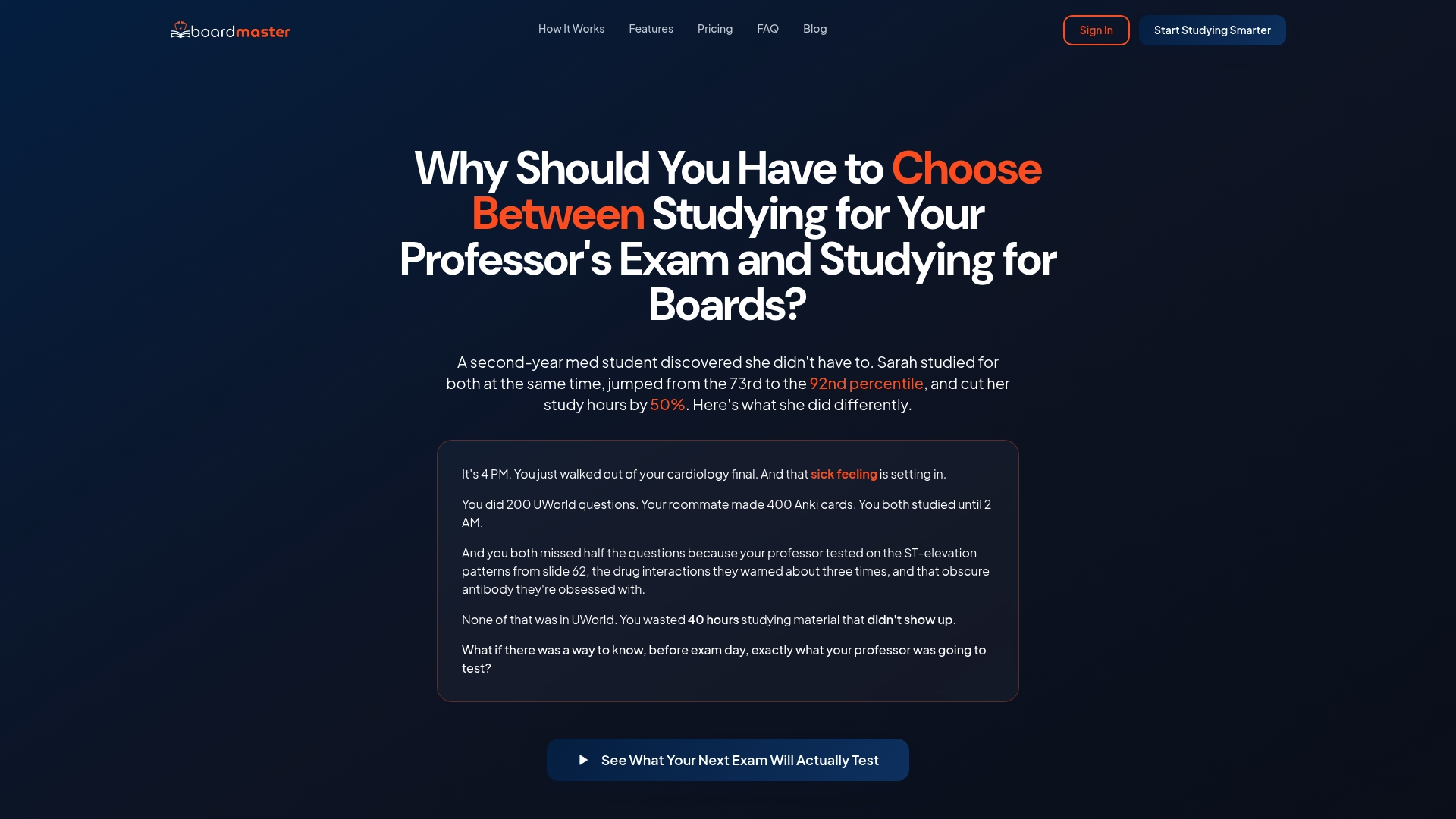
If you have spent time with UWorld or Amboss and still feel like your class exams and board prep are pulling in different directions, BoardMaster is worth a look. Upload your lecture notes, get USMLE-style questions built from your professor's content, and study both goals at once. You can see the AI question generator in action before committing to anything. For students who want a broader look at what the platform offers, the BoardMaster main page covers the full feature set, including the question bank, podcast tool, and adaptive study scheduling.
Key Takeaways
The most effective medical study tool is the one aligned to your specific curricular gaps, not the most popular one among your peers.
| Point | Details |
|---|---|
| Start with your gaps | Identify weak subject areas from recent exams before selecting any tool. |
| Five core criteria | Evaluate every tool on pedagogical value, usability, accessibility, cost, and engagement. |
| Learner priorities | Research shows semantic relevance (priority weight 0.230) and autonomous learning support (0.186) are the top learner-rated criteria. |
| Trial before committing | UWorld, Osmosis, Amboss, and BoardMaster all offer trial access; use it before paying. |
| BoardMaster's edge | BoardMaster generates USMLE-style questions from your own lecture notes, merging class and board prep into one workflow. |
FAQ
What are the most important criteria for comparing medical study tools?
The five core criteria are pedagogical value, usability, accessibility, cost, and engagement level. Research also highlights relevance to semantic learning (priority weight 0.230) and support for autonomous learning (0.186) as the highest-weighted factors from the learner's perspective.
How do I know if a study tool matches my learning style?
Visual learners benefit most from SketchyMedical, Osmosis, and Acland Anatomy; auditory learners from OnlineMedEd and BoardMaster's podcast feature; active learners from UWorld, Prognosis, and Anki. Try a free trial before committing to any paid platform.
Is it better to use one study tool or combine several?
Most medical students combine two to three tools. A common pairing is Anki for daily retention, UWorld for board-style practice, and a reference tool like Amboss or UpToDate for clinical depth. No single tool covers every need.
How does BoardMaster differ from UWorld or Amboss?
BoardMaster generates practice questions directly from your uploaded lecture notes, so the questions reflect what your professor emphasized rather than a fixed curriculum. UWorld and Amboss use standardized question banks built around the official USMLE content outline.
Should I use free tools or paid tools for board prep?
Free tools like Anki, Radiopaedia, and MDCalc can anchor a strong study plan, but paid platforms like UWorld and Amboss offer the question volume and performance analytics that most students need for serious board prep. The right balance depends on your budget and how far out your exam is.