
Generating practice questions that match lecture topics and exam formats remains difficult for medical students. Most question generators rely on generic banks and do not accept uploads of specific course materials. This comparison covers tailored question creation, study modes, and pricing so medical students can select a platform aligned with their curriculum and preparation needs.
Table of Contents
BoardMaster.ai
At a Glance
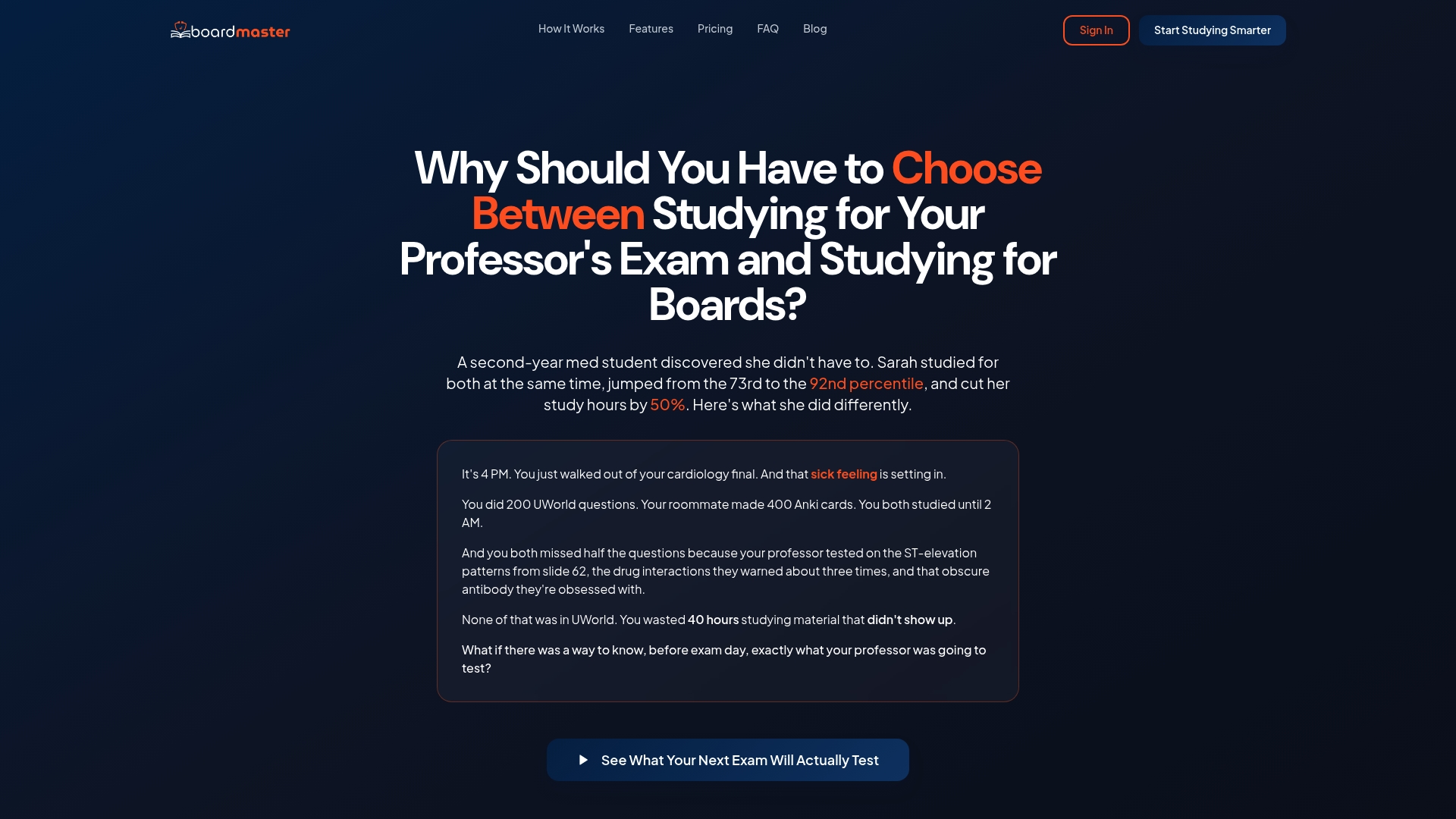
Includes a physician-written QBank with more than 5,000 practice questions. The service bundles question generation, flashcards, OSCE simulations, study podcasts, and an on-session AI assistant into one workflow. That mix targets both course exams and board-style review while using your actual lecture materials.
Core Features
BoardMaster.ai creates AI-generated practice questions from uploaded lectures or notes and produces instant flashcards with images plus spaced repetition. The platform also offers AI-driven OSCE clinical skills practice and eight-minute study podcasts that summarize lectures. A physician-written QBank and Cortex AI provide board-formatted questions and on-demand conceptual explanations inside study sessions.
Key Differentiator
Generates tailored practice questions directly from your own lectures, aligning study focus with the specific emphasis your professors place on topics.
Pros
Tailored questions improve relevance by turning your lecture slides and notes into USMLE, COMLEX, or PANCE-style practice. Multiple study modes—questions, flashcards, podcasts, and OSCE simulations—mean you can move between recall, spaced review, and clinical practice without switching tools. Upload support for PowerPoint, PDFs, and handwritten notes plus Cortex AI for instant explanations reduces time spent searching for clarifications.
Cons
- Relies heavily on the quality and completeness of your uploaded content; poor uploads may produce less relevant questions.
Who It's For
Medical students who want study material matched to their lectures and professors rather than a generic question bank. Students preparing for course exams and licensing tests will benefit most. Study groups that share decks and students practicing clinical skills with simulated patients will also find the tool useful.
Unique Value Proposition
Cortex AI for instant conceptual explanations appears inside study sessions to answer questions as you practice. That feature shortens the loop between hitting a knowledge gap and getting a focused explanation. For students juggling course work and board prep, this reduces redundant lookup time and keeps review tightly linked to the lecture material you actually need to master.
Real World Use Case
The vendor's materials state Sarah improved from the 73rd to the 92nd percentile while halving her study hours. She uploaded cardiology lecture slides, generated tailored practice questions, used flashcards with images, and practiced OSCE scenarios until she felt confident. The workflow let her focus on professor-emphasized concepts instead of generic content.
Pricing
A free plan offers limited features and trial access. Paid plans cost $39.99 per month or $399.96 per year and include unlimited uploads, questions, flashcards, and practice sessions. Subscriptions place the full suite behind a single plan rather than multiple separate subscriptions.
Website: https://boardmaster.ai
Ora AI
At a Glance
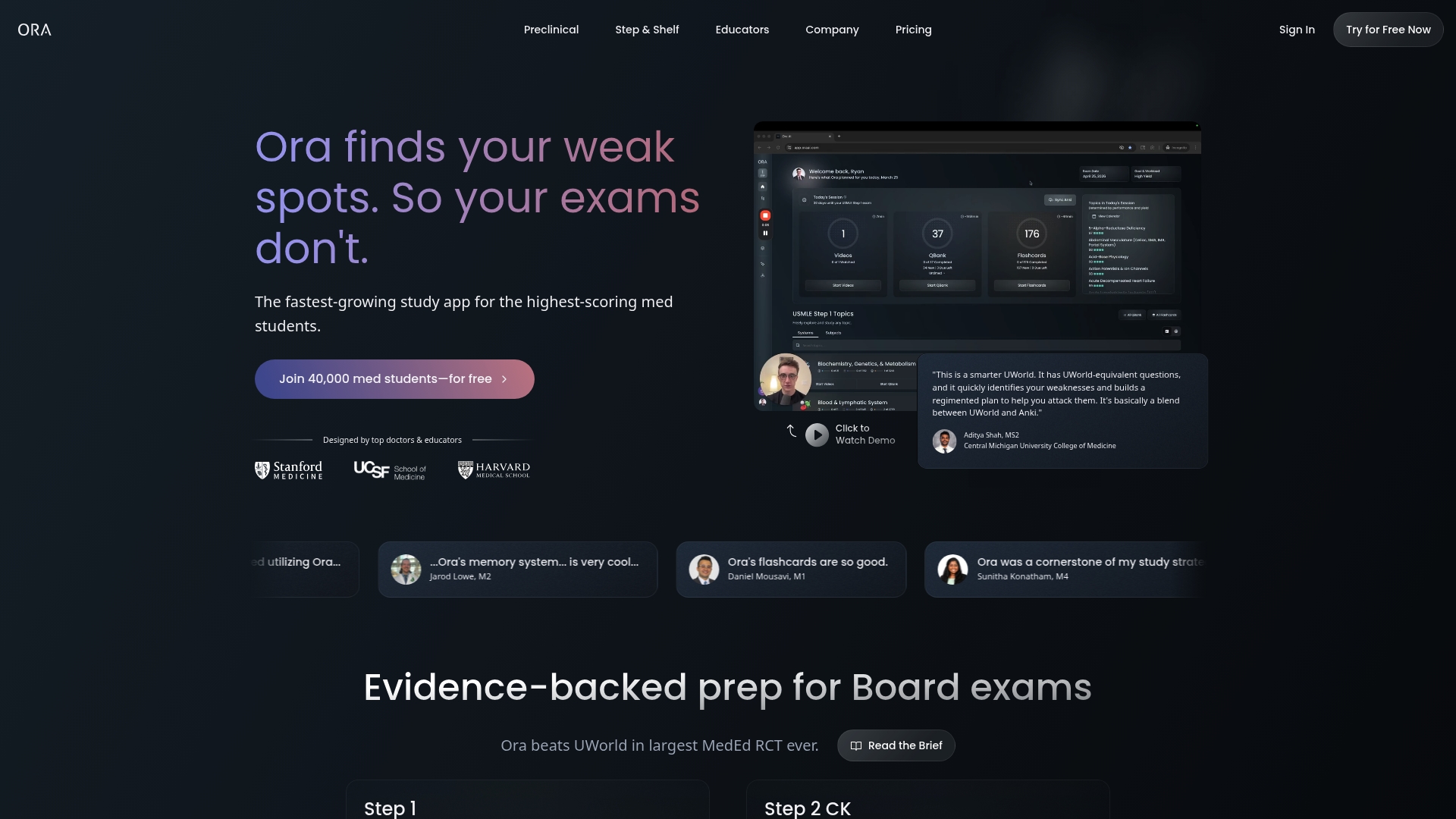
Ora AI's marketing materials state evidence from large, multi-institutional randomized controlled trials that report better outcomes than UWorld. The platform combines a question bank, flashcards, and over 300 videos into a single study workflow. It also offers institution-grade privacy controls for schools and individual learners.
Core Features
Ora AI pairs an integrated question bank with a flashcard workflow and spaced repetition using the FSRS algorithm to manage long term retention. An AI Copilot offers on-demand topic help and links students to a curated medical library and videos. Mobile apps for iOS and Android keep study sessions consistent across devices.
Key Differentiator
The product emphasizes research validation and institutional privacy as its primary selling points. That research claim sets it apart from general purpose banks and flashcard apps. Schools that require configurable privacy and documented trial support will find that combination unusual among study platforms.
Pros
Ora AI groups study materials into a single workflow so you do not jump between separate apps for questions and flashcards. The platform reports results from randomized controlled trials, which suggests measured educational benefit rather than marketing alone. Institutional controls let faculty set privacy options and monitor cohort progress while students receive spaced repetition schedules tuned to weak topics.
Cons
- Some features require institutional adoption and setup. This creates onboarding work for IT and course directors.
- Pricing details and subscription models are available on the vendor site and may appear complex to new users. Comparing tiers requires visiting the pricing page.
- Heavy reliance on AI and platform security requires trust in the vendor. Organizations must review compliance before wide deployment.
When It May Not Fit
Individual learners who want a zero setup, pay-as-you-go QBank may find institutional features unnecessary. Programs that cannot allocate IT time for initial configuration will face delays. Teams that require specific third party integrations should confirm compatibility first because integrations are not listed publicly.
Who It's For
Medical students from preclinical years through MD candidacy who want research-backed study mechanics will benefit. Educators and administrators who need privacy controls and cohort monitoring will also find the platform relevant. Schools evaluating evidence for curriculum adoption will particularly appreciate the trial emphasis.
Real World Use Case
A medical school integrates Ora AI into a preclinical course to align questions with lecture objectives. Faculty monitor dashboards to spot students falling behind and assign targeted flashcard decks. The administration reports improved engagement and clearer remediation paths for at-risk learners.
Pricing
Detailed plans and tier descriptions are available on the vendor pricing page. The platform directs prospective customers to view pricing and choose plans that match either individual learners or institutional deployments. For exact figures consult the listed pricing URL.
Website: https://oraai.com
Eminence
At a Glance
Eminence reports unlimited AI generated questions through its QGen tool. The vendor advertises personalized exam content and community practice spaces for medical learners. The platform emphasizes vetted medical material sourced from publishers for exam prep and institutional use.
Core Features
Eminence combines personalized study plans with AI driven question generation, performance analysis, and collaborative practice environments. QGen creates practice items on demand while performance analytics flag weak topics and trends. The platform also curates publisher vetted content so study material aligns with established references.
Key Differentiator
That AI driven question generation plus vetted source material defines Eminence. The combination lets faculty or students generate targeted practice while keeping questions anchored to publisher reviewed content. That capability supports group practice and instructor guided review in a single platform.
Pros
The platform supports a customizable study flow with question creation tailored to individual needs, which helps cover gaps quickly. Community features promote group practice and shared question sets for cohort based review. The vendor advertises affordable solutions aimed at increasing access, which may suit learners on a budget or institutions seeking broad access. Vetted publisher content reduces the need to cross check core references during review.
Cons
- No clear integrations: The product lists no connections to learning management systems, which complicates sync with existing course workflows.
- Live instruction unclear: The company does not specify real time instructor led sessions or scheduled live teaching options.
- Pricing opacity: Public pricing is not transparent and the vendor signals institutional plans may vary in cost.
- Usability details limited: Little public information exists on the interface, mobile support, or clinician friendly navigation.
When It May Not Fit
Programs that require tight LMS integration will find Eminence lacking. Teams needing scheduled live classes or built in instructor dashboards should look elsewhere. Organizations that require public pricing or self serve subscriptions will want a platform with explicit tiered rates.
Who It's For
Medical students and physicians preparing for high stakes exams will benefit from on demand question creation and analytics. Educational programs that want scalable, AI assisted practice for cohorts may use Eminence to distribute publisher based material. Training directors who prioritize vetted sources and collaborative practice will find the feature set aligned with institutional needs.
Real World Use Case
A medical school deploys Eminence to let faculty generate exam style questions that map to course objectives. Students use QGen to create mixed topic quizzes and review analytics to prioritize study sessions. The school reports using the tool to reduce redundant review time and centralize question banks.
Pricing
No public pricing is listed. The product entry notes pricing is informational only and may depend on institutional plans. Prospective buyers should request a demo or institutional quote for exact costs.
Website: https://eminenceai.com
Medical Study Platforms Comparison
Selecting the ideal medical study platform involves considering features, user focus, and limitations to ensure the best fit for study and exam preparation.
| Platform | Core Feature | Key Differentiator | Best For | Pricing | Notable Limitation |
|---|---|---|---|---|---|
| BoardMaster | AI-generated practice questions, flashcards, podcasts | Tailored practice questions from personal lecture material | Students targeting lecture-aligned exam preparation | $39.99/month or $399.96/year | Requires high-quality uploads for optimal utility |
| Ora AI | Question bank, flashcards, and spaced repetition | Research-validated effectiveness claims | Learners and institutions needing privacy controls | Check vendor site for details | Requires setup for institutional features |
| Eminence | AI for question generation and analytical tools | Vetted publisher content and QGen tool | Students and cohorts seeking institutional scalability | Price not published | Missing LMS integration and live instructor sessions |
How Can Medical Students Avoid Studying the Wrong Material for Exams?
Many medical students struggle with generic question banks that do not reflect the exact content their professors emphasize. This challenge can waste valuable study time and reduce confidence on exam day. BoardMaster solves this problem by letting students upload their own lecture notes and slides to generate tailored USMLE-style questions focused on high-yield topics. That approach helped Sarah improve from the 73rd to the 92nd percentile while cutting her study hours in half.
BoardMaster combines AI-powered question creation, flashcards, and clinical simulations all aligned with your courses. Find out how this tool can enhance your preparation for course exams and boards at BoardMaster. Start using your lecture content to focus your study time and boost exam readiness today.
Explore BoardMaster's tailored QBank and study tools
FAQ
How does BoardMaster generate practice questions for medical students?
BoardMaster generates tailored practice questions from uploaded lectures or notes. This feature allows students to study exactly what their professors emphasize, aligning study materials directly with course content.
What is the difference between BoardMaster and Ora AI?
Ora AI pairs an integrated question bank with a flashcard workflow and emphasizes research validation and institutional privacy. BoardMaster, on the other hand, excels in generating questions from users' specific lecture materials, making it ideal for personalizing study focused on course exams.
Which platform offers clinical skills practice for medical learners?
BoardMaster provides AI-driven OSCE clinical skills practice. This capability allows students to simulate clinical scenarios, enhancing their practical skills alongside theoretical knowledge.
Can I use BoardMaster for both course exams and board-style reviews?
Yes, BoardMaster bundles question generation, flashcards, and study podcasts specifically for both course exams and board reviews. This feature ensures that students can prepare effectively for varying types of assessments.
How much does a subscription to BoardMaster cost?
BoardMaster offers a paid plan costing $39.99 per month or $399.96 per year. This pricing includes unlimited uploads, practice questions, and flashcards, providing significant resources for medical students.