
TL;DR:
- Adaptive medical exam prep uses AI to personalize questions and target knowledge gaps in real time. It improves efficiency, reduces study hours, and enhances retention by focusing on areas that need improvement. Consistent engagement and starting early maximize its benefits for high-stakes exams like the USMLE and NCLEX.
Adaptive medical exam prep is a personalized, AI-driven study system that continuously analyzes your performance and adjusts your study plan to target your specific knowledge gaps in real time. Unlike static question banks that serve every student the same content, adaptive test preparation uses AI algorithms to track where you struggle, where you excel, and what you need to review next. This method applies directly to high-stakes exams like the USMLE Step 1, Step 2, and NCLEX. Tools like BoardMaster have built their entire platform around this model, and the results for students like Sarah, who jumped from the 73rd to the 92nd percentile while cutting her study hours in half, speak for themselves.
What is adaptive medical exam prep and how does it work?
Adaptive medical exam prep is defined as a data-driven instructional model that adjusts study content dynamically based on your real-time performance. The system does not wait until the end of a session to evaluate you. It reads every answer you submit, updates its model of your knowledge, and immediately recalibrates what comes next.
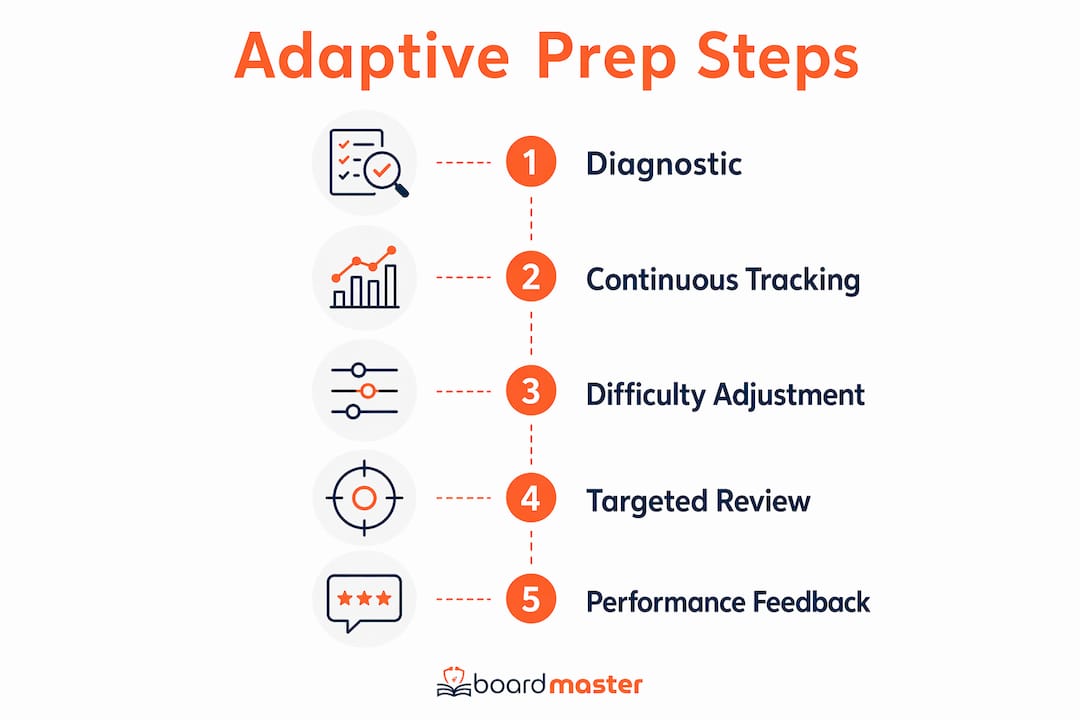
The process starts with a diagnostic assessment. When you first log into an adaptive platform, it runs you through a baseline set of questions across multiple topics. Your answers tell the system where your competency sits before any focused study begins. From that point forward, the platform has a working map of your strengths and weaknesses.
After the diagnostic, the AI monitors every subsequent question session. It tracks accuracy by topic, response time, and error patterns. That data feeds an algorithm that decides which concepts to reinforce, which to advance, and which to revisit after a delay. This is where active recall and spaced repetition become central. The system spaces out review of material you have already learned while pushing harder content to the front of your queue.

The key mechanism is working at the "edge of competency." Adaptive systems increase difficulty as your proficiency grows, keeping you in a zone where the material is challenging but not overwhelming. This reduces wasted time on content you already know and prevents the false confidence that comes from reviewing easy material repeatedly.
Pro Tip: Start your first adaptive session without reviewing anything beforehand. A cold diagnostic gives the algorithm the most accurate baseline, which means better personalization from day one.
The core mechanics of adaptive exam prep include:
- Diagnostic baseline: An initial assessment maps your starting knowledge across all tested topics.
- Real-time performance tracking: Every answer updates your competency profile instantly.
- Dynamic difficulty adjustment: Question difficulty rises or falls based on your current accuracy.
- Spaced repetition scheduling: The system resurfaces weak topics at optimal intervals for retention.
- Personalized feedback loops: Detailed explanations after each question guide your error review.
Adaptive vs. traditional study methods: what is the difference?
Traditional study methods treat every student identically. A static question bank gives you the same 2,000 questions in the same order regardless of whether you already know 60% of the material. Adaptive test preparation eliminates that redundancy entirely.
A 30-question adaptive test can be more accurate than a 60-question static test. That efficiency gain comes from continuous difficulty adjustment. Every question is chosen because it tells the algorithm something useful about your current ability level. Static tests cannot do this because the question order is fixed.
| Feature | Static question banks | Adaptive exam prep |
|---|---|---|
| Question selection | Fixed, same for all students | Personalized to your performance |
| Difficulty adjustment | None | Real-time, question by question |
| Weak area targeting | Manual, student-directed | Automatic, algorithm-driven |
| Study time efficiency | Lower, covers known material | Higher, focuses on gaps only |
| Retention support | Passive, no spaced repetition | Active, built-in spaced repetition |
| Burnout risk | Higher with repetitive content | Lower with calibrated challenge |
The advantages of adaptive learning extend beyond efficiency. Adaptive prep enforces "desirable difficulties" by forcing you to engage with material that genuinely challenges your current level. This prevents the false security that comes from passive reading or reviewing topics you already understand well.
The benefits that matter most to medical students preparing for boards include:
- Faster identification of weak areas without manual self-assessment
- Reduced total study hours by cutting review of already-mastered content
- Better score predictions because the system tracks true proficiency, not just completion
- Lower burnout risk through calibrated pacing that matches your cognitive load
The psychological advantage is real. When every question session feels appropriately hard but not impossible, engagement stays high. Students who use adaptive platforms consistently report that studying feels more purposeful than grinding through a fixed question bank.
Which medical exams and tools use adaptive exam prep in 2026?
USMLE and NCLEX increasingly incorporate adaptive testing approaches and adaptive prep tools to simulate real exam conditions and personalize practice. The NCLEX itself uses computerized adaptive testing, meaning the exam adjusts question difficulty in real time based on your responses. Preparing with a static question bank for an adaptive exam is a structural mismatch.
The most widely used adaptive prep tools in 2026 include:
- BoardMaster: Generates USMLE-style questions directly from your uploaded lecture notes, targeting concepts your professors emphasize. This merges class exam prep and board prep into one workflow. BoardMaster's AI question generator converts your own course material into high-yield practice questions.
- UWorld: A large static question bank with some performance tracking features. Strong on content depth, though its question selection is less dynamically personalized than fully adaptive platforms. For a direct comparison of how these tools differ, the UWorld vs. BoardMaster breakdown covers the key distinctions.
- Emerging AI platforms: Several newer tools now offer simulated patient cases and AI-generated learning paths tailored to specialty-specific board exams beyond USMLE.
Choosing the right tool depends on your exam target and study timeline. For USMLE Step 1 and Step 2, a platform that aligns with your course curriculum, like BoardMaster, reduces the gap between what your professors test and what the boards test. For NCLEX, prioritizing a tool that mirrors the exam's own adaptive format gives you the most realistic preparation.
How to optimize your study strategy with adaptive exam prep
The biggest mistake medical students make with adaptive platforms is waiting too long to start practice questions. Starting practice questions early, even when initial accuracy is low, gives the algorithm the data it needs to build an accurate picture of your gaps. Low early scores are not a failure. They are the system doing its job.
A strong adaptive study strategy follows this sequence:
- Run a full diagnostic first. Do not skip the baseline assessment. It sets the foundation for everything the algorithm does afterward.
- Use exam mode regularly. High-performing students avoid overusing tutor mode where feedback appears after every question. Exam mode builds the stamina and pacing you need on test day.
- Schedule sessions to match your exam time. Aligning your peak cognitive window with your actual exam start time improves alertness and performance when it counts.
- Review every wrong answer deliberately. Do not just read the explanation and move on. Write down the concept, identify why you missed it, and flag it for the next spaced repetition cycle.
- Build in physical breaks. Combining adaptive prep with physical and mental self-care improves long-term retention and reduces the cognitive fatigue that tanks performance in the final weeks before an exam.
Pro Tip: Block your hardest adaptive sessions for the same time of day as your actual exam. After four weeks of this habit, your brain will be primed to perform at that hour.
The discipline required here is specific. Adaptive platforms give you data, but you have to act on it. Students who treat their error review as a passive reading exercise miss the point entirely. The feedback loop only works when you engage with it actively, update your mental model, and return to the flagged material with intent.
Key Takeaways
Adaptive medical exam prep outperforms static study methods because it targets your actual knowledge gaps in real time, not a generic curriculum.
| Point | Details |
|---|---|
| Core definition | Adaptive prep uses AI to adjust question difficulty and content focus based on your live performance data. |
| Efficiency advantage | A 30-question adaptive test can match the accuracy of a 60-question static test by targeting your true ability level. |
| Best practice start | Begin practice questions early, even with low accuracy, to give the algorithm a precise baseline. |
| Mode selection matters | Use exam mode regularly, not just tutor mode, to build the stamina and pacing required on test day. |
| Wellness is part of prep | Physical activity and mental breaks combined with adaptive study improve retention and reduce burnout. |
What I have learned after watching students use adaptive prep
The students who get the most out of adaptive exam prep are not the ones with the highest baseline scores. They are the ones who trust the process when it feels uncomfortable.
I have seen students abandon adaptive platforms after two weeks because the algorithm kept serving them the same cardiology questions. That is not a flaw in the system. That is the system telling them exactly what they need to hear. The discomfort of returning to a topic you thought you understood is precisely where the learning happens.
The mistake I see most often is treating tutor mode as the default. Tutor mode is a teaching tool. Exam mode is a performance tool. You need both, but students who live in tutor mode never build the mental stamina to sit through a 40-question block without second-guessing every answer. Top students use exam mode to train that stamina deliberately, then use tutor mode to dissect the results afterward.
The other thing nobody talks about enough is timing. Scheduling your hardest study blocks to match your actual exam start time is one of the highest-return habits you can build. It costs nothing and the cognitive benefit on test day is real.
Adaptive prep works. But it only works if you show up consistently, engage with the feedback, and resist the urge to skip the hard topics. The algorithm cannot do the discipline part for you.
— Dr. Ahmed Abuzoor
How BoardMaster takes adaptive prep further
BoardMaster is built specifically for medical students who need their study time to count twice: once for class exams and once for boards.
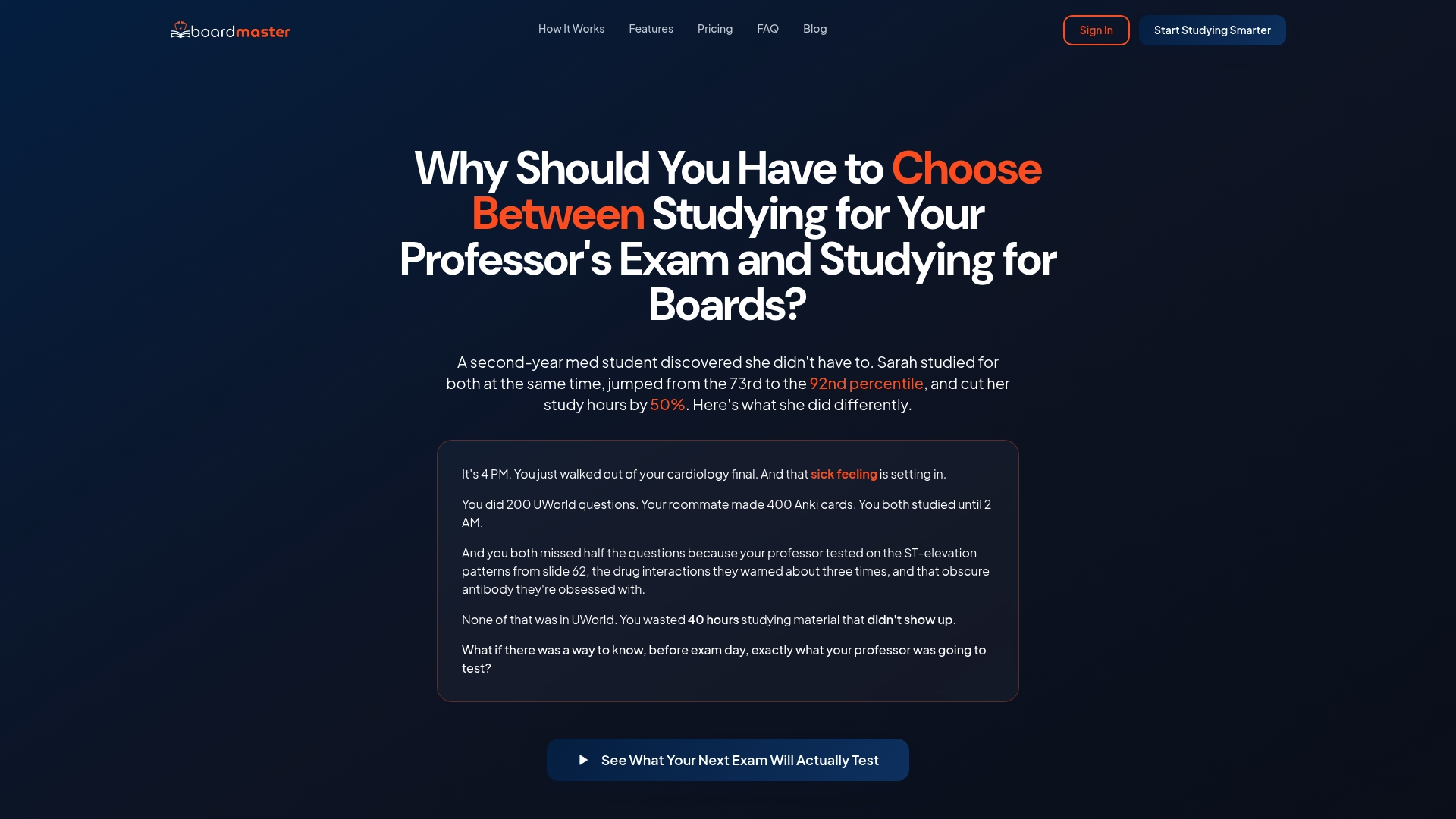
Upload your lecture notes and BoardMaster generates USMLE-style questions targeting exactly what your professors emphasize. That means no more studying generic content that misses your actual exam. The platform's adaptive USMLE prep tools adjust to your performance just like the best adaptive systems described in this article, but with the added advantage of being anchored to your specific course material. For students preparing for block exams, BoardMaster's block exam prep tools bring the same AI-driven personalization to your immediate curriculum. Start with your own notes and let the algorithm do the rest.
FAQ
What is adaptive medical exam prep in simple terms?
Adaptive medical exam prep is a study method where AI continuously analyzes your performance and adjusts the questions and topics you study based on your current knowledge gaps. It replaces fixed study plans with a personalized, real-time learning path.
How does adaptive exam prep differ from a standard question bank?
A standard question bank gives every student the same questions in the same order. Adaptive exam prep selects each question based on your previous answers, targeting your weak areas and adjusting difficulty as your proficiency grows.
Is adaptive prep effective for USMLE Step 1 and Step 2?
Yes. USMLE prep increasingly relies on adaptive tools that simulate real exam conditions and provide targeted feedback. Platforms like BoardMaster generate course-specific USMLE-style questions that align prep with both class exams and board exams simultaneously.
When should I start using adaptive exam prep?
Start as early as possible, even if your initial accuracy is low. Early practice question use gives the adaptive algorithm the data it needs to build an accurate profile of your gaps and personalize your study path effectively.
Can adaptive prep help reduce study burnout?
Yes. Adaptive prep reduces burnout by eliminating redundant review of material you already know and calibrating challenge levels to your current ability. Studying material that is appropriately difficult keeps engagement high and prevents the fatigue that comes from grinding through irrelevant content.