
TL;DR:
- Personalized exam prep tailors practice questions and review schedules based on your performance data and confidence levels. It uses adaptive spaced repetition and feedback loops to focus on your weak areas, leading to higher scores and better retention. Most students incorrectly believe they are personalizing their prep when they are merely following intuition rather than performance evidence.
Personalized exam prep is defined as a study method that customizes practice questions, review schedules, and feedback based on your individual performance data, weak areas, and confidence levels. Unlike generic question banks, tailored exam preparation adjusts dynamically as you improve, directing your time toward the concepts most likely to cost you points on board exams. Tools like BoardMaster, AI study planners, and adaptive question banks built on spaced repetition principles have made this approach practical for medical students preparing for USMLE Step 1, Step 2, and block exams. The result is faster progress, better retention, and measurably higher scores.
What is personalized exam prep and how does it differ from standard study?
Personalized exam prep is a data-driven study system where your weaknesses, not a fixed syllabus, determine what you study next. Standard prep treats every student identically. Personalized prep treats your performance history as the curriculum.
The core difference shows up in how questions are selected. A generic question bank serves questions in a fixed rotation. A personalized system tracks which topics you answer incorrectly or rate with low confidence, then prioritizes those concepts in your next session. The American Board of Family Medicine's CKSA program demonstrates this directly. It integrates spaced repetition questions ranked by previous incorrect answers and self-reported confidence ratings, so each session targets your actual gaps rather than topics you already know.
The practical effect is significant. You stop wasting hours reviewing material you have already mastered. Every minute of study carries a higher return because it addresses a real deficit.
How does personalized exam prep work? Core mechanisms explained
Four mechanisms drive effective personalized exam preparation: diagnostic assessment, adaptive spacing, confidence-based prioritization, and feedback loops.

Diagnostic assessment is the starting point. You complete a baseline set of questions across all core content domains. The system maps your performance, identifying which topics need the most attention. Without this map, any study plan is a guess.
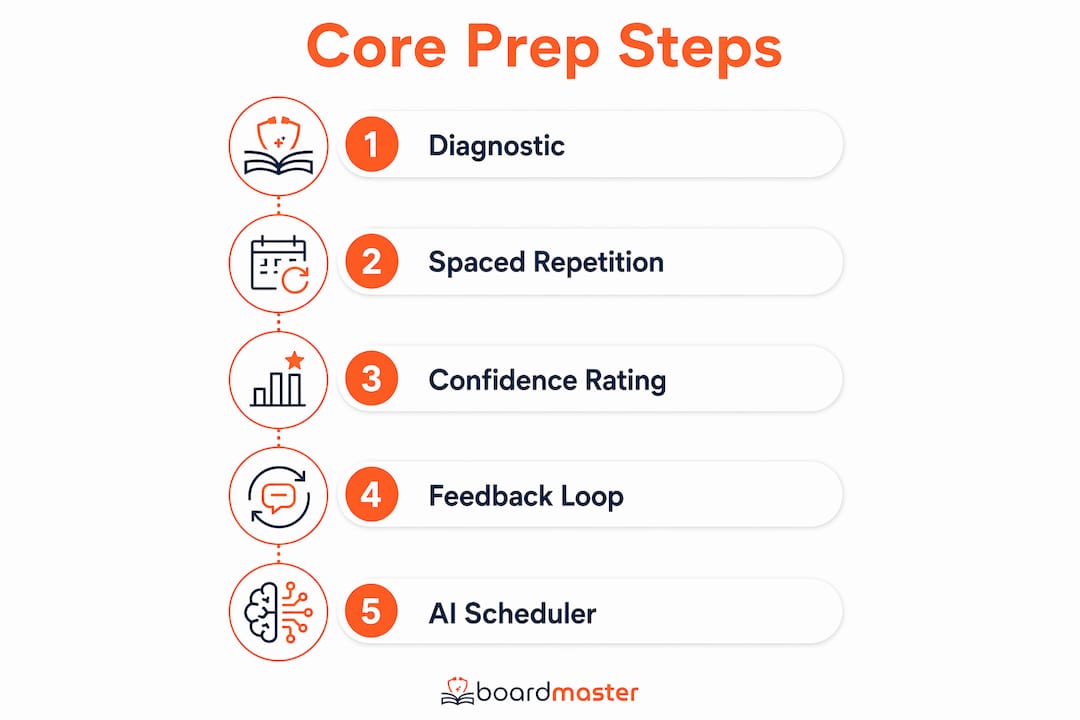
Adaptive spaced repetition is the engine. Spaced repetition targeting weak areas produces a 58% learning rate compared to 43% in control groups, with nearly 6% greater knowledge transfer. That gap exists because the system schedules review of difficult concepts at the exact interval before you would forget them, rather than reviewing everything on the same fixed schedule.
Confidence-based prioritization adds a layer that correct/incorrect scoring misses. A student who answers correctly but rates their confidence as low is flagging a fragile understanding. Personalized systems catch that signal and schedule reinforcement before the exam reveals the gap.
Feedback loops close the cycle. After each session, your performance data updates the plan. Static plans become outdated within days. Dynamic adaptation is essential to true personalization because your knowledge state changes with every study session.
Pro Tip: Rate your confidence on every question, even the ones you get right. Low-confidence correct answers are the most dangerous gaps because they feel like strengths until the real exam.
AI study planners add another dimension by analyzing your course load, deadlines, and cognitive load patterns to schedule sessions when your retention is highest. AI-generated study schedules incorporate techniques like the Pomodoro method and subject prioritization to prevent burnout while maintaining forward momentum.
What types of personalized exam prep methods exist for medical students?
Medical students have access to several distinct approaches, each with different strengths.
- AI-powered adaptive schedulers generate and update study plans automatically based on performance data. BoardMaster's AI Study Planner falls into this category. These systems work best for students who want a fully automated, data-driven schedule.
- Dialogue-based problem-solving (PEP) involves one-on-one sessions with a teaching assistant who guides you through problem-solving steps and provides personalized feedback before exams. This format uncovers reasoning errors that correct/incorrect scoring never catches.
- AI question generators like BoardMaster's tool create practice questions directly from your uploaded lecture notes. This aligns your board prep with what your professors actually emphasize, which generic question banks cannot do.
- Adaptive question banks such as BoardMaster's QBank serve physician-written questions and adjust difficulty and topic frequency based on your response history.
- Static customized plans are schedules built once from a diagnostic and not updated. These are better than generic plans but fall short of true personalization because they do not adapt as your knowledge changes.
| Method | Strength | Limitation |
|---|---|---|
| AI adaptive scheduler | Continuously updated, low effort | Requires consistent data input |
| Dialogue-based PEP | Uncovers reasoning errors | Hard to scale; time-intensive |
| AI question generator | Matches professor emphasis | Depends on quality of uploaded notes |
| Adaptive question bank | Large content coverage | May not reflect specific course content |
| Static customized plan | Easy to build | Becomes outdated quickly |
The most effective approach combines an AI question generator tied to your course content with an adaptive question bank for board-level depth. BoardMaster is built on exactly that combination.
Why is personalized exam prep effective? Research evidence and outcomes
The evidence base for personalized exam preparation is strong and growing. A 2025 study on AI-driven learning for medical residents reported 92% engagement, with students averaging 32.3 hours on the platform. The study found a significant positive correlation between time spent and quiz scores, with r=0.63 and p<0.001. That correlation means the more students engaged with the personalized system, the better they performed on assessments.
"Personalized exam prep excels not by more practice questions, but by quality-targeted repetition focused on weak or low-confidence topics, saving study time." — ABFM Research Insight
The ABFM spaced repetition data reinforces this point. A 58% learning rate with adaptive spaced repetition versus 43% in the control group is not a marginal difference. It represents a fundamentally different outcome from the same hours of study.
Dialogue-based feedback adds another layer of evidence. Dialogic feedback during problem-solving reveals errors in reasoning steps, not just final answer correctness. A student who arrives at the right answer through flawed logic will fail a differently worded board question. Personalized feedback catches that before the exam does.
| Study / Source | Key Finding | Outcome |
|---|---|---|
| 2025 AI learning study (internal medicine residents) | 92% engagement; avg. 32.3 hours | r=0.63 correlation between time and quiz scores |
| ABFM spaced repetition cohort | Adaptive spacing vs. control | 58% vs. 43% learning rate; +6% knowledge transfer |
| PEP dialogue-based feedback | Reasoning error detection | Improved conceptual accuracy beyond correct/incorrect scoring |
Reduced exam anxiety is a real outcome too. Students who conquer anxiety with predictive learning report that knowing their weak areas have been systematically addressed replaces dread with confidence. That psychological shift has a direct effect on test-day performance.
How can medical students implement personalized exam prep practically?
Building a personalized study system takes five concrete steps. Each one builds on the last.
Run a baseline diagnostic. Complete a timed set of questions across all major content domains before you open a textbook. Your goal is a performance map, not a score. Identify which domains fall below your target threshold.
Build a weakness map. Group your errors by content domain and subtopic. Cardiology, renal physiology, and pharmacology are common weak areas for Step 1 students. Your map tells you where to allocate the majority of your study time.
Set up adaptive spaced repetition for flagged concepts. Use a tool that schedules review of your weak topics at increasing intervals. BoardMaster's AI Question Generator creates USMLE-style questions directly from your lecture notes, so your spaced repetition sessions target exactly what your professors emphasized.
Update your plan weekly with new performance data. A personalized exam prep workflow must continuously reallocate study focus based on new data. Review your error log every Sunday. Promote topics you have mastered and add new weak areas as they emerge.
Integrate board-level questions alongside course prep. BoardMaster aligns class exam preparation with board exam preparation in a single workflow. This prevents the common mistake of treating block exams and USMLE prep as separate tasks that compete for your time.
Pro Tip: Avoid the trap of common exam prep misconceptions like equating hours studied with progress. Track your error rate by domain weekly. A falling error rate is the only metric that confirms your plan is working.
AI-powered adaptive platforms also allow granular content curation and real-time progression tracking. That means your study plan reflects your current knowledge state, not where you were two weeks ago.
Key takeaways
Personalized exam prep works because it directs study time toward individual weak areas using adaptive spaced repetition, diagnostic feedback, and AI-driven question generation, producing measurably better retention and exam scores than generic study methods.
| Point | Details |
|---|---|
| Definition of personalized prep | Customizes questions, pacing, and review based on your performance data and confidence levels. |
| Core mechanism | Adaptive spaced repetition targeting weak areas produces a 58% learning rate vs. 43% in control groups. |
| Evidence base | A 2025 study found a 0.63 correlation between time on AI-driven personalized platforms and quiz scores. |
| Implementation starting point | Run a baseline diagnostic first to build a weakness map before creating any study schedule. |
| Best tool combination | Pair an AI question generator tied to your lecture notes with an adaptive question bank for board-level depth. |
Why I think most medical students are personalizing wrong
Most students I have worked with believe they are personalizing their prep because they spend extra time on topics they find difficult. That is not personalization. That is intuition, and intuition is a poor proxy for performance data.
True personalized exam preparation requires a system that tracks your confidence ratings alongside your accuracy. A student who scores 70% on renal physiology but rates every correct answer with low confidence is not ready for the boards. The data reveals that. Gut feeling does not.
The other mistake I see constantly is treating personalization as a one-time setup. You build a study plan in week one and follow it through week twelve. By week six, that plan is describing a student who no longer exists. Your knowledge has shifted. Your weak areas have changed. A static plan labeled personalized is just a generic plan with extra steps.
The research on AI in medical education makes a point I find underappreciated: successful AI integration depends on balancing content integrity, learner autonomy, and personalized feedback. That balance is hard to achieve with AI alone. The students who perform best combine AI-driven question generation with deliberate self-reflection after each session. They read the explanations. They ask why they got something wrong, not just what the right answer was.
Avoiding burnout with one smart system is also part of the equation. Personalized prep should reduce your total study hours, not add to them. If your personalized system is generating more anxiety than confidence, the plan needs recalibration, not more hours.
— Dr. Ahmed Abuzoor
BoardMaster's tools for your personalized study plan
BoardMaster gives medical students a complete personalized exam prep system built around their actual course content.
Upload your lecture notes and BoardMaster's AI Question Generator creates USMLE-style practice questions focused on what your professors emphasize. The QBank adds over 5,000 physician-written board questions that adapt to your response history, so every session targets your real gaps. Students like Sarah moved from the 73rd to the 92nd percentile while cutting their study hours in half. BoardMaster's block exam prep tools and USMLE prep resources merge class and board preparation into one efficient workflow, so you stop studying twice for the same exam.
FAQ
What is personalized exam prep in medical school?
Personalized exam prep customizes your practice questions, review schedule, and feedback based on your individual performance data and confidence ratings. It uses diagnostic assessments and adaptive spaced repetition to direct study time toward your actual weak areas rather than a fixed syllabus.
How does adaptive learning differ from standard question banks?
Adaptive learning systems update your study plan after every session based on new performance data. Standard question banks serve questions in a fixed rotation regardless of whether you have already mastered those topics.
How do I create a customized study plan for the USMLE?
Start with a baseline diagnostic across all major content domains, build a weakness map from your results, then use an AI question generator like BoardMaster to create targeted practice questions from your lecture notes. Update the plan weekly as your error rates change.
Does personalized exam prep actually improve scores?
A 2025 study on AI-driven personalized learning for medical residents found a significant positive correlation between platform engagement and quiz scores, with r=0.63 and p<0.001. ABFM spaced repetition data shows a 58% learning rate with adaptive methods versus 43% in control groups.
How often should I update my personalized study plan?
Update your plan at least once per week using your latest performance data. Static plans become outdated quickly because your knowledge state changes with every study session, and an outdated plan misdirects your study time.