
AI-generated, exam-style explanations are worth building into your study routine, but only when you pair them with quick verification and active question practice. These tools produce stepwise rationales for MCQs and single best answer (SBA) items, walking through why the correct choice is right and each distractor is wrong. Blinded faculty review found AI drafts often beat expert-written explanations on depth of information, with a lower correction rate. Treat them as a fast first draft, not a final answer.
TL;DR:
- AI explanations are often more comprehensive and contain less correction-needed content than expert-written ones, with only 20% flagged for errors in studies.
- Verification should focus mainly on dosing, image interpretation, and multi-system reasoning questions, which are more prone to inaccuracies.
- Using lecture notes to generate tailored questions and explanations improves exam alignment and boosts engagement compared to generic question banks.
- Incorporating AI-generated questions into a spaced repetition schedule enhances retention and helps identify weak points more efficiently.
- The value of AI tools lies in contextualized explanations and quick verification, not in treating AI as infallible or replacing traditional study resources completely.
Table of Contents
- What Makes AI Medical Explanations Useful for Exam Prep
- Where AI Explanations Fall Short (And What to Double-Check)
- How to Turn Lecture Notes Into Verified Practice Questions
- Fast Verification Habits That Don't Cost You Study Time
- Why BoardMaster Builds Verification Into the Workflow
- AI Explanations vs. Expert-Written Ones: What the Evidence Actually Shows
- Spotting Errors and Bias in AI-Generated Explanations
- Matching AI Explanations to How You Actually Learn
- Data Privacy and Ethics When Using AI Study Tools
- Comparing AI Study Tools: Accessibility, Cost, and Fit
- Combining AI Explanations With Traditional Study Resources
- What Actually Matters Once You Cut Through the Hype
- Try the AI OSCE Practice Sessions Demo
- Sources
- FAQ
What Makes AI Medical Explanations Useful for Exam Prep
The case for AI medical explanations rests on a simple mechanic that education researchers have tested for decades: answering questions during or right after a lecture cements material far better than rereading slides. Randomized and controlled trials on this "test-enhanced learning" effect consistently show improved exam scores and retention when MCQs are paired with lecture content, especially when students get feedback quickly. AI explanation tools compress that feedback loop from days to seconds.
Large language models have also gotten noticeably better at USMLE-style reasoning. Recent evaluations show LLMs correctly identifying diagnoses in case vignettes with high concordance, and frequently surfacing an insight the student hadn't considered, not just a bare answer key. That matters for boards prep specifically, because Step-style questions reward exactly this kind of reasoning chain: clue, mechanism, consequence, and a reason each wrong answer fails.
A blinded comparison of AI-generated versus expert-written explanations for a medical education self-assessment backs this up with numbers.
- AI explanations were rated higher for the amount of relevant information they packed into each answer.
- Faculty reviewers flagged only 20% of AI-generated explanations as needing correction, compared with 38% of expert-written ones.
- Embedding SBA-style questions into lecture teaching measurably raises engagement and confidence versus a standard lecture format, with engagement scores of 4.55 versus 4.21 on a 5-point scale.
None of this means AI explanations are flawless. It means the raw material is often better organized and more complete than what a rushed TA or overworked lecturer produces under time pressure, which is exactly the baseline you're actually competing against as a student trying to move fast through hundreds of practice questions.
Where AI Explanations Fall Short (And What to Double-Check)
Accuracy is not uniform across question types, and knowing where AI explanations get shaky lets you triage your review time instead of fact-checking everything equally.
Performance drops on specific categories. Research analyzing what makes ChatGPT-style models stumble on USMLE-style items found that table-based questions and longer question stems are associated with lower accuracy, and that accuracy correlates negatively with question difficulty. Categories like immune system pathology showed weaker performance than more straightforward physiology or pharmacology recall items.
Complex integrative reasoning is the other soft spot. Anything that requires stitching together multiple systems, precise dosing, or reading an image (an EKG strip, a radiograph, a histology slide) deserves more scrutiny than a straightforward "which enzyme is deficient" question.
Use this rough verification priority list before you trust an explanation at face value:
- High risk, verify every time: dosing and treatment protocols, table-based questions, image or waveform interpretation, multi-step integrative reasoning.
- Medium risk, spot-check: longer question stems, less common specialties, questions involving drug interactions.
- Lower risk, usually fine: single-mechanism pathophysiology, straightforward pharmacology mechanisms, classic textbook presentations.
Pro Tip: If a question stem runs longer than three sentences or includes a table, read the AI's explanation twice, once for logic and once against your lecture slide, before you trust it enough to make a flashcard out of it.
How to Turn Lecture Notes Into Verified Practice Questions
This is the actual workflow, not a vague suggestion to "use AI more." Follow these five steps and you'll convert a two-hour lecture into a usable, exam-aligned practice set before your next study block.
- Pull 8 to 12 high-yield points from the lecture. Focus on what the professor emphasized twice, wrote on the board, or flagged as "commonly tested." Skip the filler slides.
- Generate SBA-format questions tied to those points. Ask specifically for single best answer format and request that the explanation address why each distractor is wrong, not just why the correct answer is right.
- Request a stepwise rationale plus a one-line summary. A good prompt asks for the pathophysiology chain (clue to mechanism to consequence) and a short line on each wrong option. This mirrors how BoardMaster generates tailored USMLE-style practice questions directly from uploaded lecture material.
- Run the verification checklist and log your edits. Anything touching dosing, tables, or images gets flagged for a faculty check or a primary source lookup before it goes into your deck.
- Schedule the verified questions into spaced practice. Revisit at 1 to 2 days, then again at 1 to 2 weeks. Track which questions you miss twice. Those are your actual weak points, not the ones you feel nervous about.
Pro Tip: Write your first prompt request as if you're asking a chief resident to teach the topic to a nervous MS2. Specificity in the prompt (organ system, exam type, difficulty level) produces a far cleaner explanation than a generic "explain this concept" request.
Fast Verification Habits That Don't Cost You Study Time
Verification doesn't have to mean re-deriving every explanation from a textbook. Two quick habits cover most of the risk.
The 5-second check works for the bulk of your practice volume: does the explanation's pathophysiology chain match what your lecture actually said, and does the "why the other options are wrong" section make internal sense? If both check out, move on.
The 10-minute review is for anything flagged high risk in your verification list. Pull up a primary source or your lecture slide, reconcile any discrepancy, then try converting the explanation into a shorter question yourself. If you can write a clean question from it, you understood it. If you can't, the explanation had a gap you almost missed.
A few added habits keep your deck clean over a full semester:
- Convert verified explanations into flashcard-friendly format immediately, while the logic is still fresh in your head.
- Log where each explanation came from (which lecture, which AI-generated draft, whether it was edited) so you can trace an error back to its source later.
- Route anything involving clinical management steps, drug dosing, or institution-specific protocols to a textbook or faculty member before it goes into your permanent question bank.
Statistic worth repeating: the 20% versus 38% correction-rate gap from the blinded faculty evaluation means roughly one in five AI explanations needs a fix. Build your review habit around that ratio, not around treating every draft as equally suspect.
Why BoardMaster Builds Verification Into the Workflow
The gap between a good AI explanation and a great one usually comes down to context. Models that get fed the right lecture material and competency framing produce noticeably more accurate, exam-aligned answers than models working from a bare question stem, which is the entire logic behind retrieval-augmented explanation generation.
BoardMaster is built around that principle. Students upload their own lecture notes, and the platform generates tailored USMLE-style practice questions built around what a specific professor actually emphasized, rather than generic question bank content that may or may not match a course's blueprint.
One student reported a significant percentile improvement on practice exams while reducing study hours after switching to lecture-aligned, targeted questions instead of a generic question bank.
That kind of jump reflects a broader pattern: study time spent on the wrong material is time wasted, no matter how many hours go into it.
- The explanations are generated directly from material tailored to what a student needs to know for their specific class.
- The lecture-to-question pipeline helps bridge the gap between learning material and answering board-style questions about it.
- Students still own the final verification step. The platform speeds up drafting; it doesn't replace a faculty member's word on clinical protocol specifics.
AI Explanations vs. Expert-Written Ones: What the Evidence Actually Shows
The comparison isn't close on volume of information, but it's not a clean sweep either. In the blinded evaluation cited earlier, faculty judges consistently rated AI-generated explanations as denser with relevant content per answer than the expert-written versions they were compared against.
That's a genuinely counterintuitive finding. Students tend to default to trusting anything with a professor's name attached to it and treat AI output with suspicion. The data suggests the opposite bias might be more accurate, at least for explanation completeness.
Where expert explanations still hold an edge is judgment calls specific to a course or institution. A professor writing an explanation knows exactly what was taught in week three of the course and what wasn't. AI models working without that context can produce a technically correct explanation that still misses the specific framing your professor wants on an exam. This is precisely why lecture-context injection, feeding the model your actual notes rather than asking it cold, closes so much of that remaining gap.
The practical takeaway: don't choose between AI and expert explanations. Use AI-generated drafts as your primary volume source for practice, and treat any faculty-provided explanation as the tie-breaker when the two disagree on a specific clinical nuance.
Spotting Errors and Bias in AI-Generated Explanations
Critical appraisal of AI output is a skill, and it's one you'll use for the rest of your medical career, not just for boards. A few patterns show up often enough to watch for specifically.
Confident wrong answers are the biggest risk. AI models rarely hedge, so an explanation can sound completely authoritative while stating an outdated dosing guideline or a mechanism that's been revised in recent literature. Confidence in tone is not evidence of accuracy.
Pattern-matching without context shows up in questions that resemble a common exam trope but have a twist. A model trained heavily on classic presentations may explain the textbook version of a disease and miss that the vignette described an atypical case on purpose.
Recency bias matters in fast-moving areas like pharmacology and infectious disease guidelines. If a treatment protocol changed in the last year or two, check whether the explanation reflects current guidance.
A quick appraisal routine:
- Ask whether the explanation's logic chain would survive being read aloud to your attending.
- Compare the stated mechanism against your lecture slide, not against general knowledge, since exam answers often hinge on the specific framing your course used.
- Flag anything with unusually confident language around numbers, dosing, or percentages for a second look.
Building this habit now pays off twice: better boards prep today, and a sharper eye for AI-assisted clinical tools later in your career.
Matching AI Explanations to How You Actually Learn
Not every student needs the same depth of explanation, and one underused feature of working with AI tools is that you can ask for a different format entirely rather than settling for whatever comes out first.
Visual learners benefit from asking the model to describe a process as a sequence: clue, mechanism, consequence, laid out almost like a flowchart in text. Students who learn better through contrast can ask specifically for a side-by-side comparison of the correct answer against the single most tempting wrong answer, which is often more useful than a rundown of all four distractors equally.
Your knowledge level should shape your prompts too. A first-year student building foundational knowledge should ask for more background on the underlying mechanism. A fourth-year student cramming for Step 2 CK needs less background and more clinical decision-making framing, since that's what the exam actually tests at that stage.
If an explanation feels too basic or too advanced, say so directly and ask for a rewrite at a different level. This is one of the genuine advantages AI explanations have over a static textbook page: the depth adjusts to you instead of you adjusting to it. Students who treat this as a fixed resource rather than an interactive one are leaving a real advantage on the table.
Data Privacy and Ethics When Using AI Study Tools
Using AI tools responsibly in medical education comes with a few considerations worth taking seriously, separate from whether the explanations themselves are accurate.
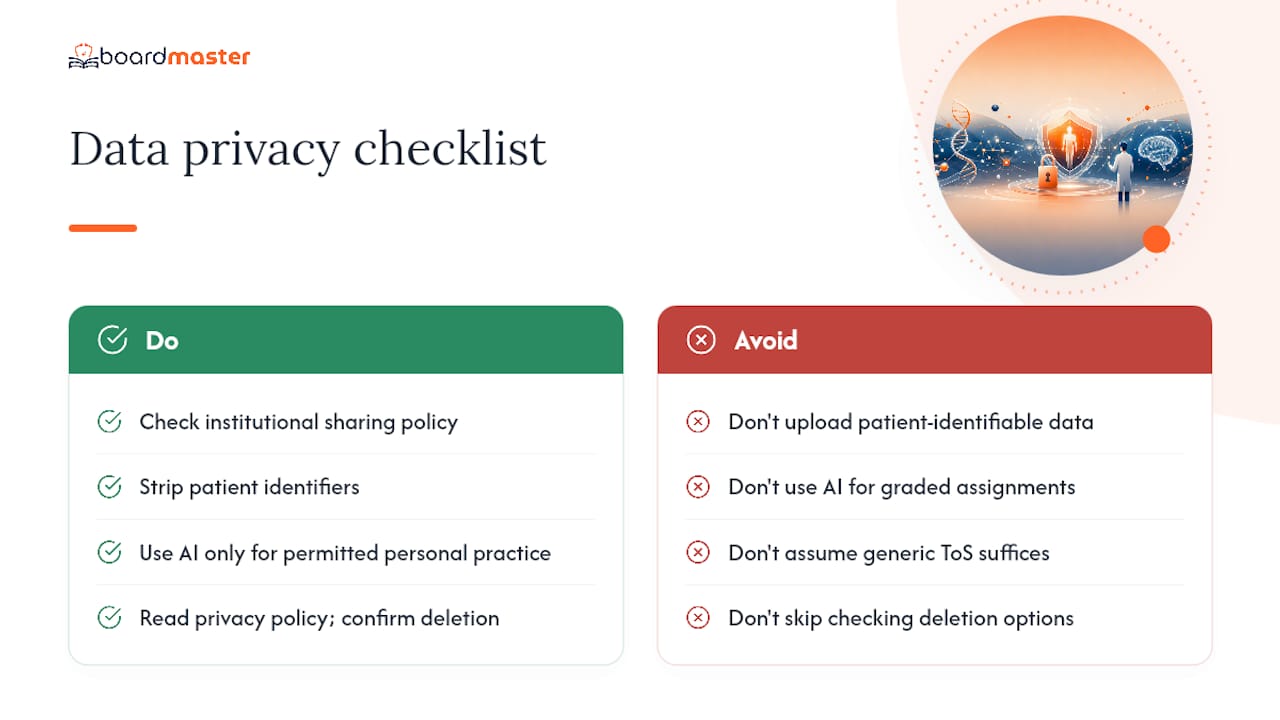
Uploaded lecture material can include copyrighted slides, faculty-created content, or in some cases patient case material adapted for teaching. Before uploading anything, check whether your institution has a policy on sharing course content with third-party tools, and strip identifying patient details from any case-based notes if your course used real (even de-identified) clinical material.
Academic integrity policies vary by school. Some programs explicitly permit AI-assisted study tools for personal practice questions; others have specific restrictions, particularly around using AI to generate answers for graded assignments rather than personal study sets. Generating your own practice questions from your own notes for personal study is a very different use case from using AI to complete graded coursework, and it's worth knowing which side of that line your school draws.
On the data side, look at what any platform does with uploaded material: whether notes are stored, whether they're used to train models further, and whether you can delete your data. A platform built specifically for medical education should have clear answers to these questions rather than a generic terms-of-service page borrowed from an unrelated product category.
None of this should discourage you from using these tools. It should just mean you read the privacy policy once, check your school's specific guidance, and proceed with reasonable caution, the same way you'd handle any new clinical software before relying on it.
Comparing AI Study Tools: Accessibility, Cost, and Fit
The AI study tool space for medical students splits roughly into three categories, and knowing which one you're actually looking at saves you from comparing apples to oranges.
General-purpose AI chatbots are free or low-cost and can generate explanations on demand, but they have no knowledge of your specific lecture content unless you paste it in yourself, every single time, and they weren't built with exam-format conventions in mind.
Generic question banks offer large volumes of pre-written questions and explanations, often at a flat subscription cost, but the content is fixed. It doesn't adapt to what your specific professor emphasized, and you can't regenerate an explanation in a different format if the one provided doesn't click for you.
Lecture-aligned platforms like this sit in a third category: they combine AI-generated question creation with a workflow built around your actual course material, plus additional exam-focused formats such as flashcards with spaced repetition and clinical practice simulations. Cost here runs on a subscription model with a free tier for limited use, which lets you test the lecture-to-question pipeline before committing.
For accessibility, the deciding factor usually isn't price alone. It's whether the tool can actually ingest your specific lecture material and produce something aligned to your course, versus producing generically accurate but course-agnostic content that leaves you doing the alignment work yourself. Consider how practice questions accelerate learning for medical students when weighing which format actually fits your study habits.
Combining AI Explanations With Traditional Study Resources
AI explanations work best as an accelerant, not a replacement for the study resources you already trust. The strongest boards prep strategies layer several sources rather than betting everything on one.
Use your lecture slides and textbook as the ground truth for course-specific framing, then use AI-generated questions as your volume driver for active retrieval practice. Question banks with faculty-vetted content remain valuable for calibrating what board-level difficulty actually feels like, especially in your dedicated study period. Anki or other spaced repetition tools still handle long-term retention of discrete facts better than any single explanation session.
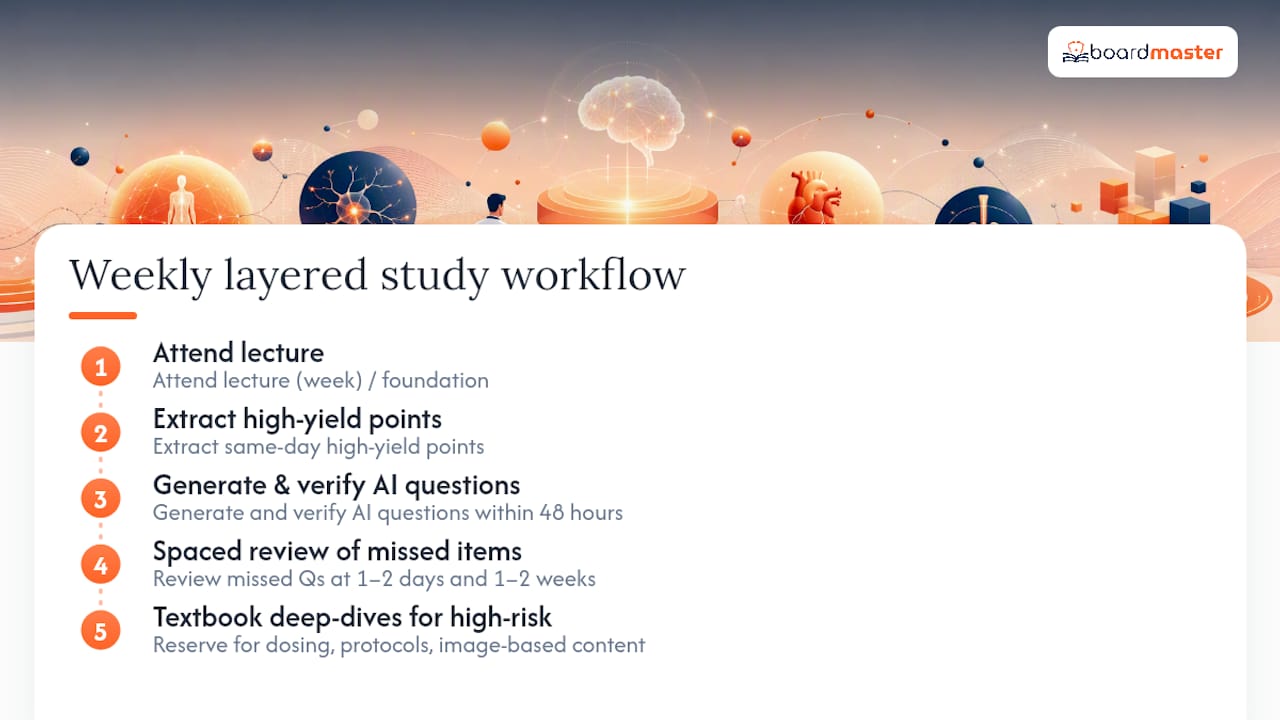
A workable weekly rhythm looks like this: attend lecture, extract high-yield points same day, generate and verify AI practice questions within 48 hours, then push missed questions into spaced review at the 1 to 2 day and 1 to 2 week marks. Reserve textbook deep-dives for anything flagged as high-risk during verification, particularly dosing, protocols, and image-based content.
The mistake to avoid is treating any single tool as sufficient on its own. Students who lean entirely on AI-generated content skip the calibration that comes from working through faculty-vetted board questions. Students who skip AI tools entirely spend hours writing their own practice questions from scratch, time that's better spent actually answering them. For platform design considerations that support this kind of layered workflow, research into healthcare UX points to why smoother upload-to-practice pipelines matter more than they might seem at first glance.
What Actually Matters Once You Cut Through the Hype
The conventional wisdom around AI study tools splits into two unhelpful camps: either AI explanations are treated as infallible tutors, or they're dismissed as unreliable shortcuts that real students shouldn't touch before boards. Both miss what the evidence actually shows.
The data points to something more specific: AI-generated explanations are frequently more complete and less error-prone than rushed expert-written ones, but that advantage only holds when the AI has real context about what's being tested. A model working from a bare question stem is guessing at emphasis. A model fed actual lecture notes is reasoning from the same material your professor built the exam around. That distinction, context versus no context, matters more than which specific model or platform you use.
What gets overrated is the idea that verification means distrust. It doesn't. It means spending ten minutes on the explanations touching dosing, tables, or images, and trusting the rest to move fast. What gets underrated is spacing. The best AI-generated explanation in the world does nothing for your retention if you read it once and never revisit the question. Prioritize the workflow, lecture notes in, verified questions out, spaced review on a schedule, over any single tool's marketing claims.
— Dr. Ahmed Abuzoor
Try the AI OSCE Practice Sessions Demo
If reading about a lecture-to-question workflow makes you want to see it running on your own material, that's the exact gap BoardMaster's demo is built to close. Instead of piecing together a workflow from a chatbot, a question bank, and a flashcard app separately, you upload your lecture notes once and get tailored questions, explanations, and clinical practice scenarios generated from that same material.
The demo walks through an actual OSCE-style clinical skills simulation alongside the standard lecture-to-question pipeline, so you can see how a single upload turns into a full practice set rather than a single AI-generated answer. The free tier lets you run this on one real lecture before you decide whether it fits your study routine. Watch the AI OSCE practice sessions demo and upload your next lecture to see what a verified, exam-aligned question set looks like for your own coursework.
This article is general information, not a substitute for advice from a qualified doctor. Consult a qualified healthcare professional about your own circumstances before acting on anything here.
Sources
- Comparative Evaluation of AI-Generated vs. Expert-written Answer Explanations for a Medical Education Self-Assessment
- AI models and USMLE performance (2024) — iterative improvement and accurate diagnosis identification in many vignettes
- Single Best Answer questions in lecture teaching increase student confidence and engagement (2024)
- Analyzing question characteristics influencing ChatGPT’s performance in USMLE-style questions (2024)
FAQ
Are AI-generated medical explanations accurate enough to study from?
They're generally strong on completeness and reasoning, with faculty flagging only 20% of AI-generated explanations for correction versus 38% of expert-written ones, but table-based, dosing, and image-based questions still need manual verification.
How is BoardMaster different from a generic AI chatbot for studying?
BoardMaster generates questions and explanations directly from your uploaded lecture notes, aligning practice content to what your specific professor emphasized rather than producing generic answers with no course context.
Should I trust AI explanations for board exam prep or only class exams?
Both, with the same verification habit: AI explanations model the reasoning chains USMLE and COMLEX-style questions reward, but always double-check dosing, protocol, and image-based content regardless of exam type.
How often do AI medical explanations need correction?
Roughly one in five AI-generated explanations needed a correction in a blinded faculty evaluation, compared with roughly two in five expert-written explanations in the same study.
Can I use AI explanations to build flashcards for spaced repetition?
Yes. Verify the explanation first, then convert the stepwise rationale into a concise flashcard-friendly format and schedule it into spaced review at the 1 to 2 day and 1 to 2 week intervals.