
Broad question banks overwhelm students because they create three simultaneous problems: content misalignment with your actual course, cognitive overload from sheer volume and interface noise, and a behavioral trap where you chase completion percentages instead of mastering concepts. The immediate fix is simple to state and hard to execute: pick one resource that aligns with your curriculum, and spend 15 minutes reviewing every question you miss before you move on.
For medical students preparing for USMLE Step 1, Step 2, or in-course NBME-style exams, this matters more than it does for almost any other exam context. The stakes are high, the content is vast, and the question banks are enormous. Doing more questions is not the same as learning more medicine.
- The core problem: Generic banks test content your professor never emphasized
- The cognitive trap: Too many varied cues overload working memory under timed conditions
- The behavioral trap: Completion-chasing replaces deep review
- The fix: One aligned bank, deep review of every miss, and a small set of metrics to track progress
- The tool: BoardMaster generates USMLE-style questions directly from your uploaded lecture notes, cutting misalignment at the source
Table of Contents
- Why broad question banks overwhelm students: what the research shows
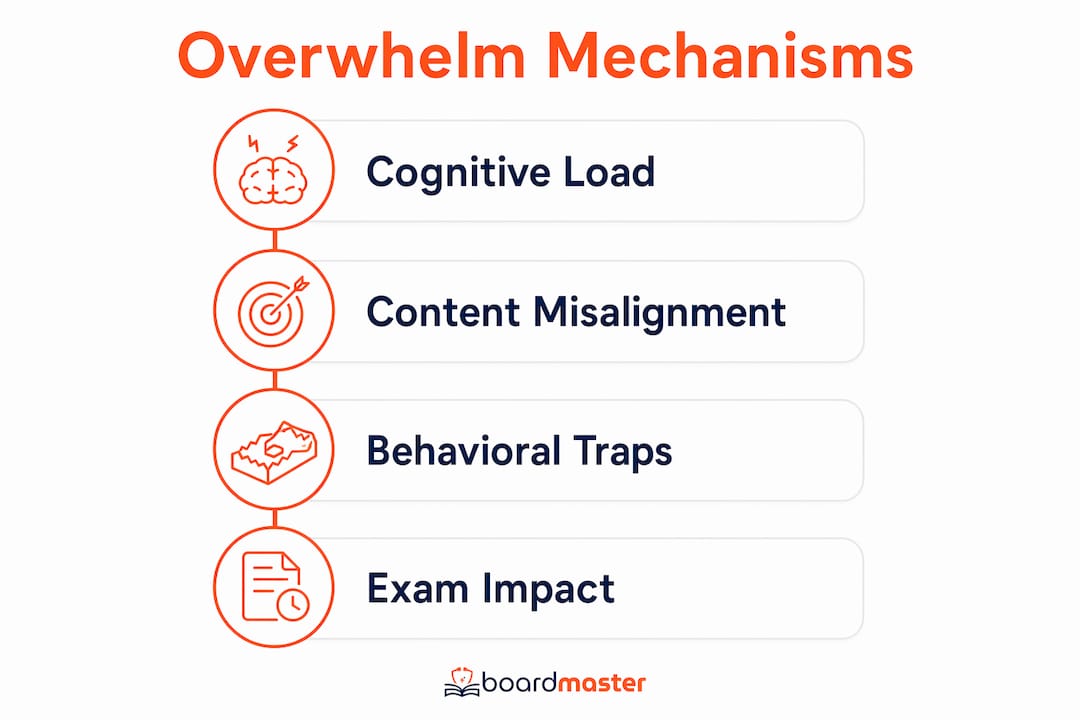
- How the overwhelm actually happens: three mechanisms working at once
- What overwhelm does to your actual exam performance
- A step-by-step plan for using question banks without burning out
- How to tell if your question practice is actually working
- What happened when one student stopped chasing volume
- The one change that makes the biggest difference
- Key Takeaways
- A note on changing how you study
- BoardMaster puts lecture-aligned practice into your hands
- Useful sources
- FAQ
Why broad question banks overwhelm students: what the research shows
The evidence here is not anecdotal. A qualitative study published in BMC Medical Education found that gamification and rapid feedback in question banks trigger anxiety-driven, compulsive engagement rather than intrinsic learning. Students described feeling compelled to keep answering questions not because they were learning, but because the platform rewarded streaks and percentages. That is a behavioral loop designed into the product, not a personal failing.
Separately, research on assessment misalignment shows that when practice tools do not reflect classroom instruction or instructor priorities, students report confusion, loss of motivation, and wasted effort on low-yield material. For a medical student whose professor emphasizes renal physiology over cardiac pharmacology, a generic bank that weights both equally is actively counterproductive.
Statistic callout: Practitioners consistently report that students who fully reviewed one primary bank improved more than those who spread effort across multiple banks. Depth of review beats sheer quantity for score gains on USMLE-style assessments.
The pattern holds across contexts. Students using large, generic question sets tend to adopt coping strategies: guessing, answer cueing, and rote memorization. These are not signs of weak students. They are rational responses to an irrational study environment.
Key sources supporting this picture:
- BMC Medical Education qualitative study on compulsive question-bank use and anxiety
- SCIRP paper on assessment misalignment and student distress
- ResidencyAdvisor practitioner guidance on USMLE score predictors
- Cognitive science literature on working memory limits under timed conditions
How the overwhelm actually happens: three mechanisms working at once
Understanding why students struggle with assessments from broad banks means looking at three distinct but reinforcing mechanisms.
Cognitive load exceeds what working memory can handle
Working memory under pressure is limited. When a timed question presents multiple clinical cues simultaneously, a student must hold the patient's age, chief complaint, lab values, and drug history in mind while retrieving the relevant pathophysiology. That is already near the ceiling for most people. Add a question style that does not match what the student practiced in class, and the mismatch creates extra processing overhead. The student knows the material but cannot retrieve it cleanly under these conditions.
This is not a knowledge gap. It is a cue-target matching failure. When the cues in a practice question do not match the cues the student encoded during lecture, retrieval fails even when the underlying knowledge is solid. Broad banks, by design, use varied phrasing, unfamiliar clinical contexts, and question styles that may differ substantially from what a student's course actually tests.
Misalignment wastes effort on low-yield material
A generic USMLE bank covers the entire content outline. Your course exam does not. Your professor's exam covers what your professor taught, weighted toward what they emphasized. When you spend three hours drilling questions on topics your professor mentioned once in passing, you are not preparing for your next exam. You are preparing for a hypothetical exam that does not exist.

Assessment misalignment between generic bank content and institution-specific learning outcomes increases distress and wastes study time on low-yield material. Students who recognize this mismatch often feel stuck: the bank tells them they are at 65%, but their course exam score does not improve. That gap is demoralizing in a specific way that generic study advice does not address.
Behavioral traps: completion-chasing and shallow review
This is the one students least want to hear about, because it implicates their own habits. Large question banks with gamified dashboards create a specific behavioral pattern: you track your percentage, you feel bad when it drops, and you answer more questions to push it back up. You are not reviewing what you missed. You are chasing a number.
The BMC Medical Education qualitative study documented this directly: students described compulsive engagement driven by platform feedback rather than learning goals. The result is shallow review and poor long-term retention. You can recognize this trap in your own habits if you see yourself in this list:
- You answer 40+ questions in a session but spend less than 5 minutes reviewing misses
- Your percentage on the platform is rising, but your NBME practice scores are flat
- You feel productive after a session but cannot explain why you missed the questions you did
- You have started a second or third bank because the first one "feels stale"
- You skip questions on topics you already missed once, because you remember the answer
Pro Tip: If you can recall the answer to a question because you remember seeing it before, not because you understand the concept, that question is no longer teaching you anything. Flag it and move on to a fresh question on the same topic.
What overwhelm does to your actual exam performance

The effects of broad question banks on performance are not abstract. They show up in specific, measurable ways.
Plateauing is the most common. You do hundreds of questions, your platform percentage climbs to 70%, and then it stops moving. Adding more questions from the same bank produces no further gains because you have already seen most of the question styles and learned to cue off surface features rather than underlying reasoning. This is shallow review and rote cueing at work: you are pattern-matching to question formats, not building clinical reasoning.
The erosion of clinical reasoning is slower and harder to notice. When you practice with cueable, low-quality questions, you train yourself to look for the "tell" in the question stem rather than working through the clinical logic. On a real NBME exam, where questions are carefully written to remove those tells, that habit costs you points.
Long-term retention suffers too. Shallow review means concepts never consolidate into long-term memory. You recognize a topic when you see it in a question, but you cannot generate the relevant information from scratch during a clinical rotation or a board exam.
- Flat or declining NBME practice scores despite rising platform percentages
- Increased anxiety before exams despite high question volume
- Inability to explain the reasoning behind correct answers
- Feeling "burned out" on questions before the exam arrives
Time pressure itself compounds all of this. Students who have trained on misaligned, high-volume banks often find that timed NBME-style conditions expose exactly the gaps that their platform percentage concealed.
Pro Tip: If your NBME practice score has not moved in two weeks despite consistent question practice, stop adding questions. Spend the next three days doing nothing but reviewing your previous misses in depth. That shift alone often breaks the plateau.
A step-by-step plan for using question banks without burning out
The goal is not to do fewer questions because you are lazy. It is to do fewer, better-chosen questions with deeper review, so each one actually changes what you know.
Step 1: Choose one primary bank based on three criteria
- Alignment: Does the bank's content match your course syllabus and professor's emphasis? For USMLE prep, does it cover the NBME content outline accurately?
- Explanation quality: Are the explanations detailed enough to teach you the concept, not just the answer?
- Question style: Do the questions resemble the format you will face on your actual exam?
Professor-specific question banks that generate questions from your own lecture notes solve the alignment problem directly. For board prep, a curated bank of physician-written questions is the baseline.
Step 2: Deep-review every miss for 15 minutes
This is the single highest-leverage habit in question-bank practice. For every question you miss:
- Write down the concept tested, not just the correct answer
- Identify why your reasoning failed (wrong assumption, missed cue, knowledge gap)
- Convert the concept to a flashcard or spaced-repetition note
- Return to that concept in your notes or a reference before moving on
Top-performing students spend focused time untangling every incorrect question rather than chasing raw question volume. Fifteen minutes per miss is the standard that separates students who plateau from those who keep improving.
Step 3: Build a weekly routine with defined question counts
The daily board exam practice that works is not the one with the highest question count. It is the one you can sustain.
- Full study day: 40 questions, 60–90 minutes of review, 20 minutes of spaced-repetition flashcards
- Light day (rotations, post-call): 10–15 questions, 20 minutes of review, no new topics
- Pre-exam week: 20 questions per day, maximum review time, one NBME practice assessment
Step 4: Add a second bank only for a specific, identified gap
Board prep advisors recommend mastering one primary bank (70–100% completed with thorough review) before adding a second resource. When you do add one, it should target a specific weakness, not replace the primary bank. Different interfaces, phrasing, and metric dashboards from multiple banks create cognitive fragmentation that slows learning.
Pro Tip: On clinical rotations, replace long question sessions with a 15-question set done during lunch and a 10-minute review before bed. Consistency beats volume when your schedule is unpredictable.
Checklist for students on rotations with limited study time:
- Set a minimum daily question count you can hit even on a hard day (10 is enough)
- Review misses immediately after the session, not the next morning
- Use lecture-aligned questions when possible to keep class and board prep unified
- Track your repeat-correct rate, not your platform percentage
- Take one NBME practice assessment every two weeks to benchmark real progress
How to tell if your question practice is actually working
Tracking the right metrics is what separates students who adjust their strategy in time from those who discover the problem on exam day.
| Week | Questions done | Review min per miss | Repeat-correct rate | NBME practice score |
|---|---|---|---|---|
| 1 | — | 15 min | — | Baseline |
| 2 | — | 15 min | — | +2 points |
| 3 | — | 15 min | repeat-correct rate improving | +4 points |
| 4 | 100 | 15 min | — | — |
The table above shows what genuine improvement looks like: question volume stays roughly flat or even drops slightly, review time per miss increases, repeat-correct rate climbs, and NBME scores move. If your repeat-correct rate is flat after two weeks, the review is not deep enough.
The metrics that actually matter:
- Repeat-correct rate: When you see a concept again, do you get it right? This is a clear signal of real learning.
- Review minutes per miss: If this number is under 5, you are not reviewing deeply enough.
- NBME practice score trend: NBME-style assessments are more predictive and less noisy than platform percentages from multiple nonstandard banks. Track this every two weeks.
- Time per question: If your average time per question is dropping but your accuracy is not improving, you are speeding up without understanding more.
When metrics show plateau: stop adding questions, increase review depth, and take an NBME practice assessment to get a clean external benchmark. When metrics show genuine improvement: stay the course and resist the urge to add a second bank prematurely. Question exposure structure matters more than total exposure volume.
What happened when one student stopped chasing volume
Sarah was a second-year medical student preparing for USMLE Step 1. She was doing 60+ questions a day across two banks, her platform percentage was sitting at 68%, and her NBME practice scores had not moved in three weeks. She was exhausted and convinced she needed to do more.
She switched to a single, lecture-aligned resource. Instead of pulling from a generic bank, she uploaded her lecture notes to BoardMaster and practiced with questions generated directly from her professors' material. Her review time per miss went from 4 minutes to 15. Her question volume dropped by more than half.
The result: she moved significantly up in percentile rankings while cutting her study hours significantly.
Why it worked comes down to the mechanisms described above. Lecture-aligned questions reduce cue-target mismatch, which means working memory is not wasted on unfamiliar formats. Fewer questions with deeper review builds long-term retention instead of surface recognition. And tracking a small set of metrics kept her strategy honest.
BoardMaster's relevant capabilities for this workflow:
- AI question generator: Uploads lecture notes and produces USMLE-style questions targeting professor-emphasized concepts
- Lecture-to-flashcards: Converts the same notes into spaced-repetition flashcards with medical images
- Curated qbank: 5,000+ physician-written board questions for students who need a vetted primary resource alongside lecture-aligned practice
- AI study assistant: Provides instant explanations for missed questions, replacing the need to hunt through multiple references
The one change that makes the biggest difference
Commit to one targeted bank, review every miss for 15 minutes, and track three metrics: repeat-correct rate, review time per miss, and NBME practice score. Add a second resource only when you have completed your primary bank with thorough review and identified a specific gap it does not cover.
The core reason this works is not complicated. Alignment plus depth beats unstructured volume. A question that matches your course content and gets reviewed until you understand the underlying concept is worth ten questions you answered quickly and moved past.
- Alignment with your curriculum eliminates wasted effort on low-yield material
- Deep review converts missed questions into durable knowledge
- A small metric set keeps your strategy honest and tells you when to adjust
- Adding a second bank is a decision, not a default
Key Takeaways
Broad question banks overwhelm medical students because they combine content misalignment, cognitive overload, and behavioral completion-traps that replace deep learning with volume-chasing.
| Point | Details |
|---|---|
| Misalignment wastes effort | Generic banks test content your professor never emphasized, creating confusion and low-yield practice. |
| Cognitive overload is real | Limited working memory under timed conditions fails when question cues do not match how you encoded the material. |
| Deep review beats volume | Spending 15 minutes per missed question produces more score gains than answering additional questions. |
| Track the right metrics | Repeat-correct rate and NBME practice scores are reliable indicators when tracking progress. |
| BoardMaster targets the source | Lecture-aligned AI questions and a curated qbank eliminate misalignment and support deep review in one workflow. |
A note on changing how you study
The hardest part of this advice is not the strategy. It is the psychology. When you are behind and anxious, doing more questions feels like doing something. Stopping to review one question for 15 minutes feels slow, almost irresponsible.
That instinct is exactly what the research on compulsive question-bank use describes. The platform is designed to make volume feel like progress. It is not. The students who improve fastest are usually the ones who do the uncomfortable thing: they slow down, they review deeply, and they resist the pull of the percentage dashboard.
Rotations make this harder. You are tired, your schedule is unpredictable, and 15 questions at lunch feels inadequate. But consistency at a lower volume beats sporadic high-volume sessions every time. Ten questions reviewed well is a better day than 50 questions skimmed.
The shift from volume to depth is not a study hack. It is a different relationship with learning, one where the goal is understanding rather than completion. That shift is what clinical reasoning actually requires, and it is what your attendings are evaluating on rotations whether or not you realize it.
BoardMaster puts lecture-aligned practice into your hands
If the article's core argument landed, the logical next step is not finding a better generic bank. It is eliminating the misalignment problem at the source.
BoardMaster does exactly that. Upload your lecture notes, and the platform generates USMLE and COMLEX-style practice questions targeting the concepts your professors actually emphasized. The same notes become spaced-repetition flashcards. The AI question generator means your class exam prep and your board prep happen simultaneously, not in competition with each other.
For students who want a vetted primary resource alongside lecture-aligned practice, BoardMaster's 5,000+ physician-written board questions give you a curated qbank built to NBME standards. The free tier lets you test the workflow before committing. Start with your next lecture's notes and see whether the questions it generates match what your professor actually tests.
Useful sources
Peer-reviewed research
- Question banks: credit? Or debit? A qualitative exploration of their use among medical students — BMC Medical Education. The primary qualitative study on compulsive engagement, anxiety, and extrinsic motivation in question-bank use among medical students.
- Assessment misalignment and student distress — SCIRP. Documents how misalignment between assessment tools and classroom instruction increases student distress and reduces motivation.
- Re-using questions in classroom-based assessment — PMC / BMC Medical Education. Examines psychometric effects of item re-use and the risks of content leakage in medical education item banks.
- Why might students fail in responding to an assessment task? — Explains cue-target matching failures and cognitive load as drivers of poor assessment performance.
Practitioner guidance
- Why More Q-Banks Don't Automatically Mean Higher USMLE Scores — ResidencyAdvisor. Practitioner analysis of depth-vs-volume trade-offs and the predictive value of NBME benchmarks.
- How many question banks should a resident use for boards? — ResidencyAdvisor. Decision framework for adding a second bank and criteria for mastery of a primary resource.
- Why some smart kids struggle with exams — Sonic Learning. Cognitive science perspective on working memory limits and processing speed under timed exam conditions.
- Why Students Struggle With Writing on Standardized Tests — Differentiated Teaching. Analysis of time pressure and format unfamiliarity as performance reducers.
- Test preparation: how top services maximize your success — TestAccommodations.org. Decision criteria for evaluating high-quality test-prep resources.
Platform resources
- BoardMaster AI question generator — Demo of lecture-to-question workflow for USMLE and COMLEX prep.
- BoardMaster curated qbank — 5,000+ physician-written board questions built to NBME standards.
| Source type | Title | Best used for |
|---|---|---|
| Peer-reviewed | BMC Medical Education qualitative study | Evidence on compulsive use and anxiety |
| Peer-reviewed | SCIRP misalignment paper | Evidence on wasted effort and distress |
| Peer-reviewed | PMC item re-use study | Understanding item bank psychometrics |
| Practitioner | ResidencyAdvisor (volume vs. depth) | Practical USMLE score strategy |
| Practitioner | ResidencyAdvisor (how many banks) | Decision rules for adding resources |
| Cognitive science | Sonic Learning working memory | Cognitive load mechanism |
| Platform | BoardMaster AI generator | Lecture-aligned practice workflow |
FAQ
Are question banks good or bad for medical students?
Question banks are effective when used with discipline: one aligned bank, deep review of every miss, and NBME benchmarks to track real progress. They become counterproductive when students chase volume and platform percentages instead of mastering concepts.
What is the biggest problem students face with broad question banks?
The biggest problem is misalignment: generic banks test content that does not match your professor's emphasis or your course exam, which wastes study time on low-yield material and creates confusion without improving scores.
What is the actual purpose of a question bank?
A question bank is meant to expose gaps in your knowledge and build retrieval practice under exam-like conditions. It works only when the questions match the format and content you will actually face, and when you review misses deeply enough to change what you know.
How do you use a question bank effectively?
Choose one bank aligned with your curriculum, spend 15 minutes reviewing every question you miss, track your repeat-correct rate and NBME practice scores, and add a second bank only after completing your primary resource with thorough review. BoardMaster's lecture-aligned AI-generated questions address the misalignment problem directly by generating practice questions from your own lecture notes.