
TL;DR:
- Professor-specific question banks focus on course-aligned content, enhancing exam preparation by mirroring instructor emphasis. They use randomized delivery, targeted material, and AI support to improve retention and practical reasoning for medical exams. Creating and maintaining these banks with structured workflows ensures long-term usefulness and better results than generic publisher resources.
A professor-specific question bank is a curated digital repository of exam questions aligned precisely to a single course or instructor's curriculum, built to sharpen study focus and lift assessment reliability. For medical students, this distinction matters more than it does for almost any other field. Generic question sets cover broad territory. Your professor's exam does not. Understanding professor-specific question banks explained in full means recognizing that the best study tool is one that mirrors exactly what will be tested, not what a publisher decided was important three years ago. Platforms like BoardMaster and learning management systems like Canvas have made building and using these targeted banks faster and more practical than ever before.
How do professor-specific question banks improve exam preparation?

A professor-specific question bank improves exam preparation by concentrating your practice on the exact concepts your instructor emphasizes, rather than spreading effort across an entire discipline. That focus is the core advantage over generic resources.
The mechanics behind this advantage are worth understanding:
- Randomized delivery reduces answer sharing. Randomization pulls unique question subsets per student from tagged pools, which limits cramming from shared answer keys and produces a truer measure of what you actually know.
- Targeted content improves exam relevance. When questions map directly to your professor's lecture slides and learning objectives, every practice session builds familiarity with the specific framing and vocabulary that will appear on your block exam.
- Repeated exposure builds retention. Cycling through a bank of 150 course-specific questions three times before an exam produces stronger recall than a single pass through 500 generic ones.
- AI integration personalizes the experience. AI systems analyze lecture notes and syllabi to auto-generate high-yield questions, including multiple-choice questions and case studies, with source-cited feedback that mirrors the logic of your professor's assessments.
Pro Tip: After each practice session, flag every question you answered incorrectly. Revisit only those flagged questions 48 hours later. This spaced repetition approach compounds retention without adding hours to your schedule.
The connection to board performance is direct. When your course bank forces you to apply pathophysiology the way your professor frames it, you are also practicing the analytical reasoning that USMLE Step 1 and Step 2 reward. Targeted practice and board readiness are not competing goals. They reinforce each other.
What are the best practices to create and maintain these banks?
Creating a professor-specific question bank that actually holds up across a semester requires structure from day one. Improvised banks become disorganized quickly, and disorganized banks get abandoned.
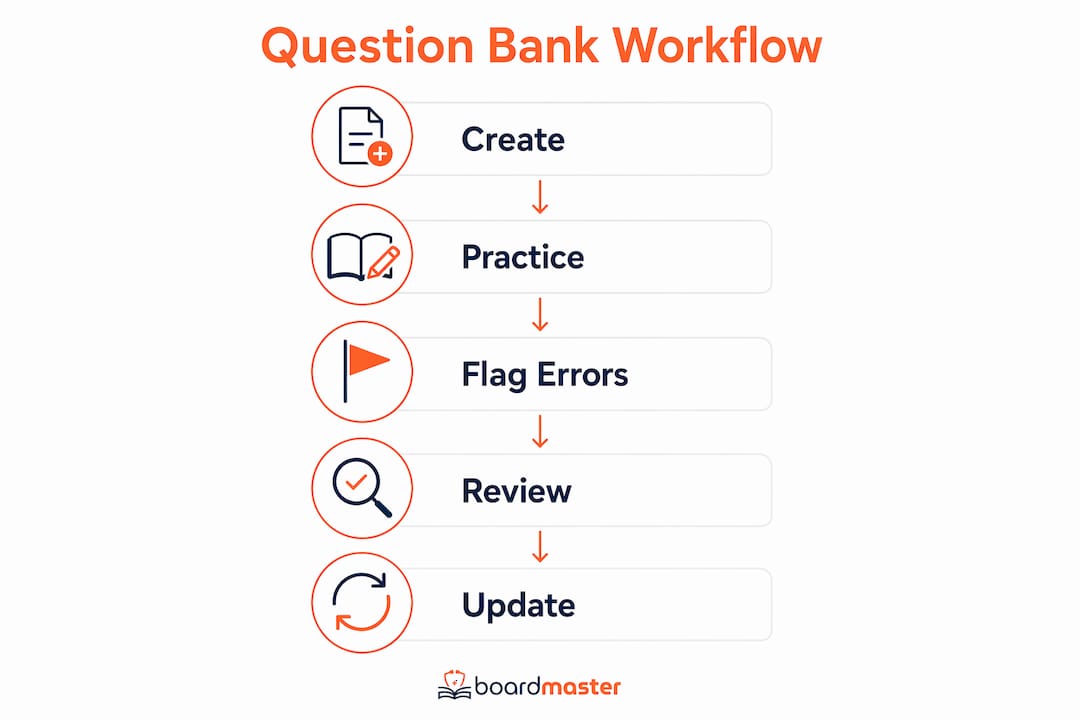
Follow this workflow to build one that lasts:
- Define your taxonomy first. Categorize every question by topic, difficulty level, and learning objective before you write a single item. Blueprinting and metadata applied early allow you to scale content and analyze performance against specific objectives later. Skipping this step makes the bank nearly impossible to search or audit.
- Use consistent naming conventions. The format [Module]-[Topic]-[Level] is a recommended standard for Canvas and Moodle environments. A question labeled "Cardio-HeartFailure-Hard" is instantly locatable six months later. A question labeled "HF question 3" is not.
- Use bulk import tools for efficiency. CSV and GIFT file formats let you upload hundreds of questions at once. Master CSV templates with predefined headers prevent ingestion failures. Minor naming variations in a bulk upload create separate unintended categories, which fragments your bank silently.
- Apply version control before editing. Editing a bank linked to an active quiz alters all associated assessments. Duplicate the bank before making changes. This preserves historical exam data and protects your ability to review past performance accurately.
- Retire low-performing questions regularly. Reviewing performance data reveals which questions are too easy, too ambiguous, or no longer aligned with current course content. Removing them keeps the bank sharp and prevents wasted practice time.
Pro Tip: Treat your question bank as a living document. Set a calendar reminder at the end of each block to review question-level analytics. Questions that every student gets right or wrong are not measuring anything useful.
The payoff for this discipline is significant. A well-structured bank built in your first semester becomes a compounding asset. By your third year, you have a searchable library of course-specific practice material that no publisher can replicate.
Which platforms and AI tools support these banks most effectively?
The platform you use determines how much of the creation and maintenance work gets automated. Not all learning management systems handle question banks with the same depth.
| Platform / Tool | Key Strength | Best Use Case |
|---|---|---|
| Canvas | Native question bank with randomization and tagging | Course-level bank management for professors |
| Moodle | Open-source flexibility with GIFT format imports | Institutions needing custom workflows |
| BoardMaster | AI generates questions from uploaded lecture notes | Medical students building professor-aligned practice sets |
| Vaps Technologies AI System | Auto-generates MCQs and case studies from syllabi | Educators automating question creation at scale |
| risr/ | Blueprinting and metadata tools for large item banks | High-stakes medical and professional licensing exams |
Canvas and Moodle are the two dominant LMS platforms in medical education. Both support tagging, randomization, and bulk imports, but they require manual question authoring unless paired with an AI layer. That manual step is where most students and professors lose time.
AI tools close that gap. BoardMaster leverages AI to generate personalized question banks aligned with professor curricula and exam formats, deploying adaptive practice sets rapidly to improve student outcomes. The workflow is direct: upload your lecture notes, and the platform produces USMLE-style questions built around what your professor actually covered. A student named Sarah used this approach and moved from the 73rd to the 92nd percentile while cutting her study hours in half. That result is not about studying more. It is about studying the right material.
Retrieval-augmented generation, or RAG, is the underlying technology that makes this possible. AI tutors using RAG ingest professor-aligned content and cite specific sources when providing feedback, so you know exactly which lecture concept a question is testing. That transparency is something no static publisher bank can offer.
How do professor-specific banks differ from publisher test banks?
Publisher test banks and professor-specific banks serve different purposes. Confusing them is one of the most common and costly mistakes medical students make.
Here is where they diverge:
- Scope vs. precision. Publisher banks like those from Elsevier or Lippincott cover entire disciplines. Professor-specific banks cover what your professor taught in the last four weeks. For a block exam, precision wins every time.
- Customization depth. Professor-specific banks offer flexible customization tied directly to course objectives. Publisher banks are fixed at the time of publication and cannot reflect a professor's unique framing or emphasis.
- Randomization quality. A professor-specific bank built in Canvas or BoardMaster randomizes from a pool of questions your instructor designed or approved. Publisher banks randomize from content that may not appear on your exam at all.
- Academic integrity. Because professor-specific banks pull unique subsets per student, they reduce the risk of answer sharing within a cohort. Publisher banks, widely circulated, are frequently shared between students and across years.
- Board exam alignment. This is where the two approaches can work together. A well-built professor-specific bank trains you on course content. BoardMaster merges that with USMLE-style question formatting, so you are not choosing between passing your block exam and preparing for Step 1. You are doing both simultaneously.
The practical implication for you is straightforward. Use professor-specific banks as your primary tool for course exams. Use exam revision strategies and board-focused resources to layer in broader preparation. The two approaches are complementary, not competing.
Key takeaways
Professor-specific question banks outperform generic resources because they align practice directly with what your professor tests, not what a publisher estimated was important.
| Point | Details |
|---|---|
| Definition matters | A professor-specific bank is a digital repository of course-aligned questions, not a generic test prep set. |
| Structure from day one | Apply taxonomy, naming conventions, and metadata before writing questions to keep the bank searchable and scalable. |
| AI accelerates creation | Tools like BoardMaster generate USMLE-style questions from lecture notes, cutting creation time and improving relevance. |
| Randomization protects integrity | Pulling unique question subsets per student limits answer sharing and produces a more accurate measure of mastery. |
| Treat banks as living documents | Regular performance reviews and question retirement keep the bank accurate and worth your practice time. |
What i have learned after years of watching students study the wrong way
I have watched hundreds of medical students grind through thousands of generic practice questions and still underperform on block exams. The pattern is consistent. They are not studying too little. They are studying the wrong material with the wrong tools.
Publisher test banks are built for coverage. Your professor's exam is built for emphasis. Those are fundamentally different things. A professor who spends three lectures on heart failure signaling mechanisms is telling you something. A publisher bank that gives heart failure the same weight as every other cardiovascular topic is not listening to that signal.
The students who perform best are the ones who treat their professor's lecture notes as the primary source and build their practice around those notes specifically. That used to require hours of manual question writing. AI tools like BoardMaster have changed that calculus entirely. Uploading a lecture and receiving a set of targeted practice questions within minutes is not a shortcut. It is a smarter allocation of limited study time.
My one caution: do not let the bank replace understanding. A question bank is a diagnostic tool. It tells you what you know and what you do not. The work of actually learning the concept still happens in the notes, the textbooks, and the clinical reasoning you build over time. Students who use banks as a substitute for understanding rather than a check on it tend to plateau quickly.
The future of medical exam preparation runs through personalized, professor-aligned practice. The students building that habit now will carry it into residency preparation and beyond.
— Dr. Ahmed Abuzoor
Build your professor-aligned practice set with BoardMaster
Medical students who want to stop guessing what will be on their next block exam have a direct path forward with BoardMaster.
BoardMaster's AI question generator converts your uploaded lecture notes into USMLE-style practice questions built around your professor's specific emphasis. There is no manual question writing and no sifting through irrelevant publisher content. The platform's adaptive learning engine tracks your performance and adjusts which questions you see next, so every session targets your actual weak points. For students preparing for both course exams and boards, BoardMaster's block exam prep tools merge those two goals into a single, time-efficient workflow. Start with your next set of lecture notes and see the difference targeted practice makes.
FAQ
What exactly is a professor-specific question bank?
A professor-specific question bank is a centralized digital repository of assessment questions built around a specific course or instructor's curriculum. It differs from generic banks by aligning directly with the topics, framing, and emphasis of a particular professor's teaching.
How do i create a question bank from my lecture notes?
Upload your lecture notes to an AI-powered platform like BoardMaster, which analyzes the content and generates course-aligned practice questions automatically. For manual creation in Canvas or Moodle, define your taxonomy first, then use bulk CSV imports with consistent naming conventions to populate the bank efficiently.
Are professor-specific question banks better than USMLE question banks for board prep?
They serve different purposes. Professor-specific banks prepare you for course and block exams by targeting your professor's material. The best approach combines both, and platforms like BoardMaster format professor-aligned questions in USMLE style so you build board reasoning skills while studying for your immediate exams.
How often should a question bank be updated?
Item banks should be reviewed regularly and treated as evolving documents. Retire questions that no longer reflect current course content or that fail to differentiate between strong and weak performers. A review at the end of each block is a practical minimum.
Does using a professor-specific question bank improve grades?
Targeted practice on professor-aligned content directly improves exam performance by focusing study time on high-yield material. BoardMaster reports that students using its professor-specific approach, like Sarah who moved from the 73rd to the 92nd percentile, achieve significant score gains while reducing total study hours through more precise preparation.