
TL;DR:
- Personalized question banks adapt to individual performance to target study weaknesses more effectively. They align content with official exam blueprints and adjust difficulty in real time for better efficiency. Replacing generic banks with these tools improves scores and reduces wasted study time.
Personalized question banks are defined as adaptive study tools that adjust content difficulty and topic focus based on your individual performance data. Medical students who replace generic question banks in med school with tailored alternatives consistently outperform peers who rely on broad, one-size-fits-all resources. Generic banks flood you with questions that may have nothing to do with your professor's emphasis or your specific exam blueprint. BoardMaster addresses this directly by generating USMLE-style questions from your own lecture notes, targeting the exact concepts your professors test. The result is faster preparation, higher scores, and less wasted study time.
Why generic question banks fail med school exam prep
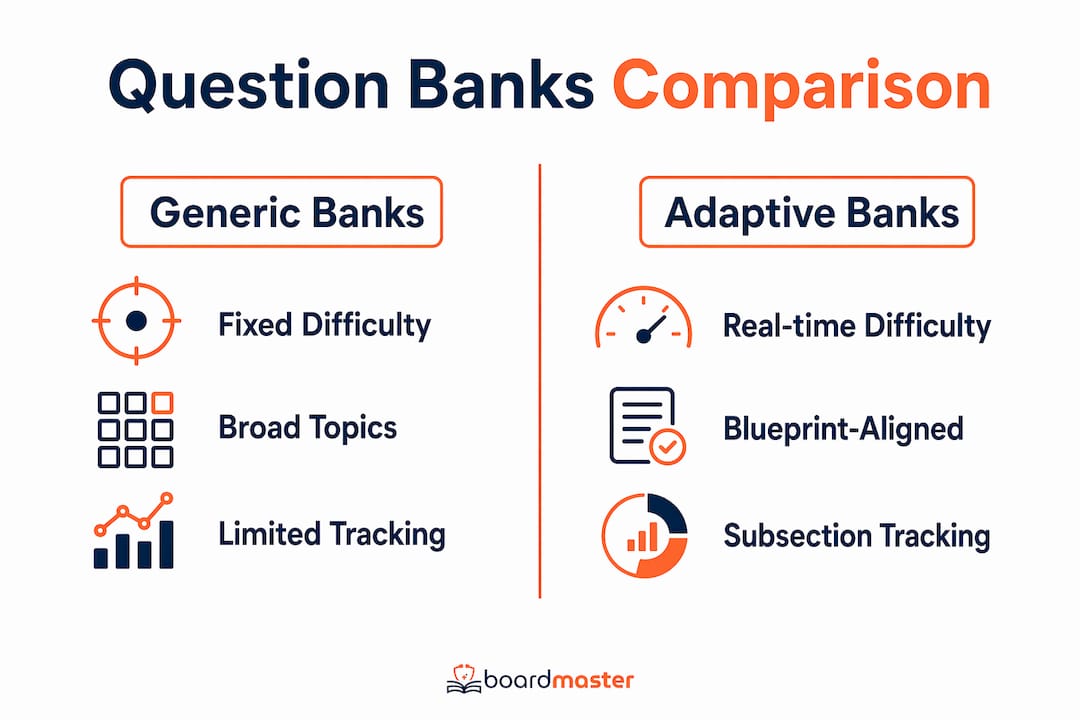
Generic question banks share one critical flaw: they are built for the average student, not for you. They cover broad content without adapting to your weak areas, your course syllabus, or the specific exam you are sitting. That mismatch costs you hours of study time on material that will never appear on your test.

The content alignment problem is serious. Question banks that fail to update with official exam blueprints like the UKMLA Content Map leave students practicing outdated material. Exam content maps change regularly, and a bank calibrated to last year's blueprint can actively mislead your preparation.
High question volume is not the same as high-quality preparation. Over-prioritizing question volume without quality review and explanation wastes preparation time and hinders deeper understanding. A student who grinds through 3,000 loosely relevant questions learns less than one who works through 800 well-explained questions tied directly to their knowledge gaps.
Generic banks also fail to track your skill level across subsections. They record right and wrong answers, but they do not tell you whether your cardiology reasoning is improving or whether your pharmacology recall is still your weakest link. Without that granular feedback, you cannot make smart decisions about where to spend your next study hour.
The risks compound over time. Students who stick with generic resources often discover, weeks before their board exam, that they have been studying the wrong material. Switching strategies late is costly. The smarter move is to identify the problem early and shift to a personalized approach.
What do custom question bank alternatives offer?
Custom and adaptive question banks solve the problems that generic banks create. AI-powered adaptive learning provides personalized question difficulty tailored to individual performance, improving study efficiency in ways that static banks cannot match.
Real-time difficulty adjustment
Adaptive platforms recalibrate question difficulty after every response. If you answer a series of renal physiology questions correctly, the platform raises the difficulty and moves toward your weaker topics. This mirrors how a skilled tutor would work with you, except the algorithm never gets tired and never loses track of your performance history.
Blueprint-aligned content
The best custom question bank alternatives map their content directly to official exam frameworks like the USMLE content outline or the UKMLA Content Map. Aligning question banks with the latest official exam content maps addresses the core limitation of outdated generic banks. Every question you practice has a direct line back to something you will actually be tested on.
Subsection-level performance tracking
Adaptive platforms track skill levels per exam subsection in real time, showing progress beyond simple right/wrong counts. That level of detail changes how you study. Instead of guessing which topics need more work, you see exactly where your performance lags and by how much.
Spaced repetition and topic filtering
Top-rated medical question banks include spaced repetition scheduling, which surfaces questions at the optimal moment for memory consolidation. Topic filters let you isolate a single system or subject for a focused session. Timed modes, subject filters, and detailed explanations linking back to core concepts are standard features in high-quality adaptive banks.
Pro Tip: Use topic filters to run a focused 30-question session on your weakest subsection before each study block. Targeted repetition on weak areas produces faster score gains than mixed-topic practice sessions.
How to replace generic question banks step by step
Switching from a generic to a personalized question bank is not complicated, but it requires a deliberate sequence. Jumping straight into a new platform without a plan wastes the first two weeks of your subscription.
Audit your current performance. Pull your most recent practice test results and identify your three weakest content areas. Cross-reference those areas against your exam's official content blueprint, whether that is the USMLE content outline or the UKMLA Content Map. This audit tells you exactly what your new bank needs to cover.
Select a bank aligned with your specific exam. Successful USMLE students use one core bank plus a supplemental bank to cover gaps without overloading. Choose a primary bank that maps directly to your exam blueprint, then identify a secondary resource for your weakest subsections.
Configure your personalized study plan. Use the platform's analytics dashboard to set up a study schedule weighted toward your weak areas. Most adaptive platforms let you set daily question targets, topic priorities, and session length. Spend 20 minutes on this setup. It will save you hours later.
Run mixed practice modes. Alternate between timed exam-simulation sessions and untimed tutor mode. Timed sessions build exam stamina. Tutor mode lets you read full explanations immediately after each question, which accelerates conceptual understanding. Never spend an entire week in one mode only.
Review explanations, not just answers. The explanation is where the learning happens. Read every explanation for every question you get wrong, and read the explanations for questions you got right but guessed on. Platforms with integrated, searchable explanations make this review process faster and more thorough.
Reassess weekly. Check your subsection performance data every seven days. If a topic is no longer in your bottom three, shift some study time to the next weakest area. This weekly recalibration keeps your preparation aligned with your actual progress.
Upload your lecture notes to BoardMaster. BoardMaster generates USMLE-style questions directly from your professor's lecture notes, which means your practice questions reflect the exact concepts your course emphasizes. Sarah, a medical student using BoardMaster, moved from the 73rd to the 92nd percentile while cutting her study hours in half. That result comes from studying the right material, not more material.
Pro Tip: Set a recurring calendar block every Sunday to review your weekly analytics. Students who review their performance data consistently adjust their study plans faster and avoid spending weeks on already-mastered content.
Common challenges when switching to personalized question banks
Every transition has friction. Knowing the obstacles in advance lets you move through them faster.
- Interface learning curve. New platforms take time to learn. Difficulties with new platforms include interface learning curves and interpreting diagnostic data correctly. Budget three to five days to explore the platform before you start counting those sessions as productive study time.
- Analytics overload. Adaptive platforms generate a lot of data. Focus on two or three key metrics: your overall performance trend, your weakest subsection score, and your improvement rate over the past two weeks. Ignore the rest until you are comfortable with the basics.
- Cost and subscription management. Adaptive platforms typically cost more than generic banks. Treat the cost as an investment in score improvement. A higher board score has direct career implications, and the time saved by studying targeted material often justifies the price difference.
- Over-relying on question count. The temptation to chase a high question count is real. Resist it. Effective exam prep balances broad question exposure with focused mastery of weak topics. Quality review of fewer questions beats passive scrolling through hundreds.
- Motivation dips. Personalized banks surface your weakest material repeatedly. That can feel discouraging. Track your subsection scores weekly so you can see concrete improvement, which is the most reliable motivation to keep going.
"The students who improve fastest are not the ones who do the most questions. They are the ones who study the right questions, review every explanation carefully, and adjust their plan based on real performance data rather than gut feeling."
Key Takeaways
Replacing generic question banks with personalized, adaptive alternatives is the single most effective change a medical student can make to exam preparation.
| Point | Details |
|---|---|
| Generic banks misalign with exam blueprints | Banks not updated to current content maps like UKMLA waste your study time on irrelevant material. |
| Adaptive platforms adjust in real time | AI-driven banks recalibrate question difficulty and topic focus based on your actual performance data. |
| Subsection tracking beats right/wrong counts | Effective platforms show skill-level progress per topic, not just whether you answered correctly. |
| One core bank plus one supplemental bank | Top scorers use a primary bank aligned to their exam and a secondary bank targeting weak areas. |
| BoardMaster targets professor-specific content | Uploading lecture notes generates questions tied to your course, merging class and board prep into one workflow. |
Why I stopped trusting generic question banks years ago
I spent the first year of my clinical preparation cycling through large generic question banks, convinced that volume was the answer. I was wrong. The questions were well-written, but they were calibrated to a hypothetical average student, not to the specific exam I was sitting or the gaps in my own knowledge.
The shift happened when I started tracking my subsection performance data instead of my total question count. I realized I had been spending roughly 40% of my study time on content I already understood well. That is not studying. That is false confidence.
Adaptive question banks changed my preparation because they forced me to confront my actual weak areas rather than the ones I assumed I had. The personalized exam prep approach is not a shortcut. It is a more honest way to study. You see exactly where you stand, and the platform keeps pushing you toward the material that will actually move your score.
My advice is direct: verify that any question bank you use aligns with the current official content blueprint for your exam. Check the update date. If the bank has not been revised to reflect the latest exam framework, move on. Outdated questions do not just waste time. They build false confidence in the wrong areas, which is worse than not studying at all.
— Dr. Ahmed Abuzoor
BoardMaster gives you questions your exam actually tests
Medical students who want to move beyond generic preparation need a tool built specifically for their course and their exam.
BoardMaster lets you upload your lecture notes and generates USMLE-style practice questions focused on the concepts your professors emphasize. That means your block exam prep covers both your course requirements and your board exam content at the same time. The platform's AI-powered QBank includes over 5,000 physician-written questions with adaptive difficulty, so every session targets your real knowledge gaps. Students like Sarah have already seen what targeted preparation can do. BoardMaster is where that preparation starts.
FAQ
What is a personalized question bank for med school?
A personalized question bank is an adaptive study tool that adjusts question difficulty and topic focus based on your individual performance data. Unlike generic banks, it targets your specific knowledge gaps and aligns with your exam's official content blueprint.
How do I replace generic question banks in med school effectively?
Audit your weak areas first, then select an adaptive bank aligned with your specific exam blueprint such as USMLE or UKMLA. Configure a study plan using the platform's analytics and review every explanation, not just your answer.
How many question banks should a med student use?
Top-scoring students use one core bank aligned to their exam plus one supplemental bank targeting their weakest subsections. Using more than two banks at once typically leads to content overlap and wasted study time.
Does BoardMaster work alongside other study resources?
BoardMaster generates questions directly from your lecture notes, so it complements any other resource you use. It fills the gap between generic board prep and your specific course content, which most other tools do not address.
Why do adaptive question banks outperform generic ones?
Adaptive banks recalibrate in real time based on your performance, surfacing your weakest material more frequently and tracking skill-level progress per subsection. Generic banks present the same content to every student regardless of individual strengths or weaknesses.