
Medical students abandon question banks because these tools, despite their popularity, routinely cause burnout, reward shallow memorization, and fail to match what professors actually test. The 2024 BMC Medical Education study confirmed that student motivation for using question banks is driven overwhelmingly by fear of failure rather than genuine curiosity, a pattern that sets up anxiety cycles instead of real learning.
Why med students abandon question banks: the core reasons
The reasons med students quit question banks cluster into a few predictable patterns:
- Burnout from sheer volume. Doing hundreds of questions daily for weeks grinds focus into dust. Retention drops, review gets lazy, and NBME scores can actually fall despite more questions completed.
- Completion obsession over comprehension. Students chase 100% dashboards instead of understanding. That's ego-grinding, not studying.
- Diminishing returns past a threshold. The jump from zero to a few thousand quality questions is enormous. Past that point, gains flatten fast.
- Shallow learning habits. Cueing, avoidance, and memorizing answer patterns replace actual clinical reasoning.
- Curriculum misalignment. Generic banks don't reflect what your professor emphasized last Tuesday. That gap makes them feel useless, because often they are.
9 detailed factors driving question bank abandonment
1. Exam anxiety masquerading as productivity
Question banks become emotional security blankets. Students open them not to learn but to feel like they're doing something. The 2024 BMC study found that students deliberately turned to question banks when tired or guilty, which provoked anxiety and reinforced extrinsic motivation loops rather than genuine engagement. When the tool makes you feel worse, you eventually stop using it.
2. The completion culture trap
Chasing completion percentages masks knowledge gaps instead of closing them. Students who underperform typically bounce between multiple resources and obsess over finishing rather than understanding why each wrong answer was wrong.

3. Gamification that backfires
Rapid feedback cycles and scoring systems feel motivating at first. The problem is that gamification features push students toward avoidance: they skip harder questions to protect their percentage, which is exactly the opposite of what good studying requires. Virtual reward structures can produce addictive engagement patterns that distort priorities toward scores rather than understanding.
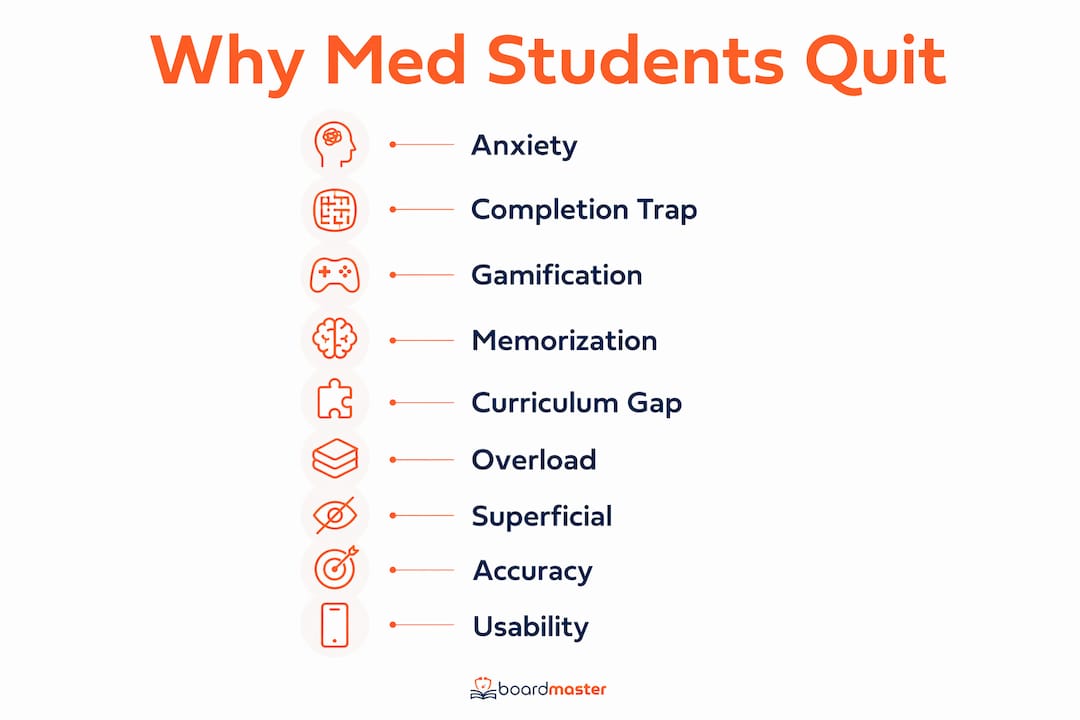
4. Memorization without reasoning
Students learn what the right answer is without understanding why. Repeated exposure to the same question stems creates pattern recognition that works inside the bank but fails in clinical settings. As one student noted in the BMC study, MCQ answer options let you eliminate choices in ways that real clinical decision-making never allows. That shortcut becomes a liability.
5. Curriculum misalignment and the utility gap
Generic question banks are built for a national standard, not your school's cardiology block or your professor's favorite renal physiology angles. Traditional banks misalign with evolving curricula, creating a perceived utility gap that pushes students toward institution-specific methods. When a bank consistently tests material your course hasn't covered, you stop trusting it.
6. Cognitive overload from stacking multiple banks
Excessive use of multiple question banks leads to fragmentation and cognitive overload without improving exam performance. Every platform switch means a new interface, different keyword highlighting, and a different explanation style. Your brain keeps re-learning the format instead of refining test-taking skills. One bank done well consistently outperforms three done badly.
7. Superficial learning behaviors: cueing and avoidance
Cueing is when you recognize the correct option without actually knowing the answer. Avoidance is when you skip difficult questions to protect your score. Both are documented patterns in question bank use, and both are reinforced by the gamified design of most platforms. Students who fall into these habits eventually notice their scores aren't moving, and they quit.
8. No critical engagement with content accuracy
Students rarely question whether the content in a question bank is current or accurate. The BMC study found a complete absence of skepticism about question bank veracity. When students eventually encounter outdated or incorrect explanations, the trust collapses quickly, and so does the habit.
9. Technical usability frustrations
Clunky interfaces, poor mobile experiences, and dashboards that prioritize completion metrics over learning insights all contribute to abandonment. When the platform itself feels like an obstacle, students find reasons to open something else. Usability isn't a minor complaint; it's often the final push.
How targeted study tools fix what traditional banks break
The core problem with generic question banks isn't the format. It's the mismatch between what they test and what you actually need to know right now.
Targeted, curriculum-aligned practice questions shift studying from anxiety-driven completion to genuine understanding, which is where score gains actually come from.
What focused tools do differently:
- Generate questions from your actual lecture notes, not a generic national pool
- Align with what your professor emphasized, not just USMLE content at large
- Reduce redundancy by focusing on your weak areas rather than repeating mastered concepts
- Support deep review by connecting questions to the reasoning behind each answer
BoardMaster's approach in practice:
| Problem with traditional banks | How targeted tools address it |
|---|---|
| Curriculum misalignment | Questions generated from your uploaded lecture notes |
| Completion obsession | Focus on high-yield concepts, not question volume |
| Shallow memorization | USMLE-style reasoning built into every question |
| Burnout from volume | Fewer, better-targeted questions per session |
| Anxiety-driven use | Progress tied to comprehension, not dashboard percentages |
BoardMaster generates AI-powered, professor-specific questions directly from your lecture notes, so every practice session targets the concepts your course actually emphasizes. The result is less time wasted on irrelevant material and more confidence going into both class exams and boards.
Pro Tip: Upload your lecture slides after each class and complete 10–15 targeted questions the same evening. That single habit builds retrieval practice into your routine without the volume pressure that causes burnout.
One student, Sarah, moved from the 73rd to the 92nd percentile while cutting her study hours in half after switching to BoardMaster's targeted approach. The gain came from studying the right material, not more material.
What actually works: moving beyond traditional question banks
The research and expert consensus point in the same direction. Quality beats quantity, and alignment beats volume.
- One strong bank, done deeply, outperforms three done shallowly. Review every missed question until you can explain why each wrong answer is wrong.
- Diminishing returns are real. Past a certain threshold of questions, extra volume feeds anxiety more than knowledge.
- Curriculum alignment matters more than question count. A professor-specific question bank that reflects your actual course is worth more than thousands of generic questions.
- NBME practice exams, not completion percentages, predict actual performance. Track your readiness there, not on a dashboard.
- Targeted supplemental questions fill specific gaps. Use them for known weak areas, not as a default strategy.
The students who perform best aren't the ones who finished the most questions. They're the ones who understood what they reviewed.
BoardMaster targets what generic banks miss
Generic question banks give you volume. BoardMaster gives you the right questions for your specific course, your specific professor, and your specific exam.
Upload your lecture notes and BoardMaster's AI generates USMLE-style questions built around the concepts your professor actually tested. You study less material, but the right material. Sarah's jump from the 73rd to the 92nd percentile while halving her study time shows what that kind of alignment produces. BoardMaster also includes 5,000+ physician-written board questions for students who want comprehensive board coverage alongside their course-specific prep. Both tools work together so you're never choosing between passing your class exam and building toward boards.
FAQ
Why do med students stop using question banks?
Most students abandon question banks due to burnout from excessive volume, completion obsession that prioritizes dashboards over understanding, and curriculum misalignment that makes generic banks feel irrelevant to their actual coursework.
Does finishing every question bank improve USMLE scores?
No. Expert guidance is clear that one high-quality bank reviewed deeply outperforms multiple banks done shallowly, and chasing 100% completion often causes fatigue that stagnates or drops scores.
What are the biggest challenges with question banks for med students?
The main challenges include superficial learning behaviors like cueing and memorization, gamification that undermines intrinsic motivation, and content that doesn't align with individual school curricula.
How does BoardMaster address common question bank problems?
BoardMaster generates questions directly from your uploaded lecture notes, aligning practice with what your professor emphasized rather than a generic national pool, which reduces wasted study time and targets high-yield content.
Can targeted question banks reduce exam anxiety?
Yes. When practice questions match your actual course material, you build confidence through relevant preparation rather than anxiety from irrelevant volume, which shifts motivation from fear-driven to comprehension-driven.
Key Takeaways
Medical students abandon question banks primarily because of burnout, completion obsession, and curriculum misalignment, not because question practice itself is ineffective.
| Point | Details |
|---|---|
| Completion culture backfires | Chasing 100% dashboards masks knowledge gaps and drives burnout without improving scores. |
| Diminishing returns are real | Past a threshold of quality questions, extra volume feeds anxiety more than retention. |
| Curriculum misalignment drives abandonment | Generic banks fail when they don't reflect what your professor and course actually emphasize. |
| Deep review beats question volume | One bank reviewed thoroughly outperforms three banks skimmed for completion. |
| BoardMaster targets the gap | By generating questions from your lecture notes, BoardMaster aligns practice with your actual course and board prep simultaneously. |