
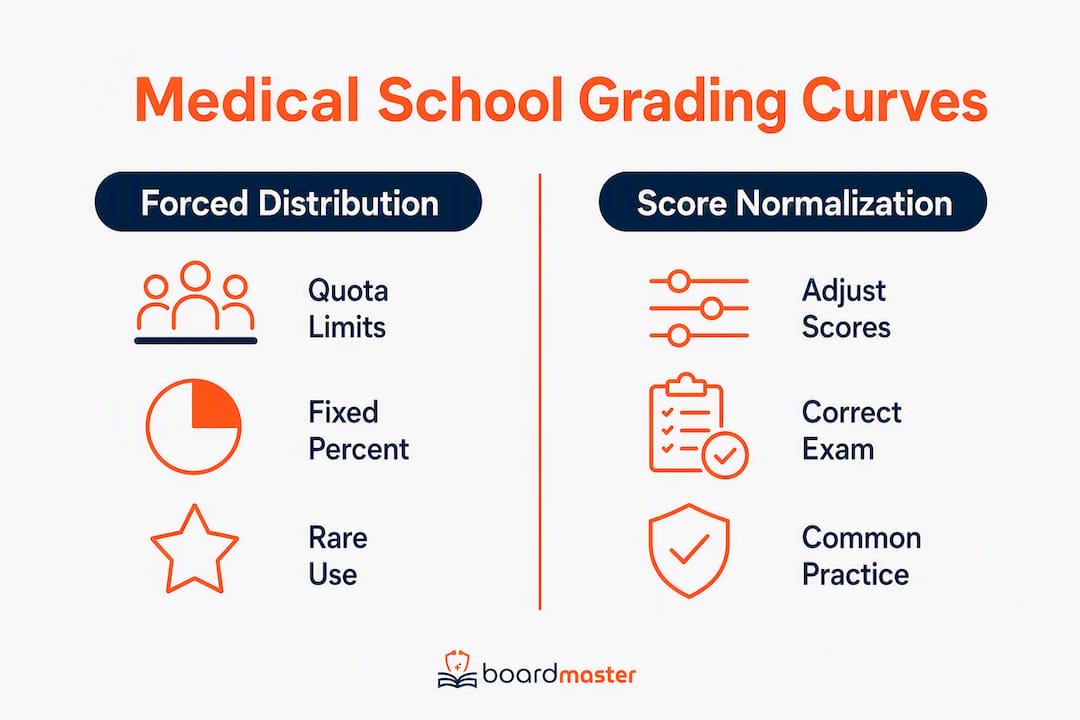
In U.S. medical schools, a "grading curve" almost never means what undergraduates think it means. Forced-distribution curves, where only a fixed percentage of students can earn top grades regardless of performance, are rare in professional health programs. What you are far more likely to encounter is score normalization: an adjustment to the exam mean or standard deviation to correct for a flawed or unusually difficult assessment.
Two meanings matter here:
- Forced distribution (norm-referenced curve): Limits the number of students who can receive Honors or a top grade, regardless of absolute performance. Uncommon in U.S. medical schools.
- Normalization/adjustment: Shifts scores upward (or rescales spread) to align with historical benchmarks or correct for assessment errors. This is the standard practice when adjustments occur.
Academic literature on health-professions education confirms that forced-distribution grading conflicts with the collaborative, competency-based goals of professional training and is largely an undergraduate holdover.
Table of Contents
- How common is grade curving across U.S. medical schools?
- What are the main grading systems in U.S. medical schools?
- What does "grading on a curve" actually mean in medical school?
- When do schools legitimately adjust grades, and how does it work?
- How do curves and adjustments affect your grades, class rank, and residency?
- How do you find and read your medical school's grading policy?
- What should you do if your school uses adjustments or a curve?
- Common myths about grading curves and why forced curves do not belong in medical school
- What the research and institutional policies actually show
- Key Takeaways
- Why the grading-curve conversation misses the real point
- BoardMaster helps you stay above the cutoff
- Useful sources and further reading
- FAQ
How common is grade curving across U.S. medical schools?
Forced curves are genuinely uncommon in U.S. medical education. The more accurate picture: most schools use criteria-referenced thresholds, and adjustments happen when an exam warrants it, not on a routine schedule.
The phase of training matters a lot; understanding your clinical rotations and preceptor roles helps you navigate grading expectations more effectively, as explained in this preceptor guide. Preclinical years (M1–M2) at many schools run on Pass/Fail systems, where the only question is whether you cleared the minimum. Clinical years (M3–M4) shift toward tiered systems, Honors/High Pass/Pass/Fail, that create distinctions residency programs actually use. That transition catches a lot of students off guard.
Institutional policy transparency is also a requirement, not a courtesy. Schools like the University of Cincinnati College of Medicine require course directors to publish minimum passing scores and grade components at the start of each block or clerkship. If your school's syllabus does not include those thresholds, that is worth flagging with the Office of Medical Education.
What are the main grading systems in U.S. medical schools?
Three models dominate, and most schools blend them across phases.
| Grading System | Typical Phase | How "Curve" Applies |
|---|---|---|
| Pure Pass/Fail | M1–M2 (preclinical) | MPL-based cutoff; normalization corrects for hard exams |
| Tiered H/HP/P/F | M3–M4 (clerkships) | Honors threshold may be fixed at a percentage cutoff (e.g., ≥88%) or reserved to the top portion of the class (e.g., top 20%), depending on the school and phase |
| Letter/Numeric | Some preclinical or hybrid | Traditional curve or normalization both possible |

The University of Maryland School of Medicine's grading policy illustrates the tiered model clearly: Honors at 88% or above, High Pass at 78%, Pass at 68%, and Fail below 68% for preclinical courses. Those are fixed percentage cutoffs, not a quota. In contrast, some clerkships at other institutions, such as at the University of Nebraska Medical Center, reserve Honors to the top 20% and High Pass to the next 30% of the class, determined by overall clerkship score.
Geisel School of Medicine at Dartmouth shows how systems evolve over time. M1 grading moved to Pass/Fail only in 2009, M2 followed in 2011, and as of April 2025, M3–M4 core clerkships use Honors/Pass/Fail. Your school's transcript key will show the same kind of historical layering.
A few practical notes:
- Preclinical Pass/Fail removes grade competition but does not eliminate the need for strong performance; USMLE Step scores become the primary differentiator.
- Tiered clerkship grading reintroduces ranking signals. Honors counts and NBME shelf exam percentiles feed directly into your MSPE.
- Hybrid schools may use Pass/Fail preclinically and letter grades for certain clerkships, so read each course syllabus separately.
What does "grading on a curve" actually mean in medical school?
The phrase carries two very different meanings, and mixing them up causes real confusion.
Meaning A: Forced distribution (norm-referenced curve)

This is the undergraduate version most students know. A fixed percentage of the class earns each grade tier, so your grade depends on where you rank relative to peers, not on how much you actually know. If the top 10% get Honors and you score 89% on an exam where 15% of the class scored 90% or above, you do not get Honors. The ceiling is structural.
Research on professional health programs shows this model is discouraged because it pits students against each other in a field that depends on collaboration and shared competency.
Meaning B: Normalization or score adjustment
This is what most medical schools actually do when they "curve" an exam. The goal is to correct for an assessment that was harder than intended or contained flawed items. The school adjusts the mean, the standard deviation, or both to align with a historical reference. Your grade reflects your mastery relative to a stable benchmark, not relative to how your classmates happened to perform that day.
Pro Tip: Scan your syllabus for these specific phrases. "Top X% receive Honors" signals a quota-based distribution. "Honors requires a score of X% or above" signals criteria-referenced grading. "Scores will be adjusted to a historical mean" signals normalization. The language tells you which system you are actually in.
When do schools legitimately adjust grades, and how does it work?
Grade adjustments are not arbitrary. Common triggers include:
- A question with a documented flaw or ambiguous wording
- An exam that was statistically harder than the course's historical average
- Technical or administrative issues during exam delivery
- Cross-section benchmarking when two student cohorts take different exam versions
The most structured approach is the Minimum Pass Level (MPL). The University of Nebraska Medical Center's grading policy sets the minimum passing score as the average of final block scores that fell 2.5 standard deviations below the mean across the preceding three years. That formula anchors the cutoff to historical performance data rather than to any single exam's difficulty.
When normalization adjusts both mean and standard deviation, the distributional effects are uneven. Rescaling that raises the mean while compressing the standard deviation lifts low-end scores proportionally more than high-end scores. A student who scored near the bottom gains more points than a student who scored near the top. That shift can change who passes and who earns Honors, which is why understanding the method matters.
How do curves and adjustments affect your grades, class rank, and residency?
The downstream effects depend on which system your school uses, but a few patterns hold across institutions.
In tiered clerkship systems:
- Honors counts on your MSPE are one of the clearest signals residency programs use. A school that reserves Honors for the top 20% of each clerkship creates a hard ceiling; a school with a fixed percentage threshold does not.
- NBME subject exam scores serve as an objective anchor. Even when clinical performance ratings are subjective, shelf exam percentiles are comparable across students and institutions.
- Normalization that shifts scores upward can increase the number of students clearing an Honors threshold, which benefits the cohort but may dilute the signal for programs that track Honors counts carefully.
In Pass/Fail preclinical systems:
- Adjustments rarely change your transcript outcome (you either pass or you do not), but they affect whether borderline students need remediation.
- UNMC's policy illustrates a common clerkship structure: Honors are awarded to the top 20% of the class, High Pass to the next 30%, and the remainder are eligible for Pass if they meet cumulative score thresholds.
Practical implications for study priorities:
- If your school uses a top-percentage Honors quota, relative performance matters. Knowing where the class is performing helps you calibrate effort.
- If your school uses fixed cutoffs, absolute mastery is the target. Closing a 3-point gap from 85% to 88% is more valuable than outpacing a peer.
- USMLE scores interact with clerkship grades in residency selection, so a strong shelf exam performance can partially offset a weaker clinical evaluation.
How do you find and read your medical school's grading policy?
- Start with the student handbook or academic catalog — Search the PDF for "grading policy," "Minimum Pass Level," or "Honors threshold." Most schools publish this in a dedicated section.
Pro Tip: Save a PDF copy of the grading policy section from your syllabus the day it is distributed. Policies occasionally get updated mid-year, and having the version in effect at the start of the course protects you in any grade dispute.
What should you do if your school uses adjustments or a curve?
Immediate steps:
- Confirm whether your school uses a fixed-percentage Honors quota or a criteria-referenced threshold. The distinction changes your study strategy.
- Save the exact grading policy language from your syllabus. Screenshot it, PDF it, email it to yourself.
- Track your raw percentage scores and component weights throughout the course, not just the final grade.
Study strategy:
- Dual-purpose studying is the most efficient approach under any grading system. Practicing NBME-style questions prepares you for shelf exams and board exams simultaneously, so neither competes with the other for study time.
- Use item analysis after each exam. If your school releases question-level performance data, identify the item types you missed most. A pattern of missing application questions versus recall questions calls for different practice.
- In tiered systems where a few points separate grade tiers, targeted practice on high-yield topics closes gaps more efficiently than broad re-review.
Administrative actions:
- If you believe a question was flawed, submit a formal item review request within the window your syllabus specifies. Most schools have a defined process; missing the deadline forfeits the option.
- If you are near a cutoff after normalization, ask the grading committee whether borderline cases receive individual review. Many do, per UNMC's policy framework.
- Understand remediation pathways before you need them. Knowing the process in advance reduces panic and preserves options.
Common myths about grading curves and why forced curves do not belong in medical school
Myth: Curves make grading fairer. A forced distribution does the opposite. It penalizes students in a strong cohort for performing well collectively. If 40% of the class genuinely masters the material at an Honors level, a quota that caps Honors at 20% is not fair; it is arbitrary.
Myth: Curves motivate elite performance. Competition for a fixed number of top grades can motivate, but it also discourages collaboration. In medicine, the student who shares a useful study resource or explains a concept to a struggling peer is practicing the professional behavior that patient care requires.
Myth: All grade adjustments are curves. Most adjustments correct for assessment flaws, not for class performance distribution. Guidance documents from health-professions education research consistently frame normalization as a tool to protect students from poorly designed exams, not to limit high achievers.
Myth: Pass/Fail means grades do not matter. Pass/Fail removes transcript differentiation, but it shifts the competitive signal to USMLE scores, research, and clinical evaluations. The stakes do not disappear; they relocate.
The ethical case for criteria-referenced assessment in medical education is straightforward: competency-based training requires that every student who meets the standard be recognized as meeting it. Capping that recognition at an arbitrary percentage undermines the entire premise of professional licensure.
Normalization, used correctly, is ethically sound. Its purpose is to prevent a bad exam from misrepresenting a student's actual knowledge.
What the research and institutional policies actually show
Academic literature on health-professions grading reaches a clear consensus: forced-distribution curves are uncommon in professional programs and are actively discouraged because they conflict with competency-based and collaborative training models. Criteria-referenced grading, where thresholds are set against a defined standard rather than against peer performance, is the norm.
Institutional policies reflect this. The University of Maryland School of Medicine uses fixed percentage cutoffs (Honors ≥88%, High Pass ≥78%, Pass ≥68%). UNMC anchors its MPL to a three-year historical average, 2.5 standard deviations below the mean. The University of Cincinnati requires published thresholds at the start of every block. These are criteria-referenced systems, not forced curves.
| Policy Element | Example Institution | Key Detail |
|---|---|---|
| Fixed percentage cutoffs | Univ. of Maryland SOM | Honors ≥88%, HP ≥78%, Pass ≥68% |
| MPL via historical SD | UNMC | Mean of scores 2.5 SD below 3-year avg |
| Top-class Honors quota | UNMC (clerkships) | Honors: top 20% of class, High Pass: next 30% |
| Published syllabus requirement | Univ. of Cincinnati COM | Minimum passing score stated at block start |
The GASPUBLISHERS review of grading adjustments adds an important technical note: when both mean and SD are adjusted, the distributional effects are asymmetric, with lower-scoring students gaining more than higher-scoring ones. That asymmetry can shift Honors and Fail counts in ways that are not obvious from the adjustment formula alone.
Key Takeaways
Forced-distribution curves are rare in U.S. medical schools; what students actually encounter is criteria-referenced grading with occasional normalization to correct for flawed or unusually difficult exams.
| Point | Details |
|---|---|
| Two meanings of "curve" | Forced distribution limits top grades by quota; normalization adjusts scores against a historical benchmark. |
| Prevalence | Forced curves are uncommon; most schools use fixed percentage cutoffs (e.g., Honors ≥88%) or MPL-based thresholds; some clinical clerkships use a top 20% Honors quota. |
| Phase differences | Preclinical years typically use Pass/Fail; clinical clerkships use tiered H/HP/P/F with Honors affecting residency signals. |
| How to check your policy | Search your syllabus for "Minimum Pass Level," "Honors threshold," or "top X% of class" to identify which system applies. |
| BoardMaster for grade protection | BoardMaster's lecture-aligned practice questions help you target the exact content your professor emphasizes, reducing the risk of falling near a cutoff. |
Why the grading-curve conversation misses the real point
The anxiety students bring to grading-curve questions is understandable, but it often focuses on the wrong variable. Whether your school uses a quota or a fixed threshold matters less than whether you are consistently performing above the relevant cutoff with enough margin to absorb a bad exam day.
The students who get hurt by grading adjustments are not the ones who understood the policy wrong. They are the ones who studied broadly instead of deeply, who covered material once instead of retrieving it repeatedly, and who prepared for class exams and board exams as though those were two separate tasks.
Normalization protects you from a flawed exam. It does not protect you from insufficient preparation. And a forced-distribution quota, rare as it is, only becomes a real threat when you are competing in the top tier without a clear sense of where the class is performing.
The practical move is simple: know your school's exact policy, track your scores against the relevant threshold throughout the course, and use every study hour to close the gap between where you are and where the cutoff sits. The grading system is a constraint. Your preparation is the variable.
BoardMaster helps you stay above the cutoff
When grading thresholds are tight, the margin between Pass and Honors often comes down to a handful of questions on a shelf exam or a course assessment. Generic question banks give you broad coverage; what you need is practice that matches what your professor actually tested.

BoardMaster generates USMLE-style and COMLEX-style practice questions directly from your uploaded lecture notes, targeting the concepts your course emphasizes rather than the entire content universe. Spaced-repetition flashcards reinforce the same material, and an AI study assistant explains the reasoning behind each answer. If your school uses NBME shelf exams as a clerkship component, lecture-aligned practice is the most direct way to prepare for both the shelf and the course grade simultaneously.
Try BoardMaster's free tier at boardmaster.ai and see how many of your professor's high-yield concepts show up in the first set of generated questions.
Useful sources and further reading
- A Practical Guide to Grade Adjustment or Curving for Pharmacy and Other Professional Health Programs (PMC) — Academic literature review on why forced curves are discouraged in professional health programs and how normalization is used ethically.
- Grading Policies — University of Nebraska Medical Center — Institutional example of MPL calculation using historical standard deviations and clerkship Honors quota language.
- Grading System Policy — University of Maryland School of Medicine — Concrete example of a tiered H/HP/P/F system with fixed percentage cutoffs.
- Grading System Policy — University of Cincinnati College of Medicine — Illustrates the syllabus transparency requirement: minimum passing scores published at block start.
- Geisel School of Medicine at Dartmouth — Transcript Key — Historical record of how one school's grading system evolved from letter grades to Pass/Fail and tiered systems across decades.
FAQ
Do medical schools grade on a curve?
Most U.S. medical schools do not use forced-distribution curves. Grade adjustments do occur, but they are typically normalization corrections for unusually difficult exams or flawed questions, not quotas that limit how many students can earn top grades.
What is a grading curve in medical school?
In medical school, "grading on a curve" most often refers to score normalization: adjusting the exam mean or standard deviation to align with historical benchmarks. Forced distribution, where only a fixed percentage earns Honors, is rare and discouraged in professional health programs.
Is a B+ a good grade in medical school?
It depends on your school's grading system. In a tiered H/HP/P/F system, the equivalent of a B+ typically falls in the High Pass range, which is a solid outcome. In schools using letter grades, a B+ is competitive but may fall short of Honors thresholds that residency programs track.
Does a 3.7 GPA hurt your medical school application?
A GPA above the average matriculant GPA at most U.S. medical schools is generally competitive. Residency programs focus more on clerkship Honors counts and USMLE scores than on preclinical GPA, especially at schools that use Pass/Fail preclinically.
How do clerkship grading curves affect residency applications?
Clerkship grading directly shapes your MSPE, which residency programs read carefully. Schools that cap Honors at the top 20% of each clerkship create a harder ceiling than schools using fixed percentage thresholds. Strong USMLE performance metrics can offset a weaker clerkship grade distribution, but Honors counts remain one of the clearest differentiators in competitive specialties.