
TL;DR:
- A three-digit USMLE score ranges from 1 to 300 and reflects your performance adjusted for question difficulty.
- Since Step 1 now reports only pass or fail, your Step 2 CK score has become the most important numeric factor for residency applications.
A three-digit USMLE score is the primary quantitative measure residency programs use to evaluate your clinical knowledge and readiness. Understanding what this number actually represents, how it is calculated, and what it signals to program directors is not optional knowledge. It is the foundation of a competitive residency application strategy, especially now that Step 1 no longer reports a three-digit score.
What does a three-digit USMLE score mean?
A three-digit USMLE score is a scaled number ranging from 1 to 300 that represents your performance on a given exam step. It is not a raw score, a percentage, or a simple count of correct answers. The number is generated through a statistical process designed to make scores comparable across different test forms and testing dates.

The score reflects your clinical knowledge relative to a defined standard, not relative to other test-takers on the same day. That distinction matters because it means your score is stable and comparable to scores earned months or years earlier. Residency programs use this number as a consistent, objective data point when screening hundreds of applications.
Step 2 CK and Step 3 both report three-digit scores. Step 1, as of its 2022 policy change, reports only pass or fail. That shift placed significantly more weight on your Step 2 CK three-digit score, making it the single most important numeric signal in your application.
How is the three-digit score calculated?
Three-digit scores are scaled using Item Response Theory (IRT), a statistical method that accounts for the difficulty of each individual question. IRT means two students who answer the same number of questions correctly can receive different three-digit scores if they faced questions of different difficulty levels. The system adjusts for this to produce a fair, comparable result.
Raw percent correct does not equal your three-digit score. A student who answers 70% of questions correctly on a harder form may score higher than a student who answers 70% correctly on an easier form. IRT eliminates that inequity by calibrating each question's contribution to your final score.
There is no penalty for guessing on any USMLE step. Every unanswered question counts as wrong, so leaving items blank only hurts you. Different test forms are equated statistically so that a 245 earned in march means the same as a 245 earned in october.
Pro Tip: Do not try to reverse-engineer your three-digit score from your practice test percentages. The IRT scaling process makes that calculation impossible without knowing the exact difficulty weights of every item you saw.
Scores across different Steps cannot be directly compared. A 220 on Step 2 CK does not represent the same proficiency level as a 220 on Step 3. Each exam measures a different stage of clinical development, and the norming cohorts differ between steps.
How do you interpret Step 2 CK and Step 3 scores?
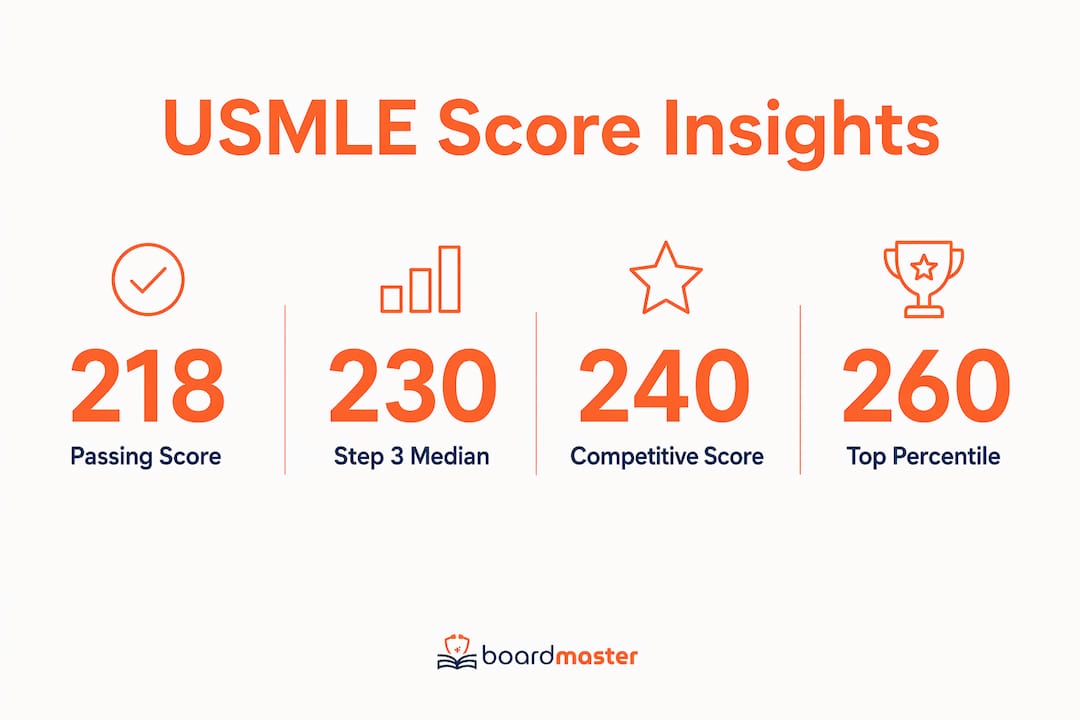
Score interpretation starts with the passing threshold. The Step 2 CK minimum passing score is 218 as of july 2025, raised from the previous standard of 214. A score of 218 places you at roughly the bottom 3% of first-time test-takers. Passing is necessary, but passing alone is rarely competitive for most residency programs.
The percentile data tells a more useful story. For Step 2 CK first-time takers:
| Score | Approximate Percentile | Competitive Context |
|---|---|---|
| 218 | ~3rd percentile | Minimum passing standard |
| 245 | ~34th percentile | Below average for most specialties |
| 255 | ~60th percentile | Competitive for many programs |
| 260 | ~74th percentile | Strong for most specialties |
| 265+ | ~85th+ percentile | Highly competitive for top programs |
Step 3 uses the same 1–300 scale with a passing standard of 200. A Step 3 score of 230 corresponds to roughly the 55th percentile, 240 to the 79th, and 250 to the 93rd percentile. Step 3 is typically taken during residency, so its role in initial application screening is limited compared to Step 2 CK.
Pro Tip: Your Step 2 CK score report breaks your performance into content categories. Use those breakdowns to identify your weakest areas before you apply, not after. A targeted second attempt is far more effective than a general review.
Step 1's shift to pass/fail was intended to reduce burnout and the intense focus on a single number. The practical result is that Step 2 CK now carries the numeric weight that Step 1 once did. For competitive specialties, your Step 2 CK score is now the most scrutinized number in your entire application file.
Why do three-digit scores matter for residency applications?
Residency programs receive far more applications than they can interview. Three-digit Step 2 CK scores give program directors a fast, numeric filter. Matched U.S. seniors typically average between 245 and 250 on Step 2 CK, with competitive specialties like dermatology, orthopedic surgery, and plastic surgery often exceeding 257.
Your score's relationship to specialty averages determines your application strategy in concrete ways:
- Scores at or above the specialty mean place you in the interview pool without score-related concerns. Other application elements carry equal weight.
- Scores 1–5 points below the specialty mean fall within the standard error of measurement, roughly 5–6 points. Experts caution against overinterpreting these small differences, and so should you.
- Scores 6–10 points below the specialty mean require strong supporting elements: research publications, strong letters of recommendation, and a compelling personal statement.
- Scores more than 10 points below the specialty mean signal a need for strategic application adjustments. A 10-plus point gap below the specialty average suggests you should strengthen other parts of your application or consider broadening your specialty list.
Residency programs are encouraged to conduct holistic reviews, but three-digit scores remain primary screening tools because they offer numeric clarity that other application elements do not. A strong score does not guarantee an interview, but a weak score can end your application before a human ever reads it.
Common misconceptions about three-digit USMLE scores
The most damaging misconception is that a three-digit score is a percentage. A score of 240 does not mean you answered 240 out of 300 questions correctly, or that you got 80% right. It is a scaled measure that accounts for question difficulty, making it incomparable to any raw percentage.
A second common error is comparing scores across Steps. Students sometimes assume a 245 on Step 2 CK and a 245 on Step 3 reflect identical performance levels. They do not. Step 2 and Step 3 scores use different norming cohorts and measure different clinical proficiency levels. Treat each step's score as its own independent data point.
A third misconception involves the score report itself. Many students glance at their three-digit number and ignore the detailed breakdown. The Step 2 CK report flags content areas as performing "Higher" or "Lower" relative to your own average, not as percentages. That breakdown is the most useful remediation tool available to you, and most students never use it strategically.
Pro Tip: If you are within 2 points of your target specialty's mean score, treat the gap as statistically negligible and focus on strengthening your letters of recommendation and research profile instead of retaking the exam.
Applicants who score well below their target specialty average sometimes assume a retake will automatically fix the problem. A retake only helps if you identify and address the specific content areas driving your lower score. Use your score report's "Higher" and "Lower" indicators to build a targeted study plan before registering for a second attempt. BoardMaster's AI-powered question generator lets you upload your notes and generate questions focused on your exact weak areas, making that targeted prep far more efficient.
Key Takeaways
Your Step 2 CK three-digit score is now the single most important numeric data point in your residency application, and understanding its calculation, interpretation, and strategic implications is the difference between a reactive and a deliberate application strategy.
| Point | Details |
|---|---|
| Scores are scaled, not raw | A three-digit score reflects IRT-adjusted difficulty, not the percentage of questions answered correctly. |
| Step 2 CK passing standard | The minimum passing score is 218 as of july 2025; a 255 places you near the 60th percentile. |
| Step 1 shift raises Step 2 stakes | Step 1 is now pass/fail, making your Step 2 CK three-digit score the primary numeric filter for residency programs. |
| Small gaps are often negligible | Score differences within 5–6 points fall inside the standard error of measurement and should not trigger a retake decision alone. |
| Use your score report strategically | The "Higher" and "Lower" content breakdowns in your report are your most precise tool for targeted improvement. |
Scores matter, but they are not the whole story
By Dr. Ahmed Abuzoor
After years of working with medical students navigating the residency application process, I have watched the same mistake repeat itself. Students treat their three-digit score as a verdict rather than a data point. A 248 does not define your clinical ability. It defines where you sit on a statistical scale relative to a norming cohort, and that is a much narrower claim than most applicants realize.
The shift of Step 1 to pass/fail was supposed to reduce the obsession with a single number. What actually happened is that the obsession transferred to Step 2 CK. I understand why. Programs need a fast filter, and a number is easier to act on than a nuanced letter of recommendation. But the students I see thriving in competitive matches are not always the ones with the highest scores. They are the ones who understand what their score means, address genuine knowledge gaps, and build applications where every element reinforces the same narrative.
The score report breakdown is the most underused tool in USMLE preparation. Students look at their three-digit number, feel relief or disappointment, and move on. The "Higher" and "Lower" content indicators tell you exactly where your knowledge is weakest. That information is worth more than any generic study plan. Use it. A score gap addressed with targeted preparation is far more recoverable than one ignored in favor of retaking the same broad review.
My honest advice: know your specialty's score expectations, understand where you fall relative to that standard, and make decisions based on the full picture. A 10-point gap below the mean is a strategy problem, not a character flaw. Solve it like one.
— Dr. Ahmed Abuzoor
BoardMaster helps you target the scores that matter
Knowing what your three-digit score means is the first step. Knowing how to move it is the second.

BoardMaster's USMLE prep tools are built specifically for Step 2 CK and Step 3 preparation. You upload your lecture notes and course materials, and BoardMaster generates USMLE-style practice questions focused on the exact content your professors emphasize. That means less time reviewing material you already know and more time closing the gaps that actually affect your score. One student, Sarah, moved from the 73rd to the 92nd percentile while cutting her study hours in half. If your Step 2 CK score needs to move before your application goes out, targeted preparation with BoardMaster is the most direct path to get there.
FAQ
What is the three-digit USMLE score range?
Three-digit USMLE scores run on a scale from 1 to 300. In practice, most scores fall between 140 and 280, with passing thresholds set at 218 for Step 2 CK and 200 for Step 3.
Does a higher three-digit score guarantee a residency interview?
A high score improves your chances of passing initial screening filters, but it does not guarantee an interview. Programs weigh scores alongside letters of recommendation, research, and personal statements.
Can I compare my Step 2 CK score to my Step 3 score?
No. Step 2 and Step 3 scores use different norming cohorts and measure different clinical proficiency levels, so a 240 on one step does not equal a 240 on the other.
Should I retake Step 2 CK if my score is close to the specialty mean?
If your score falls within 2 points of your target specialty's mean, the gap is likely within the standard error of measurement and a retake is rarely justified. Gaps of 10 or more points warrant a strategic retake with targeted preparation.
How do I use my Step 2 CK score report to improve?
Your score report flags content areas as "Higher" or "Lower" relative to your own average. Focus your next study cycle on the "Lower" categories, using those breakdowns to guide a targeted study plan rather than a general review.