
The fastest way to make class time count for boards is to convert your lectures into timed, vignette-style practice questions and review them on a spaced schedule. Lecture summarization for boards, done right, means uploading one lecture right now and generating a 20-question block in timed mode before you do anything else.
Two things back this up. First, retrieval practice beats passive rereading for long-term retention, and board-style questions are retrieval practice in its most exam-relevant form. Second, BoardMaster's own data includes a student named Sarah who jumped from the 73rd to the 92nd percentile while cutting her study hours in half, using exactly this lecture-to-question loop.
Start here today:
- Upload one lecture (PDF, slide deck, or recording transcript).
- Generate a 20-question timed set and complete it under real exam conditions.
- Tag missed questions to their topic before moving to the next lecture.
Key Takeaways
Converting lectures into timed, board-style practice questions and reviewing them on a spaced schedule builds board readiness faster than studying lectures and question banks as separate tracks.
| Point | Details |
|---|---|
| Start with one lecture | Upload a single lecture and generate a 20-question timed set before scaling to a full workflow. |
| Organize by topic, not date | Merge lectures covering the same concept before generating questions to avoid duplicate, low-yield items. |
| Track weak-topic frequency | Review which topics repeat in your missed-question log weekly and shift study time toward them. |
| Use timed mode consistently | Timed practice correlates more strongly with board score improvement than untimed or tutor-mode review. |
| BoardMaster runs the full loop | Its lecture upload, question generator, flashcards, and analytics work together, illustrated by Sarah's jump from the 73rd to 92nd percentile. |
Table of Contents
- How Lecture Summarization for Boards Actually Works
- Building a Weekly Workflow Around Your Lectures
- A 45-Minute Checklist to Test the Workflow Today
- How to Tell If the Lecture-Based Approach Is Working
- Taking Better Lecture Notes So Summaries Are More Accurate
- Keeping Generated Questions Aligned With Exam Blueprints
- Customizing Study Materials Around Your Weak Areas
- Troubleshooting Common Problems With Lecture-Generated Questions
- What Most Study Advice Gets Backward
- Try BoardMaster on Your Next Lecture
- Sources
- FAQ
How Lecture Summarization for Boards Actually Works
Behind the scenes, a lecture-to-question pipeline does three distinct jobs, and understanding them helps you catch errors before they cost you points.
- Parsing and concept extraction. The system reads slide text, speaker notes, and transcripts, then isolates testable concepts, that is, diagnoses, mechanisms, drug classes, lab values, rather than filler like agenda slides or citations.
- Terminology mapping. Your professor might call something "Bence Jones proteinuria" while a board vignette buries the same finding inside a stem about a 68-year-old with back pain and anemia. Good mapping connects the two so you're not memorizing your professor's exact phrasing.
- Vignette and distractor synthesis. The tool builds a clinical stem, a lead-in, and answer choices, with distractors chosen because they're commonly confused with the correct answer, not just random wrong facts. This is what makes the output read like a real USMLE or COMLEX item instead of a flashcard reworded as a question.
That third step is also where you, the student, have to do a little quality control. Numeric lab values, drug dosages, and specific findings mentioned in the source lecture need a quick sanity check against what you already know. If you're studying for COMLEX specifically, confirm that OMM-related content, technique names and findings, actually shows up; a pipeline tuned mostly on USMLE-style content can under-represent osteopathic material unless you flag it.
Pro Tip: Run your first generated set through once as a "trust but verify" pass. Flag any stem where a number looks off, then check it against your lecture slide directly instead of assuming the AI got it wrong or right.
Building a Weekly Workflow Around Your Lectures
The workflow only holds up if you organize by topic, not by lecture date. If three separate lectures across two weeks all touch heart failure, that is, pathophysiology, pharmacology, and a clinical correlation session, merge them into one packet before you generate questions. Educational guidance on retrieval practice supports this kind of topic-centered organization specifically because it cuts down on duplicate, low-yield questions and forces integration across subtopics instead.
Here's a repeatable weekly cadence for M1 and M2 years:
- Batch-upload 2 to 3 lectures per week, grouped by organ system or topic.
- Generate one question block per topic cluster, typically 15 to 25 questions.
- Schedule two or three 20 to 40 minute timed sessions across the week to work through them.
- Route missed and flagged questions into a spaced-repetition queue for review 2, 7, and 21 days out.
A sample M2 week might look like: Monday and Wednesday for new lecture uploads and question generation, Tuesday and Thursday for 30-minute timed blocks, and Friday for spaced-repetition review only, no new material. That's roughly 3 to 4 hours of dedicated question work layered onto class time you were already spending.
During the dedicated study period, the ratio flips. You're no longer uploading new lectures, you're mining the backlog you already built. Students who integrate lecture-to-flashcard tools with spaced repetition before dedicated often report entering that period having already encoded a meaningful share of first-pass material, which shortens the grind considerably.
A 45-Minute Checklist to Test the Workflow Today
You don't need to overhaul your whole study system to see if this works. Try it with exactly one lecture first.
Before you upload (10 minutes):
- Strip out administrative slides (syllabus reminders, grading policy, announcements).
- Screenshot or note any images your professor emphasized, gross pathology slides, ECG strips, histology.
- Jot down anything your professor explicitly said would be "on the exam" or "high yield."
Generation settings (5 minutes):
- Pick a difficulty level that matches where you are in the curriculum, don't jump to hardest if this is your first pass through the material.
- Set vignette length to match board-style stems (usually a short clinical paragraph, not a one-line question).
- Turn on inclusion of lab values and reference ranges if your lecture covered them.
- Select timed mode. Timed practice correlates with stronger outcomes than untimed or tutor-mode review.
Validation (20 to 30 minutes):
- Read every stem once for clarity, if a question reads awkwardly, don't trust its answer key blindly.
- Cross-check two or three answer explanations against your lecture slides or a reference source.
- Tag each question to its exam topic (cardiology, renal, biochemistry, etc.) so weak-area data stays organized.
- Export flagged or missed questions to a spaced-repetition tool or Anki-style deck if you want a second review layer.
Pro Tip: Do this checklist once, in full, before you scale up to batch uploads. It takes less than an hour and tells you immediately whether the generated questions match how your professor actually tests.
How to Tell If the Lecture-Based Approach Is Working
Four numbers matter more than the rest, and you should be checking them weekly, not just before an exam.
- Timed percent correct on lecture-derived question blocks, tracked over time, not as a single snapshot.
- Weak-topic frequency, which topics keep showing up in your missed-question log week after week.
- Retention on spaced review, whether you're still getting a topic right on the second and third pass, not just the first.
- NBME or COMSAE-style practice test performance, the closest proxy you have to your actual board score.
The research backing this isn't soft. Systematic reviews of licensing exam preparation find consistent positive correlations between question-bank practice, timed self-assessments, and higher USMLE and COMLEX scores. One study went further: regression models built on formative assessment data predicted a substantial portion of the variance in eventual Step 1 scores by the end of the second year. That's not a minor signal, it means the questions you're missing right now in class-linked practice are a genuine early warning system for board performance months later.
Use the data to make a decision, not just to feel informed. If your weak-topic list keeps repeating the same two or three organ systems across multiple weeks, shift more time to targeted content review for those specific topics before adding more question volume. If your timed percent correct is climbing steadily and weak topics are rotating (meaning you're actually learning, not just memorizing question patterns), that's your signal to keep the current ratio and add volume instead of switching strategy.
Taking Better Lecture Notes So Summaries Are More Accurate
Garbage in, garbage out applies directly here. A lecture-to-question pipeline can only extract what's actually present in your notes or slides, so how you take notes during class determines how good your generated questions end up being.
Write down more than the professor's slide text. If they say a finding aloud but it's not written anywhere on the slide, that verbal detail is often exactly what shows up on their in-house exam, and it's the kind of thing an AI pipeline can't summarize if it was never captured. A quick shorthand system works: underline anything stated as "high yield" or "will be tested," star anything repeated twice, and bracket any number, dose, or lab value mentioned aloud that isn't already printed.

Resist the urge to transcribe everything verbatim. Dense, unstructured notes actually make automated concept extraction harder, not easier, because the system has to guess which details matter. A cleaner approach: organize your notes by concept headers as you go (mechanism, presentation, treatment, complications) rather than as one continuous block of text. This also happens to match how board vignettes are structured, so you're building board-relevant organization into your notes from day one instead of retrofitting it later. If your lecture notes are chaos by the end of the semester, reorganizing them into cleaner topic packets before your next upload will noticeably improve question quality.
Keeping Generated Questions Aligned With Exam Blueprints
A lecture-derived question is only useful if it actually resembles what you'll see on test day, and that means checking it against the current exam blueprint, not just against your professor's slide deck.
The USMLE and COMLEX blueprints weight content by system and physician task, and that weighting shifts periodically. A pipeline trained heavily on one professor's pet topics can accidentally over-represent niche content relative to how the actual exam weights it. The fix isn't complicated: after generating a block, spot-check whether the topic distribution roughly matches known high-yield categories (cardiovascular, renal, and reproductive systems carry heavy weight on Step 1 and Level 1, for instance) rather than assuming every lecture deserves equal question volume.
Understanding USMLE-style question structure also helps you evaluate whether a generated stem is doing its job. A board-style question tests clinical reasoning through a scenario, not simple recall of an isolated fact. If a generated question reads more like a fill-in-the-blank than a vignette, that's a sign to regenerate it with adjusted settings rather than keep a weak item in your practice set.
For COMLEX-specific prep, this alignment step matters even more. Generic question generation tuned mostly toward USMLE content will often under-produce OMM-related items, so explicitly tagging osteopathic content and confirming technique names and findings appear is a necessary manual step, not an optional one.
Customizing Study Materials Around Your Weak Areas
Generic practice wastes time you don't have. The real value of lecture-derived questions shows up once the system starts building a weak-area map, a running list of topics where you're missing questions at a higher rate than average.
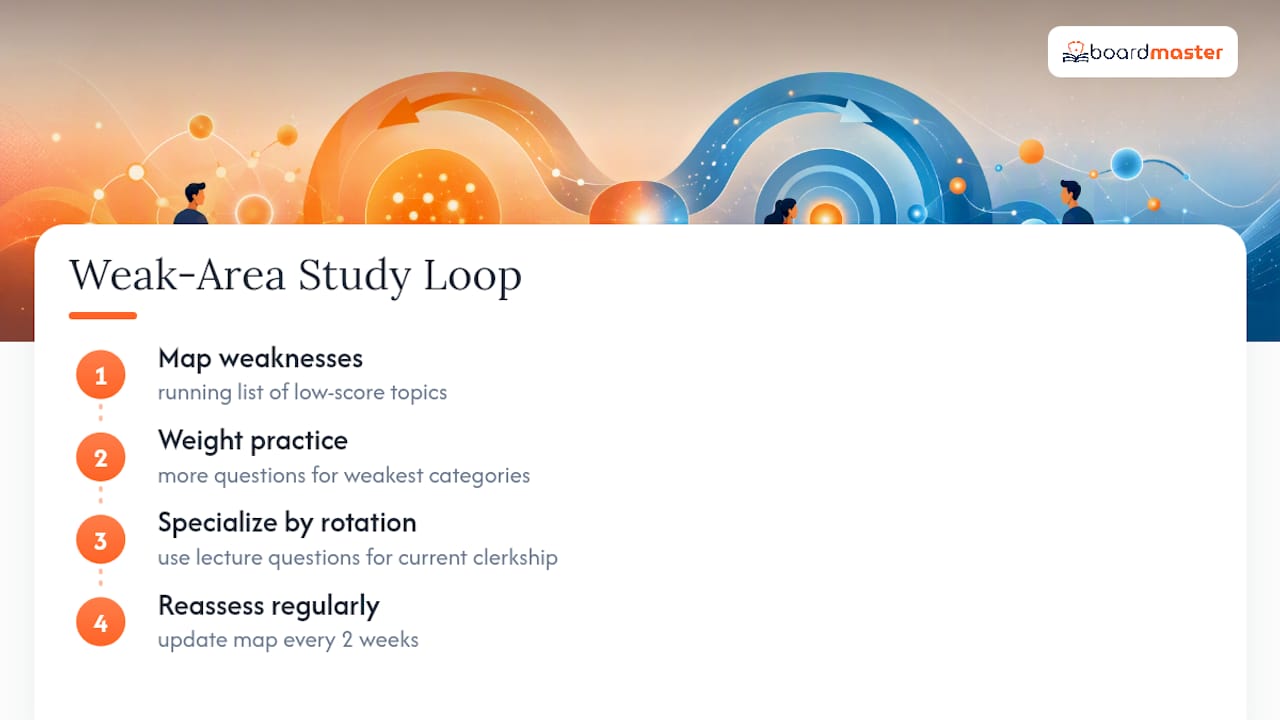
That map should drive what you study next, not just what you review. If pulmonology questions are consistently your lowest-scoring category, the next batch of practice shouldn't be evenly distributed, it should be weighted toward pulm until your numbers improve. Some students resist this because it feels like "avoiding" strong areas, but the data argues the opposite: personalizing prep around measured weak areas is a more efficient use of limited study hours than spreading effort evenly across everything.
Specialty-specific customization matters too, especially once you're in clerkships. A student heading into a surgery rotation benefits from generating extra practice around perioperative management and surgical emergencies, pulled from their surgery lectures specifically, rather than relying on a generic shelf-exam question bank that treats every student's rotation schedule identically. The lecture-tied approach lets you front-load practice on exactly the content your current rotation and upcoming shelf exam will test.
Keep this customization dynamic. Weak areas shift as you learn, a topic that was your worst category in M2 might be solid by dedicated, while a new gap opens up somewhere else. Re-check your weak-area map every couple of weeks rather than setting a study plan once and following it blindly for months.
Troubleshooting Common Problems With Lecture-Generated Questions
A few issues come up often enough that it's worth knowing the fix before you hit them.
Questions feel too easy or too literal. This usually means the source lecture was dense with direct facts and light on clinical application. Try merging that lecture with a related clinical-correlation session before regenerating, so the question pool has enough context to build real vignettes instead of fact-recall stems.
Answer explanations reference outdated or overly narrow information. Cross-check against a current reference whenever a generated explanation cites a specific drug, dose, or guideline. This is rare, but it happens most often with rapidly updated treatment guidelines, so treat therapeutics content with slightly more scrutiny than anatomy or physiology.
Too much overlap between question sets from different lectures. This is the central-anchor problem again: if you're uploading lecture by lecture instead of merging by topic first, you'll generate near-duplicate questions on the same concept. Merging lectures around a shared topic before generation fixes this directly.
Weak-area data feels noisy or inconsistent. A handful of questions per topic isn't enough sample size to trust. Wait until you've accumulated at least 15 to 20 questions per topic before treating that category's accuracy rate as meaningful, otherwise you'll chase noise instead of a real pattern.
Generated stems don't match your course's testing style. Some professors write unusually short or unusually literal exam questions compared to board style. If your goal includes acing the class exam too, keep a note of that mismatch so you're mentally prepared to see two different question styles.
What Most Study Advice Gets Backward
Most advice on board prep treats lectures and question banks as competing priorities: pick a generic Qbank, then squeeze in lecture review if there's time left. That framing has it backward. Your lectures already contain the exact content your professors think is important enough to test twice, once on the class exam, once implicitly on boards. Treating that material as a separate, lower-priority track wastes the most exam-relevant information you have access to.
The bigger mistake I see is students waiting until dedicated to start building this system. By then you're reconstructing months of material from scratch instead of reviewing a bank you built incrementally. The systematic evidence on third-party resource use backs this up loosely, students who integrate structured question practice earlier and more consistently tend to show stronger outcomes than those who cram question volume into a short window.
Start small. One lecture, one 20-question block, timed. Judge the workflow on that single test before deciding whether to build your whole M2 year around it.
— Dr. Ahmed Abuzoor
Try BoardMaster on Your Next Lecture
BoardMaster is built around exactly the workflow this article describes: upload a lecture, generate a board-style question set tuned to what your professor actually emphasized, then layer spaced-repetition flashcards and analytics on top so nothing you learn gets wasted.

The pipeline runs upload, question generation, flashcard creation, and weak-area analytics as one connected system, so a single lecture turns into a study asset you can revisit through dedicated. Sarah, a BoardMaster user, moved from the 73rd to the 92nd percentile while cutting her study hours roughly in half by working this exact loop instead of studying from generic question banks disconnected from her coursework.
If you'd rather listen than read, BoardMaster also generates MedTalk AI study podcasts from your lectures, useful for review during a commute or a workout. But the fastest way to see whether this approach fits your study style is to try the AI question generator on one lecture and generate a 20-question timed set today.
Sources
- Predictive modeling linking formative assessments to Step performance (PubMed)
- Resources That Improve Medical Board Licensing Examination Performance - PMC
- How to Turn Your Medical School Lecture PDFs into a Complete USMLE Step 1 Study System Using AI | Scholarly
FAQ
What Does Lecture Summarization for Boards Mean?
It means converting your uploaded lecture notes or recordings into USMLE or COMLEX-style practice questions, flashcards, and other board-focused study materials, rather than turning lectures into plain summary notes.
How Many Lectures Should I Upload at Once?
Start with one lecture to test the workflow, then move to a weekly batch of 2 to 3 lectures grouped by topic once you're comfortable with the process.
Does This Work for COMLEX, Not Just USMLE?
Yes, but confirm OMM-related content is explicitly tagged and included in generation settings, since generic outputs tuned toward USMLE content can under-represent osteopathic material.
How Long Before I See Results From This Method?
Weak-area patterns typically become meaningful after 15 to 20 questions per topic, and most students notice clearer study direction within two to three weeks of consistent use.
Can BoardMaster Replace My Class Question Bank?
BoardMaster is designed to align directly with your course lectures while producing board-style questions, so it can serve both class exam prep and board prep simultaneously rather than functioning as a separate, disconnected resource.