
TL;DR:
- Effective USMLE preparation involves mapping lecture notes onto the official content outline to focus on high-yield concepts. Combining annotations in First Aid, targeted questions, and AI tools streamlines active learning and builds a personalized, exam-aligned knowledge base. Avoid isolating study resources by integrating lecture content, question banks, and AI-generated practice to enhance retention and test performance.
Lecture notes are the most personalized USMLE study material you will ever own. Understanding how lecture notes connect to USMLE topics is the difference between studying hard and studying smart. Your professors emphasize exactly the concepts your school tests, and those same concepts overlap heavily with the official USMLE content outline from the NBME. When you align your notes with high-yield resources like First Aid, UWorld, and Pathoma, and layer in AI-assisted tools, you stop wasting hours on low-yield content and start building the targeted knowledge base that moves your score.
How to map lecture notes onto the USMLE content outline
The official USMLE content outline by NBME is your study roadmap. Every lecture your professor delivers maps onto one or more of its organ systems and disciplines. The students who score highest treat this outline as a filter, not an afterthought.
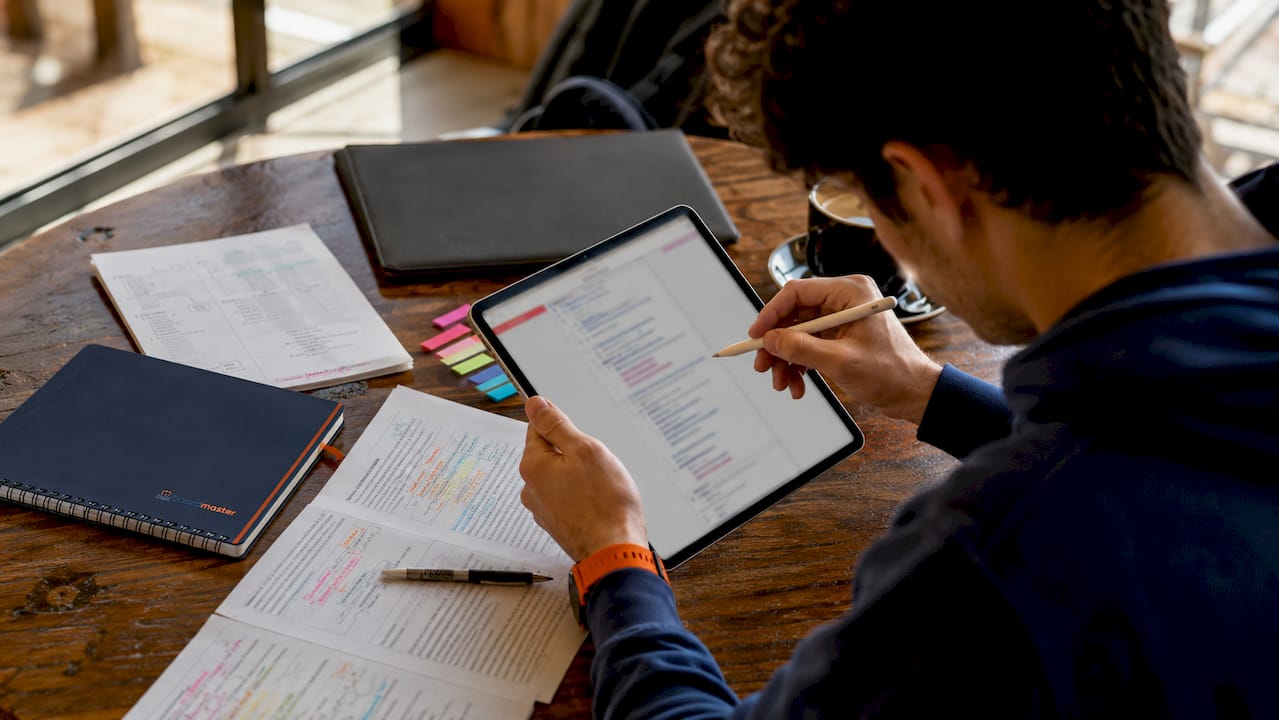
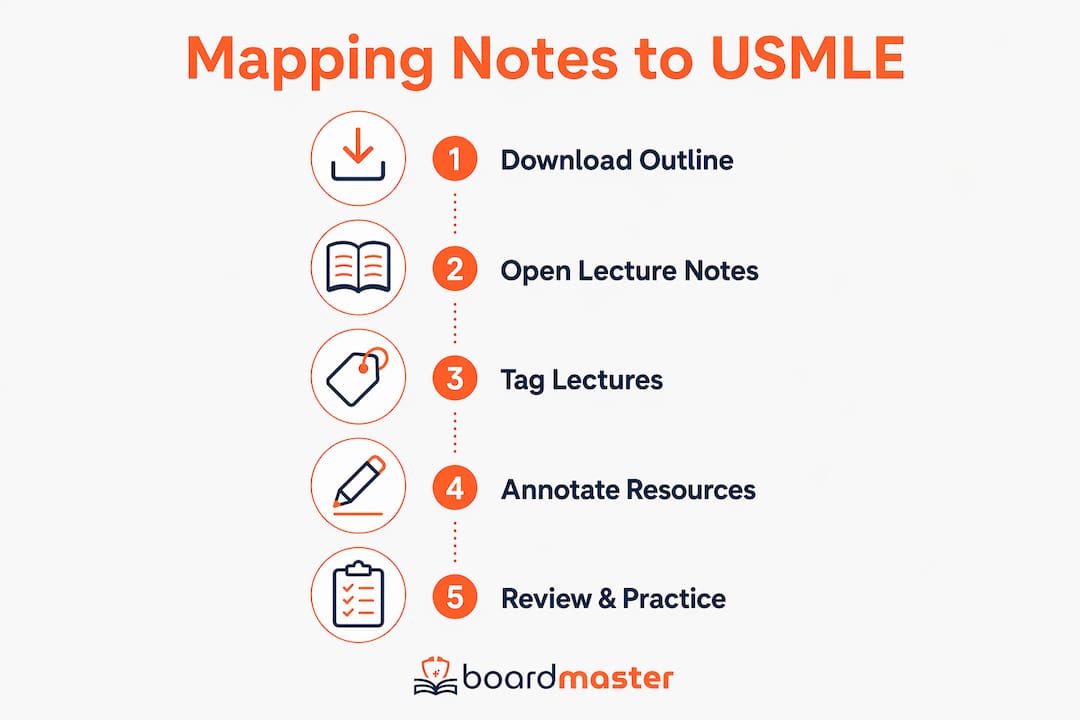
Start by downloading the NBME content outline and printing or bookmarking it. Then open your lecture notes for each course block and identify which organ system or discipline each lecture belongs to. Cardiology lectures map to the cardiovascular system. Microbiology lectures on gram-positive cocci map to infectious disease within multiple organ systems. This cross-referencing takes about 20 minutes per course block and pays off for the entire study season.
Once you have mapped your lectures to USMLE domains, prioritize by exam weighting. The USMLE Step 1 is a 280-question exam across 7 blocks, built around clinical vignettes that link a scenario to a diagnosis or treatment. That format tells you exactly what your notes need to do: they need to connect mechanisms to clinical presentations, not just list facts.
Here is a practical mapping workflow:
- Tag every lecture with its primary USMLE domain (cardiovascular, renal, neurology, etc.) in your note headers.
- Highlight professor-emphasized concepts with a separate color or tag, since these are the highest-yield items for both your block exam and boards.
- Cross-reference lecture topics against First Aid chapter headings to confirm alignment before you study.
- Flag low-yield tangents your professor covers that do not appear in the USMLE outline, and deprioritize them during dedicated prep.
Pro Tip: Use a free annotation tool like Notability or GoodNotes to add USMLE domain tags directly onto your PDF lecture slides. A simple color code system (one color per organ system) makes review dramatically faster.
This mapping process transforms a passive stack of PDFs into a structured, exam-aligned study system. The goal is not to memorize every slide. The goal is to know which slides matter most on test day.
Should you annotate first aid, uworld, or pathoma with your notes?
The answer is all three, but in a specific order and with a clear purpose for each. Integrating multiple resources including lecture notes, First Aid, Pathoma, and UWorld within a smart study plan maximizes learning without cognitive overload.
First Aid as your living document. First Aid works best when you treat it as a dynamic annotation layer continually updated with lecture content and QBank explanations. When your professor emphasizes a specific mechanism or clinical pearl, write it directly into the relevant First Aid section. This creates a single, consolidated reference that reflects both the USMLE blueprint and your school's curriculum emphasis.
UWorld for deepening understanding. UWorld explanations are not just answer keys. They are mini-lectures. When you miss a question, read the full explanation and then find the corresponding section in your lecture notes. Write a one-sentence summary of why you missed it and add it to your First Aid annotation. This closes the loop between practice and content review.
Pathoma for pathology integration. Pathoma by Dr. Husain Sattar covers pathology in a way that mirrors how USMLE vignettes are written. When your pathology lectures cover a disease process, watch the corresponding Pathoma section the same week. Then annotate your lecture notes with Pathoma's mechanism summaries.
| Resource | Primary Role | How to Connect to Lecture Notes |
|---|---|---|
| First Aid | Central annotation hub | Write lecture pearls directly into relevant sections |
| UWorld | Active recall and gap identification | Link missed question logic back to lecture content |
| Pathoma | Pathology mechanism reinforcement | Annotate lecture notes with Pathoma summaries |
| Lecture Notes | Personalized, school-specific emphasis | Use as the source material for all annotations |
Reading First Aid passively without accompanying practice questions yields little score improvement. Active recall and question application drive USMLE success. The annotation system above forces active engagement every time you open a resource.
Pro Tip: Keep a sticky note or digital flag on each First Aid chapter marking which of your lecture blocks it corresponds to. When you start dedicated prep, you will know exactly which lectures to revisit for each chapter.
How do AI tools strengthen the lecture-to-usmle connection?
AI tools have changed how efficiently you can convert raw lecture notes into exam-ready study material. The core benefit is automation of the most time-consuming steps: flashcard creation, question generation, and gap identification.
Here is a step-by-step workflow for using AI tools with your lecture notes:
- Upload your lecture notes to an AI study platform. Tools that accept PDF or text input can parse your professor's emphasis and generate targeted questions from that specific content.
- Generate organ-system-specific flashcards. Uploading lecture notes and annotated First Aid to AI tools generates personalized, Anki-compatible flashcards tailored to your curriculum emphasis. This approach improves study efficiency by automating material synthesis.
- Use "why I missed this" logic from QBanks. QBank explanations integrated with AI tools create atomic flashcards focused on personal knowledge gaps rather than generic facts. Feed your missed UWorld questions into the AI alongside your lecture notes for that organ system.
- Limit your sources per organ system. AI-generated content bloat is a real risk. Use a dedicated notebook per organ system containing 10–20 focused sources: one First Aid chapter, one Pathoma section, and your lecture notes. More sources do not mean better cards.
- Run daily targeted question sets. Experts recommend 20–40 daily targeted questions during the pre-dedicated phase, increasing to 80–120 per day during dedicated prep. AI-generated questions from your lecture notes fill the gap between generic QBank questions and your school's specific content.
Pro Tip: When you build a BoardMaster study session from your uploaded lecture notes, the AI generates USMLE-style vignette questions based on what your professor actually emphasized. This means your block exam prep and board prep happen simultaneously, not sequentially.
This workflow is how a student like Sarah moved from the 73rd to the 92nd percentile while cutting her study hours in half. She stopped treating lecture notes and QBanks as separate universes and started feeding both into a single, AI-assisted review loop.
What are the biggest mistakes when connecting notes to USMLE topics?
The most common mistake is treating lecture notes and question banks as separate study tracks. Students who read their notes in isolation and then do QBank questions in isolation never build the mental connections that USMLE vignettes require.
Here are the most damaging habits and how to fix them:
- Passive reading of notes. Highlighting and re-reading feels productive but does not build recall. Replace passive review with a customized USMLE study plan that forces you to retrieve information actively.
- Unstructured annotations. Writing random comments in the margins of First Aid without linking them to a USMLE domain creates noise. Every annotation should answer: "Which exam domain does this belong to?"
- Content bloat from too many sources. Adding Sketchy, Anki, Boards and Beyond, and lecture notes all at once creates overlap and confusion. Pick a core stack and stick to it.
- Ignoring professor emphasis. Your professor signals high-yield content through repetition, case examples, and explicit statements. These signals are gold for both block exams and boards.
Pro Tip: After every lecture, spend five minutes writing three questions you expect to see on your block exam based on what your professor emphasized. This habit builds the vignette-thinking muscle you need for USMLE.
Balancing lectures and USMLE prep on a weekly schedule prevents the all-too-common scenario of arriving at dedicated prep with disconnected notes and no integrated study system. Build the connection from day one of medical school, not six weeks before your exam date.
Key takeaways
Connecting lecture notes to USMLE topics requires active annotation, organ-system mapping, and daily question practice tied directly to your course content.
| Point | Details |
|---|---|
| Map notes to USMLE domains | Tag every lecture by organ system using the NBME content outline as your guide. |
| Annotate First Aid continuously | Write lecture pearls and QBank insights directly into First Aid to build one consolidated resource. |
| Use AI to generate targeted questions | Upload lecture notes to AI tools to create personalized, vignette-style practice items. |
| Limit sources per organ system | Cap your inputs at 10–20 focused sources per system to prevent content bloat. |
| Replace passive reading with active recall | Do 20–40 daily targeted questions tied to your current lecture block from the start of the year. |
What i have learned about lecture notes and USMLE prep in 2026
The biggest shift I have seen in how students prepare for the USMLE is the move away from isolated memorization toward integrated, AI-assisted workflows. Students who treat their lecture notes as a standalone resource consistently underperform compared to those who use them as the anchor for everything else.
First Aid is not a textbook. It is a framework. The students I have worked with who score highest use it as a living document, annotating it with professor pearls and QBank insights from the very first week of school. By the time dedicated prep starts, their First Aid copy is already personalized to their curriculum.
The AI tools available in 2026 have made this process faster and more precise than anything I saw in earlier years. The ability to upload a lecture PDF and receive USMLE-style vignette questions within minutes is a genuine advantage. The students who resist these tools because they feel "too easy" are making a strategic mistake. Efficiency is not cheating. It is smart preparation.
My honest recommendation: stop thinking about lecture notes and board prep as two separate problems. They are the same problem. Solve them together from day one.
— Dr. Ahmed Abuzoor
How BoardMaster turns your lecture notes into USMLE practice
Medical students who want to close the gap between classroom content and board performance need more than a generic question bank. BoardMaster's AI question generator converts your uploaded lecture notes into targeted USMLE-style vignette questions built around what your professor actually emphasized. That means your block exam prep and board prep happen in the same study session.
BoardMaster also generates AI study podcasts from your notes, turning dense lecture content into focused 8-minute audio episodes you can review anywhere. For students who want a complete AI-powered prep system, the BoardMaster USMLE prep platform integrates lecture notes, QBank data, and spaced repetition into one personalized workflow. Start uploading your notes and see how quickly your study sessions become exam-ready.
FAQ
How do lecture notes connect to USMLE topics directly?
Lecture notes connect to USMLE topics by mapping onto the NBME's official organ-system content outline. When you annotate First Aid with professor-emphasized concepts and practice with targeted questions from that content, your notes become a direct bridge to exam domains.
Should i use my lecture notes or first aid as my primary study resource?
Use both together. Annotate First Aid with your lecture notes so that one document reflects both the USMLE blueprint and your school's curriculum emphasis. Neither resource alone is as effective as the two combined.
How many questions should i do daily during pre-dedicated prep?
Experts recommend 20–40 targeted questions per day during the pre-dedicated phase, rising to 80–120 per day during dedicated prep. Tying those questions to your current lecture block maximizes retention and relevance.
Can AI tools really improve how i connect notes to USMLE content?
Yes. AI tools that accept lecture note uploads generate personalized flashcards and USMLE-style vignette questions tailored to your curriculum. This automates the most time-consuming parts of note integration and keeps your study focused on high-yield content.
What is the biggest mistake students make with lecture notes and boards?
The biggest mistake is treating lecture notes and QBanks as separate study tracks. Integrating QBank explanations with your lecture notes through annotation and AI-assisted flashcard creation produces far better retention and score gains than studying each in isolation.