
The fastest way to fix messy lecture notes is a five-step loop: prepare before class, capture concepts instead of transcripts, write a five-minute summary right after the lecture ends, store everything in one searchable course hub, and review weekly. Skip the summary step and the rest barely matters, because that's the point where information either gets locked in or quietly disappears.
TL;DR:
- Without the five-minute post-lecture summary, notes are less likely to be consolidated and retained effectively.
- Using a structured note-taking method that encourages restating ideas, like Cornell or outlining, improves review speed and memory retention.
- Preparing before class with syllabus review and slide preloading takes only a few minutes but significantly reduces time spent searching and clarifying during lectures.
- Tagging, summarizing, and linking notes to textbooks and recordings turn fragmented information into an organized, searchable course hub.
- Converting organized notes into targeted practice questions and flashcards enhances active recall and prepares you more efficiently for exams.
Table of Contents
- Why Lecture Note Organization Matters for Retention
- Which Note-Taking Method Should You Use?
- How to Prepare Before Class for Better Notes
- What Should You Actually Write Down in Class?
- Why the Five-Minute Summary Matters Most
- How Do You Build One Searchable Course Hub?
- From Clean Notes to Targeted Practice Questions
- How to Highlight and Summarize Key Concepts
- How Do You Take Active Notes Instead of Passive Ones?
- How to Organize Notes Across Labs, Seminars, and Lectures
- How to Combine Lecture Notes With Textbooks and Recordings
- Building the Habit, One Week at a Time
- Turn Organized Notes Into Targeted Practice Questions
- Sources
- FAQ
Why Lecture Note Organization Matters for Retention
Disorganized notes cost you twice: once when you can't find what you need, and again when your brain never fully processed it in the first place. A prepare-capture-consolidate sequence produces better lasting learning regardless of whether you write by hand or type, according to research on note-taking methods and cognitive load. The consolidation step, where you restate ideas in your own words, is what turns a transcript into actual knowledge.
Organization also cuts the tax you pay every time you hunt for something. A tagged, dated, searchable note system means less time flipping through notebooks before an exam and more time actually studying. Concise summaries lower cognitive load too. When your notes are trimmed to the core claims instead of a wall of raw text, your working memory has room to connect ideas instead of just decoding handwriting.
Which Note-Taking Method Should You Use?
The method matters less than whether it forces you to restate ideas instead of copying them. Structured formats like the Cornell method work because they physically separate cues and questions from detailed notes, which builds in a review prompt every time you open the page.
- Cornell method: Splits the page into cues, notes, and a summary strip. Best for lecture-heavy courses where you'll review weekly.
- Outline method: Nested bullet points that mirror a slide deck's hierarchy. Fast to write during fast-talking lectures.
- Mapping method: A visual web connecting concepts. Works well for courses built on relationships, like pharmacology or physiology pathways.
- Sentence method: One line per new idea, numbered sequentially. Good for dense, rapid-fire lectures where structure would slow you down.
- Zettelkasten: Atomic, linked notes with unique IDs. Suited to long-term research projects or thesis work, not weekly coursework.
Pick one method per course and stick with it. Switching formats mid semester breaks the pattern recognition that makes review fast, and it makes your course hub harder to scan later.
How to Prepare Before Class for Better Notes
Preparation is the step most students skip, and it's the one that saves the most time later. Walking in cold means you spend the first ten minutes just figuring out what the lecture is even about.
- Skim the syllabus and stated objectives for the week so you know what the professor considers important enough to test.
- Pre-load slides or assigned readings onto your device or print them, so your notes can focus on what the slides don't already say.
- Set a filename convention before the semester starts, something like
[CourseCode]_[Week]_[Topic]_[Type], so every file lands in a predictable place without you having to think about it. - Set up your device for zero interruptions: notifications off, and if you plan to record audio or photograph slides, have that shortcut ready before the professor starts talking.
None of this takes more than five minutes, and it pays off the moment you sit down to review three weeks later and can actually find things.
What Should You Actually Write Down in Class?
Paraphrase, don't transcribe. Verbatim note-taking keeps your hand busy but your brain passive, and it produces pages you'll never want to reread. The goal is capturing the professor's logic, not their exact words.
- Write down examples the professor uses to illustrate a concept. They're often the exact scenario that shows up on an exam.
- Mark anything the instructor repeats, slows down for, or explicitly flags as important with a symbol you use consistently, like a star or an exclamation point.
- Use headings that match the lecture's own structure, and bold terms you'll need to define later.
- Leave a visible mark, a question mark works fine, next to anything confusing so you can follow up instead of losing the thread mid lecture.
- Photograph a slide only when a diagram or equation would take too long to redraw, and tag the photo with the date and topic immediately, not later that night when you've forgotten which slide was which.
Pro Tip: *Keep a running "parking lot" line at the bottom of each page for questions you don't have time to resolve in the moment. Revisit it during your five-minute summary instead of breaking your note-taking flow to chase an answer mid lecture.
Why the Five-Minute Summary Matters Most
The single highest-leverage habit in this entire system is the one most students cut when they're rushing to their next class. Taking five minutes immediately after a lecture to summarize the professor's key points consolidates information before it fades, according to the UNC Learning Center. Wait until that night and you've already lost the thread.
Write one to three sentences capturing the lecture's core claim, not a recap of everything covered. Ask yourself: if a friend missed today's class, what's the one thing they'd need to know?
Weekly upkeep prevents this from becoming a backlog:
- Tag each note with its topic and exam relevance.
- Remove duplicates between your notes and the slides you already have saved.
- Add links from your notes to the corresponding textbook chapter or recording timestamp.
- Write five to ten recall prompts per week based on your summaries, turning passive review into active retrieval practice.
Those recall prompts convert easily into flashcards for spaced repetition, which is where the five-minute habit actually starts compounding instead of just sitting in a folder.
How Do You Build One Searchable Course Hub?
Every course gets one home, not three. Scattered notes across a notebook, a laptop folder, and a phone's camera roll are the single biggest reason students can't find anything before an exam. University learning centers consistently recommend separating materials by course, then by unit or topic, rather than building an elaborate filing system that takes more effort to maintain than it saves.
A workable structure looks like: Course > Unit > Lecture Date + Topic. Keep it that simple.
- Use a consistent filename pattern across every file, something like
BIO201_Wk4_CellSignaling_Lecture.pdf. - Build two or three tag categories and reuse them everywhere: key concept, exam-relevant, and lab versus lecture.
- Use backlinks or a simple knowledge graph tool only once you have more than a semester's worth of notes; folders alone work fine for a single course.
- If you use AI to help classify notes, feed it your existing subject and topic structure first rather than letting it invent its own categories. AI works best as an organizational layer, sorting material you've already structured, not as a replacement for the structuring itself.
For a deeper walkthrough of centralizing scattered course materials into one workspace, see this guide on turning note chaos into a clear system.
From Clean Notes to Targeted Practice Questions
Once your five-minute summaries exist, they're raw material for active recall, not just an archive. Turn each summary into three to five practice prompts mapped to the syllabus topic it covers, and you've built a focused review set without starting from scratch.
Mapping notes to syllabus objectives, rather than reviewing chronologically, means you spend time on what will actually be tested. Whatever tool or method generates those prompts, whether it's a study partner or software that converts notes into practice questions, always check the output against your original notes. AI can misread emphasis or invent a detail your professor never mentioned.
How to Highlight and Summarize Key Concepts
Highlighting everything is the same as highlighting nothing. If half the page is yellow, you haven't identified what actually matters, you've just decorated the page.
A better rule: highlight definitions, formulas, and anything the professor repeated more than once. Everything else stays plain text. This single constraint forces you to make a judgment call in the moment, which is itself a form of active processing.
For summarization, the "one sentence per section" rule works better than trying to compress an entire lecture into a single paragraph. After each major heading in your notes, write one sentence that captures the core claim of that section before moving to the next. By the end of the lecture, you have a running summary built in real time instead of a separate task waiting for you at home.
Structured formats make this easier. The Cornell method's summary strip at the bottom of the page exists for exactly this purpose, and it turns note-taking into a built-in review step rather than an afterthought.
Watch for these common summarization mistakes:
- Summarizing too late, after the details have already blurred together.
- Copying the professor's phrasing instead of restating the idea in your own words, which skips the cognitive work that makes it stick.
- Writing summaries so short they lose the actual claim, just a topic label with no content.
A good summary sentence names a claim, not just a subject. "Cardiac output equals stroke volume times heart rate" beats "notes on cardiac output" every time.
How Do You Take Active Notes Instead of Passive Ones?
Writing down what you hear is passive. Asking a question about it, even a small one, is active, and it's the difference that determines whether the material shows up on your exam or fades by Thursday.
Build a habit of asking one question per major concept, even a simple "why does this matter here?" written in the margin. You don't need to answer it immediately. The act of asking forces you to check whether you actually understood the point or just transcribed it.
Annotation works the same way. Instead of just underlining a sentence, write a two or three word note in the margin explaining why it's underlined. "Underlined because it's on last year's exam" is a more useful annotation than a highlighter mark with no context, because it captures your reasoning at the moment you had it.
Reflection closes the loop. At the end of each lecture, or during your five-minute summary, ask yourself what confused you and what connected to something you already knew. That connection is often what makes a concept retrievable later, because you're not storing it in isolation, you're linking it to something already in memory.
A few practical ways to build this in:
- Leave a dedicated margin column for questions, separate from your main notes, so you're not disrupting your capture flow to write them.
- Circle anything you wrote down but don't actually understand, and resolve those circles during weekly review, not during the lecture itself.
- End each note page with one reflection line: what was the hardest idea today, and why?
None of this needs to slow down your note-taking. A single word in the margin is enough to flag active engagement, and it's the marginal notes, not the transcribed ones, that you'll remember writing.
How to Organize Notes Across Labs, Seminars, and Lectures
Different class formats produce different kinds of information, and forcing them into the same note structure usually loses something important.
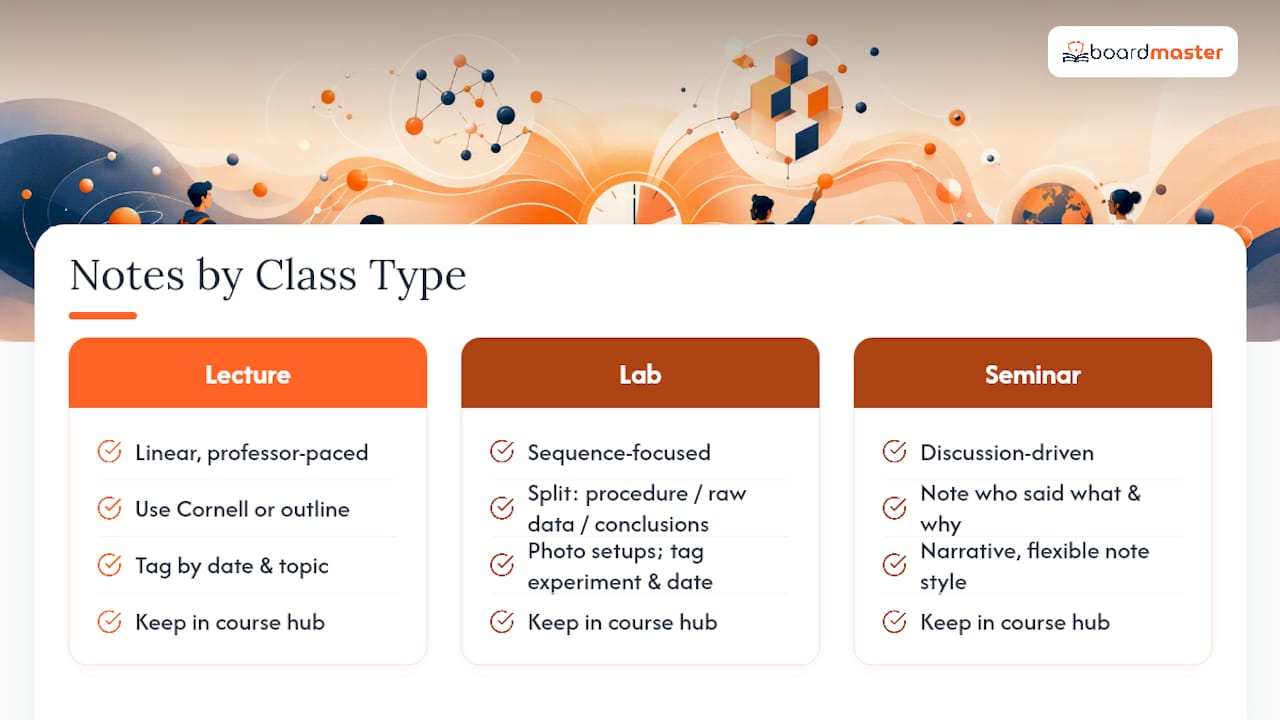
Lectures are the most straightforward: linear, professor-paced, and well suited to whatever single method you picked for that course, whether Cornell or outline. Keep lecture notes tagged by date and topic, and don't mix them into the same file as lab data.
Labs need a different structure entirely, because the sequence matters. Record procedure, raw observations, and conclusions as separate sections, not blended together, since you'll often need to reference just the raw data later without wading through your interpretation of it. Photograph setups and results immediately, and tag those images with the experiment name and date, not just "lab 3."
Seminars tend to be discussion-driven rather than content-delivery, so the useful information is often what your classmates and the instructor argue about, not a fixed set of facts. Note who made which point and why, since seminar material often reappears as essay prompts or discussion questions rather than exam facts. A looser, more narrative note style usually works better here than a rigid template.
Keep all three formats inside the same course hub, but as separate subfolders or clearly tagged sections; BIO201_Lecture, BIO201_Lab, BIO201_Seminar. That way your weekly review pulls from the right bucket instead of mixing lab procedure with lecture theory.
How to Combine Lecture Notes With Textbooks and Recordings
Lecture notes are one input, not the whole picture, and treating them as complete on their own leaves gaps that show up right before an exam.
Link each lecture note to its corresponding textbook chapter using a simple reference at the top of the page, something like "see Ch. 14, pp. 220 to 235." That link means when you're reviewing later, you know exactly where to go for more depth without rereading the entire chapter to find the relevant section.
If the lecture was recorded, timestamp anything confusing directly in your notes, "unclear at 34:00," so you can jump straight to that moment instead of rewatching an entire hour-long recording. This small habit alone saves enormous amounts of review time during exam prep.
Slides deserve their own treatment too. Don't transcribe a slide's bullet points verbatim into your notes; instead, note what the professor said about the slide that isn't written on it. The slide itself is already saved as a file. Your notes should capture the layer of explanation that only existed in the room.
A workable integration routine during weekly review:
- Cross-check your lecture summary against the textbook's chapter summary and flag anything that contradicts or extends what the professor said.
- Add recording timestamps to any note flagged with a question mark during class.
- Merge slide files into the same course folder as your notes, using the same filename convention, so a search for one topic surfaces every related material type at once.
Building the Habit, One Week at a Time
Realistically, this system takes about three weeks to feel automatic. Budget five minutes after each lecture for the summary, one thirty-minute block each week for tagging and cleanup, and expect that rhythm to intensify during exam periods, when daily review replaces the weekly one. Start with just the five-minute summary before adding tags or folder structures. As someone who has spent years studying how medical students prepare for board exams, I've found the students who stick with organization long term are the ones who started small and let the system grow with their course load, not the ones who tried to build the perfect structure on day one.
— Dr. Ahmed Abuzoor
Turn Organized Notes Into Targeted Practice Questions
Once your notes are clean, tagged, and summarized, the next question is what to do with them before an exam. There are platforms that generate practice questions and flashcards aligned with the concepts emphasized by your specific professor, rather than using a generic question bank pulled from someone else's course.

This works best as the step after organization, not instead of it. A messy pile of unsorted notes produces messy practice questions, but a well-tagged, summarized set of notes gives the AI Question Generator something precise to work with. Some study platforms also build flashcards with spaced repetition, offer OSCE-style clinical practice, and include physician-written question banks for board-level review. As with any AI-generated study material, check the output against your original notes before trusting it fully, especially for concepts your professor covered in a way that differs from a standard textbook explanation.
If you want to see how it handles a real lecture upload, the AI question generator demo shows the process end to end. You can start with the free tier to test it against one of your own recently organized courses before deciding whether to subscribe.
Sources
For course-specific templates, check your campus learning center first. The UNC Learning Center's note-taking guide and Stanford's guide to organizing notes both offer practical handouts worth adapting to your own courses.
- Effective Note-Taking in Class - UNC Learning Center
- The effects of note-taking methods on lasting learning: the role of motivation and cognitive load
- How AI is reshaping the future of work (Stanford GSB)
FAQ
What is the best way to organize lecture notes?
The most reliable approach follows a sequence: prepare before class, capture concepts rather than transcripts, write a five-minute summary immediately after, then store everything in one searchable course hub organized by topic. Research on note-taking methods confirms this sequence produces better retention whether your notes are digital or handwritten.
What are the 5 R's of note-taking?
The 5 R's, drawn from the classic Cornell method framework, are Record, Reduce, Recite, Reflect, and Review. Record your notes during class, reduce them to key cues and summaries afterward, recite the material aloud from memory, reflect on how it connects to what you already know, and review regularly rather than only before exams.
What are the 7 rules of note-taking?
Definitions of "the 7 rules" vary across study-skills guides, so there's no single universally cited list. The consistent principles across most guidance are: paraphrase instead of transcribing, use one consistent method per course, tag and date everything, summarize within minutes of class ending, separate cues from details, review weekly, and link notes to related materials like slides and recordings.
What are some ideas for organizing my notes?
Build one folder or notebook per course, then subdivide by unit or topic rather than by date alone. Use a consistent filename pattern, tag notes by concept and exam relevance, and keep labs, seminars, and lectures in clearly separated sections within the same course hub.
Can AI help organize my lecture notes?
AI works best once you've already built a basic subject and topic structure, since it can then classify and link material within that framework rather than inventing its own categories. Tools like BoardMaster's Cortex AI study assistant can turn organized notes into instant explanations and practice questions, but the underlying structure still has to come from you first.