
Active recall is how you study; spaced repetition is when you review. They are not competitors, they are partners, and skipping either one leaves real retention on the table. Active recall strengthens memory by forcing your brain to retrieve information instead of re-reading it. Spaced repetition times your reviews so you revisit that information right before you would otherwise forget it. A practical example: turn your lecture notes into flashcards you must answer from memory, then review those cards on a growing schedule instead of cramming them all at once.
TL;DR:
- Combining active recall and spaced repetition doubles learning efficiency compared to massed review alone, with optimal gaps depending on the exam timeline.
- Short-term exams benefit from daily compressed spacing, while long-term retention requires wider intervals like weekly or monthly reviews for sustained memory.
- Pruning low-value facts and focusing on high-yield material prevents overload and keeps review sessions productive, especially when using scenario-based prompts.
- Automated tools like BoardMaster streamline scheduling and prioritize high-impact questions, reducing the risk of burnout and maintaining focused study habits.
- Recognizing the distinction between recognition and recall, and interleaving subjects, enhances retention and prevents common study mistakes.
Table of Contents
- Active Recall vs Spaced Repetition: What Each One Actually Does
- What Does the Research Say About Combining Them?
- How Do You Build a Study Routine Around Both?
- What Mistakes Ruin Active Recall and Spaced Repetition?
- How BoardMaster Puts This Into Practice
- Quick Decision Guide: When to Lean on Recall, Spacing, or Both
- BoardMaster: Automate the Scheduling So You Don't Have To
- Sources
- FAQ
Active Recall vs Spaced Repetition: What Each One Actually Does
The confusion between these two terms usually comes from treating them as competing study methods when they answer completely different questions. Active recall, also called retrieval practice, answers how you should study a piece of material: by testing yourself on it, not by rereading it. The mechanism behind it is the testing effect, the well-documented finding that pulling information out of memory strengthens that memory more than passively reviewing it does.
Spaced repetition answers when you should study that same material again. It's built on the spacing effect, or distributed practice, the idea that spreading reviews across days or weeks beats cramming them into one sitting. The mechanism ties directly to the forgetting curve: reviewing right as you're about to forget something resets the clock more efficiently than reviewing it while it's still fresh.
Here's the how-to versus when-to split in practice:
- Active recall tells you to close your notes and quiz yourself, use practice questions instead of highlighting, and explain a concept out loud before checking if you got it right.
- Spaced repetition tells you to review a new concept the next day, then again three days later, then a week after that, rather than reviewing it five times in one evening.
Use active recall without spacing, and you'll retain material for a day or two before it fades. Use spacing without active recall, meaning you reread notes on a schedule instead of testing yourself, and you get a much weaker version of the same benefit. Neither trick alone matches what the pair does together.
What Does the Research Say About Combining Them?
The evidence for active recall goes back to foundational work by Roediger and Karpicke, whose experiments found that students who tested themselves on material outperformed students who restudied it, even when the restudy group spent more total time with the material. Retrieval beats rereading on delayed tests, and the gap widens the longer you wait before that test.
The spacing side comes largely from Cepeda and colleagues, whose large-scale review of distributed practice found that the ideal gap between study sessions depends on how long you need to remember the material. If your exam is 30 days away, review around day 3 to day 6, not the night before.
The research in numbers: Spaced repetition has been shown to roughly double the learning efficiency of massed instruction in controlled study comparisons, and applied reviews in health professions education report measurably better academic performance among students who combine spacing with retrieval versus those using traditional rereading methods.
A broader review in Nature Reviews Psychology concludes that retrieval practice and spacing rank among the highest-utility learning strategies available, and that most students underuse both, largely because retrieval-based study feels harder in the moment than rereading does, even though it works better.
Three numbers worth keeping:
- 10 to 20%: the spacing gap as a percentage of your total retention window.
- 2x: the rough efficiency gain from spaced study over massed cramming.
- Days, not hours: short-notice exams call for compressed spacing (daily reviews); long-term retention calls for wider gaps (weekly, then monthly).
How Do You Build a Study Routine Around Both?
Turning theory into a routine comes down to converting your source material into testable prompts and then feeding those prompts into a schedule you actually follow. Here's a workflow that works whether you're prepping for a class exam or a board exam.
- Convert notes into atomic prompts. Break each concept into a single question, a cloze deletion, or a short clinical scenario. A prompt like "What causes hyponatremia in SIADH?" beats a vague flashcard that just restates a definition.
- Start each session with a recall warm-up. Before opening new material, quiz yourself on what's already due. This reactivates yesterday's learning and flags what's slipping.
- Process new material with immediate retrieval. Don't just read a new topic. Read it once, close the source, and try to reconstruct it from memory before moving on.
- Feed everything into a spaced queue. New cards go on a short interval; cards you get right move to longer ones; cards you miss reset to the beginning.
- Review only what's due, not everything you've ever made. A queue with 40 due cards beats a backlog of 2,000 you're too intimidated to open.
For scheduling, three patterns cover most situations. A compressed schedule (0, 1, 2, 4 days) suits exams less than two weeks out. A standard schedule (1, 3, 7, 14, 30 days) suits normal-length courses. The 2-3-5-7 pattern, reviewing on day 2, then adding 3, 5, and 7 day gaps between subsequent reviews, works well as a middle ground for material you need to hold for a month or two. If you don't know your exact test date, default to the 1, 3, 7, 14 progression and adjust once you do.
Pro Tip: Before adding any card to your spaced queue, ask whether it's high-yield or just interesting trivia. If a professor spent ten minutes on a concept, it belongs in your queue. If it was a one-line aside, skip it. A resource like the BoardMaster spaced repetition schedule for med school walks through a ready-made version of this if you'd rather not build one from scratch.
What Mistakes Ruin Active Recall and Spaced Repetition?
The single biggest efficiency killer is card overload. Piling thousands of low-value facts into a deck buries the material that actually matters on your exam, and a backlog that large discourages you from opening the app at all. Prune aggressively, merge overlapping cards, and favor scenario-based prompts over isolated trivia. This guide on avoiding common active recall mistakes points out that high-performing students actually keep card counts moderate on purpose.

The second trap is confusing recognition with recall. Reading a flashcard's answer and thinking "yeah, I knew that" is not the same as producing the answer yourself. Always attempt a real answer, out loud or in writing, before flipping the card.
A few more fixes worth adopting:
- Interleave subjects instead of blocking one topic for hours; this is especially valuable in STEM and medicine, where you need to tell similar conditions apart under pressure.
- Prefer problem-solving to rote fact cards for quantitative material. This active recall guide for math students shows how the same testing-effect logic applies to worked problems, not just definitions.
- Protect focus with single-tasking blocks (25 to 50 minutes) rather than studying with five tabs open.
Pro Tip: *If you haven't opened your review queue in three days, don't try to catch up on everything at once.
How BoardMaster Puts This Into Practice
The theory above is straightforward. Executing it by hand, especially during board exam prep, is where most students fall behind. BoardMaster was built around this exact gap: it turns uploaded lecture notes into flashcards with spaced scheduling built in and generates practice questions aligned with what individual professors actually emphasize, rather than generic board-review trivia.
One student reportedly improved her exam percentile while cutting her study hours by using targeted questions, a result that tracks with what the research above predicts: cutting low-yield review time and concentrating retrieval practice on high-value material compounds fast.
If you're not using a tool like this, the same principle works manually:
- Use a Leitner box (three or five physical piles) to mimic expanding intervals.
- Batch your own cloze deletions from lecture slides instead of buying a pre-made deck.
- Set calendar reminders for your 1, 3, 7, 14-day checkpoints if you don't have software tracking them for you.
Quick Decision Guide: When to Lean on Recall, Spacing, or Both
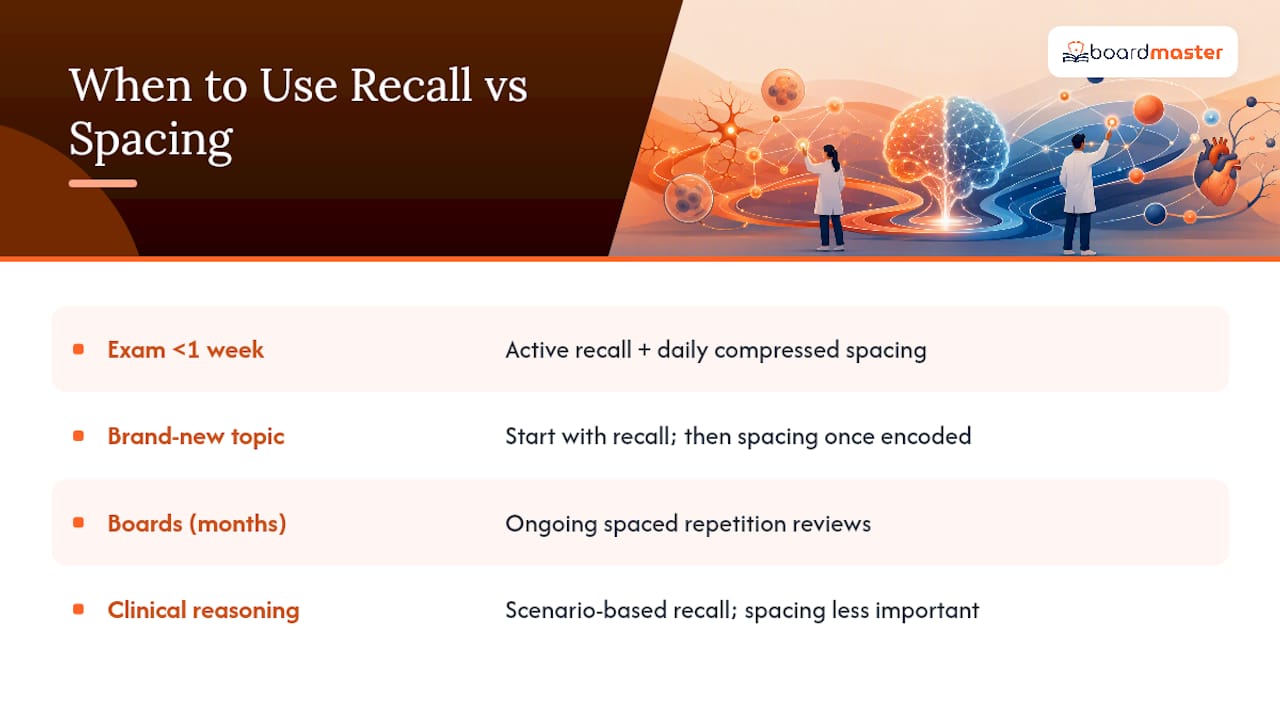
Four situations, four emphases. Exam in under a week? Prioritize active recall with daily compressed spacing. Learning something brand new? Lead with recall to build the memory, then let spacing take over once it's encoded. Maintaining knowledge for boards months out? Building a transferable skill like clinical reasoning? Favor scenario-based recall over flashcards entirely, since spacing matters less than the quality of each retrieval attempt.
The short version hasn't changed: active recall is how you study, spaced repetition is when you review, and the two together outperform either one alone.
BoardMaster: Automate the Scheduling So You Don't Have To
Everything in this article works whether you build it by hand or let software handle it, but manually tracking due dates across hundreds of cards is exactly the kind of friction that makes students quit halfway through a semester. This software generates flashcards with spaced repetition already built into the scheduling, straight from uploaded lecture notes, so the review queue updates itself instead of relying on a spreadsheet.

It also addresses the card-overload problem covered earlier: instead of guessing which facts are worth a card, it generates USMLE-style practice questions tied to material emphasized by professors, so the queue stays focused on high-yield content instead of trivia. You can see the instant flashcard workflow in action here or browse the full AI flashcard feature set generating hundreds of cards in seconds. If you want to try building a routine around this instead of a manual Leitner system, start with BoardMaster's platform and upload your next lecture set.
Sources
- PMC article on spaced repetition benefits
- Nature Reviews Psychology — spacing and retrieval practice review
- Cepeda et al. review on distributed practice
- Review: spaced repetition and active recall improves academic performance
FAQ
Is Active Recall Good for ADHD?
Retrieval practice can help learners with ADHD because it breaks study into short, active bursts rather than long passive reading sessions, which tends to hold attention better, though pairing it with focused work intervals like the Pomodoro method improves results further.
What Is the 2-3-5-7 Method of Revision?
It's a spacing pattern where you review new material on day 2, then again after gaps of 3, 5, and 7 days, gradually widening the interval as the memory strengthens. It works well as a middle-ground schedule for material you need to retain for a month or two.
What Is the 3-2-1 Memory Technique?
Definitions of this technique vary across sources, and no single version is standard in the cognitive science literature, so it's worth treating any specific "3-2-1" framework you encounter with caution rather than as an established method.
Does BoardMaster Use Spaced Repetition?
Yes. BoardMaster generates flashcards from uploaded lecture notes with spaced scheduling built in, alongside practice questions targeted to what individual professors emphasize, so reviews stay both timed correctly and focused on high-yield content.