
Three plan types reliably raise exam percentiles: short intensive (6 weeks of high-volume question blocks), distributed longitudinal (3 to 6 months of spaced, interleaved review), and hybrid targeted (lecture-aligned questions focused on what your professors actually test). Depending on your starting point and how consistently you follow the plan, students typically see gains in the range of 10 to 25 percentile points. None of that matters until you know your baseline.
Your first move, today, is a timed practice NBME or CBSE. Not a review session. Not a topic list. An actual timed exam that tells you where you stand right now.
- If you're below the 50th percentile, start with short intensive or hybrid targeted.
- If you're between the 50th and 75th, distributed longitudinal usually fits better.
- If you're above the 75th and chasing the top decile, hybrid targeted with heavy weak-topic remediation tends to close the gap fastest.
Key Takeaways
Percentile gains come from matching plan structure to your starting point and running retrieval-based sessions consistently, rather than simply increasing study hours.
| Point | Details |
|---|---|
| Test before you plan | Take a timed NBME or CBSE first to set a real baseline percentile, not a guess. |
| Match plan to timeline | Short intensive suits a near exam date; distributed longitudinal suits 3 to 6 months out. |
| Structure every session the same way | Questions first, then immediate correction, then remediation, then spaced flashcards. |
| Set a hard decision rule | Change the plan if two full-length exams show under 5 percentile points of movement. |
| Use lecture-aligned tools for hybrid plans | BoardMaster generates targeted questions from uploaded notes so study time maps to what's actually tested. |
Table of Contents
- Examples of Percentile Improvement Plans You Can Copy Today
- How to Set a Baseline and Track Percentile Progress
- The Research Behind These Plan Structures
- Why a Real Case Study Beats a Theoretical Plan
- What Most Study Advice Gets Wrong
- Run the Hybrid Targeted Plan Without the Manual Setup
- Sources
- FAQ
Examples of Percentile Improvement Plans You Can Copy Today
These aren't theoretical frameworks. Each one maps daily activity to a measurable checkpoint, so you know within two weeks whether it's working.
1. Short intensive (6 weeks, best for a tight exam date)
This plan front-loads volume. Weeks 1 to 2 build a question habit at moderate volume (50 to 70 questions daily) while you identify weak systems. Weeks 3 to 5 push to 80 to 120 questions per day, split into two or three timed blocks. Week 6 tapers volume and shifts to full-length practice exams and light review.
- Daily order: timed question block, immediate review of every miss, 20 to 30 minutes of concept remediation, then a short spaced-flashcard session.
- Weekly checkpoint: one NBME mini-assessment (subject-specific or short-form) every Sunday.
- Decision rule: if your percentile hasn't moved by week 3, cut question volume by 20% and double remediation time. Volume without correction just reinforces mistakes.
2. Distributed longitudinal (3 to 6 months, best when the exam is far off)
Lower daily question count (30 to 50 per day) but far more consistency, plus deliberate interleaving across subjects rather than blocking one system at a time. This structure leans on the role of practice questions in retention building over months instead of weeks.
- Weeks 1 to 4: build the habit, cover foundational systems, log every card into a spaced review queue.
- Weeks 5 to 12: rotate subjects weekly (interleaving), maintain daily flashcard reviews, sit one full-length NBME monthly.
- Final 4 to 6 weeks: shift toward intensive mode, increasing question volume and reducing new material.
Expect slower, steadier gains than the intensive plan. A common pattern is a 5 to 10 percentile jump by month two, with another 5 to 15 by the final stretch, assuming daily consistency holds.
3. Hybrid targeted (8 to 12 weeks, best if lecture exams and boards overlap)
This is the plan for students juggling class exams and long-term board prep at once. Instead of studying generic high-yield lists, you align practice questions to what each professor actually emphasizes; uploading your own weekly schedule that balances lectures and USMLE prep is the backbone here.
- Upload lecture notes weekly, generate targeted questions from that specific content, and drill it within 48 hours while it's still fresh.
- Dedicate one afternoon a week purely to weak-topic remediation flagged from missed questions.
- Track a study-hours-to-score ratio, not just raw score. The goal is fewer hours for the same or better percentile, not just a higher score at any cost.
Checkpoint rule across all three: if two consecutive full-length exams show less than a 5-percentile gain, the plan needs a structural change, not just more hours.
How to Set a Baseline and Track Percentile Progress
Every plan above depends on getting these mechanics right. Skip this step and even a well-designed template will underperform.
- Take a timed, full-length NBME or CBSE first. Record raw score, percentile, and a breakdown by subject. This becomes your reference point for every future comparison.
- Build every session around retrieval, not review. Start with a timed question block, then immediately correct misses, then spend 20 to 30 minutes on concept remediation, then close with 15 to 30 minutes of spaced flashcards. Testing yourself before reviewing material is what separates evidence-based learning strategies from passive rereading.
- Schedule interleaving deliberately. Don't study cardiology for five straight days. Rotate two or three systems within each week; it forces your brain to distinguish between similar-looking conditions instead of pattern-matching on recency.
- Reschedule spaced cards based on performance, not calendar. A card you nail three times in a row can wait two weeks. A card you keep missing needs to reappear within 24 to 48 hours.
- Sit full practice exams on a fixed cadence. Biweekly for short intensive plans, monthly for longitudinal ones. Log the result the same day, including which subjects dragged the score down.
- Apply a hard decision threshold. If two consecutive exams show under 5 percentile points of movement, something in the plan isn't working. Change the ratio of volume to remediation before you assume the whole plan has failed.
Pro Tip: Log your missed questions in a single running document, tagged by "knowledge gap" versus "careless error." Careless errors need slower, more careful reading under time pressure. Knowledge gaps need remediation. Treating both the same way wastes weeks.
The Research Behind These Plan Structures
None of this is guesswork. A 2026 meta-analysis covering more than 21,000 learners found a substantial effect favoring spaced repetition over standard massed studying, with a standardized mean difference of 0.78. That's a large effect in education research, and it's the reason every plan above builds in a spaced flashcard component rather than treating flashcards as optional.
Students who engage more heavily with practice questions consistently show higher CBSE scores and higher rates of passing USMLE Step 1 on time.
- Regular Anki and spaced-flashcard use correlates with modest but consistent score gains on standardized exams.
- Higher engagement with a practice-question tool was significantly associated with better CBSE outcomes, even after adjusting for other variables.
These are observational studies, not randomized trials, so self-selected high performers may simply be more disciplined students to begin with. The honest takeaway: the tools don't do the work. Retrieval practice and spaced review are the mechanisms, and question banks or flashcard apps only matter to the extent they get you doing those two things consistently.
Why a Real Case Study Beats a Theoretical Plan
Dr. Ahmed Abuzoor has spent years analyzing how medical students allocate study time against what boards and class exams actually test, and the gap between the two is usually larger than students expect.
One case that illustrates the hybrid targeted approach: a student named Sarah moved from the 73rd percentile to the 92nd while cutting her study hours roughly in half. She didn't study more. She stopped grinding through generic question banks and instead used questions generated from her actual lecture content, so nearly every practice question mapped to something her professors had already flagged as important.
The gap isn't between students who work hard and students who don't. It's between students who study broadly and students who study what's actually being tested.
BoardMaster operationalizes exactly this workflow: upload lecture notes, generate targeted USMLE-style questions from that material, then layer in spaced flashcards and progress tracking so the whole hybrid targeted plan runs without manual setup.
What Most Study Advice Gets Wrong
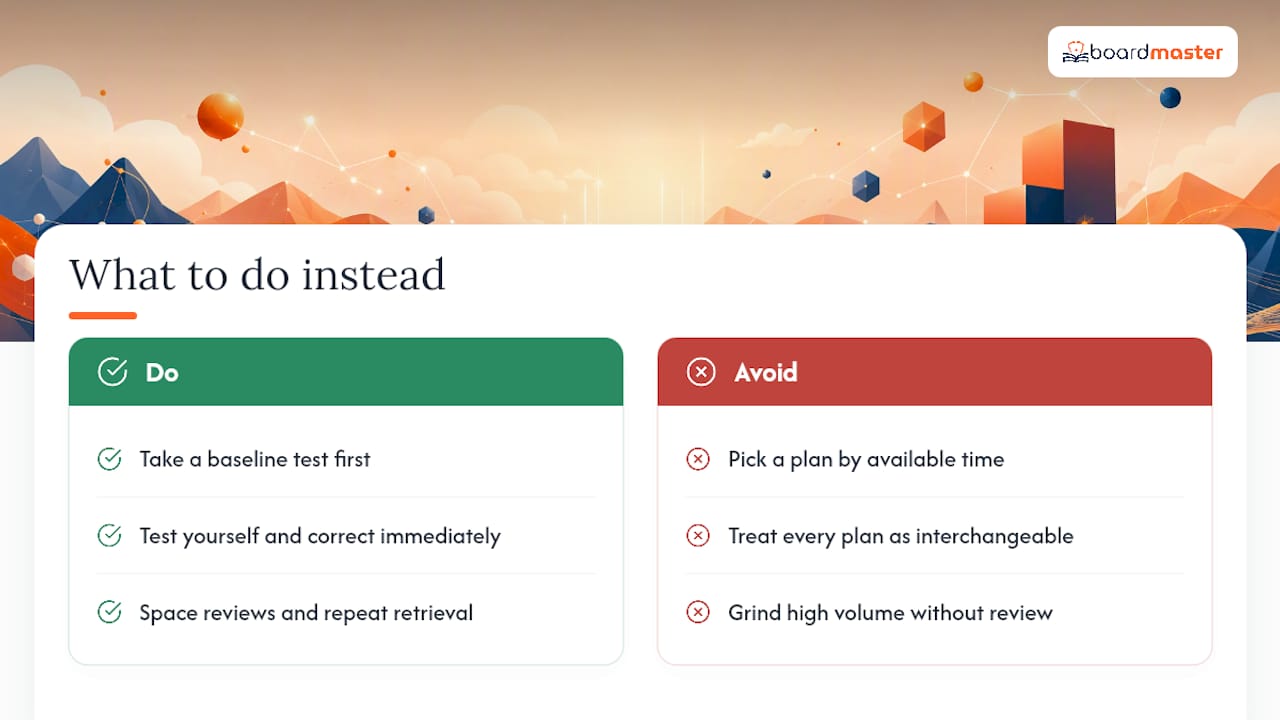
Most percentile advice treats every plan as interchangeable, as if the same 90-day question bank grind works whether you're at the 40th percentile or the 85th. It doesn't. A student stuck at the 40th usually has knowledge gaps that need direct remediation. A student stuck at the 85th usually has a speed or test-taking problem that more content review won't fix.
The bigger failure in conventional advice is treating volume as the whole strategy. Grinding 150 questions a day with no structured review of misses is close to wasted effort. The evidence on retrieval practice points to something narrower and less exciting than "study more": test yourself, correct immediately, space the review, and repeat. That's it. That's the mechanism behind every percentile jump this article describes.
If you take one thing from this, take the baseline test first. Students routinely pick a plan based on how much time they have, not on what their weaknesses actually are, and end up spending six weeks reinforcing skills they already had.
Run the Hybrid Targeted Plan Without the Manual Setup
Building a hybrid targeted plan by hand means manually cross-referencing lecture slides against a generic question bank, then guessing which topics your professor will test again. BoardMaster cuts that step out entirely: upload your lecture notes, and it generates targeted USMLE-style questions built around what your specific professors emphasize, not a generic high-yield list written for a different curriculum.

Pair that with BoardMaster's spaced flashcards and its bank of 5,000+ physician-written board-style questions, and you get the full hybrid targeted structure this article describes, running with progress tracking built in instead of a spreadsheet you maintain yourself. If you want to see how lecture notes turn into targeted questions before committing, watch the question generator demo or start with the free tier on the USMLE prep page and run your next study block against your actual class material.
Sources
- Spaced repetition meta-analysis (PubMed 2026)
- Anki use and academic performance systematic review (Medical Science Educator, 2026)
FAQ
How many percentile points can I realistically gain?
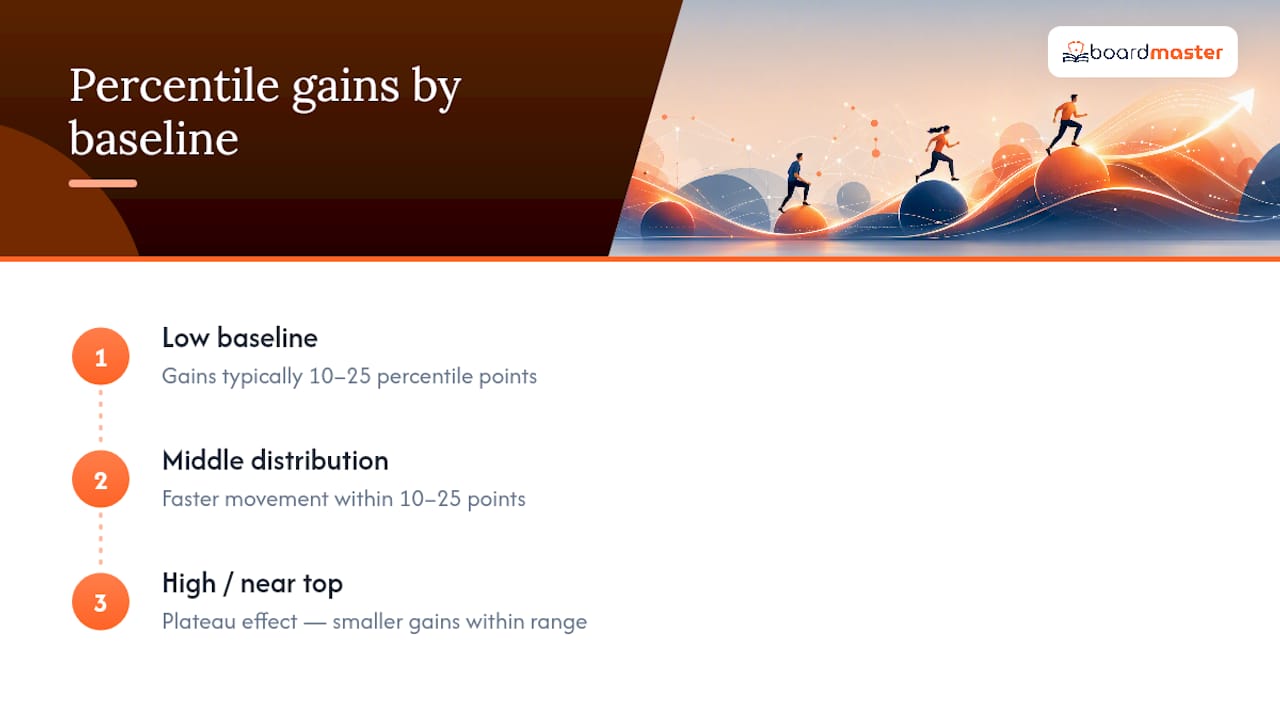
Gains typically range from 10 to 25 percentile points depending on your baseline, plan adherence, and how far you started from your ceiling. Students closer to the middle of the distribution tend to see faster movement than those already near the top.
Which plan works best with a short timeline?
The short intensive plan, built around 6 weeks of high-volume timed question blocks and weekly NBME mini-checks, fits best when your exam date is close and you need fast, measurable gains.
Do I need a question bank tool, or can I use notes alone?
Practice questions with immediate review consistently outperform passive note review; a tool that generates targeted questions from your own lecture content, such as BoardMaster, makes that process far more efficient than building question sets by hand.
How often should I take full-length practice exams?
Biweekly works well for short intensive plans; monthly fits distributed longitudinal plans better. Sitting one too infrequently makes it hard to catch a stalled plan early.
What if my percentile plateaus mid-plan?
Apply the decision rule directly: if two consecutive practice exams show under 5 percentile points of improvement, shift the ratio of question volume to remediation time rather than simply adding more hours.