
Targeted review reliably raises scores on concept and problem-solving exams, and it usually gets you there faster than rereading notes or grinding through generic question banks. The core method is simple: recognize your exact weak points, then resolve them with focused practice and a re-test that proves the fix worked. That's the role of targeted review in score improvement, and it works because it puts your limited study hours against the specific gaps costing you points instead of spreading effort evenly across material you already know.
Here's what to do in the next three days if you want proof this works before you commit to it long-term:
- Diagnose one weakness today. Pull your last practice test or quiz and find the single topic or error type that cost you the most points.
- Pick 10 targeted questions tomorrow. Find or generate questions that hit that exact weak spot, not a general review set.
- Re-test in 48 to 72 hours. Retry the same question type, untimed first, then timed, and confirm the gap closed before moving to the next one.
That three-step loop, called "recognize and resolve," is the backbone of everything below.
Key Takeaways
Targeted review improves scores fastest in concept and problem-solving subjects by replacing broad rereading with a diagnose-drill-retest cycle built on your own mistakes.
| Point | Details |
|---|---|
| Diagnose before drilling | Classify every missed question as a content gap, careless error, trap answer, or timing issue before choosing what to study. |
| Best fit is quantitative subjects | Math, physics, chemistry, and standardized-test reasoning respond fastest to targeted review. |
| Pair with memory techniques for recall-heavy subjects | Mnemonic-heavy biology and anatomy need spaced repetition alongside targeted review, not instead of it. |
| Measure with percent improvement | Compare pre- and post-test scores on the same skill using comparable difficulty and timing. |
| Avoid poor retest hygiene | Use fresh questions for re-tests, not the same drilled set, to get an honest read on progress. |
| BoardMaster automates the cycle | The platform generates lecture-based targeted questions and schedules spaced re-tests, cutting manual tracking time. |
Table of Contents
- What Is Targeted Review, and How Is It Different From Regular Studying?
- Does Research Actually Support Targeted Review for Raising Scores?
- Which Subjects and Exams Benefit Most From Targeted Review?
- How Should Students Build a Targeted Review Plan?
- How Can Teachers Run Targeted Review Sessions With a Whole Class?
- What Does a Good Targeted Practice Set Actually Look Like?
- How Do You Know If Targeted Review Actually Raised Your Score?
- What Mistakes Undermine Targeted Review, and How Do You Avoid Them?
- What Do Real Studies and Student Results Show About Targeted Review?
- What's the Bottom Line on Targeted Review?
- What Do an Educator and a Student Actually Think About This Method?
- How BoardMaster Turns Targeted Review Into a Faster Workflow
- Sources
- FAQ
What Is Targeted Review, and How Is It Different From Regular Studying?
Targeted review means diagnosing your exact error pattern before you study, then drilling only that pattern until it's fixed. A target-based reviewing trial built around this exact structure describes it as two phases: recognizing specific deficiencies, then resolving them with curated practice matched to those deficiencies. Conventional review skips the diagnosis step entirely. You reread the chapter, redo the problem set, or watch the lecture again, hoping the repetition sinks in somewhere useful.
That difference sounds small until you look at what each approach actually asks of your time.
- Assessment first. Targeted review starts by classifying exactly what went wrong on each missed question, not just that it was missed.
- Smallest high-impact gap. You drill the narrowest skill that's costing you the most points, not the whole subject.
- Spaced re-checks. You revisit the same error type at set intervals to confirm it actually stuck.
| Conventional Review | Targeted Review |
|---|---|
| Rereads all material evenly | Diagnoses specific error types first |
| No feedback loop on what changed | Re-tests the exact gap that was drilled |
| Timeline: open-ended, often weeks | Timeline: days, tied to a specific re-test date |
| Input: notes, textbooks, lectures | Input: your own missed questions and error log |
The practical distinction is that conventional review treats all content as equally in need of attention. Targeted review treats your mistakes as data, then acts on that data directly. The Mistake Audit method takes this even further by having students redo every missed question untimed, categorize the miss, and only then build a drill around it.
Does Research Actually Support Targeted Review for Raising Scores?
Yes, and the evidence is more specific than most study advice you've read. A trial testing target-based reviewing with 28 students compared it against conventional review across four subjects. The target-based group showed an upward trend in grades for math, physics, and chemistry, and it took less time to produce those gains than the conventional review approach did. Biology, which leans heavily on memorization and mnemonics rather than problem-solving, showed a smaller improvement.
That subject split matters more than the headline finding. Targeted review works best when a wrong answer reveals a specific, fixable procedural error, something that's much easier to isolate in a physics problem than in a biology term you either remember or don't.
Three mechanisms explain why this approach outperforms generic review:
- Error diagnosis narrows the target. You stop studying broadly and start studying the exact thing that's wrong.
- Specificity of practice beats volume. Ten questions matched to your actual gap beat fifty questions covering everything.
- Error-category matching separates content gaps from careless mistakes and pacing problems, so you're not re-learning material you already understand.
Research on the Mistake Audit method found that students who diagnosed each wrong answer and converted it into a targeted drill, with spaced re-testing at 48 hours and two weeks, saw the largest score jumps of any group studied. The gains came from converting review time into corrective action rather than passive rereading.
A trial of 28 students is not a large sample, and the subject mix (math, physics, chemistry, biology) doesn't cover every exam format you might be preparing for. Treat the upward trend as a solid signal, not a guarantee, especially outside quantitative subjects.
Which Subjects and Exams Benefit Most From Targeted Review?
Targeted review earns its keep fastest on exams where a wrong answer points to a specific, correctable process. It underperforms where wrong answers usually mean the fact simply wasn't memorized.
| Subject or Exam Type | Fit for Targeted Review | Why |
|---|---|---|
| Math, physics, quantitative chemistry | Best fit | Errors usually trace to a specific step or formula misuse |
| Standardized tests (SAT, ACT, LSAT logical reasoning) | Best fit | Question types repeat, making error patterns easy to isolate |
| USMLE and COMLEX board-style questions | Suitable | Concept-based reasoning responds well, though high-yield recall still matters |
| Mnemonic-heavy biology, anatomy, pharmacology | Combine with memory techniques | Misses often reflect gaps in recall, not process errors |
| Essay-based or open-response exams | Not well suited alone | Grading criteria are harder to isolate into a single fixable pattern |
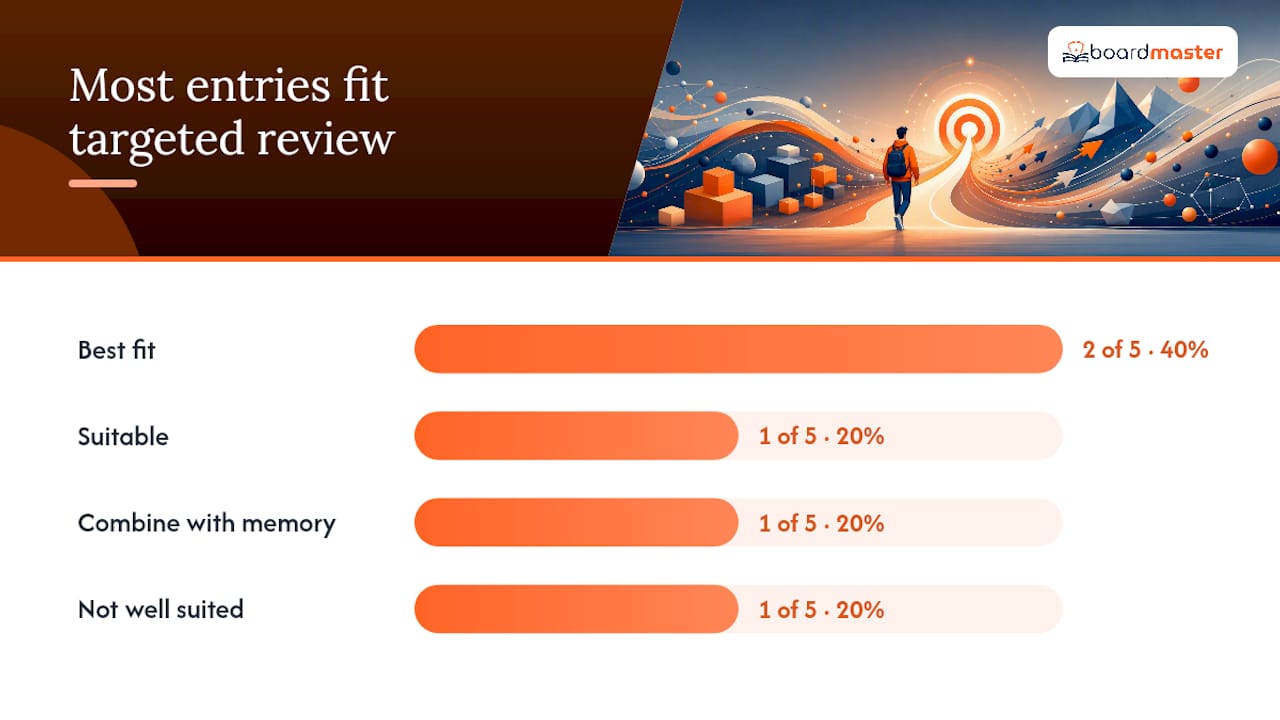
For time-limited prep, lean almost entirely on targeted review since it produces the fastest measurable gain per hour invested. For longer prep windows, mix in spaced repetition and mnemonic systems for memorization-heavy content, then layer targeted review on top once you've built the foundational recall. Trying to targeted-review your way through pure memorization gaps wastes the method's biggest strength: turning process errors into fixable drills.
How Should Students Build a Targeted Review Plan?
Start with a diagnostic pass before you touch a single practice question. Pull your last graded test, quiz, or timed set, and classify every miss into one of four buckets:
- Content gap. You didn't know the material at all.
- Careless error. You knew it but rushed, misread, or made an arithmetic slip.
- Trap answer. You fell for a distractor designed to catch a specific misconception.
- Timing issue. You got it wrong only because you ran out of time or rushed the final stretch.
That fourth category matters more than most students realize. If you can redo a missed question untimed and solve it correctly, the root cause usually isn't content, it's pacing or attention. Fixing pacing reclaims points faster than re-learning material you already understand.
Here's a 7-day plan for students with an exam coming up fast:
- Day 1: Diagnose your last three practice tests using the four-bucket classification above.
- Day 2 to 3: Drill only your top two content-gap categories with 15 to 20 targeted questions each.
- Day 4: Untimed re-test on those same categories.
- Day 5: Timed re-test to confirm the fix holds under pressure.
- Day 6: Address careless errors and trap answers with a slower, error-checking pass.
- Day 7: Full practice set, timed, to confirm overall gains.
For a longer runway, stretch this into a 2-week cycle: week one for diagnosis and drilling, week two for spaced re-testing at 48-hour and one-week intervals, which matches the spacing pattern the Mistake Audit method recommends for locking in gains.
Pro Tip: Cap each targeted drill session at 20 to 25 minutes on a single error type. If you're still missing questions in that category after 25 minutes, the problem usually isn't the drill, it's a content gap that needs direct instruction first. If you're working through medical board content, customizing your study plan around weak subjects speeds this whole process up considerably.

How Can Teachers Run Targeted Review Sessions With a Whole Class?
Running targeted review at scale requires a different workflow than one-on-one tutoring, but the recognize-resolve structure stays identical. The difference is you're diagnosing 30 students instead of one.
- Capture diagnostic data first. Use a recent quiz or practice test and tag each question by skill, not just topic.
- Group students by error pattern, not score band. Two students with the same overall score can have completely different gaps.
- Assign focused materials to each group. Give the algebra-error group different drills than the word-problem group, even if they scored similarly.
- Reassess within a week. A short quiz targeting only the drilled skill tells you whether the intervention worked.
A workable 50-minute session might look like this:
- First 10 minutes: Quick diagnostic quiz or review of pre-collected error data.
- Next 25 minutes: Small-group targeted drills, grouped by error type, with the teacher rotating between groups.
- Final 15 minutes: Timed re-test on the specific skill, followed by a quick show of results.
Grouping by error type instead of general ability level tends to produce better engagement, since students in each group are working on the same specific problem rather than a mix of things some already know. Lightweight tools like shared spreadsheets, exit tickets, or a quiz platform with per-question tagging work fine for capturing the diagnostic data. You don't need anything sophisticated to start this. Educators working with medical students preparing for USMLE Step 1 weak-subject identification can apply the same grouping logic across cohorts studying different systems.
What Does a Good Targeted Practice Set Actually Look Like?
The design of your practice questions matters as much as the diagnosis. A vague drill wastes the specificity that makes targeted review work in the first place.
For numerical or problem-solving subjects, build a template around the exact procedural step that failed. If a student consistently misapplies a formula under time pressure, the drill should isolate that formula in five variations before mixing it with anything else. For mnemonic-heavy tasks, the template shifts toward retrieval practice: flashcard-style recall with spaced intervals rather than procedural drilling, since there's no "process" to fix, only recall strength to build.
Progression should follow a clear structure:
- Micro-drill. Five to ten questions isolating the single weak skill, no distractions from other topics.
- Mixed set. Combine the drilled skill with two or three related skills to test whether the fix holds under normal conditions.
- Timed set. Add time pressure once accuracy is solid untimed.
- Re-test. A fresh set of questions on the same skill, at least 48 hours later, to confirm retention.
Spacing matters more than most students budget for. Revisit the same error type at roughly 48 hours and again at two weeks, which mirrors the interval pattern used in the Mistake Audit approach and gives you a real signal about whether the fix stuck or just looked good in the moment. Interleaving drilled skills with previously mastered ones during the mixed-set phase also helps you catch any regression before it shows up on the actual exam.
How Do You Know If Targeted Review Actually Raised Your Score?
Measuring improvement doesn't require a statistics degree, but it does require more rigor than "I felt more confident." Start with a simple percent-improvement calculation: subtract your pre-test score from your post-test score, divide by the pre-test score, and multiply by 100.
- Record a baseline score from a full practice test before starting any targeted drilling.
- Complete your targeted review cycle on the specific weak areas identified.
- Take a second practice test of comparable difficulty, ideally covering the same skill distribution as the first.
- Calculate percent improvement: (post-test score minus pre-test score) divided by pre-test score, times 100.
- Check whether the gain is isolated to the drilled skill or reflects broader improvement, which tells you whether the targeting actually worked.
A student who goes from 60% to 75% on the drilled skill category shows a 25% improvement in that specific area, a much more meaningful number than an overall test score bump that could reflect a dozen other factors.
For this comparison to mean anything, a few conditions have to hold:
- Same difficulty level between pre-test and post-test, or the comparison is meaningless.
- Representative sampling of the same skill areas, not a lucky or unlucky mix of questions.
- Consistent retest timing, ideally 48 hours to two weeks out, matching the spacing used during drilling.
- More than one data point before drawing conclusions, since a single test result can swing based on luck, fatigue, or an unusually easy or hard question set.
Single-case anecdotes, including impressive ones, can mislead because they don't account for natural variation between test administrations. A student who jumps 15 points might have simply gotten an easier version of the test, not experienced a real skill gain. Looking at the pattern across multiple targeted drills and re-tests gives a far more reliable signal than any one result on its own.
What Mistakes Undermine Targeted Review, and How Do You Avoid Them?
Targeted review fails in predictable ways, and most of them come from skipping the diagnosis step or misreading what a wrong answer actually means.
- Overfitting to practice-test formats. Drilling the exact question style you've seen before can create false confidence that doesn't transfer to a differently worded version on the real exam. Mix in questions from varied sources, not just one bank, to test whether the underlying skill actually transferred.
- Treating all wrong answers the same. A careless slip and a genuine content gap need completely different fixes; lumping them together wastes drilling time on material you already understand. Always run the four-bucket classification before choosing a drill.
- Neglecting pacing and attention issues. If untimed practice reveals you actually know the material, more content review won't help. Add timed drills specifically targeting speed and focus instead.
- Poor retest hygiene. Re-testing on the exact same questions you drilled tells you almost nothing about real mastery. Use fresh questions covering the same skill for any re-test that's supposed to measure progress.
- Stopping too early. A single successful re-test doesn't confirm the fix holds under exam conditions weeks later. Schedule a second check closer to the actual exam date.
Reviewing common Step 1 preparation mistakes is worth a look if you're prepping for boards specifically, since several overlap directly with the pitfalls above.
What Do Real Studies and Student Results Show About Targeted Review?
The clearest evidence comes from small but well-structured studies paired with practitioner accounts of students applying the method directly.
| Study or Source | Sample Size | Subjects Covered | Outcome Direction | Key Limitation |
|---|---|---|---|---|
| Target-based reviewing trial | 28 students | Math, physics, chemistry, biology | Upward trend in quantitative subjects; smaller gains in biology | Small sample; four-subject scope only |
| Mistake Audit method | Practitioner-reported | SAT and ACT | Largest reported score jumps tied to converting misses into drills | Not a controlled trial; based on practitioner observation |
| Test Prep Scout guidance | Practitioner-reported | SAT | Targeted weak-area focus outperforms even distribution of study time | Qualitative recommendation, not a measured trial |
Alongside the research, BoardMaster's own users provide a real-world illustration of what happens when targeted review is automated. A medical student named Sarah moved from the 73rd to the 92nd percentile on her practice exams while cutting her study time in half, using BoardMaster's lecture-based question generation to focus only on the concepts her professors actually emphasized. That's a single anecdotal case, not a controlled study, but it lines up with the same mechanism the research points to: less time spent on material you've already mastered, more time on the specific gaps that are actually costing you points.
- Small trial sizes mean effect sizes should be read as directional signals, not guaranteed outcomes for every student.
- Mnemonic-heavy subjects consistently show weaker results from targeted review alone, so pairing it with spaced repetition flashcards or memory techniques matters more there.
- Anecdotal results, including Sarah's, illustrate what's possible under favorable conditions rather than a typical or average outcome.
What's the Bottom Line on Targeted Review?
Targeted review earns its reputation because it replaces guesswork with a diagnosis, and it produces measurable gains fastest in subjects where wrong answers point to a fixable process rather than a missing memory. It's not magic, and it won't help much if your gaps are pure recall problems in a mnemonic-heavy subject without also building in spaced repetition. But for math, physics, chemistry, standardized tests, and most board-style reasoning questions, it's one of the higher-leverage study strategies available.
Five things worth doing this week if you're starting from scratch:
- Audit your last three full practice tests and classify every miss using the four-bucket system.
- Build a running mistake log instead of just moving on after each practice test.
- Schedule two focused re-tests at 48 hours and two weeks after your first drilling session.
- Combine targeted review with memory techniques for any subject that's mostly recall-based.
- Track percent improvement on the specific skill you drilled, not just your overall score, to confirm the fix actually worked.
What Do an Educator and a Student Actually Think About This Method?
Building targeted review into a curriculum takes more upfront work than assigning a standard review packet, but the payoff shows up fast once diagnostic data starts guiding grouping decisions instead of guesswork. The hardest part isn't the method, it's convincing students that spending less time on material they already know is a legitimate strategy rather than cutting corners. Once a class sees a re-test confirm real improvement in a narrow skill, buy-in comes quickly.
Practical tip for educators: Build the diagnostic quiz into your existing testing schedule rather than adding a separate assessment, so you're not asking for extra classroom time you don't have.
From a student's side, the appeal of targeted review is speed. Cutting hours out of a study schedule while still seeing scores climb changes how sustainable exam prep feels, especially during a stretch with multiple exams stacked close together. The harder part is discipline: it's tempting to keep rereading familiar material because it feels productive, even when a diagnostic clearly points somewhere else.
Practical tip for students: Trust the diagnostic over your gut feeling about what you need to review. The topic that feels comfortable is rarely the one actually costing you points.
How BoardMaster Turns Targeted Review Into a Faster Workflow
Running the recognize-resolve cycle by hand works, but it takes real time to tag every missed question, build a matching drill, and schedule a re-test on your own. BoardMaster is built specifically to automate that workflow for medical students preparing for class exams and board exams at the same time, using the actual lecture material your professors emphasize instead of a generic question bank.

The platform maps directly onto the steps covered in this guide:
- AI question generation from your own lecture notes, so drills match exactly what your professor tested, not a generic topic list.
- Mistake logging that tracks error patterns across sessions instead of leaving you to build a spreadsheet manually.
- Spaced re-testing tools that automatically schedule follow-up questions on the same weak areas at the intervals shown to work.
Sarah's jump from the 73rd to the 92nd percentile, achieved while cutting her study hours in half, came from exactly this kind of automated targeting rather than working through a static question bank. It's one student's reported result, not a guarantee, but it reflects the same mechanism the research supports: less time on mastered material, more time on the exact gaps costing points. If you want to see how the AI question generator turns lecture content into targeted practice, the demo shows the full recognize-to-resolve cycle in action, and the free tier lets you test it against your next block exam before committing to anything.
Sources
- Target-based Reviewing Method
- Why your wrong SAT/ACT answers are worth more than your right ones: The Mistake Audit Method
- How to improve your SAT score by 100+ points | Test Prep Scout
FAQ
What is the purpose of a targeted review in exam prep?
The purpose is to diagnose your exact error pattern and fix it directly, rather than rereviewing all material evenly regardless of where your actual gaps are.
How can I improve my test scores quickly?
Diagnose your last practice test by error type, drill only the top one or two weak areas with focused questions, then re-test within 48 hours to confirm the fix held.
What is the best way to introduce, reinforce, and review information for exams?
Introduce new material through initial instruction, reinforce it with spaced practice, and review it through targeted drills on whatever a diagnostic test shows you missed, rather than a blanket reread.
What are some effective review methods besides targeted review?
Spaced repetition flashcards work well for memorization-heavy content, while interleaved practice sets help confirm that a fixed skill holds up when mixed with other material; both pair well with targeted review rather than replacing it.
Does targeted review work for medical board exams like the USMLE?
Yes, targeted review suits concept-based board reasoning well, and platforms like BoardMaster apply it by generating practice questions directly from a student's own lecture material to match what professors actually emphasize.
How do I know if my targeted review is actually working?
Compare a pre-test and post-test score on the same drilled skill using comparable difficulty, and calculate percent improvement rather than relying on how confident you feel.