
Custom questions reduce study time most reliably when you answer targeted, pre-made sets with spaced re-testing, as answering curated sets is more efficient. When time allows, generating your own questions can deepen understanding, but typically requires more time and is best reserved for consolidation phases. When you have time for deeper consolidation, generating your own questions can further improve retention, but requires more upfront time. Instead of rereading chapters you already understand, you spend every minute on the material that's actually costing you points.
Three things you can do right now:
- Identify one weak topic from your last practice exam or quiz and write it down.
- Run a 15–25 question targeted quiz on that topic only, using available question banks or AI-generated sets.
- Schedule two spaced reviews of those same items: one tomorrow, one in 5–7 days.
That's the whole system in miniature. The rest of this article explains why it works, how to build it properly, and where students go wrong.
Key Takeaways
Custom questions reduce study time most reliably when you answer targeted, pre-made sets with spaced re-testing, as answering curated sets is more efficient. When time allows, generating your own questions can deepen understanding, but typically requires more time and is best reserved for consolidation phases.
| Point | Details |
|---|---|
| Retrieval beats rereading | Answering targeted questions encodes material more durably per minute than passive review. |
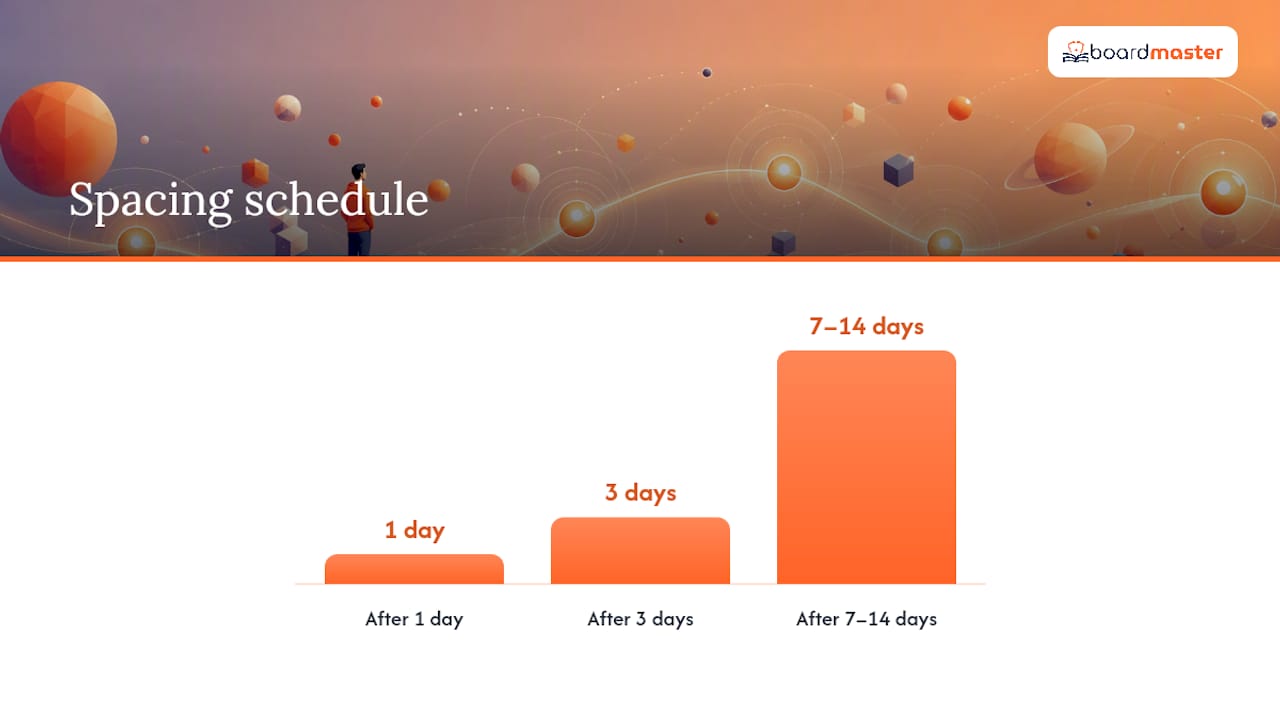
| Spacing multiplies the benefit | Schedule re-tests at 1 day, 3 days, and 7–14 days to lock in retention without extra hours. |
| Generation vs. answering trade-off | Testing effect sizes (d≈0.96) exceed question generation (d≈0.75); use curated sets when time is short. |
| Track retention, not hours | Measure accuracy on spaced re-tests, not time at the desk, to know whether studying is working. |
| BoardMaster automates the setup | BoardMaster generates syllabus-aligned questions from lecture notes, cutting creation time and preserving retrieval benefits. |
Table of Contents
- Why custom questions reduce study time: what they are and how they differ
- The cognitive mechanisms that make targeted practice so efficient
- How to build high-efficiency custom questions and short quizzes
- What the research actually says about time saved and the trade-offs
- Common mistakes that blunt the time-saving benefit
- Custom-question sets for different exams and subjects
- The case for a two-week pilot before you commit to anything
- BoardMaster turns lecture notes into targeted practice in minutes
- Where to read more
- Sources
- FAQ
Why custom questions reduce study time: what they are and how they differ
A custom question is any practice item selected or generated to match your syllabus, your weak topics, your exam format, and your current difficulty level. That specificity is what separates them from generic question banks, which hand you 2,000 items with no filter for what you already know.
The main variants:
- Student-authored questions — you write your own MCQs or short-answer items from lecture notes; high effort, high depth.
- Filtered question-bank quizzes — you apply topic, difficulty, and format filters to a pre-built bank and pull a focused set.
- AI-generated questions from lectures — software reads your uploaded notes and produces syllabus-aligned items automatically.
- Instructor-curated short sets — a professor or tutor selects 10–20 high-yield items tied to a specific session.
Format matters too. An 8–20 item MCQ quiz takes about 15–30 minutes and keeps focus tight. Five-minute rapid-fire recall prompts work for vocabulary or definitions. Cloze (fill-in-the-blank) items and mixed-difficulty interleaved sets push you to retrieve across contexts, not just recognize a familiar stem.
The cognitive mechanisms that make targeted practice so efficient
Retrieval practice and the testing effect
Answering a question is harder than rereading a paragraph. That difficulty is the point. Research on retrieval practice consistently shows that active recall encodes material more durably per minute than passive review. The struggle to retrieve an answer strengthens the memory trace in a way that simply reading the same text again does not.
UNC's Learning Center frames this as the core efficiency driver: the effort of retrieval is not a sign that you're studying wrong. It's the mechanism.
Targeted weak-area remediation
Generic review forces you to cover everything. Custom questions let you skip what you already know and concentrate on the gaps. That alone can cut hours from a study week, because most students spend a disproportionate amount of time on comfortable material.
Scientific American's coverage of that same research puts it plainly: the techniques most students default to are among the least effective. Custom questions are the practical delivery mechanism for the two techniques that actually work.
Spacing and distributed practice
A single two-hour cramming session is far less effective than four 30-minute sessions spread across a week. Short custom quizzes scheduled across days force distributed practice, which encodes material more durably and reduces the total review time needed before an exam.
Interleaving and reduced cognitive fatigue
Cornell's Learning Strategies Center recommends mixing topics and difficulty levels within a single quiz session. Interleaving forces your brain to retrieve the right framework for each item, not just pattern-match within a single topic block. It's harder in the moment and more effective over time. It also keeps sessions short enough to maintain real concentration, which matters more than most students realize.
How to build high-efficiency custom questions and short quizzes
Diagnose first. Run a 30–50 question untimed diagnostic or list every topic you've missed on recent practice exams. You need a concrete list of weak areas before you filter anything.
Filter or create questions tied to those topics. Match the format to your exam: MCQ for boards and licensing exams, short-answer for essay-heavy courses. For professor-specific content, pull items that reflect the concepts your instructor emphasizes.
Set quiz size and timing. Keep sessions to 8–20 items and 15–30 minutes. Add a timer when your exam is timed; pacing under pressure is a skill that needs practice.
Schedule spacing. Repeat targeted quizzes after 1 day, then 3 days, then 7–14 days depending on how well you retained the material. Accuracy on the spaced re-test tells you whether you actually learned it.
Require immediate feedback. Read the explanation for every item you miss, and mark those items for re-drill. Skipping explanations is one of the fastest ways to waste a quiz session.
Track the right metrics. Accuracy, time per question, and confidence level guide your next custom set. Hours studied tells you almost nothing about what you retained.
Pro Tip: When time is tight, start with filter-based custom quizzes from a vetted bank. Reserve student-authored question generation for consolidation phases or when you want to mirror the exact style of your exam.
What the research actually says about time saved and the trade-offs
The evidence for custom-question practice is strong, but it comes with a nuance worth knowing before you commit to a method.
Answering pre-made targeted questions is efficient. Creating your own questions is effective but slower. A comparative study found that testing produced an effect size of approximately d≈0.96 and question generation approximately d≈0.75 in some adult samples, with both outperforming simple restudying. The trade-off: generating questions often requires more time and cognitive effort than answering a well-curated set.
| Study / Source | Main Finding | Time Implication |
|---|---|---|
| Roediger & Karpicke (2006), PubMed | Retrieval practice outperforms passive review for long-term retention | Answering targeted questions saves time vs. rereading |
| Dunlosky et al. (2013) | Practice testing and distributed practice rated highest utility | Focused quizzes replace hours of low-yield review |
| Wiley/ACP (question generation vs. testing) | Testing d≈0.96, generation d≈0.75; both beat restudying | Generation is effective but costs more time upfront |
| PMC systematic review, medical students | Student-generated MCQs mostly positive; time cost and variability noted | Generation works best with guidance and structured support |
| Quizzical classroom study (PMC) | Engagement with authored question banks correlated with higher exam performance | Incentives and feedback are required for the benefit to hold |
The practical guidance from this evidence:
- When you're short on time, answer curated custom quizzes rather than writing your own.
- When you have time to invest, student-authored questions deepen understanding and improve transfer, especially for complex clinical reasoning.
- Practice question retention research for medical students shows that the combination of targeted selection and spaced re-testing produces the most durable gains.
Common mistakes that blunt the time-saving benefit
Most students who try custom questions still waste time. Here's where it goes wrong:
Too-broad custom sets. Pulling 80 questions across every topic defeats the purpose. Keep sets small and filtered aggressively by weakness. If you're comfortable with a topic, it doesn't belong in the set.
Poor-quality questions or ambiguous distractors. A badly written MCQ teaches you to guess, not to reason. Use vetted question banks or write simple, clear stems with one unambiguously correct answer and plausible wrong choices. Why generic banks fall short is partly a quality problem, not just a relevance one.
No spacing — cramming the same items repeatedly. Running the same 20-question set three times in one afternoon is not spaced practice. Schedule re-tests across days. The gap between sessions is where consolidation happens.
Skipping feedback and reflection. Reading an explanation for a missed item takes 90 seconds. Skipping it means you'll miss the same item again in three days. A systematic review of student-generated MCQs in medical education found that structured feedback and guidance were the factors that separated effective programs from ineffective ones.
Measuring hours instead of retention. Three hours of unfocused review feels productive. Twenty minutes of targeted retrieval with 85% accuracy on a spaced re-test is productive. Track correct-on-re-test, not time at the desk.
Custom-question sets for different exams and subjects
USMLE Step 1 or Step 2
Pull 15 mixed-difficulty MCQs from your last three lectures, then add 10 high-yield items flagged by your tutor or a physician-written bank. Run the session in 40–60 minutes with a timer. Schedule a spaced re-check in 3 days on the items you missed. This mirrors the actual exam format while keeping the content tied to what your course is currently covering.
BoardMaster's workflow maps directly to this: upload lecture notes, auto-generate USMLE-style questions aligned to your professor's emphasis, and use the analytics to flag items for re-drill. It collapses the creation step from hours to minutes.
Undergraduate course finals
Two 10-question quizzes on your two weakest chapters, run as 20-minute daily sessions across one week. That's 100 targeted retrievals in seven days, all focused on the material most likely to cost you points. No marathon sessions, no rereading the whole textbook.
Language vocabulary
Five-minute cloze sets interleaved across three sessions per week outperform a single hour-long vocab marathon. The Cornell Learning Strategies Center recommends exactly this kind of distributed, interleaved practice for retention across subjects.
The case for a two-week pilot before you commit to anything
The most common objection to custom-question practice is that it takes time to set up. That's partly true for student-authored questions. It's not true for filtered or AI-generated sets, which can be ready in under five minutes.
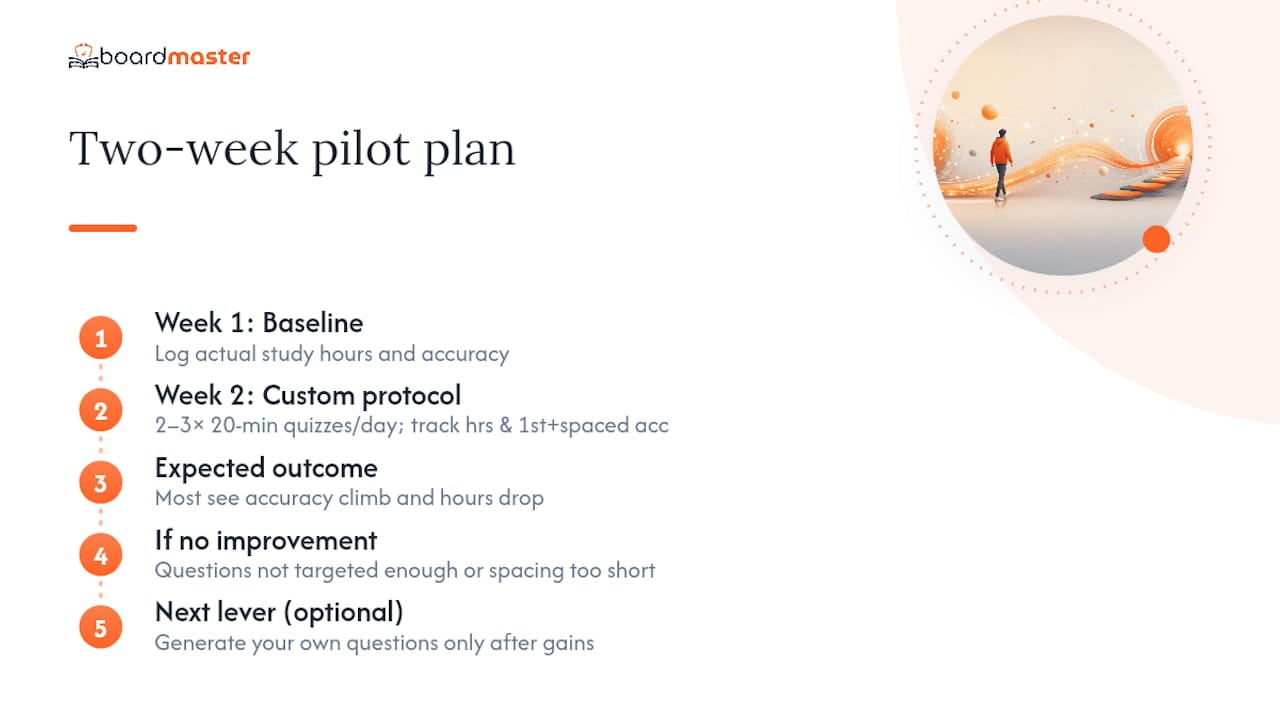
Here's what I'd recommend: run a two-week pilot before you change your entire study system.
Week 1 (baseline): Log your actual study hours and your accuracy on any practice items you attempt. Don't change anything yet. You need a real number to compare against.
Week 2 (custom-question protocol): Replace passive rereading with two or three 20-minute custom quiz sessions per day, spaced across the week. Track hours, accuracy on first attempt, and accuracy on spaced re-test.
Most students see accuracy climb and hours drop within the second week. If you don't, the problem is usually one of two things: the questions aren't targeted tightly enough, or the spacing intervals are too short. Both are fixable. If you're preparing for boards and want to go deeper, switching from answering curated sets to generating your own questions is the next lever, but only after you've captured the efficiency gains from targeted retrieval first.
BoardMaster turns lecture notes into targeted practice in minutes
The hardest part of custom-question practice isn't the studying. It's the setup: finding the right questions, filtering them to your syllabus, and scheduling re-tests without losing track of what you've already covered.
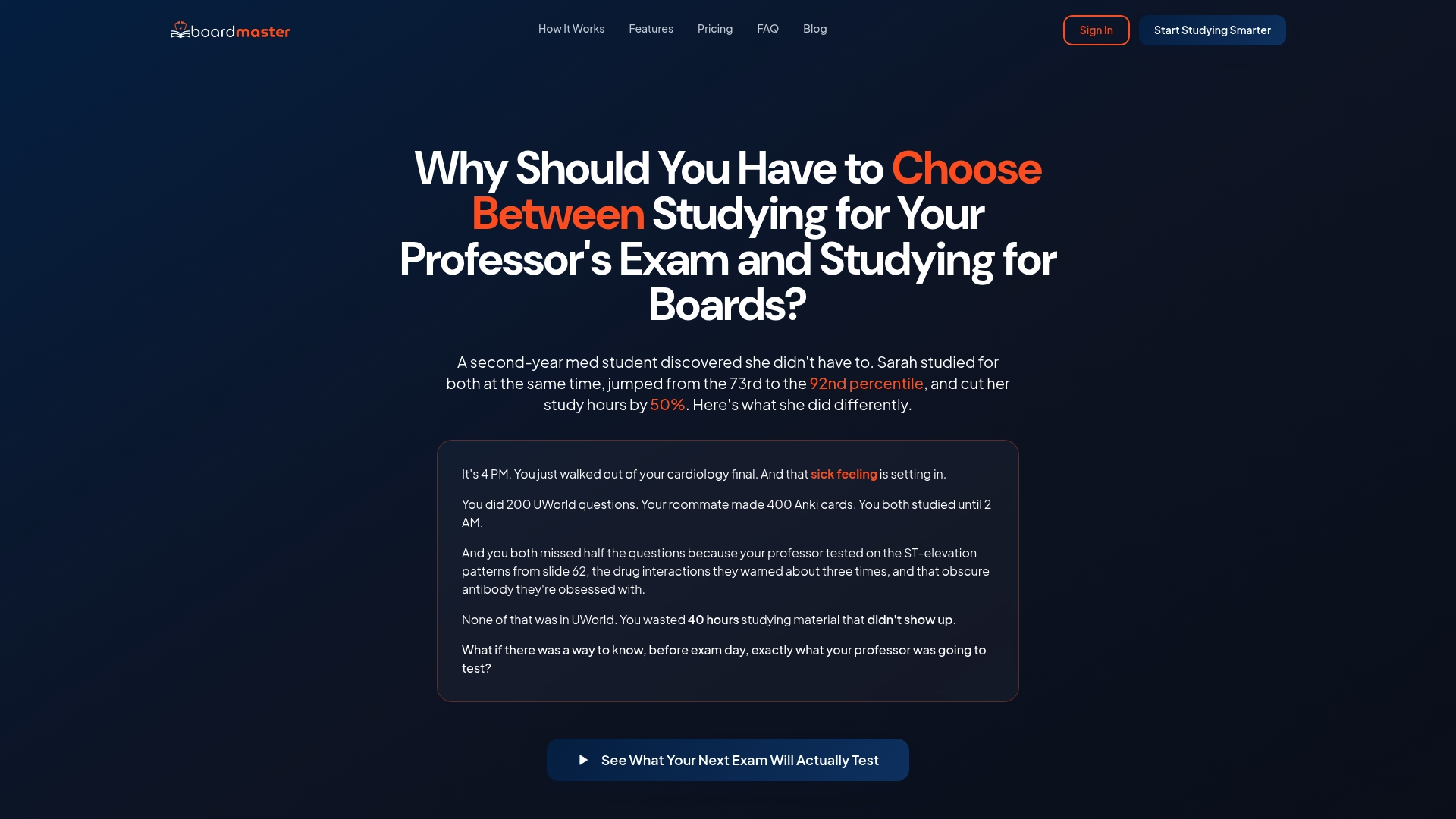
BoardMaster handles that entire layer. Upload your lecture notes and the platform generates AI-powered USMLE-style questions aligned to what your professor actually emphasized, not a generic curriculum. Every session includes immediate explanations, timed practice, and analytics that tell you exactly which items to re-drill and when. Sarah, a medical student who used BoardMaster's targeted question workflow, moved from the 73rd to the 92nd percentile while cutting her study hours in half. That's not a promise of identical results, but it illustrates what focused retrieval on the right material can do.
If you're preparing for USMLE Step 1 or Step 2, the USMLE prep tools include both AI-generated lecture-based questions and a bank of 5,000+ physician-written items you can filter by topic, difficulty, and exam relevance. Start with a free session and see how many questions your first lecture generates.
Where to read more
- Dunlosky et al. (2013), Psychological Science in the Public Interest — The foundational meta-analysis rating practice testing and distributed practice as highest-utility techniques. Start here for the evidence base.
- Roediger & Karpicke (2006), PubMed — The core retrieval-practice study showing active recall outperforms passive review for long-term retention.
- UNC Learning Center: Studying 101 — Practical, student-facing guide to retrieval practice and spacing. Good first read for anyone new to these techniques.
- Cornell Learning Strategies Center: Effective Study Strategies — Covers blank-page testing, interleaving, and spacing with classroom-ready tactics.
- Wiley/ACP: Question Generation vs. Testing — Comparative effect sizes for generating questions versus answering them; useful for deciding which method fits your time budget.
- PMC Systematic Review: Student-Generated MCQs in Medical Education — Covers benefits, time costs, and the conditions under which student-authored questions work best.
- Quizzical MCQ Authoring Study (PMC) — Classroom evidence on question-authoring programs and the role of feedback and incentives.
- Scientific American: Psychologists Identify the Best Ways to Study — Accessible lay summary of the Dunlosky findings; useful for sharing with study partners who want the short version.
Sources
- PubMed entry on retrieval practice vs. passive review
- Studying 101: Study Smarter Not Harder – The Learning Center (UNC)
- Improving Students’ Learning With Effective Learning Techniques (Dunlosky et al.)
- Quizzical MCQ authoring, testing, and learning tool study (PMC)
- Article on the effects of question generation versus testing (Wiley/ACPersonality & Cognition)
- Does developing multiple-choice Questions Improve Medical Students’ Learning? A Systematic Review (PMC8725700)
- Effective study strategies – Learning Strategies Center (Cornell)
- Psychologists identify the best ways to study (Scientific American)
FAQ
Do custom questions actually save study time?
Yes, when they target genuine weak areas and are paired with spaced re-testing. Research consistently shows that answering targeted questions outperforms passive rereading for long-term retention, replacing hours of low-yield review with shorter, higher-impact sessions.
Are shorter study sessions better than longer ones?
For most material, yes. Distributed practice across multiple short sessions encodes information more durably than a single long session, according to Dunlosky et al. The key is spacing those sessions across days, not cramming them into one afternoon.
How does a personalized study plan help you succeed long-term?
Targeting your specific weak areas means you spend time where it produces the most improvement, rather than reviewing material you already know. That efficiency compounds: each study cycle closes real gaps, so later review sessions start from a higher baseline.
Is it better to write your own questions or answer pre-made ones?
When time is limited, answering curated custom quizzes is more efficient. A comparative study found testing produced a higher effect size than question generation, and generation typically requires more time. Write your own questions during consolidation phases when you can afford the extra investment.
What is the 1-3-5-7 rule in studying?
Definitions vary across sources, but the phrase typically refers to a spaced-repetition schedule where you review material at 1 day, 3 days, 5 days, and 7 days after first learning it. The underlying principle matches well-established distributed-practice research: spacing reviews across days produces more durable retention than massed review.