
Clinical correlation in preclinical medical education is an instructor's clinical example or case that directly links a basic-science concept — anatomy, physiology, biochemistry, histology, or pharmacology — to a patient presentation or medical application. Recognizing these connections is what separates students who score in the 90th percentile from those who memorize facts without context, and it is the exact skill that USMLE-style vignettes test on every exam. The International Association of Medical Science Educators (IAMSE) and peer-reviewed medical education literature both confirm that building this skill early, during preclinical years, is the most reliable path to stronger clinical reasoning and better exam outcomes.
Key Takeaways
Clinical correlation in preclinical education is the skill of tracing a patient presentation back to its basic-science mechanism — and practicing that skill with vignettes is the most direct path to higher board scores.
| Point | Details |
|---|---|
| Core definition | Clinical correlation links a basic-science concept to a patient presentation through instructor-provided examples or cases. |
| Five recognized types | Types range from brief lecture factoids to longitudinal PBL cases; complexity increases as foundational knowledge grows. |
| Exam application | Every USMLE vignette hides a basic-science hook; reverse-engineer from clinical signs to mechanism to answer. |
| Top study action | Convert one lecture slide per session into a vignette stem, answer, and spaced-repetition flashcard. |
| BoardMaster | Upload lecture notes to generate professor-targeted USMLE-style questions and flashcards, cutting vignette-creation time significantly. |
Table of Contents
- Why does clinical correlation matter for preclinical exams?
- What are the five types of clinical correlation in basic science courses?
- How do you recognize and use clinical-correlation vignettes on exams?
- How do instructors design effective clinical correlations?
- High-yield ways to study with clinical correlations
- Common pitfalls with clinical correlations and how to fix them
- Step-by-step: convert a lecture slide into a vignette
- What clinical correlations actually teach you
- BoardMaster turns your lecture notes into vignette practice
- Sources
- FAQ
Why does clinical correlation matter for preclinical exams?
The payoff is concrete. According to peer-reviewed medical education research, clinical correlations help students develop clinical reasoning skills, increase motivation, and improve long-term retention by linking biomedical and clinical concepts across curricular stages. That is not a soft benefit — retention and reasoning are exactly what vignette-style questions measure.
Key benefits backed by the literature:
- Retention: Connecting a biochemical pathway to a disease presentation creates a dual memory trace. The clinical story anchors the science.
- Clinical reasoning: Working from symptom to mechanism trains the diagnostic logic that board exams require.
- Motivation: Students who see why a concept matters study it more thoroughly.
- Exam alignment: Many medical schools embed at least one clinical correlation per lecture specifically because those examples tend to reappear as exam vignettes, without requiring in-depth disease memorization.
IAMSE notes that while lectures deliver information efficiently, case-based clinical correlation formats are more effective at training problem-solving and linking bench science to patient care. For you as a student, that means passive note-taking is not enough. You need to practice the translation step.
Two immediate practice implications: first, after every lecture, identify the one clinical example your professor used and write a single-sentence explanation of the underlying mechanism. Second, when you review, start from the clinical sign and work backward to the basic science — not the other way around.
What are the five types of clinical correlation in basic science courses?
A 2018 review in the journal Anatomical Sciences Education describes five distinct types of clinical correlations used in basic-science teaching. Knowing the taxonomy helps you recognize what your instructor is doing and how to study it.
| Type | Description | Discipline Example |
|---|---|---|
| Correlated examples | A brief clinical factoid embedded in a lecture slide | Physiology: "Excess aldosterone causes hypertension via Na⁺ retention" |
| Interactive demonstrations | Real-time instructor demonstration with student participation | Anatomy: cadaveric lesion mapped to expected motor deficit |
| Specialized workshops | Dedicated sessions pairing basic science with clinical skills | Histology: disease slide matched to microscopic image of lung fibrosis |
| Small-group activities | PBL-style cases students work through collaboratively | Pharmacology: drug mechanism case solved in teams |
| Course-centered problem solving | Longitudinal cases that recur across multiple courses | Biochemistry + Pathology: a metabolic disorder traced from enzyme defect to organ failure |
Complexity increases from top to bottom. Correlated examples appear in almost every lecture; course-centered problem solving is typically introduced once students have enough foundational knowledge to handle multi-system cases. The University of Maryland pre-clerkship curriculum illustrates this progression, listing formats from didactic illustrations through simulation and PBL as students advance.
The Tufts School of Medicine MD curriculum shows how histology and organ-system units explicitly integrate clinical-anatomic correlations, simulation, and physical-exam practice — a real-world example of all five types appearing within a single program.
How do you recognize and use clinical-correlation vignettes on exams?
Board-style vignettes almost always hide a basic-science hook inside a clinical story. Your job is to find it fast.
Here is an annotated example:
Vignette stem: A 19-year-old male presents with tall stature, arm span greater than height, lens dislocation, and aortic root dilation. His mother has similar features.
- Identify the clinical signs: tall stature, lens dislocation, aortic root dilation, family history.
- Map to a system: connective tissue (skeletal + ocular + cardiovascular involvement).
- Name the basic-science mechanism: defect in fibrillin-1 (FBN1 gene) disrupts microfibrils in the extracellular matrix, weakening elastic tissue throughout the body.
- Predict the answer: questions will ask about the structural protein affected, the inheritance pattern (autosomal dominant), or the cardiovascular complication (aortic dissection).
The answer is never just "Marfan syndrome." The question is testing whether you know why the aorta dilates, which is the basic-science layer the vignette is built on.
Pro Tip: Reverse-engineer every vignette. Start with the clinical signs, infer the affected structure or pathway, then name the basic-science concept. This trains the same reasoning loop that board exam vignettes are designed to test.
How do instructors design effective clinical correlations?
Understanding faculty best practices helps you anticipate what your professors are doing and ask better questions. According to IAMSE's collaborative integration strategy, the most effective programs share a few consistent features:
- Clinician–basic scientist collaboration: A surgeon or internist co-designs the case with the biochemist or anatomist. This prevents clinical details from being disconnected from the science being taught.
- Longitudinal case reuse: The same core patient case reappears across courses — first in anatomy, then in physiology, then in pathology — so students build layered understanding rather than isolated facts.
- Assessment alignment: Correlations are tied to learning objectives that appear on exams. If a clinical example is not on the blueprint, it is context, not a testable item.
- Scaffolded complexity: Simple correlated examples come first; small-group and simulation formats are introduced after foundational concepts are in place.
A first-year elective combining surgeon-led sessions with cadaveric demonstrations reported higher student satisfaction and better anatomy exam averages among participants — evidence that clinically oriented programs produce measurable outcomes, not just engagement.
High-yield ways to study with clinical correlations
A lean study workflow built around clinical correlations takes about 15–30 minutes per lecture and produces material you can reuse for both class exams and boards.
- Identify the core concept. Pull the single most testable fact from the lecture (a pathway, a structure, a drug mechanism).
- Write a one-line clinical hook. "A patient with X presents with Y because of Z." Keep it to one sentence.
- Draft a 1–2 question vignette. Use the hook as your stem. Write one correct answer and two plausible distractors.
- Self-test immediately. Answer your own question without looking at notes.
- Add to spaced repetition. Drop the vignette into a flashcard system for review at 1, 3, and 7 days.
Pro Tip: You do not need to write every vignette from scratch. Upload your lecture slides to BoardMaster and the platform generates USMLE-style questions targeting the concepts your professor emphasized — cutting the vignette-creation step from 20 minutes to under 2.
Common pitfalls with clinical correlations and how to fix them
- Treating correlations as trivia. Fix: always trace the clinical sign back to a mechanism. "Aortic dilation in Marfan" is trivia; "fibrillin-1 defect weakens elastic tissue" is testable.
- Memorizing the disease instead of the concept. Fix: ask "what basic-science principle does this disease illustrate?" not "what are the features of this disease?"
- Cognitive overload from excessive clinical detail. Fix: if a correlation introduces more than two new clinical facts, strip it back to the one fact that maps directly to the learning objective.
- Poor scaffolding. Fix: do not attempt course-centered problem-solving cases before you have the foundational science. Build from correlated examples upward.
- Misalignment with assessment. Fix: check whether the clinical example appears in the learning objectives or the professor's stated exam topics. If it does not, treat it as context only.
- Skipping the reverse-engineering step. Fix: after reading any vignette, always ask "what structure or pathway is broken here?" before looking at the answer choices.
Step-by-step: convert a lecture slide into a vignette
This exercise takes 20–30 minutes and produces one exam-ready question.
- Pick a learning objective. Example: "Describe the role of fibrillin-1 in connective tissue integrity."
- Select 1–2 clinical signs that follow from the defect. Lens dislocation (zonular fibers) and aortic root dilation (elastic lamina).
- Write the vignette stem. "A 17-year-old male with tall stature, pectus excavatum, and bilateral lens dislocation is found to have aortic root dilation on echocardiogram. His father had a similar build and died of a sudden aortic event at age 42. Which protein is most likely defective?"
- Write answer options. (A) Collagen type I, (B) Fibrillin-1, (C) Elastin, (D) Laminin, (E) Fibronectin.
- Map to the mechanism. Correct answer: B. Fibrillin-1 forms microfibrils that anchor elastic fibers; its loss weakens the aortic wall and the zonular fibers of the lens.
- Convert to a flashcard. Front: the vignette stem. Back: correct answer + one-sentence mechanism.
Repeat this for three lecture slides per week and you will have a personal vignette bank by the end of the block.
What clinical correlations actually teach you
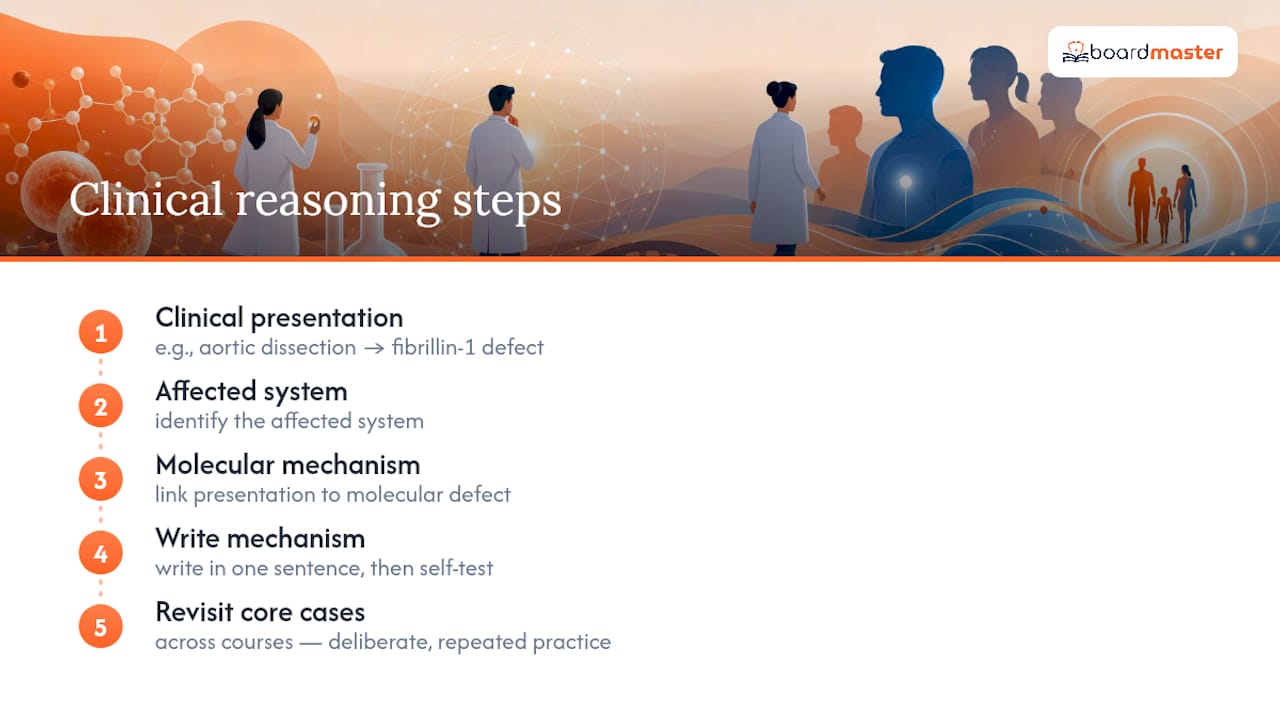
The conventional wisdom is that clinical correlations are motivational tools — a way to make biochemistry feel relevant. That framing undersells them. The real function is cognitive restructuring. When you work from a patient's aortic dissection back to a fibrillin-1 defect, you are not just learning Marfan syndrome. You are training a reasoning pattern: clinical presentation → affected system → molecular mechanism → testable concept. That pattern is what every USMLE vignette is built on.
The mistake most students make is consuming clinical correlations passively — they hear the example in lecture, think "interesting," and move on. The ones who improve their percentile scores are the ones who stop the lecture, write the mechanism in one sentence, and then test themselves on it. According to IAMSE's collaborative integration strategy, revisiting the same core cases across courses is what builds longitudinal reasoning. That is not something a single lecture can do — it requires deliberate, repeated practice with the same conceptual framework applied to new presentations.
BoardMaster turns your lecture notes into vignette practice
Generating vignettes by hand is the right method. It is also slow. BoardMaster gives you the same outcome in a fraction of the time: upload your lecture slides and the platform produces USMLE-style questions targeting the exact concepts your professor emphasized, not a generic question bank's version of the topic.

The platform also generates spaced-repetition flashcards with medical images and provides an AI study assistant for instant mechanism explanations — everything the worked example above requires, automated. Sarah, a BoardMaster student, moved from the 73rd to the 92nd percentile while cutting her study hours in half by focusing on professor-targeted questions instead of broad review.
Try the AI question generator demo or explore the full BoardMaster platform to see how it maps to your current block.
Sources
- Clinical Correlations as a Tool in Basic Science Medical Education
- CLINICAL CORRELATIONS IN THE BASIC SCIENCES - International Association of Medical Science Educators - IAMSE
- Surgical Clinical Correlates in Anatomy: Design and implementation of a first-year medical school program
- MD Curriculum | School of Medicine
FAQ
What is clinical correlation in preclinical medical education?
Clinical correlation is an instructor's use of a patient example or case to show how a basic-science concept applies to real medical practice. It appears in anatomy, physiology, histology, pharmacology, and biochemistry courses as a teaching tool.
How does clinical correlation help with USMLE preparation?
Board vignettes are built around basic-science mechanisms dressed in clinical language. Practicing clinical correlation trains you to strip the clinical story back to its underlying concept, which is the reasoning step every USMLE question requires.
What are the five types of clinical correlations?
The five types are correlated examples, interactive demonstrations, specialized workshops, small-group activities, and course-centered problem solving, as described in peer-reviewed medical education literature. They range from brief lecture factoids to multi-course longitudinal cases.
How can students practice clinical correlation on their own?
Pick one lecture concept, write a one-sentence clinical hook, draft a short vignette with answer options, and add it to a spaced-repetition system. BoardMaster automates this process by generating USMLE-style questions directly from your uploaded lecture notes.
Why do some clinical correlations not appear on exams?
A clinical correlation only becomes a testable item when it is tied to a stated learning objective or assessment blueprint. Examples used purely for motivation or context are not typically tested, which is why checking your professor's exam topics against the correlation is a necessary step.