
Your per-question pace should hover around 90 seconds. If a question runs longer than that, flag it and move on rather than fighting for a definitive answer under pressure. Your review time after a block should exceed your answering time, roughly a 2:1 ratio, so a 60-minute block earns 90 to 120 minutes of review before you touch another one.
That's the whole rule. Everything else is execution detail.
- Target pace: ~90 seconds per question.
- Decision rule: past 90 seconds with no clear answer, flag it and move on.
- Review ratio: review time should exceed practice time (aim for roughly 2:1).
- The USMLE's 2026 format change alters block length and question count, not this pacing logic.
Key Takeaways
Timing for question blocks comes down to two numbers: roughly 90 seconds per question with a hard flag-and-move rule, and a review-to-practice ratio near 2:1.
| Point | Details |
|---|---|
| Per-question pace | Target about 90 seconds; flag and move on if you exceed it rather than forcing an answer. |
| Review ratio | Budget 90 to 120 minutes of review for every 60-minute practice block, close to 2:1. |
| 2026 format shift | Sixteen 30-minute blocks replace eight 60-minute blocks; total time is unchanged, but transitions increase. |
| Break strategy | Use one 15 to 20 minute midpoint meal break plus short micro-breaks between other blocks. |
| Practice progression | Start in tutor mode, shift to timed mode in the final 4 to 6 weeks, and taper volume to avoid overtraining. |
Table of Contents
- Timing Strategies for Quizzes: Old vs New USMLE Block Format
- Building a Repeatable Routine for Optimal Timing for Tests
- Question Block Timing Tips for Staying Sharp Mid-Block
- Best Time for Question Blocks and Break Placement
- How to Time Question Blocks During Practice
- How to Build Stamina Without Overtraining
- Common Timing Mistakes and a Pre-Block Checklist
- How BoardMaster Turns Study Time Into Timing Practice
- Get Timed Practice Built From Your Own Lecture Notes
- Why the 2026 Format Change Should Reset How You Practice
- Sources
- FAQ
Timing Strategies for Quizzes: Old vs New USMLE Block Format
Starting May 7, 2026, the USMLE restructures Step exam blocks: instead of eight 60-minute blocks, you'll work through 16 shorter 30-minute blocks. Total testing time stays the same, but the rhythm of the day changes completely. Tutorial length and per-block break mechanics shift too, according to the official USMLE format details.
Here's what actually matters for your pacing strategy:
- More blocks means more transitions, and each transition is a small chance to lose momentum.
- Finishing a block early still banks unused time into your pooled break, a mechanic that hasn't changed.
- A slow start in a 30-minute block is proportionally more expensive than a slow start in a 60-minute one. You have less runway to recover.
- The 90-second target per question still applies. Block length changes; math doesn't.
Practically, this means your warmup routine before block one matters more in the new format. You can't coast through a rough first five questions and still make up the time the way you could in a longer block.
Building a Repeatable Routine for Optimal Timing for Tests
Consistency beats heroics. The students who manage timing for question blocks well aren't the fastest readers; they run the same sequence every time so their brain doesn't waste cycles deciding how to approach a question.
- Read the last sentence of the vignette first. This tells you what's actually being asked before you wade through three paragraphs of lab values and history.
- Form a working answer before looking at choices. Committing to a guess first keeps you from getting talked into a trap answer by well-written distractors.
- Eliminate obviously wrong choices, then compare what's left against your working answer.
- Apply the 90-second rule. If you're still stuck, flag it and move.
- Glance at the running clock every 10 to 15 questions, not every question. Constant clock checking burns time and raises anxiety.
For long vignettes with tables or multi-panel labs, skim the table headers first, then hunt for the specific values the question references. Don't read every cell.
Pro Tip: Practice the "last sentence first" habit even on untimed review questions. It needs to become automatic before test day, not something you're consciously remembering under pressure.
Question Block Timing Tips for Staying Sharp Mid-Block
Small habits inside a block prevent the slow bleed of wasted seconds that adds up across 40 questions. The flagging decision itself should be fast: at 90 seconds, if you don't have a confident answer, pick your best guess, flag it, and move. Don't renegotiate the deadline with yourself.
- When you return to flagged items at the end of a block, tackle the ones you have partial reasoning on first; pure guesses can wait until last.
- Take one deliberate breath between questions, especially after a tough one. It's a two-second reset that keeps frustration from carrying into the next question.
- Roll your neck or shift in your seat every 10 to 12 questions rather than staying rigid for the full block.
- Skip high-sugar drinks during blocks. The crash after a spike tends to land right around question 25 to 30, exactly when forum reports and practice guides describe focus dropping off in longer blocks.
Pro Tip: Keep a small water bottle and a slow-release snack, like nuts or a granola bar, at your micro-break station rather than relying on the vending machine that day.
Best Time for Question Blocks and Break Placement
The biggest lever you control on test day isn't inside any single block. It's how you spend your pooled break time between blocks. A single longer midpoint break of 15 to 20 minutes for a full meal does more for afternoon performance than scattering that same time across several short breaks.
- Use short 2 to 5 minute micro-breaks between other blocks to stand, stretch, and look at something other than a screen.
- Save the real meal, water, and a short walk for the midpoint break, not a quick snack between every block.
- If you finish a block a few minutes early, that time rolls into your pooled break automatically, so budgeting to finish slightly ahead of schedule builds you a longer midpoint window.
- At the midpoint, do something physical for even 60 seconds. A short walk down the hallway resets attention better than sitting still.
Guidance on scheduling breaks for sustained focus backs this pattern: fewer, better-timed breaks outperform frequent short ones for maintaining concentration across a long task.
How to Time Question Blocks During Practice
Practice mode choice matters as much as the clock. Early in your prep, tutor mode with immediate feedback builds conceptual accuracy faster than timed mode does, since you're not rushing past a question you don't yet understand. Shift to scheduled timed-mode sessions in your final four to six weeks, when pacing and stamina become the bottleneck rather than raw knowledge.
The review-to-practice ratio is where most students shortchange themselves. Guidance on review budgeting recommends 90 to 120 minutes of review for every 60-minute, 40-question block, close to a 2:1 ratio. Skipping that review to squeeze in another block is the single most common way students sabotage their own progress; testing without adequate review and feedback timing measurably affects retention outcomes.
- Weeks 1 to 6 (early prep): 2 to 3 tutor-mode blocks weekly, heavy on review.
- Weeks 7 to 10 (mid prep): mix tutor and timed blocks, 4 to 5 weekly, review every block same day.
- Final 4 to 6 weeks (dedicated phase): primarily timed mode, 6 to 8 blocks weekly, review days built into the schedule rather than squeezed in.
| Phase | Blocks per week | Mode | Review approach |
|---|---|---|---|
| Early prep | 2 to 3 | Tutor | Deep review same day |
| Mid prep | 4 to 5 | Mixed | 2:1 review ratio |
| Dedicated phase | 6 to 8 | Timed | Full 2:1 ratio, dedicated review days |
A staged pattern, alternating timed blocks with a heavier review day every few days, tends to build pacing skill without the burnout that comes from stacking timed blocks back to back.
How to Build Stamina Without Overtraining
Full-day endurance is trainable, but it has to be built gradually. Jumping straight into eight-hour simulated exam days in week two of dedicated prep usually backfires; you'll practice bad habits under fatigue instead of good ones.
- Early prep: 4 to 6 blocks per week, spread out, no full-day simulations yet.
- Mid prep: 8 to 10 blocks weekly, including one half-day simulation every other week.
- Dedicated phase: 10 to 14 blocks weekly, with one or two full-day simulated test days that replicate pooled breaks and a midpoint meal break exactly as you'll run them on test day.
- Rest days matter as much as practice days. Schedule at least one full day off weekly, even in the dedicated phase.
Watch for overtraining signs: scores flattening or dropping despite rising block volume, slower reading speed by afternoon, or dreading practice sessions you used to tolerate fine. That's a signal to cut volume and add a review-only day, not to push harder. A structured approach to block scheduling across both lecture exams and board prep helps prevent the volume creep that leads to this exact problem.
Common Timing Mistakes and a Pre-Block Checklist
The mistakes that wreck timing for question blocks are almost always small and repetitive rather than dramatic. Fixation on one impossible question, skipped review sessions, poor nutrition choices, and forgetting to bank early-finish time into breaks all cost more cumulative time than any single hard question ever will.
- Spending three or four minutes on one question instead of flagging it at 90 seconds.
- Ending a block and immediately starting another without reviewing, "saving time" that actually costs retention.
- Skipping meals or relying on sugar for energy, then crashing mid-afternoon.
- Not tracking banked time, so you never build a longer midpoint break.
Before every block or simulation, run this quick checklist:
- Confirm the mode (tutor or timed) and block length before you start the clock.
- Make sure the on-screen clock is visible; don't hide it out of anxiety.
- Decide your flagging threshold out loud (90 seconds) before question one.
- Have water and a snack staged for your next micro-break.
- Know when your next scheduled break falls so you're not surprised by it.
If pacing drifts mid-block, the recovery is simple: pause for one breath, glance at the clock, and reapply the 90-second rule to the very next question rather than trying to catch up all at once.
How BoardMaster Turns Study Time Into Timing Practice
Most students lose time in practice for a reason that has nothing to do with the clock: they're answering questions on material their actual course never emphasized. BoardMaster generates USMLE-style questions directly from a student's uploaded lecture notes, so practice time goes toward the concepts a specific professor actually tests rather than generic high-yield lists.
- Questions are built from your own lecture material, aligning class-exam prep and board prep instead of treating them as separate study tracks.
- One student, Sarah, moved from the 73rd to the 92nd percentile while cutting her study hours in half using this targeted approach.
- Because the question pool matches what you're actually being tested on, timed runs measure real pacing instead of wasting flagged-question time on content you'll never see on your exam.
Once your practice set reflects your real coursework, applying the 90-second rule and the 2:1 review ratio to it stops being theoretical. Every flagged question and every review minute goes toward material that counts, an approach custom, lecture-aligned questions are specifically built to support.
Get Timed Practice Built From Your Own Lecture Notes
Timing drills only pay off when you're drilling the right material. Generic question banks force you to practice pacing on content that may never appear on your specific exams, which wastes exactly the review time this article just told you to protect. BoardMaster closes that gap by generating practice questions from your actual lecture uploads, so the 90-second rule and the 2:1 review ratio apply to concepts your professors actually emphasize.

See how it works with the AI question generator demo, and start building timed blocks around material that maps directly to your exams.
Why the 2026 Format Change Should Reset How You Practice
Most timing advice floating around forums predates the shift to 30-minute blocks, and a lot of it will quietly go stale come May 2026. The 90-second rule and the 2:1 review ratio aren't going anywhere; those are grounded in how attention and memory actually work, not in a specific block length. What needs to change is how students train for transitions.
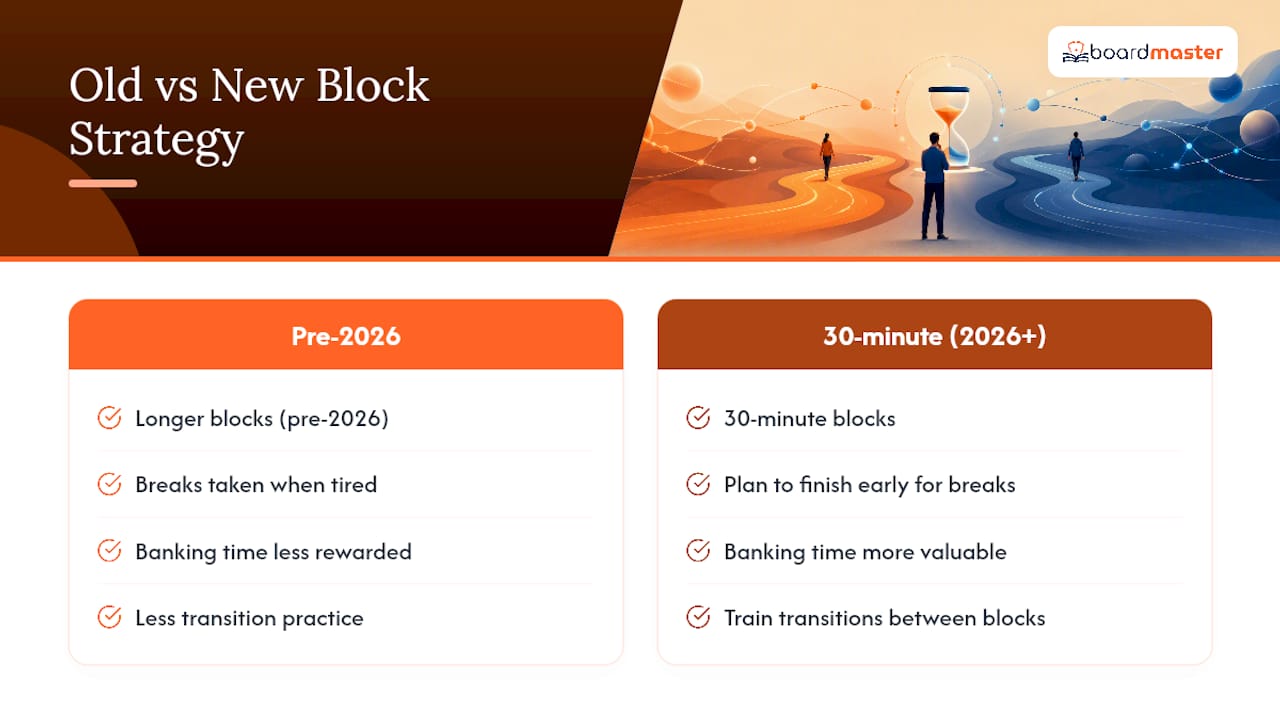
Conventional advice treats break time as something you take when you're tired. That's backwards. The pooled break mechanic rewards students who plan to finish blocks a little early and bank that time deliberately, not students who simply survive until the next scheduled stop. With more, shorter blocks, that banking habit becomes worth more than it used to be.
The other place conventional advice falls short is treating question banks as interchangeable. If your practice questions don't reflect what your own courses emphasize, your timing drills are measuring the wrong thing. You end up fast on content you'll never see tested and slow on content you will. Fix the content match first. Then the clock actually tells you something useful.
— Dr. Ahmed Abuzoor
Sources
Key sources include the USMLE's official format announcement, timed-mode pacing guidance, break-scheduling research, and peer-reviewed work on quiz timing.
- USMLE — Step exams (format & timing) — USMLE
- How to Answer UWorld Questions — Complete Strategy Guide
FAQ
Is Step 2 Changing to 20-Question Blocks?
Step 2 CK's format change effective May 7, 2026 restructures the exam into 16 shorter 30-minute blocks instead of eight 60-minute blocks, according to the USMLE's own format page. Total testing time stays the same; check the official USMLE site for the exact question count per block, since it's tied to block length rather than a fixed number like 20.
How Do You Hit a Question Block?
Set a target pace of roughly 90 seconds per question and apply a flag-and-move rule when you exceed it, rather than trying to force a confident answer under pressure. Return to flagged questions at the end of the block, starting with the ones where you have partial reasoning.
How Many Minutes Per Short Answer Question?
For USMLE-style multiple-choice question blocks, the commonly recommended pace is about 90 seconds per question, based on timed-mode strategy guidance. Short-answer formats outside the USMLE Step exams may follow different timing conventions specific to that exam.
How Long Is Each Block in Step 1?
Step 1 currently uses 60-minute blocks, matching the format Step 2 CK is transitioning away from starting May 7, 2026. Confirm current block length and question counts directly through the official USMLE Step exam page, since format details can be updated between testing cycles.