
Block scheduling aligns lecture review with board-style practice by forcing you to study the right material in the right format at the right time. The single rule to start today: use a 2:1 practice-to-review ratio — for every 60 minutes of content review, spend 120 minutes on board-style questions tied to that same topic. During a dedicated board sprint in the final four to six weeks, shift to a 3:1 ratio. A systematic review and meta-analysis confirms that active learning combined with structured time management produces the largest gains in medical student academic performance.
Start today in three steps:
- Run a 30-minute diagnostic question block on your weakest subject from last week's lectures.
- Block three 60–90 minute focus sessions for the next three days, each tied to a specific lecture topic.
- Schedule one mixed retrieval block at the end of the week to interleave two or three subjects.
BoardMaster's AI question generator converts your uploaded lecture notes into USMLE-style questions in minutes, so you can populate those blocks without spending an hour building your own question set first.
Table of Contents
- How does block scheduling reduce cognitive load and improve board alignment?
- How do you set up a block schedule for lecture and board prep?
- Sample daily and weekly block schedule templates
- What should you actually do during each block?
- Common scheduling pitfalls and how to fix them fast
- How do you merge coursework and board prep in the same blocks?
- Key Takeaways
- The schedule is not the hard part
- BoardMaster fits directly into your block workflow
- FAQ
How does block scheduling reduce cognitive load and improve board alignment?
The mechanism is straightforward: when you assign a specific block to a specific subject, your brain stops switching contexts mid-session. Context-switching is expensive cognitively, and medical content is dense enough that every unnecessary switch costs retention.
The evidence backs this up. A cross-sectional study published in BMC Medical Education found that daily time management and adequate sleep were significantly associated with higher GPA among medical students. The finding matters because it points to consistency as the driver, not raw hours.
The research signal: Active learning produced the largest performance effects in the meta-analysis, followed by time management. Passive re-reading ranked last. If your blocks are mostly highlighting and re-reading, the schedule is not the problem — the activities inside it are.
Three mechanisms explain why structured blocks work:
- Energy alignment: The AMA's guidance on time management for medical students recommends placing high-cognitive-load blocks during your peak energy window and lighter review blocks in low-energy periods.
A practical board-prep guide puts it plainly: allocate the majority of study time to practice questions, not content review. That single shift is what separates students who feel prepared from students who actually score well. For a deeper look at daily board exam practice, the pattern holds across subjects.
How do you set up a block schedule for lecture and board prep?
Follow this sequence once, then iterate weekly.
- Choose your ratio. Default to 2:1 practice-to-review during normal weeks. During a dedicated board sprint (typically the final four to six weeks before Step 1 or COMLEX Level 1), shift to 3:1.
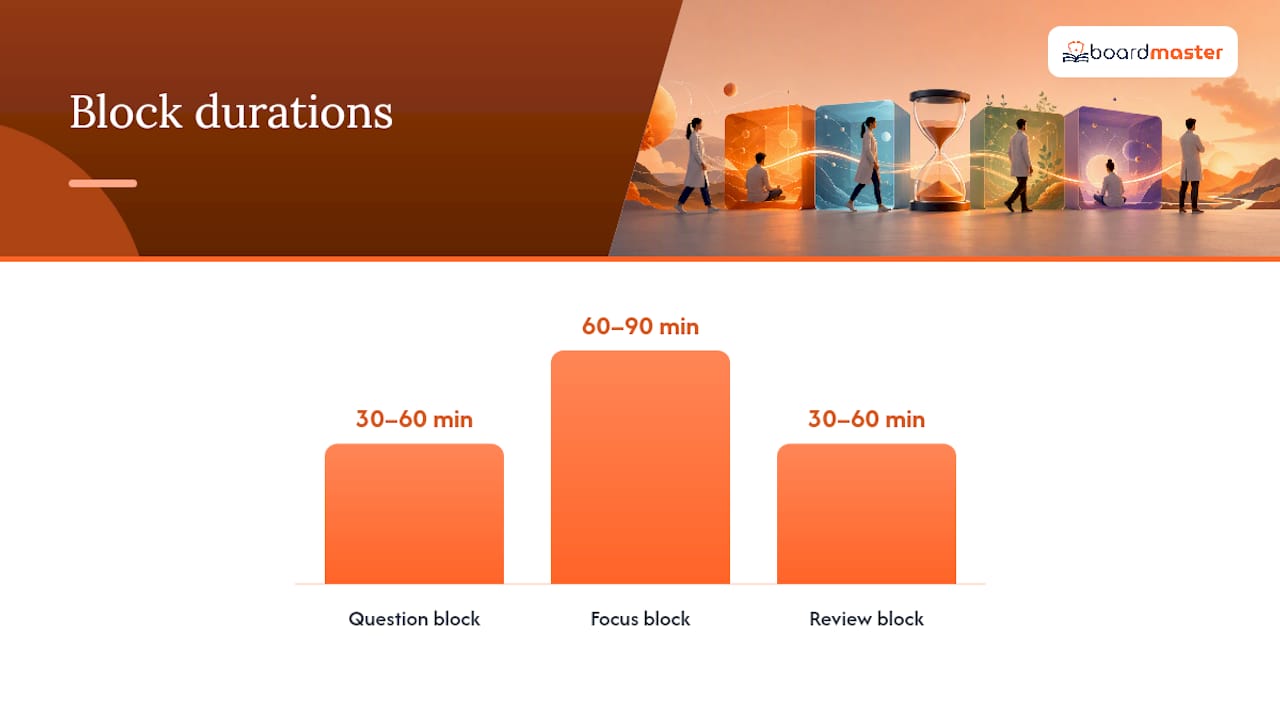
Block types and recommended durations:
- Sleep protection: — Non-negotiable. The BMC data links adequate sleep directly to GPA; treat it as a study block you cannot trade away.
A weekly schedule that balances lectures and USMLE prep typically runs two to three focus blocks, two question blocks, one review block, and one buffer per day, with Sunday as a lighter mixed-retrieval day.
Sample daily and weekly block schedule templates
Daily template (energy-mapped)
| Time | Block Type | Activity |
|---|---|---|
| 7–8:30 AM | Focus block | Case-based deep-dive on today's lecture topic |
| 8:30–8:45 AM | Transition buffer | Walk, water, reset |
| 9–10 AM | Question block | 30–40 timed Qs on same topic + error log |
| 12–12:30 PM | Review block | Anki deck for yesterday's topic |
| 5–6 PM | Focus block | Second subject (lighter: anatomy, biochem) |
| 8–8:30 PM | Mixed retrieval | 20 Qs interleaving two subjects |
| 8:30–9 PM | Buffer/admin | Reschedule, flag weak cards |
One-week sample rotation
| Day | Morning Focus | Question Block | Evening Review |
|---|---|---|---|
| Monday | Cardiology (lecture) | Cardiology Qs | Cardiology Anki |
| Tuesday | Renal (lecture) | Renal Qs | Renal Anki |
| Wednesday | Cardiology (second pass) | Mixed: Cardio + Renal | Weak-card review |
| Thursday | Pulmonology (lecture) | Pulmonology Qs | Pulmonology Anki |
| Friday | Renal (second pass) | Mixed: Renal + Pulm | Error-log review |
| Saturday | Weak subject sprint | Full 40-Q timed block | Spaced review all week |
| Sunday | Light retrieval only | 20 mixed Qs | Rest + buffer |
Build your own schedule with this checklist:
- Identify peak energy window (most students: 7–11 AM).
- Place all focus and question blocks in that window.
- Never schedule two consecutive focus blocks without a 15-minute buffer between them.
- Fill no more than 70–80% of available hours — leave room for clinical duties and unexpected remediation.
- When your class exam is within two weeks, shift toward a condensed sprint structure with daily mixed-retrieval blocks replacing second-pass content review.
For more on building an effective study schedule, the same time-allocation principles apply across science-heavy curricula.
What should you actually do during each block?
The block is just a container. What you put inside it determines whether it works.
Question block (30–60 min):
- Complete a timed set of 20–40 board-style questions on the session's subject.
- After the block, spend 15 minutes on your error log: write why you missed each question, not just the right answer.
- Flag topics with two or more misses for a remediation block later that week.
Focus block (60–90 min):
- Work through one case or mechanism in depth using a teach-back approach: close your notes and explain the concept aloud as if teaching a classmate.
- If you cannot explain it without looking, that gap goes on your error log.
Review block (30–60 min):
- Run your Anki or spaced-repetition deck for the week's subjects.
- Write a three-sentence micro-summary of the session's weakest topic before closing.
End every block with a 3-minute close:
- Write one key takeaway.
- Flag one to three weak topics.
- Schedule remediation for flagged topics in the next available buffer block.
Pro Tip: If a block contains no question-writing, teaching, or flashcard creation, it is a passive block. Passive blocks feel productive but do not build the retrieval pathways boards test. Convert any passive block by turning the first 10 minutes into a question-creation exercise on that day's lecture content.
For a lean study workflow that keeps every block active, the principle is the same: the format of the activity matters more than the hours logged.
Common scheduling pitfalls and how to fix them fast
Red flags to watch for:
- Your calendar is 100% filled with no buffer blocks.
- Most blocks are reading or re-watching lecture videos.
- You regularly miss blocks and spend the next day in a catch-up marathon.
- You have not touched a question set in more than two days.
Quick fixes:
- Apply the 70–80% fill rule: if every hour is scheduled, cut the lowest-value block first (usually a second passive review session).
- Swap content-first order to questions-first: open every session with a question block, then review only what the questions exposed as weak.
- Add one accountability check-in per week — a study partner, a group chat, or a simple written log.
- Protect sleep as a non-negotiable block; the BMC cross-sectional data links it directly to GPA, and no question block recovers what sleep deprivation costs.
Pro Tip: During clinical rotations, your schedule will break. Build a minimum viable version in advance: one 30-minute question block and one 20-minute Anki session per day. That floor keeps momentum alive without requiring a perfect schedule. See managing an overloaded semester for rotation-specific strategies.
How do you merge coursework and board prep in the same blocks?
The goal is one workflow that serves both, not two parallel systems.
The core rule: Always open a session with questions tied to that day's lecture topic. This forces you to engage with board-style framing before you review content, which surfaces gaps faster than reading first.
Workflow per lecture:
- Attend or watch lecture.
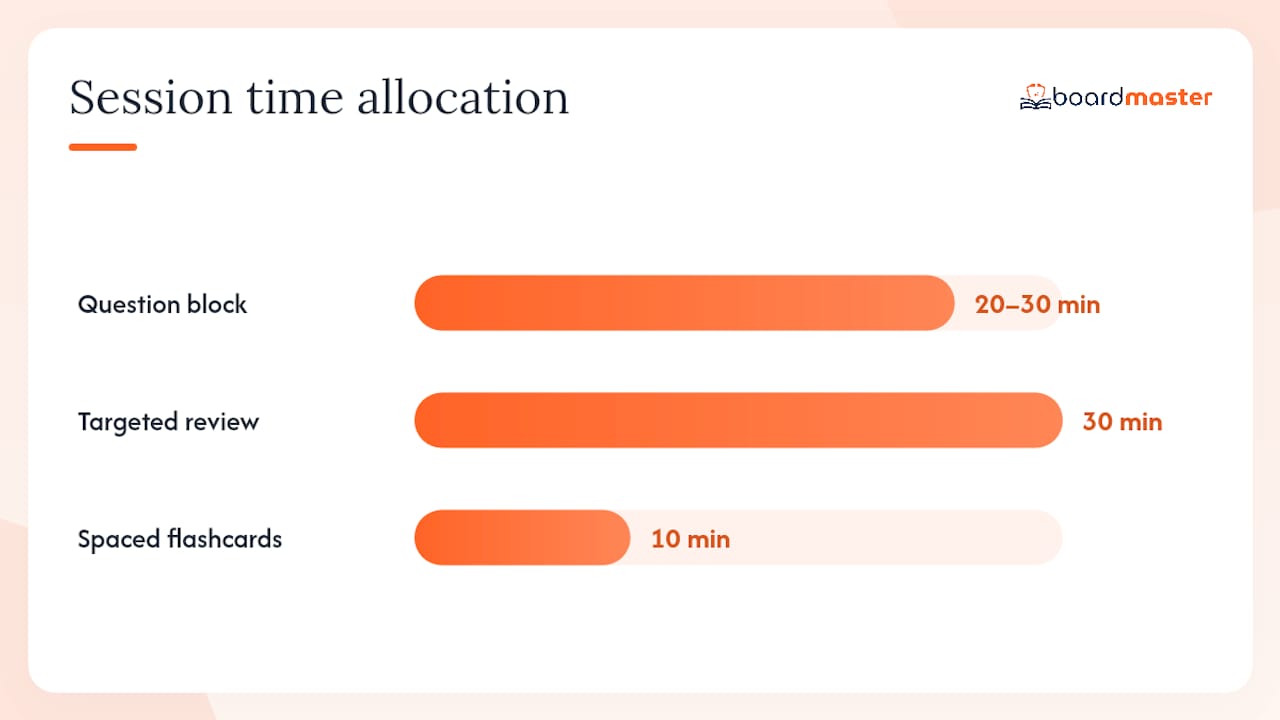
- Immediately run a 20–30 minute question block on that topic (BoardMaster can generate these from your uploaded notes).
- Spend 30 minutes on targeted content review of only the concepts the questions exposed.
- Spend 10 minutes creating spaced flashcards for the three to five highest-yield points.
- Buffer: update your error log and flag weak cards.
Weekly integration checklist:
- Every subject appears in at least one question block and one review block per week.
- Mixed-retrieval blocks interleave at least two subjects to build transfer.
- Error-log items from class exams feed directly into the next week's focus blocks.
- Board-style questions and class-exam questions draw from the same lecture content — no separate prep track needed.
Interleaving two subjects within a single mixed block, rather than studying them on separate days only, accelerates transfer and mirrors the format of the actual USMLE, where questions do not announce their subject.
Key Takeaways
Block scheduling works because it forces subject-matched, active-task study at the right time of day, replacing passive review with retrieval practice that directly mirrors board exam conditions.
| Point | Details |
|---|---|
| Default ratio | Use a 2:1 practice-to-review ratio during normal weeks; shift to 3:1 during a dedicated board sprint in the final four to six weeks. |
| Block types and durations | Focus blocks run 60–90 min, question blocks 30–60 min, review blocks 30–60 min, buffers 15–60 min. |
| Fill only 70–80% | Leave buffer blocks open; a fully packed calendar leads to missed blocks and schedule abandonment. |
| Measure weekly, not daily | Track percent-correct trend, card retention, time-on-task adherence, and fatigue score each week. |
| BoardMaster integration | Upload lecture notes to BoardMaster to auto-generate USMLE-style question blocks and spaced flashcards, cutting setup time per session. |
The schedule is not the hard part
Most students who struggle with board prep are not undisciplined — they are studying the wrong things in the wrong format. A block schedule does not fix that by itself. What fixes it is the combination of a structured container (the block) and an active task inside it (questions, teach-back, flashcard creation). The schedule is just the forcing function.
The students who improve fastest are the ones who treat their error log as seriously as their question bank. Every missed question is a data point. Every weak topic flagged at the end of a block is a future block already planned. That feedback loop, running week after week, is what moves a percentile score.
Start with the simplest version: one question block, one focus block, one review block per day. Measure it for two weeks. Then adjust.
BoardMaster fits directly into your block workflow
If the biggest friction in your block schedule is building question sets from lecture notes, BoardMaster removes it. Upload your lecture slides and BoardMaster generates targeted USMLE and COMLEX-style questions in minutes, mapped to the exact concepts your professor emphasized — not a generic question bank's version of the topic.

That means your question blocks are ready before the session starts. Your review blocks get AI-generated flashcards with spaced repetition built in. Your low-energy slots get lecture-based study podcasts — eight-minute audio summaries you can run during a commute or a meal. Every block type in this guide has a BoardMaster feature that populates it automatically.
Try the free tier at boardmaster.ai and run your first lecture-to-question block today.
FAQ
What is the best practice-to-review ratio for board prep?
A 2:1 ratio (two parts practice questions to one part content review) works well during normal weeks. During a dedicated board sprint in the final four to six weeks, shift to 3:1.
How long should each study block be for USMLE prep?
Focus blocks run 60–90 minutes, question blocks 30–60 minutes, and review blocks 30–60 minutes, per AMA time management guidance for medical students.
How does block scheduling help with both class exams and boards?
By tying every question block to that day's lecture topic, you prepare for class exams and board-style practice simultaneously — one workflow, not two separate tracks.
When should I switch from a concurrent schedule to a dedicated board sprint?
When your mixed-subject percent-correct scores consistently exceed single-subject scores and your class exam load drops, transition to a condensed sprint with daily mixed-retrieval blocks and a 3:1 question-to-review ratio.
Can BoardMaster replace a traditional question bank?
BoardMaster generates USMLE and COMLEX-style questions directly from your lecture notes, which makes it more targeted than a generic question bank for concurrent course and board prep. It also includes a large library of physician-written board-style questions for broader coverage.