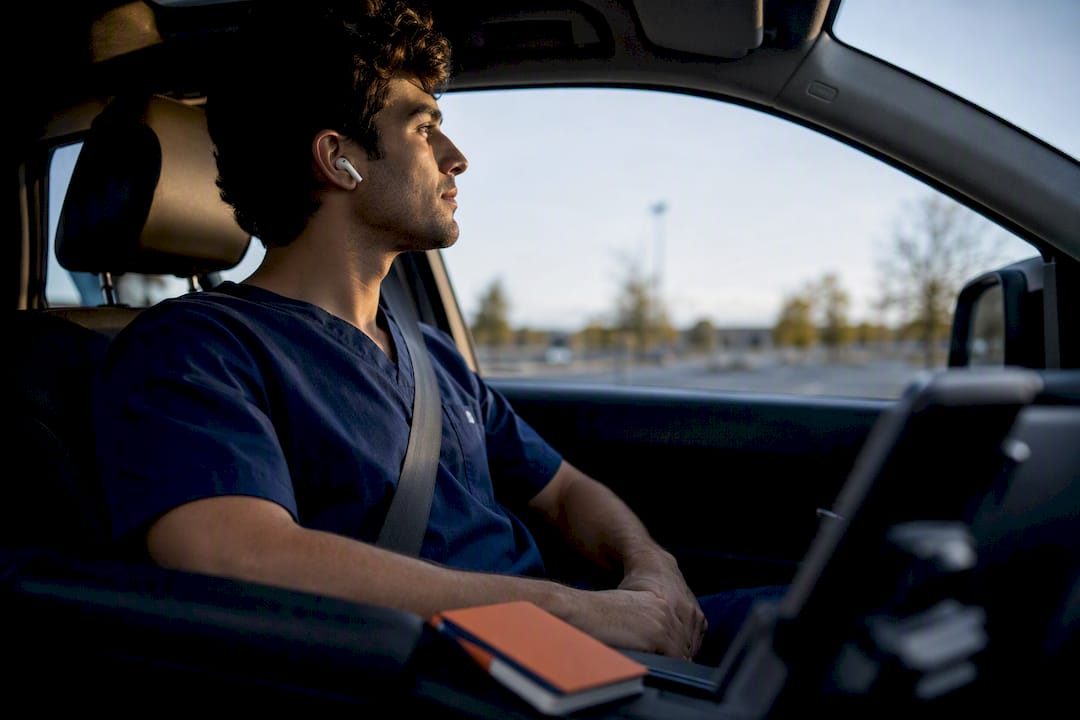
The best way to study while commuting is to use audio-based review whenever your eyes or hands need to stay on the road, the handlebars, or the sidewalk, and to save screen-based study for seated transit. That single rule solves most of the friction commuters run into. Audio carries the load on a bike or behind the wheel; flashcards and short videos carry it on a train or bus. Prep everything the night before so the first minute of your trip is study time, not decision time.
TL;DR:
- Using audio-only study methods is safest and most effective for driving or cycling, requiring no screens or manual engagement during the commute.
- Seated transit allows the use of flashcards and videos, with offline decks and eye rests essential for longer sessions or sensitive material.
- Prepare study materials in advance by downloading recordings, setting playlists, and creating recall questions to maximize commute efficiency and minimize decision fatigue.
- Study sessions should be limited to 20-30 minutes with attention checks every five minutes to prevent mind-wandering and fatigue, especially behind the wheel.
- Overdoing commute study without integrating deep problem-solving can hinder retention; use it mainly for review and spaced repetition, not initial learning.
Table of Contents
- What Study Method Fits Your Commute Mode?
- Audio-First Strategies: Podcasts, Lecture Recordings, and Text-to-Speech
- When Should You Use Flashcards and Videos Instead of Audio?
- What Are the Safety Rules for Studying While Driving?
- How Do You Prepare the Night Before a Commute Study Session?
- Three Commute Study Routines You Can Try Tomorrow
- How BoardMaster Turns Lecture Notes Into Commute-Ready Study Material
- Where Commute Study Falls Short and What to Do Instead
- Try BoardMaster on Your Next Commute
- Sources
- FAQ
What Study Method Fits Your Commute Mode?
Your commute mode decides your study format before you decide anything else. A systematic review of commute-based learning found that commute mode moderates how well multitasking works, meaning the same study task can be effective on a train and dangerous behind the wheel. Match the task to the mode, not the other way around.
- Driving or cycling: Audio only. Recorded lectures, podcasts, or mental rehearsal questions. No screens, no scrolling, no exceptions.
- Seated transit (train, bus, subway): Flashcards, e-books, short videos, or downloaded lectures. Your hands and eyes are free.
- Walking or short trips: Language audio, concept summaries, or mental rehearsal, since you still need to watch the sidewalk and traffic.
Cap sessions around 20 to 30 minutes and build in an attention check every five minutes or so. If you notice your mind wandering into autopilot, that is your cue to switch tasks or pause entirely, especially behind the wheel.
Audio-First Strategies: Podcasts, Lecture Recordings, and Text-to-Speech
Audio is the workhorse of commute study because it asks nothing of your eyes or hands. Turning notes into something you can listen to takes a few minutes of prep and pays off every single trip.
- Convert notes to audio. Use a text-to-speech app to read your typed notes aloud, or record yourself summarizing a lecture in your own words.
- Download professor recordings the night before so you are not relying on a signal that might drop in a tunnel or elevator.
- Adjust playback speed. Most students can handle 1.25x to 1.5x speed after a week of practice, which stretches your available material.
- Use the preview, listen, retrieval pattern. Skim your notes for 60 seconds before you leave, listen during the commute, then quiz yourself once you arrive.
Thomas Edison State University's guide to commute study points to recording yourself and converting notes to audio as two of the most reliable low-effort tactics students use. AI tools that generate short, exam-focused study podcasts from lecture material work well here too, since they compress an hour-long lecture into a commute-length episode.
Pro Tip: Build one dedicated "study only" playlist and never mix it with music or entertainment podcasts. That separation alone cuts the odds you default to scrolling instead of studying.
When Should You Use Flashcards and Videos Instead of Audio?
Seated transit is the one commute mode where screens make sense, and spaced-repetition flashcards are close to ideal for it. A single ride rarely gives you more than 15 to 25 minutes, which is exactly the window flashcard sessions and short video chunks are built for.
- Load offline flashcard decks before you leave. Signal drops underground or between cell towers will otherwise kill your session.
- Turn brightness down and keep decks private if you are studying anything sensitive next to strangers.
- Split a 20-minute ride roughly 60/40: spend the first stretch on active recall (flashcards or quiz questions), then shift to lighter review, like rereading a summary or watching a short explainer video, once fatigue sets in.
- Take a 30 to 60 second eye-rest break every 10 minutes if you are reading on a phone. Motion plus a small screen strains your eyes faster than a stationary desk session.
Research from the University of Reading also flags that stable, seated commutes support active recall better than jostling or noisy ones, so save your hardest review material for the smoothest part of your ride.
What Are the Safety Rules for Studying While Driving?
Distracted driving comes in two flavors: manual distraction (hands off the wheel) and cognitive distraction (mind off the road). Audio-only study avoids the first but not the second, and that distinction matters more than most drivers assume.
NHTSA's distracted-driving guidance treats cognitive distraction as a genuine safety hazard even when both hands stay on the wheel, since attention is a limited resource no matter where your eyes point.
Follow these rules without exception:
- Mount your phone before you start driving. Never touch it once you are moving.
- Use hands-free playback controls only.
- Pause your audio during merges, heavy traffic, or anything that demands full attention.
- Stop listening entirely if you feel fatigued. Tired brains process spoken information poorly anyway.
Distracted driving remains one of the most preventable causes of crashes on American roads, according to NHTSA, which is exactly why audio-only study still needs guardrails, not a green light.
How Do You Prepare the Night Before a Commute Study Session?
Every minute you spend prepping the night before is a minute you get back the next morning, because decision fatigue is the real enemy of consistent commute study.
- Queue your study playlist or podcast episode so it is one tap away.
- Download any files, decks, or lecture recordings you will need offline.
- Set your phone to Do Not Disturb for the commute window.
- Write three quick recall questions on your notes app or a small card, something you can answer from memory once you arrive.
- Pack earbuds, a charger, and a printed prompt card if you tend to lose focus without something physical to glance at.
Pro Tip: Use landmarks along your route, like the third subway stop or a familiar highway exit, as micro-deadlines. Tell yourself "I need to finish this concept before we pass the bridge." It works the same way a kitchen timer does, and it needs zero apps.
Three Commute Study Routines You Can Try Tomorrow
Pick the routine that matches your trip length and mode, then adjust after a few tries.
- 15-minute quick review: 10 minutes of audio review covering key points from today's material, then 5 minutes of mental retrieval once you step off, no notes allowed.
- 25-minute mixed session: 15 minutes of audio review, followed by 10 minutes of flashcards if you are seated on transit, or an out-loud oral summary if you are driving.
- 30-minute deep transit session: 20 minutes of focused reading or a short video, then 10 minutes writing a quick outline or synthesis of what you just covered.
None of these require special equipment beyond a phone and headphones. The point is repetition, not intensity. Doing the 15-minute version five days a week beats a single heroic hour once a week.
How BoardMaster Turns Lecture Notes Into Commute-Ready Study Material
Medical students face an unusually high cognitive load, which makes commute time better suited to passive reinforcement than to fresh problem-solving. BoardMaster is built around that reality.
- AI study podcasts turn uploaded lecture notes into short, exam-focused audio episodes sized for a commute, not a study hall.
- Auto-generated flashcards with spaced repetition pull straight from your own lecture material, so transit sessions review exactly what your professor emphasized.
- Lecture-to-question workflow means the same upload that generates your podcast also generates USMLE-style practice questions, so audio review and screen review stay aligned instead of pulling from different sources.
One student, Sarah, moved from the 73rd to the 92nd percentile while cutting her study hours in half using BoardMaster's targeted questions, a result tied directly to studying material her professors actually emphasized rather than generic content.
Where Commute Study Falls Short and What to Do Instead
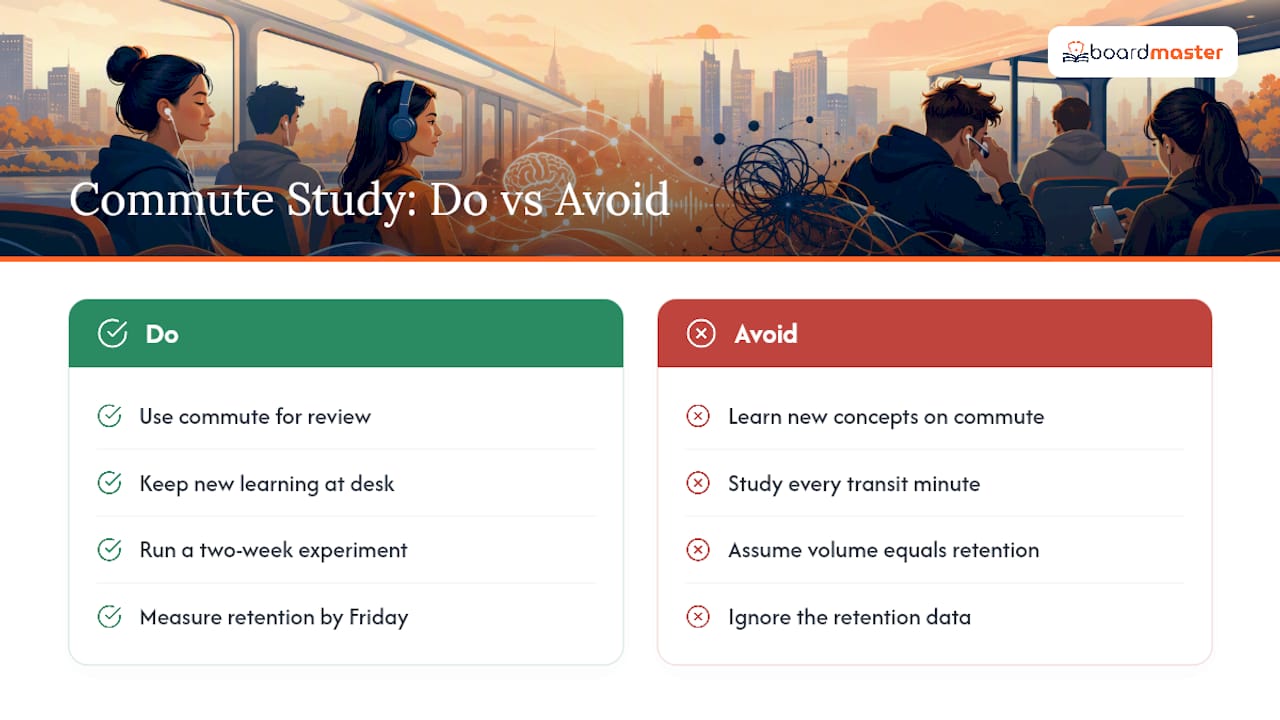
Commute study is excellent for preview and review, the kind of spaced repetition that keeps facts fresh between real study blocks. It is not a substitute for deep problem-solving, the messy work of working through a differential diagnosis or a multi-step calculation, which needs a desk, quiet, and room to backtrack.
Watch for signs you are overdoing it: if you finish a commute and cannot recall a single concept, or if you are stacking study onto every waking transit minute with no downtime, you are trading retention for volume. Try a two-week experiment instead. Use commute audio for review only, keep new concept learning at your desk, and track how much you retain by Friday compared to a normal week. The data will tell you more than any productivity hack.
— Dr. Ahmed Abuzoor
Try BoardMaster on Your Next Commute
If you already like the idea of turning lecture notes into commute-ready audio and flashcards, BoardMaster does exactly that: upload your lecture slides and it generates a short study podcast, a matching flashcard deck, and USMLE-style practice questions from the same material, so your commute review lines up with what your professor actually tests.
It is one option among several commute study tools, but it is the one built specifically around how medical students are actually tested rather than generic question banks. If you want to see the workflow before committing to anything, watch the AI question generator in action and try it against your own lecture notes. Most students know within one upload whether it fits how they study.
Sources
For more on commute-based learning and safety, the systematic review on commute-based learning covers how transportation mode shapes learning outcomes. The University of Reading's commuter study guide offers device-free techniques. NHTSA's distracted-driving guidance sets the safety baseline every driver should know. For general adjustment tips, this guide on acclimating to online learning is worth a look too.
- 10 Ways to Turn Your Work Commute Into a Study Session — Thomas Edison State University
- Distracted driving guidance — NHTSA
FAQ
Is a 40-Minute Commute Too Long for College Students?
A 40-minute commute is manageable for most college students if it is split into two or three focused study segments rather than one long stretch, since attention naturally dips after 20 to 30 minutes of continuous review.
What Are the Signs of Overstudying During a Commute?
Overstudying shows up as an inability to recall anything you just reviewed, rising irritability, or stacking study material onto every free minute with no downtime between sessions; scaling back to review-only tasks usually fixes it.
Is Commuting 30 Minutes a Day Bad for Students?
A 30-minute commute is not inherently bad and, when used for structured audio review or flashcards on transit, can become genuinely productive study time rather than lost time.
How Long of a Commute Is Considered Unhealthy?
There is no single agreed-upon cutoff, but commutes that regularly exceed 60 minutes each way are commonly linked to higher stress and less time for sleep and focused study, so pairing longer commutes with lighter, audio-based review matters more than trying to cram in heavy screen work.
Can BoardMaster Help Me Study During a Commute?
Yes. BoardMaster generates short study podcasts and spaced-repetition flashcards directly from your uploaded lecture notes, giving you audio for driving or walking and screen-based review for seated transit from the same source material.