
TL;DR:
- A last-minute review should focus on active recall, high-yield topics, and proper logistics. Students improve their exam confidence and scores by structured 45-minute sprints and prioritizing known weak areas. Sleep and early preparation are essential for optimal performance on exam day.
A quick review strategy before med exams is a focused, evidence-based method for consolidating knowledge, correcting mistakes, and sharpening recall in minimal time. This is not cramming. It is a structured approach grounded in cognitive psychology, built around active recall and high-yield prioritization. Active recall improves retention by more than 50% compared to passive methods like rereading. Medical students who apply this method systematically report stronger confidence and fewer surprises on test day. BoardMaster's AI-powered tools are built specifically around this framework, turning your lecture notes into targeted practice questions that match what your professors actually test.
What does a quick review strategy before med exams actually require?

A quick review session requires three things: the right materials, a distraction-free environment, and a clear plan for the time you have. Without all three, you default to passive reading, which feels productive but builds almost no durable memory.
The core materials you need
Gather these before you sit down:
- Condensed notes or one-page summaries covering each major topic
- Flashcard decks organized by subject, not by date created
- Past exam questions or a question bank with explanations
- A blank notebook for the Blank Page method (explained below)
- A timer for structured recall sprints
A lean study workflow starts with having everything in one place before the session begins. Hunting for notes mid-review kills momentum and wastes time.
Setting up your environment
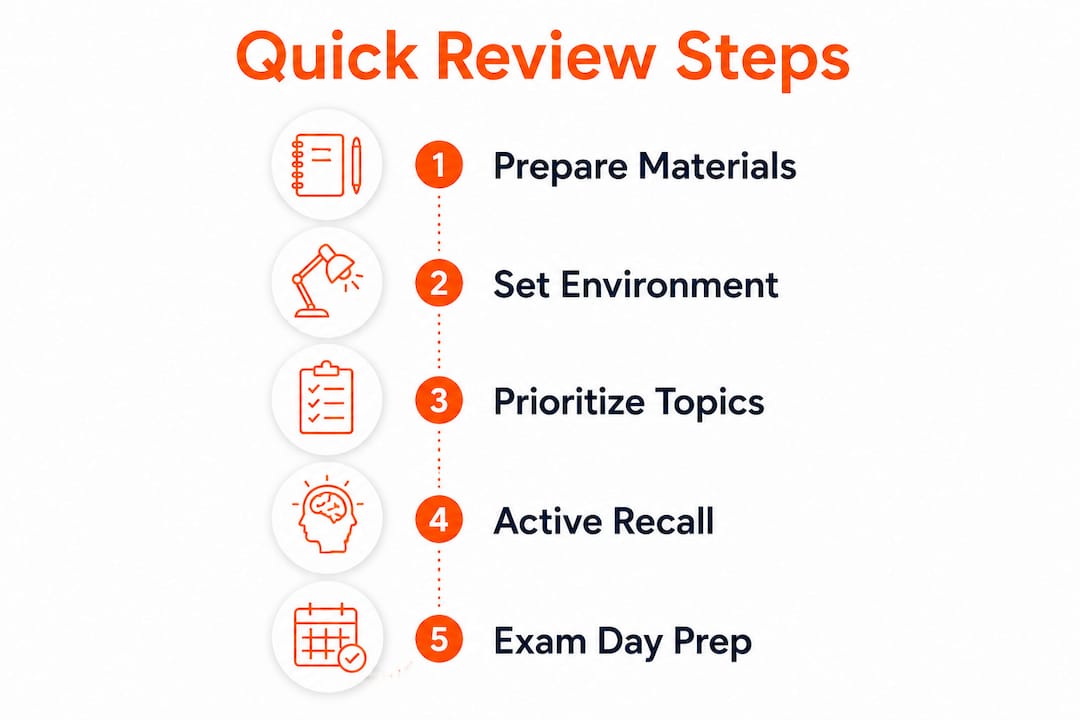
Remove your phone from the room or use an app lock. Close every browser tab unrelated to your review. A distraction-free space is not a luxury. Research on cognitive load shows that task-switching drops effective study output significantly. Treat your review session like a clinical rotation: you show up prepared, and you stay focused for the full block.
Pro Tip: Build a one-page exam sheet the night before. Include formulas, common mistake patterns, key definitions, and one mini-example per concept. This compact review tool doubles as a confidence anchor on exam morning.
| Resource | Best use |
|---|---|
| One-page summaries | Rapid topic overview before active recall |
| Flashcard decks | Spaced repetition and quick self-testing |
| Past exam questions | Identifying high-yield question patterns |
| Blank notebook | Blank Page retrieval practice |
| Timer | Structuring 45-minute active recall sprints |
How do you identify high-yield topics for last-minute review?
Last-minute study should focus on optimization, not new learning. Attempting to cover unfamiliar material the night before an exam adds cognitive load without adding marks. The goal is to make what you already know more retrievable.
High-yield topics meet at least two of these three criteria:
- High exam frequency. Topics like pharmacology, pathology, and clinical medicine appear most often on board-style exams and contribute the most marks per hour of review.
- Previous personal mistakes. Your error notebook or bookmarked questions in a question bank are a direct map to your weakest areas. These are the highest-yield items you own.
- High conceptual weight. Topics that underpin multiple clinical scenarios, such as acid-base disorders or autonomic pharmacology, pay dividends across multiple question types.
Avoid topics you have never studied at all. Picking up a brand-new subject two days before an exam rarely produces usable knowledge. It produces anxiety.
Pro Tip: Review your bookmarked or flagged questions in your question bank first. These are the exact gaps your brain has already flagged. Spending 20 minutes on them is worth more than an hour on material you already know well.
The most efficient short study plan runs backward from your exam. Identify your three weakest high-yield areas, assign each a time block, and do not let any single topic consume more than 40% of your total review time.
What is the most effective study technique during a quick review?
Active recall is the most effective study technique for last-minute exam preparation. Retrieval practice uses discomfort as a signal of real learning. If your review feels easy, you are almost certainly in passive mode.
The 45-minute active recall sprint
Structure each session as follows:
- Minutes 1–5: Write down everything you remember about the topic on a blank page, without looking at notes.
- Minutes 6–20: Answer 10–15 practice questions on that topic from a question bank or self-made quiz.
- Minutes 21–35: Review only the questions you got wrong. Read the explanation, then close it and restate the concept in your own words.
- Minutes 36–45: Return to your blank page and fill in only the gaps you missed. Do not rewrite what you already had correct.
This is the Blank Page method applied within a timed sprint. It forces retrieval, surfaces gaps, and avoids the trap of re-reading content you already know.
Why passive review fails
Rereading notes creates a false sense of familiarity. You recognize the words, so your brain signals comprehension. But recognition is not recall. On exam day, the question does not show you the answer and ask you to recognize it. It asks you to produce it under pressure. Active recall creates new neural pathways that passive review never builds.
Common passive review pitfalls to avoid:
- Highlighting text without testing yourself afterward
- Watching lecture recordings at 2x speed without pausing to recall
- Reading through flashcards instead of covering the answer and guessing first
- Reviewing material you already know well because it feels comfortable
Practice questions accelerate learning precisely because they force your brain to retrieve, not recognize. Even getting a question wrong is productive. It signals exactly where to focus next.
Applying spaced repetition in a short window
True spaced repetition requires weeks. But even in a two-day window, you can apply its core principle. Review a topic, then return to it after a gap of several hours rather than immediately. Studying pharmacology in the morning and returning to it briefly before bed is more effective than a single three-hour pharmacology block.
How do you manage exam-day logistics and mental prep?
Exam-day performance depends on decisions made the night before. Preparing your ID, admit card, and materials early removes cognitive friction on the morning of the exam. Searching for your identification card at 7:00 AM activates stress hormones that impair working memory.
The night-before checklist
- Confirm exam location, start time, and required identification
- Pack all permitted materials (pencils, calculator, water)
- Set two alarms and lay out your clothes
- Stop active studying by 10:00 PM
- Get 7–8 hours of sleep to support memory consolidation
Sleep is not optional. Even one extra hour of sleep measurably improves recall and cognitive sharpness the next day. An all-nighter destroys the memory consolidation that happened during your entire review week.
Pacing and question strategy on test day
Reading the final line of a complex question first tells you exactly what is being asked before you process the clinical details. This prevents analysis paralysis and saves minutes across a long exam.
Reading the question's final requirement first is one of the most underused exam-day tactics in medical testing. Most students read top to bottom, get lost in the clinical vignette, and then realize the question is asking something narrow. Flip the order. Read the last sentence, then process the stem with the answer target already in mind.
For questions you cannot answer confidently, mark and move. Do not spend four minutes on a single question when 40 others are waiting. Tactical exam navigation also means recognizing trap answers. Distractor options on board-style exams are designed to exploit common misconceptions. If an answer looks obviously correct within two seconds, verify it before selecting.
Exam prep misconceptions often include the belief that more time on a question means a better answer. The data says otherwise. Trust your first instinct on questions where you have genuine knowledge, and reserve extended time for questions requiring clinical reasoning.
Key Takeaways
A structured quick review strategy built on active recall, high-yield prioritization, and proper exam-day logistics consistently outperforms unstructured last-minute cramming for medical students.
| Point | Details |
|---|---|
| Active recall over passive review | Retrieval practice improves retention by more than 50% compared to rereading. |
| Prioritize known weak areas | Focus on bookmarked errors and high-frequency topics, not new material. |
| Use 45-minute sprint cycles | Structure each block with recall, practice questions, gap review, and retest. |
| Protect sleep the night before | Seven to eight hours of sleep is non-negotiable for memory consolidation. |
| Prepare exam logistics early | Pack materials and confirm location the night before to eliminate morning stress. |
What I've learned about quick review that most guides get wrong
Most advice on last-minute exam prep focuses on what to study. The harder problem is how your brain behaves under time pressure, and almost no one addresses that honestly.
The students I see struggle most are not the ones who studied too little. They are the ones who spent their final review hours in passive mode, rereading notes and feeling prepared, then hit the exam and found their recall was shallow. If your review feels too easy, that is a warning sign, not a good sign. Discomfort during retrieval practice is the signal that real learning is happening.
The second mistake I see constantly is the all-nighter. Students treat sleep as a variable they can trade for more study time. It does not work that way. The consolidation that happens during sleep is not optional processing. It is when your brain actually encodes what you reviewed. Cutting it short does not just make you tired. It actively erases the work you did.
My honest advice: taper your study hours as you approach exam day. Study hard three days out, moderately two days out, and lightly the day before. Use the final evening to review your one-page exam sheet, confirm your logistics, and stop. The goal of a quick review is not to learn more. It is to trust what you already know.
— Dr. Ahmed Abuzoor
How BoardMaster fits into your final review
Medical students who use BoardMaster report cutting study time significantly while improving their exam scores. BoardMaster's AI question generator converts your own lecture notes into USMLE-style practice questions, targeting exactly what your professors emphasize. That means your active recall sprints are built from high-yield content specific to your course, not generic material.

BoardMaster also includes a QBank of physician-written board questions for students who want to practice beyond their own notes. One student, Sarah, moved from the 73rd to the 92nd percentile while cutting her study hours in half. If you want your final review sessions to work harder, BoardMaster's block exam prep tools are built for exactly this phase of preparation.
FAQ
What is a quick review strategy for med exams?
A quick review strategy is a structured, time-limited approach to consolidating existing knowledge before an exam using active recall, high-yield prioritization, and spaced repetition. It focuses on retrieval practice rather than re-reading new material.
How long should a last-minute review session be?
A 45-minute active recall sprint is the most effective unit. It includes free recall, practice questions, targeted gap review, and a retest, all within a single focused block.
Should I study the night before my medical exam?
Light review using your one-page exam sheet is fine, but stop active studying by 10:00 PM. Protecting 7–8 hours of sleep does more for your exam performance than any additional study time.
Should I take a mock exam the day before?
Avoid mock exams in the final 1–2 days before your exam. They add minimal value and can erode confidence at the worst possible time.
What topics should I prioritize in a quick review?
Focus on pharmacology, pathology, and high-frequency clinical subjects, plus any areas where you have made repeated errors. Skip topics you have never studied before.