
Question-first learning means organizing a lesson around questions, student-generated or instructor-framed, rather than starting from a list of stated objectives. It drives engagement, surfaces what students actually think before you correct it, and creates natural targets for practice. A 2025 meta-analysis confirms the targeted benefit, and platforms like BoardMaster show how questions can become practice material almost immediately.
TL;DR:
- When students generate questions, applied learning improves, and factual recall can match retrieval practice, but continued individual study remains necessary.
- Use ReQuest or anticipation guides with beginners, and reserve question formulation routines for complex topics that can support a meaningful set of student questions.
- Model shallow, testing, and deep questions, delay sentence stems until around the fourth session, and pilot prompts because students need more processing time.
- Start with an exploratory task, answer the questions it raises through instruction, then use an application task to test understanding.
Table of Contents
- Key Terms Every Educator Should Know
- What the Research Actually Shows About Prequestions and SGQ
- A Three-Tier Way to Sort Question Quality
- Five Routines You Can Run This Week
- Building a Question-First Lesson You Can Repeat
- Measuring Whether It's Working
- Making the Case to Administrators
- Question-First Learning in Medical Education
- Where AI Question Generators Fit Into the Routine
- Why Question-First Learning Suits USMLE and Board Exam Prep
- Personalizing Question-First Study From Lecture Notes
- Traditional Study Methods vs. Question-First Learning
- Start Small, Then Let the Data Guide You
- Turning Classroom Questions Into Targeted Practice With BoardMaster
- FAQ
- Sources
Key Terms Every Educator Should Know
Before you plan a lesson, it helps to know which label matches which move. The terms overlap in casual conversation but mean distinct things in the classroom.
- Key learning questions: guiding questions you, the teacher, frame for a lesson or unit to anchor the day's purpose.
- Prequestions: targeted questions you ask before instruction begins, meant to prime attention toward specific content that follows.
- Student-generated questions (SGQ): questions students write themselves, often after a reading or demonstration, used as a Question Formulation Technique (QFT) protocol or as a standalone activity.
- Routine teacher questioning or cold-calling: the familiar "who can tell me" pattern, which checks recall but rarely drives the kind of anticipatory thinking that prequestions or SGQ produce.
A biology teacher might open a unit on cell division with a key learning question ("Why do cells split instead of growing forever?"), follow with prequestions before a short video, then close with a SGQ round where students write what still confuses them. Each label marks a different point in the lesson, not a competing method.
What the Research Actually Shows About Prequestions and SGQ
The evidence is more specific than "questions help." A 2025 multi-level meta-analysis found that prequestions significantly aid learning of the exact items they target, with a moderate effect size, but show no measurable benefit for content the questions did not touch.
Prequestions produce a targeted effect size of g = .66 on the material they ask about, and essentially no effect (g = .01) on everything else, according to the meta-analysis. That distinction matters for planning: prequestions are a precision tool, not a blanket comprehension booster.
A related 2023 review reports that pre-instruction testing can lift short-term scores by about 7% on the pretested content, though those gains do not reliably outperform standard post-lesson retrieval practice over the long run.
- Prequestions work best when paired with feedback right after the question, which strengthens the targeted benefit.
- Student-generated questions boost applied learning and, on factual items, can match the results of retrieval practice, according to controlled studies on SGQ.
- Neither method substitutes for follow-up study; both work as primers, not replacements for practice.
The practical takeaway: use prequestions to sharpen attention on specific concepts, use SGQ to build applied reasoning, and do not expect either to raise scores on material you never asked about.
A Three-Tier Way to Sort Question Quality
Not every question pushes thinking the same amount. Design literature on inquiry-based instruction proposes a three-tier taxonomy that separates questions by cognitive demand: shallow or simple questions that check verification, testing questions that ask for an example or specification, and deep or complex questions that require causal reasoning, evaluation, or transfer to a new case.
- Shallow/verification: "Is mitosis part of the cell cycle?"
- Testing/specification: "What phase comes right after metaphase, and what happens to the chromosomes?"
- Deep/transfer: "Why would a cell that skips checkpoint control be more likely to become cancerous?"
A one-line checklist works well mid-activity: ask whether the question could be answered with a yes or no (shallow), a fact lookup (testing), or a reasoned explanation involving cause and effect (deep). Sort a stack of index cards into those three piles and you have an instant read on where the class is thinking.
Pro Tip: Keep a running wall chart of the three tiers with example questions pinned under each; students start sorting their own questions before you ask them to.
Five Routines You Can Run This Week
These protocols turn the research into something you can schedule tomorrow.
- ReQuest (Reciprocal Questioning): split a text into manageable segments, have students ask you questions about each segment first, model strong questions in return, repeat the process, then close with a synthesis question that ties the segments together, a structure detailed in practitioner guides on reciprocal teaching.
- Transition to Reciprocal Teaching: once students handle the question role comfortably in ReQuest, shift them into Reciprocal Teaching roles such as predicting, questioning, clarifying, and summarizing for longer texts.
- QFT quick workflow: students generate as many questions as possible without stopping to answer, then improve the wording, categorize open versus closed, and prioritize questions for discussion.
- Anticipation guides: before reading, give students a short set of statements to agree or disagree with, drawing on the 4 Ps (purpose, preview, prior knowledge, predict) or a KWL+ chart to activate background knowledge, as the Center for Educational Effectiveness and related prereading guidance describe.
- Active learning cycle: open with a short exploratory activity that creates a need to know, introduce the concept to answer the questions that activity raised, then move to application tasks, a sequence outlined in the active learning cycle framework.
- Start with ReQuest or an anticipation guide if your students are new to question-first routines.
- Save QFT for topics with enough complexity to generate a real list of candidate questions.
Building a Question-First Lesson You Can Repeat
A reliable lesson template has three phases: a short exploratory activity that surfaces what students need to know, an instructor-led segment that directly answers the questions students raised, and an application or synthesis task that tests whether the concept stuck.
Scaffolding makes the difference between a one-off activity and a routine student improve at over time.
- Model each question tier explicitly before asking students to write their own.
- Withhold sentence stems until around session four so students build the habit of framing questions independently rather than filling in a template, a pattern practitioners note in reciprocal teaching research.
- Use peer critique rounds where students swap questions and suggest one improvement each.
- Collect questions on rotating index cards so you can sort and reuse them across sessions.
Before running a new set of questions with a full class, pilot them with a colleague or a small group to check timing and difficulty. Experts in question design note that student groups often need more processing time than content experts expect, according to scaffolding guidance for classroom questions.
Pro Tip: Convert your best student-generated questions into formative quiz items the same week, while the context is still fresh for the class.
Measuring Whether It's Working
A light rubric keeps this from becoming extra grading work. Rate each question on dimensions such as tier (shallow, testing, or deep), originality, feasibility as something the class could actually investigate, and connection to prior knowledge.
- Track the percent of deep questions per session to see whether students are climbing the tiers.
- Run short quizzes on prequestioned material to check targeted-item gains.
- Watch transfer-task performance to see if applied reasoning is improving, not just recall.
A shift toward testing and deep questions may take time. The 2025 meta-analysis reports targeted-item gains from prequestioning. Use index cards, an ungraded LMS pretest, or a brief exit ticket to gather the data without adding grading load, and consider rewarding students whose questions get reused as actual exam items.
Making the Case to Administrators
If you need to justify piloting question-first routines in a department meeting, three findings carry weight on their own. Prequestions produce a moderate targeted-item effect (g = .66) but no generalized benefit for untested content, according to the 2025 meta-analysis. Pre-instruction testing can raise short-term scores by about 7% on targeted material, per the 2023 review. Student-generated questions boost applied learning and can match retrieval practice on factual items, according to research on SGQ as a learning strategy.
- Propose a pilot goal: encourage students to develop questions that move from shallow toward testing or deep.
- Pair that with a measurable target: a modest gain on targeted-item quizzes after prequestion activities.
- Keep the proposal narrow and time-boxed so it reads as a trial, not a curriculum overhaul.
Practitioner commentary also backs the diagnostic value of student questions: they reveal what students actually believe and where gaps sit, which science education researchers treat as a built-in formative assessment.
Question-First Learning in Medical Education
Medical training leans on question-first methods more than most disciplines, largely because board exams reward applied reasoning over memorized facts. Clinical case discussions already follow a question-first shape: an attending presents symptoms and asks "what do you want to know next" before revealing lab results, which mirrors the ReQuest pattern of asking before being told.
Problem-based learning (PBL), a staple of many medical curricula, pushes this further by having small groups generate their own learning objectives from a patient case before any lecture happens. That structure matches the SGQ research directly: students who generate their own questions about a case tend to retain the applied reasoning better than those handed a list of objectives to memorize.
The taxonomy of shallow, testing, and deep questions also maps cleanly onto clinical reasoning. A shallow question asks whether a symptom is present. A testing question asks what lab value confirms a diagnosis. A deep question asks why two conditions with overlapping symptoms require different treatment pathways, the kind of causal and comparative thinking board exams test directly. Framing case discussions about that climb, rather than jumping straight to the diagnosis, gives students repeated practice at the exact reasoning pattern they will face on exam day.
Where AI Question Generators Fit Into the Routine
AI tools now handle a step that used to eat most of a teacher's prep time: turning raw material into a usable set of questions. Instead of writing prequestions or SGQ prompts from scratch, an instructor can feed in lecture notes or a reading and get a draft set of questions sorted by difficulty almost immediately.
This matters most for the testing tier, the middle ground between a simple fact check and open-ended inquiry, where writing good questions by hand is slow. AI question generators can produce a bank of these quickly, leaving the instructor's time for modeling the deep, transfer-level questions that still need human judgment.
For students, the same technology closes the loop the other direction: a question they could not answer in class becomes a targeted practice item within minutes rather than waiting for the next quiz. AI-driven question generation from course material is one example of how that conversion from question to practice now happens almost instantly rather than at the next test cycle.
Why Question-First Learning Suits USMLE and Board Exam Prep
Board exams like the USMLE test applied clinical reasoning under time pressure, which is exactly the skill prequestions and SGQ build. A student who has practiced writing and answering testing-tier and deep-tier questions during coursework walks into a board-style vignette already fluent in the reasoning pattern the exam demands, rather than encountering it cold.
The targeted-item research also explains why cramming broad content rarely helps as much as students expect: prequestions and focused practice raise scores on the material they specifically address, with no measurable spillover to untested topics, per the 2025 meta-analysis. For board prep, that means practice aligned to the actual tested concepts beats broad review passes. How targeted practice questions accelerate learning for medical students walks through why narrowing practice to high-yield, testable material changes outcomes more than studying longer.
Personalizing Question-First Study From Lecture Notes
One limit of generic question banks is that they test what a national exam blueprint covers, not what a specific professor actually emphasized in lecture. Students preparing for a class exam built from one instructor's slides need questions that mirror that instructor's phrasing and focus, not a broad national average.
Uploading lecture notes or course material and generating questions from that specific content solves this mismatch directly. The questions reflect which concepts the professor stressed, which terminology they used, and which level of depth, shallow, testing, or deep, they tend to test. This personalization works for both class exams and board prep simultaneously, since the same underlying content usually serves both purposes. Explanations of how AI generates medical questions from lecture notes show the mechanics of that conversion from raw notes to a tailored question set.

Traditional Study Methods vs. Question-First Learning
Traditional study, rereading notes, highlighting, and passive review, keeps students exposed to content without forcing retrieval or reasoning. Question-first methods flip that: students engage with material by trying to answer or generate questions before or instead of simply rereading.
The efficiency gap shows up directly in the research already discussed. Passive rereading has no equivalent to the g = .66 targeted effect that prequestions produce, because rereading does not prime attention toward specific concepts the way a prequestion does. Student-generated questions likewise beat passive review on applied tasks and match retrieval practice on factual recall, according to the SGQ research, while demanding comparable or less total study time. The case for custom, question-driven study over broad review lays out why narrowing practice to targeted questions tends to cut study time rather than extend it.
Start Small, Then Let the Data Guide You
Run one ReQuest session with a short text this week and expect mostly shallow questions at first. That is normal, not a sign the method failed.
This week, try a ReQuest round on tomorrow's reading, a quick anticipation guide for your next unit, and a stack of index cards to collect student questions for the next concept introduction. Small, repeatable steps beat a full curriculum overhaul.
— Dr. Ahmed Abuzoor
Turning Classroom Questions Into Targeted Practice With BoardMaster
For medical educators and the students they teach, the gap between a good classroom question and a usable practice item is often the real bottleneck. We built BoardMaster to close that gap: upload lecture notes and generate practice questions, flashcards, and explanations that match what was actually taught, rather than a generic question pool.
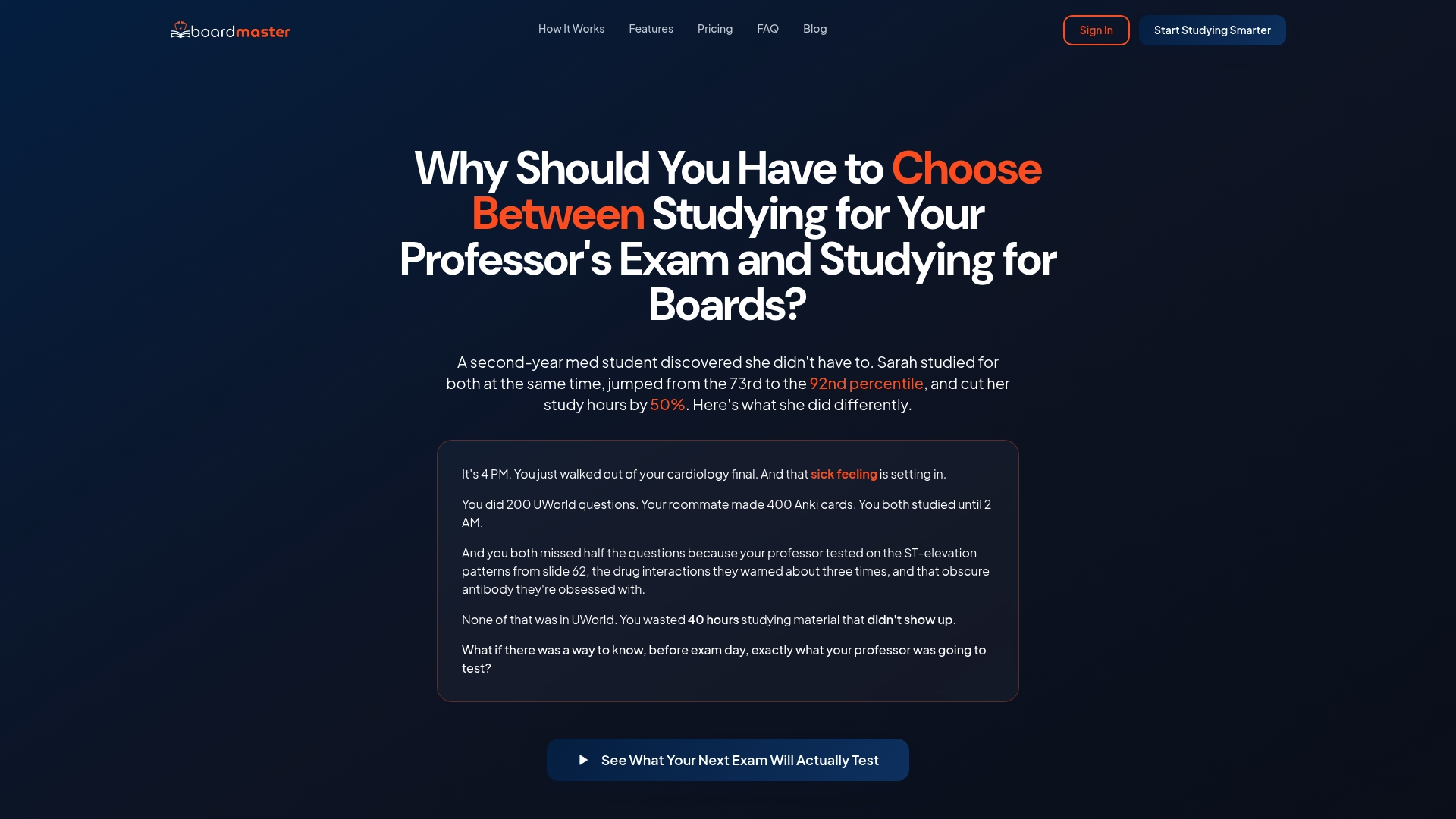
- Our AI Question Generator turns lecture notes into USMLE-style practice items aligned to what the professor emphasized.
- Our AI Flashcards convert the same material into spaced-repetition cards with medical images for quick follow-up review.
- Our Cortex AI study assistant gives instant explanations when a student question needs more depth than a quick answer provides.
- Our QBank adds physician-written board-style questions for broader board prep alongside class-specific practice.
If you want to see how a set of classroom questions becomes targeted practice material, start with our Boardmaster and try converting one lesson's worth of questions into a quiz.
FAQ
What is the term for learning through questioning?
This approach is generally called question-first learning, inquiry-based learning, or Socratic questioning, depending on the discipline. Related terms like prequestioning and student-generated questions (SGQ) describe specific techniques within the broader approach.
What are 10 questions to ask?
There is no single fixed list, since good questions depend on the content and the tier you are targeting, shallow, testing, or deep. A practical starting set mixes verification questions ("what happened"), testing questions ("what example fits this"), and deep questions ("why did this happen" or "how would this change under different conditions").
What is the 70/30 rule in teaching?
There is no single standard, citable definition for a prescribed balance between active student work and direct instruction. Educators may use different approaches, depending on their students and lesson goals.
Why is it important to ask questions?
Questions, whether teacher-framed or student-generated, prime attention toward specific content and reveal what students already think before you correct misconceptions. Research shows prequestions produce a targeted learning benefit with a moderate effect size, and student-generated questions can match retrieval practice on factual recall while boosting applied reasoning, according to meta-analytic and experimental findings.
How can medical students use AI tools for question-first study?
Medical students can upload lecture notes to generate practice questions, flashcards, and explanations tailored to what their specific course covered. Tools like our AI Question Generator turn that personalized material into targeted practice for both class exams and board prep.
Sources
- Harnessing Student-Generated Questions as a Learning Strategy
- Role of questions in inquiry-based instruction: towards a design taxonomy for question-asking and implications for design