
Question difficulty progression is the deliberate ordering of test items from easier to harder so that measurement stays accurate and learner motivation holds up across the exam. The strongest approach is statistical calibration through Item Response Theory when you have response data to support it; when you don't, Bloom's Taxonomy paired with staged difficulty bands and later validation against real response analytics gets you most of the way there. The benchmark worth memorizing: under the Rasch model, an item is most informative when a learner has about an even chance of answering it correctly.
TL;DR:
- Using a ramp difficulty progression works best for high-stakes, timed exams where confidence building is key, while wave patterns suit formative assessments aiming to keep learners engaged.
- Items with a 50% answer probability, according to Item Response Theory, provide the most information about a test-taker’s true ability, guiding adaptive test design.
- Calibrating question difficulty with response data requires large sample sizes for stability, but initial estimates can rely on Bloom's Taxonomy or answer variation when data is limited.
- Spikes in empirical difficulty often signal authoring errors or miscalibration, highlighting the importance of continuous validation through metrics like response times and answer distribution.
- Effective difficulty management in assessments involves predefined tiers, pilot testing, thorough documentation, and ongoing revisions based on detailed performance metrics.
Table of Contents
- What Shapes Should Difficulty Progression Take?
- What Is Item Response Theory and Why Does the 50% Rule Matter?
- How Do You Set Up Difficulty Levels in Practice?
- How Do You Estimate Difficulty Without Norming at Scale?
- What Item Mix and Pacing Actually Work in Practice?
- How Do You Validate and Improve Difficulty Progression Over Time?
- How BoardMaster Applies Progressive Difficulty to Medical Question Banks
- Author Checklist: Steps to Implement Progressive Difficulty in Your Next Assessment
- Sources
- FAQ
What Shapes Should Difficulty Progression Take?
Most people picture difficulty progression as a straight ramp, easy items first, hardest last. That's one legitimate pattern, but it's not the only one, and picking the wrong shape for your context can quietly wreck both your measurement and your learners' morale.
The ramp is the classic choice for high-stakes, timed exams like board certification tests or standardized admissions tests. Items climb steadily in difficulty, which lets early success build confidence before the harder material shows up. The ACT's structure is a well-documented example: it uses a rough three-zone layout, easy, medium, hard, with fuzzy boundaries rather than a hard cutoff between zones. That fuzziness is intentional. Real difficulty doesn't snap between categories; it drifts.
The wave pattern alternates hard and easy items throughout the test instead of saving difficulty for the end. This works well in formative quizzes and low-stakes practice sets, where you want students re-engaged after a tough question rather than demoralized into disengagement. A wave also protects against fatigue-driven errors on late-test hard items, since the difficulty spikes are spread out rather than stacked at the finish.
The spike pattern, a scattering of unexpectedly hard items dropped into an otherwise moderate test, is usually a design flaw rather than a strategy. Spikes happen when an item's actual difficulty (measured after the fact through response data) diverges sharply from its intended difficulty at authoring time. They're the single most common cause of a test "feeling unfair," and they're almost always fixable once you have p-value data on the item.
Zones matter more than exact difficulty numbers for most classroom and even many licensure contexts. Instead of assigning items a precise numeric difficulty, group them into bands (easy, intermediate, advanced) and accept overlap at the edges. This mirrors how the ACT and similar standardized exams actually operate, and it's far more forgiving to build and maintain than a system that demands rigid cutoffs you can't defend statistically.
Pacing is the part designers underestimate. A ramp structure typically expects learners to move faster through early items and slow down as difficulty rises, meaning your time-per-item budget should scale alongside your difficulty curve. If test-takers are burning triple the expected time on early "easy" items, that's a strong signal the item is miscalibrated, not that the learners are slow.
Practical shape choices break down like this:
- Ramp: high-stakes, timed, single-attempt exams where building momentum matters (board exams, certification tests).
- Wave: formative quizzes, spaced practice, and any context where re-engagement after a hard item matters more than pacing efficiency.
- Zones with fuzzy bands: most classroom tests and adaptive pools, where precision isn't worth the added complexity.
- Spikes: not a design choice. Treat any spike you find in response data as a bug to fix.
Pro Tip: If you're not sure which shape fits your test, default to a ramp with fuzzy zone boundaries. It's the safest choice for measurement validity and the easiest to explain to stakeholders who ask why the test is ordered the way it is.
What Is Item Response Theory and Why Does the 50% Rule Matter?
Item Response Theory (IRT) models the relationship between a learner's ability, denoted theta (θ), and an item's difficulty, denoted b. The Rasch model, the simplest and most widely used IRT model, makes a specific claim worth internalizing: when a learner's ability equals an item's difficulty (θ = b), the probability of a correct response is 0.5.
That's not a coincidence of math. It's the point of the model.
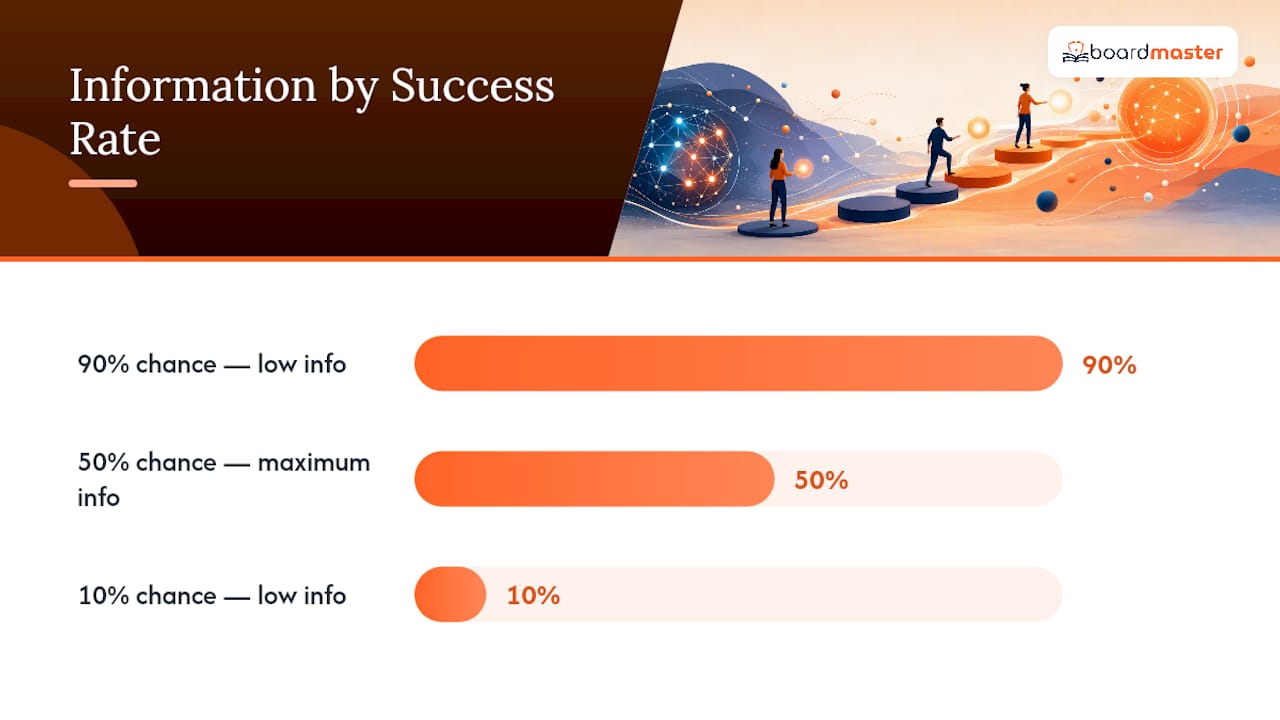
An item where a learner has a 90% chance of getting it right tells you almost nothing new about their ability. You already knew they'd probably succeed. An item where they have a 10% chance is nearly as uninformative in the opposite direction. The item that tells you the most about a learner's true ability is the one sitting right at the edge of their competence, where the outcome is genuinely uncertain. Columbia University's overview of Item Response Theory frames this as maximum information: difficulty calibrated so a learner has roughly a 50% chance of answering correctly extracts the most measurement value from a single item.
This is why adaptive testing platforms, the kind used in computerized adaptive testing (CAT), don't hand every test-taker the same fixed sequence. After each response, the system re-estimates the learner's ability and selects the next item to sit near that estimate, chasing that 50% probability zone in real time. The result is a shorter test that measures ability more precisely than a fixed-form exam of the same length, because every item is doing near-maximum informational work.
Here's the practical breakdown of when each calibration approach makes sense:
- Full IRT with adaptive item selection: appropriate for large item pools (typically hundreds of calibrated items) feeding a CAT engine, common in licensure and certification testing.
- IRT calibration on a fixed-form test: useful when you have enough historical response data to estimate item parameters but don't need real-time adaptivity, common in large lecture courses that reuse item banks across semesters.
- Bloom-based approximation with no response data yet: the practical fallback for new items, small classes, or first-run exams where no norming data exists.
- Hybrid: author with Bloom's Taxonomy, then recalibrate toward IRT estimates once enough response data accumulates.
The 50% target is a population-level statement, not a promise for any single learner. A well-calibrated item sits at 50% correct-response probability across the group of test-takers whose ability matches that item's difficulty parameter, not for every individual who happens to see it. Someone well above or below that ability level will still find the item easy or hard, exactly as they should.
One caveat worth stating plainly: full IRT calibration needs a meaningful sample size to produce stable difficulty estimates, generally into the hundreds of responses per item for reliable parameter fits. Below that, your estimates carry enough error that treating them as precise is a mistake. That's the gap Bloom's Taxonomy and other cold-start methods exist to fill, which the next section covers in detail.
How Do You Set Up Difficulty Levels in Practice?
Configuring difficulty levels is a series of concrete decisions, not an abstract exercise. Here's the sequence that works whether you're building in a learning management system, an authoring tool, or a custom question bank.
Choose your level structure first. Most designers land on three to five discrete tiers: Easy, Intermediate, Advanced is a common three-tier setup; some licensure exams add a Foundational tier below Easy and an Expert tier above Advanced. More than five tiers rarely earns its complexity, since the distinctions between adjacent levels blur past that point.
Set pragmatic cutoffs, not perfectionist ones. If you're using p-values (the percentage of test-takers answering correctly), a common starting convention is: Easy above 80% correct, Intermediate between 50% and 80%, Advanced below 50%. These are starting heuristics, not fixed law, and you'll adjust them once real response data comes in.
Run a pilot before trusting any label. A pretest with even 30 to 50 respondents per item gives you a rough p-value and a sense of whether the item behaves as intended. It won't give you a stable IRT parameter, but it will catch obviously broken items before they reach a graded exam.
Move from pilot data to IRT estimates once you have volume. As response counts grow, run the item parameters through Rasch or a more general IRT model to get an actual difficulty estimate (b) rather than a raw percentage. This is also the point where you link scales across different test forms, ensuring that "Advanced" means the same thing on Form A as it does on Form B.
Name levels for the learner, not just the database. Internally you might track difficulty as a numeric b-value; externally, learners need labels they can act on. "Advanced" reads clearly. A raw logit score does not. Keep the learner-facing label simple, and keep the underlying calibration hidden unless the audience is technical (item writers, psychometricians).
Freeze levels once they're published and comparisons matter. If students are being ranked or scored against a passing standard, changing an item's difficulty label mid-cycle undermines every comparison made before the change. Recalibrate between cohorts or exam administrations, not within one.
Document every recalibration decision. When you do shift a level, whether from a rewrite, a new pilot, or fresh response data, keep a record of what changed and why. This audit trail matters most in high-stakes contexts where a challenged score needs a defensible history behind it.
Accessibility deserves a specific mention here. Difficulty labels and any visual difficulty indicators (icons, color coding, star ratings) need to work for screen readers and for learners who are color blind. A difficulty tag that's conveyed only through a red versus green icon fails a meaningful share of your audience before they've even read the question.
How Do You Estimate Difficulty Without Norming at Scale?
Not every context has the luxury of hundreds of piloted responses. A single instructor writing a midterm, a small cohort in a specialized elective, or a brand-new question bank all face the same problem: how do you assign difficulty before you have data to calibrate against?
Bloom's Taxonomy is the oldest and still most practical fix. Coding each item by cognitive demand at the moment you write it, rather than after the fact, gives you a reasonable proxy for difficulty. A one-hop recall question ("What is the normal serum potassium range?") sits at the bottom. A question that requires synthesizing multiple concepts across several inferential steps, an "n-hop" item in NLP terminology, sits higher. This mapping isn't perfect, but the correlation between cognitive complexity and empirical difficulty is strong enough that Bloom-coding remains a standard authoring heuristic when no response data exists.
Answer variation is the best post-response signal you can get without full norming. Once you have even a modest set of responses, the spread across answer options, often called SAV (spread of answer variation), correlates meaningfully with Rasch-estimated difficulty. Research on estimating question difficulty without norming found that this variation measure tracks difficulty closely enough to serve as a practical stand-in when a full psychometric norming study isn't feasible. In plain terms: if test-takers' answers are scattered widely across every option, the item is probably harder than one where responses cluster tightly around the correct choice.
Automated and LLM-based ranking methods are the newest tool in this space. Recent research on automated approaches to rank multiple-choice questions by difficulty shows that zero-shot comparative prompting, where an instruction-tuned language model is asked to judge which of two items is harder rather than score each in isolation, often outperforms methods that try to assign an absolute difficulty score directly. Comparative judgments are simply easier for both humans and models to make reliably than absolute ones.
A few points worth keeping in mind before you lean on these fallback methods:
- Bloom-coding works best within a single domain; cognitive demand doesn't always transfer cleanly across subjects with different baseline vocabulary and reasoning norms.
- Paraphrase variance is real: two items testing the identical concept can land at different difficulty levels purely because of wording, so don't assume topical similarity implies difficulty similarity.
- Newer ordinal-regression approaches to question difficulty estimation, including metrics like the Discrete Ranked Probability Score, are built specifically to respect the ordering of difficulty levels rather than treating them as unrelated categories, which matters if you're evaluating an automated difficulty classifier.
- None of these methods substitute for calibration once real response data exists. Treat them as cold-start estimates, not permanent labels.
What Item Mix and Pacing Actually Work in Practice?
The right blend of easy, medium, and hard items depends heavily on stakes and format, and treating every test type the same is a common design mistake.
The goal here is reinforcement and confidence, not fine-grained ranking, so overloading a quick check-in with hard items mostly just frustrates students without producing useful measurement.
This range gives you enough spread across ability levels to differentiate students meaningfully while still letting most of the class experience some early success.
High-stakes licensure or board-style exams typically lean on a ramp with a heavier proportion of Intermediate and Advanced items, since the whole point of the exam is to discriminate finely among test-takers clustered near a passing threshold.
Time-per-item budgeting is the pacing signal most designers ignore until it causes a problem. If your intended budget for an Advanced item is 90 seconds but analytics show median response times running past four minutes, you don't have a time-management problem, you have a difficulty-miscalibration problem, or an ambiguous item. Response-time data is one of the fastest ways to catch this before it shows up as a complaint.
- Use adaptive sequencing when you have a large calibrated item pool, want to minimize test length, and need precision near a specific cut score (licensure, certification).
- Use linear (fixed-form) sequencing when comparability across all test-takers matters more than test-length efficiency, or when your item pool isn't large enough to support real adaptivity.
- Watch for spikes: an unexpectedly hard item dropped into an otherwise moderate stretch, almost always caused by an authoring estimate that diverged from actual empirical difficulty.
- Watch for misaligned instruction: if an entire cohort bombs an item that should be Intermediate based on cognitive demand, the problem may be the teaching, not the test question.
- Watch for ambiguous wording: high answer variation on an item intended to be Easy usually signals a clarity problem rather than a genuine difficulty issue.
Pro Tip: Track the ratio of actual to intended time-per-item across your first two administrations of any new test. A ratio consistently above 1.5 on any single item is your earliest, cheapest warning that something's miscalibrated, well before you have enough data for a full IRT re-estimate.
How Do You Validate and Improve Difficulty Progression Over Time?
Difficulty progression isn't a one-time setup; it's a system you monitor and adjust. The metrics below are the ones psychometricians and assessment teams actually track, and each one answers a different question about how an item is behaving.
| Metric | What it tells you | Rough signal of trouble |
|---|---|---|
| P-value (item difficulty) | Percentage of test-takers answering correctly | Far outside the intended band for that difficulty tier |
| Point-biserial discrimination | Whether high-ability test-takers outperform low-ability ones on this item | Near zero or negative value |
| Response time | How long test-takers actually spend on the item | Median far exceeds the designed time budget |
| Answer variation / entropy | Spread of responses across all answer options | Unusually high spread on an item coded as Easy |
| IRT fit statistics | Whether the item behaves consistently with the model | Poor fit flags an item that doesn't measure ability cleanly |
A small pretest, even 30 to 50 responses, gives you a usable p-value and a first read on discrimination. That's often enough to catch a broken item (one with negative discrimination, meaning weaker students outperform stronger ones on it) before it ever reaches a graded exam. As response volume grows into the hundreds, you can move to real Rasch or IRT parameter estimates and start making relabel, rewrite, or retire decisions with actual statistical grounding instead of guesswork.
The decision tree is straightforward once you have the numbers:
- Relabel an item when its empirical difficulty lands consistently in a different band than its assigned tier, but the item itself is otherwise sound.
- Rewrite an item when discrimination is weak or answer variation is unusually high, both signs the wording is ambiguous rather than the concept being poorly matched to the intended difficulty.
- Retire an item when it shows negative discrimination that persists across multiple administrations, since that usually means the item is measuring something other than the intended skill.
A soft-launch or A/B approach, testing new or revised items alongside a proven set before fully committing them to a graded exam, catches difficulty cliffs faster than intuition ever will. This mirrors how game designers track quit-locations to find frustration spikes; in assessment, the analogous signal is a sudden jump in abandonment, guessing behavior, or wildly elevated response time at a specific item position. Assignify's guide to question-level analysis walks through this kind of empirical monitoring in more operational detail, and it's worth building into any recurring assessment program rather than treating validation as a one-time launch task.
Instrument your platform to log response time, answer selection, and completion status at the item level, not just the total score. Aggregate scores tell you almost nothing about where a test broke down; item-level logs tell you exactly where.
How BoardMaster Applies Progressive Difficulty to Medical Question Banks
Medical students face a specific version of the difficulty progression problem: professors emphasize different concepts even when teaching the same nominal topic, so a generic question bank calibrated to a "typical" curriculum often mismatches what any individual course actually tests.
BoardMaster addresses this by generating practice questions directly from uploaded lecture material rather than pulling from a fixed, generic pool. Because each question is tied to what a specific professor emphasized, difficulty exposure can be tuned to the actual concepts a student will face on their class exam, not a generic approximation of "cardiology topics a board exam might cover." This practical version of the calibration principle discussed earlier: exposure that sits near a learner's actual knowledge gaps produces more useful practice than exposure spread evenly across everything a subject could theoretically include.
One student, Sarah, used this targeted approach and moved from the 73rd to the 92nd percentile while cutting her study time roughly in half. That result illustrates the core payoff of well-matched difficulty exposure: time spent on questions calibrated to actual gaps in knowledge, rather than spread thin across material already mastered or wildly beyond current ability, does more work per study hour.
A few operational notes for anyone applying this logic to medical education specifically:
- Course-aligned calibration matters more in medical school than in many other domains, because board-style exam content and individual professor emphasis frequently diverge, and students need practice for both.
- OSCE-style clinical skills practice benefits from the same n-hop reasoning logic used in Bloom-based item design: a straightforward symptom-recall question sits at a different difficulty tier than a multi-step differential diagnosis scenario, and calibrating exposure across both matters.
- Spaced repetition, when combined with difficulty-tuned question exposure, is more effective than blanket repetition, since it concentrates review time on material near the edge of a student's current competence rather than material already secure.
BoardMaster's lecture-based question generation is one practical demonstration of how this concept maps concept emphasis to question difficulty automatically, rather than requiring a student to guess which topics deserve the most practice time.
Author Checklist: Steps to Implement Progressive Difficulty in Your Next Assessment
Before you build your next test, work through this sequence rather than jumping straight to writing items.
Start with your item mix and time budgets, decided before you write a single question. Know roughly what percentage of your test should be Easy, Intermediate, and Advanced given your stakes level, and set a realistic time-per-item target for each tier.
Decide your calibration approach next. If you have (or will accumulate) enough response volume, plan for real IRT calibration from the start, even if you begin with Bloom-coded estimates. If you'll never have that volume, commit to Bloom's Taxonomy as your primary method and treat it as final rather than provisional.
Pilot before you trust any label. Even a small pretest catches broken items early, and instrumenting response time and answer distribution from day one means you're collecting the data you'll need for validation before you even realize you need it.
Document your rules. Write down your cutoffs, your labeling conventions, and every recalibration decision you make. When someone challenges a score six months from now, that audit trail is the difference between a defensible answer and a shrug.
None of this requires perfection on the first attempt. It requires a system that gets more accurate every time you run it.
— Dr. Ahmed Abuzoor
Sources
- Item Response Theory — Columbia University
- Question Difficulty -- How to Estimate Without Norming, How to Use for Automated Grading
FAQ
What Are the Different Difficulty Levels of Questions?
Most assessments use three to five discrete tiers, commonly Easy, Intermediate, and Advanced, sometimes extended with a Foundational tier below and an Expert tier above. These labels typically map to statistical difficulty bands (like item p-values) or to cognitive-demand levels from Bloom's Taxonomy when response data isn't yet available.
What Are the Four Levels of Difficulty?
A four-tier system commonly runs Foundational, Easy, Intermediate, and Advanced, though exact naming varies by field and testing organization. There's no single universal four-level standard; the key is that each tier maps to a defined difficulty band or cognitive-demand level, applied consistently within your own exam.
What Are the Different Types of Difficulty Levels?
Difficulty can be set through predefined discrete labels chosen by the designer, automatically calibrated through statistical methods like Item Response Theory, or estimated through fallback methods like Bloom's Taxonomy coding and answer-variation analysis. Which type fits best depends on whether you have enough response data to support statistical calibration.
How Do You Assess Question Difficulty Without Test Data?
Code each item by cognitive demand using Bloom's Taxonomy at the time you write it, since inferential complexity correlates reasonably well with empirical difficulty. Once even limited response data exists, answer variation across response options serves as a practical stand-in for full statistical norming.
Why Is the 50% Correct-Response Rate Considered Optimal?
Items far above or below that threshold tell you little new about a learner's true ability, since the outcome is already largely predictable.