
Use Pomodoro as the container for timed active recall: a short, repeatable rhythm that turns passive hours into retrieval practice. For USMLE prep, the method works best when every timer block ends with a self-test, a flashcard set, or a graded question run, not just rereading. Start with a 50/10 rhythm for question blocks and a 25/5 rhythm for quick review, then adjust the ratio to match your own fatigue curve.
TL;DR:
- Use cycles lasting 60 minutes for full question sets, and 90 minutes for dense reading or cross system integration, where frequent interruptions can break concentration.
- Set one testable goal per session, review each missed answer immediately, tag its cause, and schedule it again in two to four days.
- Choose a short walk or stretching over phone scrolling, and schedule a restorative midday break lasting 30 minutes on long study days.
- Assign each weekday a primary system, then reserve a short block for material revisited three to five days earlier, preventing gaps longer than a week.
Table of Contents
- Which Pomodoro rhythms fit which USMLE tasks
- How to run an active-learning Pomodoro
- What to do during your breaks (and why it matters)
- Daily and weekly Pomodoro templates for USMLE prep
- Timers and tools that remove startup friction
- Applying Pomodoro to targeted question practice
- A personal note on finding your own rhythm
- Running Pomodoro cycles with BoardMaster
- FAQ
- Sources
Which Pomodoro rhythms fit which USMLE tasks
Not every study task deserves the same timer. The classic 25/5 split works well for short retrieval sets: a quick Anki deck, a single organ system recap, or a 10-question warm-up before a longer block. The short cycle keeps you moving fast enough that fatigue never builds, which suits early mornings or the last hour before bed.
Once you're into sustained QBank practice, 50/10 or 60/10 tends to perform better. A 44-question NBME-style block runs close to an hour, so a 50 or 60-minute timer lets you finish a realistic set without an artificial stop mid-block. The 10-minute break afterward is long enough to review a handful of missed questions before moving on.

Deep reading, pathophysiology mapping, or multi-system integration work (the kind where you're building connections across cardiology, renal, and pharmacology at once) benefits from longer, less interrupted stretches. A 90/10 rhythm gives you room to get into that material without the timer cutting you off right as the ideas start to connect.
The decision rule is simple: match the rhythm to cognitive intensity, not to the clock. Low-intensity recall gets short cycles. High-intensity question practice gets medium cycles. Complex integration gets long cycles. Total daily hours matter too: a 12-hour dedicated study day needs more variation in cycle length than a 3-hour weeknight session, or fatigue compounds by the afternoon.
- 25/5: quick Anki decks, single-topic recall, warm-ups.
- 50/10 or 60/10: QBank blocks, mixed practice sets, timed question review.
- 90/10: dense reading, integrative mapping, first-pass content review.
For a pacing plan that maps these blocks to actual test-day timing, our guide on timing for question blocks walks through how to scale practice sessions toward exam-length stamina.
How to run an active-learning Pomodoro
A timer by itself does nothing. What makes a Pomodoro useful for board prep is what happens inside it, and what you do in the ten minutes right after it ends.
- Set one learning goal before you start the timer. Decide exactly what you're testing yourself on (a specific disease cluster, a drug class, 20 practice questions) rather than opening the timer and figuring it out as you go.
- Keep the block active, not passive. Spend the time answering practice questions, running a spaced flashcard deck, or closing your notes and writing out what you remember from memory.
- Stop when the timer stops, even mid-thought. The discipline of stopping is part of what keeps the next block fresh.
- Review immediately after the bell, before the break starts. Check every wrong answer, tag the reason (knowledge gap, careless error, timing pressure), and log it somewhere you'll see again.
- Schedule the spaced repeat. Anything you missed goes back into review in two to four days, not "eventually." The spacing effect is one of the more consistent findings in learning research: distributing review over time improves long-term retention compared with cramming the same material once.
A 50-minute QBank Pomodoro might look like this: five minutes to pull a 20-question block, 35 minutes to answer it at test pace, and the remaining time to flag anything you weren't fully confident about. Then, during the break, you glance at your error log before switching tasks, not after you've already moved on to something else.
Pro Tip: Keep a single running error log across your whole study block, not one per session. Patterns across hundreds of missed questions are more useful than patterns across twenty.
Active learning strategies built around retrieval and spaced repetition consistently outperform passive review, and structured interventions combining active learning with time-management techniques show measurable gains in both performance and consistency for medical students. The timer is the scaffolding. The retrieval is the actual work.

What to do during your breaks (and why it matters)
The break is not downtime you're owed for finishing a block. It's part of the mechanism that makes the next block work.
Active breaks (a short walk, stretching, a few minutes of deep breathing, drinking water) outperform passive breaks like scrolling your phone. A pilot study on active breaks during study sessions found measurable improvements in cognitive test performance and heart-rate variability after short movement-based interventions, compared with more passive recovery. Phone scrolling feels restful but keeps your attention system engaged on new, fragmented stimuli, which doesn't give your brain the same recovery.
- 5-minute breaks: stand up, stretch, refill water, look away from screens.
- 10-minute breaks: short walk, light stretching sequence, or a few minutes of slow breathing.
- 30-minute breaks: a real walk outside, a proper meal, or a short nap if you're running a marathon study day.
On long study days, plan at least one 30-minute restorative break, usually around midday, and don't be afraid to nap if you're genuinely fatigued rather than pushing through a flat hour of low-retention studying. One controlled comparison of Pomodoro, Flowtime, and self-regulated breaks found no single method clearly outperformed the others on raw productivity, but fatigue and motivation trajectories differed between approaches, which is a reminder that personalization matters more than rigidly following one system.
Daily and weekly Pomodoro templates for USMLE prep
These are starting points. Adjust the number of blocks to your available hours and energy, not the other way around.
- Weeknight short routine (2 to 3 hours): one 25-minute lecture or content review, a 5-minute break, then two 50-minute Pomodoros of QBank or flashcard retrieval with 10-minute breaks between them. End with a 5-minute scan of your error log from earlier in the week.
- Full study day template (8 to 10 hours): three 50/10 QBank Pomodoros in the morning, a 30-minute restorative break around midday, two 90/10 blocks in the early afternoon for denser reading or integration work, then two more 50/10 blocks in the late afternoon before a lighter 25/5 review session in the evening.
- Weekly spacing template: assign each weekday a primary system (cardiology Monday, renal Tuesday, and so on) but reserve the last 25-minute block of each day for a spaced return to material from three to five days earlier, so nothing goes untouched for more than a week.
This kind of structure mirrors the way USMLE Step 1 itself is organized: multiple timed blocks with defined break allocations across an 8-hour testing session. Practicing in blocks that resemble that structure, rather than studying in open-ended stretches, builds the stamina the actual exam day requires. For more detail on scaling your daily question volume as your test date approaches, see our breakdown of daily question targets for USMLE. If your schedule also needs to account for coursework deadlines alongside board prep, a weekly review and planning routine can help keep both tracks from colliding.
Timers and tools that remove startup friction
The best timer is the one you'll actually start. Overthinking the tool wastes more time than any app saves you.
- Mobile apps: most phone operating systems include a free built-in timer, and dedicated Pomodoro apps add session labeling and streak tracking if that motivates you.
- Browser extensions: useful if most of your studying happens on a laptop, since they can pair a timer with a site blocker in one tool.
- Desktop utilities: simple countdown apps that sit in your menu bar work well for distraction-free blocks.
- Analog timers: a physical kitchen timer removes the temptation to check your phone the moment the countdown starts.
Label each timer profile by task (QBank 50/10, Anki 25/5, Reading 90/10) so you're not reconfiguring settings every session. Pair your timer with a site blocker or your phone's do-not-disturb mode during work blocks, and if you don't trust yourself with notifications, leave your phone in another room entirely. Time-blocking and similar structuring techniques lower the activation energy needed to start a session, which is often the actual barrier, not the studying itself.
Applying Pomodoro to targeted question practice
Dr. Ahmed Abuzoor's background in medical education informs the framing throughout this guide: a timer only pays off when the content inside it is the right content. Some students have reported significant improvement in their exam percentiles while reducing study hours by focusing their timed sessions on practice questions built from their own lecture material rather than generic high-yield lists. The gain came from narrowing what she studied inside each block, not from studying longer.
Timing technique effectiveness is secondary to active learning: use the timer to manage the intensity of retrieval and spaced repetition, not as the goal in itself.
That principle is echoed in guidance from medical-education practitioners on active learning strategies, who emphasize retrieval and spacing over the timing method itself. In practice, that means generating a focused question set from your own lecture notes before you start the timer, running it as a timed Pomodoro, and feeding every miss into spaced flashcards for review two to four days later. You can read more about Dr. Abuzoor's background on his author page.
A personal note on finding your own rhythm
Pomodoro is a framework, not a prescription. Some students concentrate best in 25-minute sprints; others lose momentum every time the timer interrupts a good thread of thinking. Test a few ratios in your first week of using this system and keep whichever one leaves you sharper at the end of the day, not just busier.
Sleep and active recovery aren't optional extras around your schedule. They're part of what makes the next day's retrieval practice actually stick. Track what you recall, not just how many hours you logged.
— Dr. Ahmed Abuzoor
Running Pomodoro cycles with BoardMaster
We built BoardMaster around the same idea this whole guide is built on: the quality of what's inside your timer matters more than the timer itself. Upload your lecture notes and we generate board-style questions tailored to what your own professors actually emphasize, so every Pomodoro you run is pointed at material that counts twice, for your class exam and for boards.
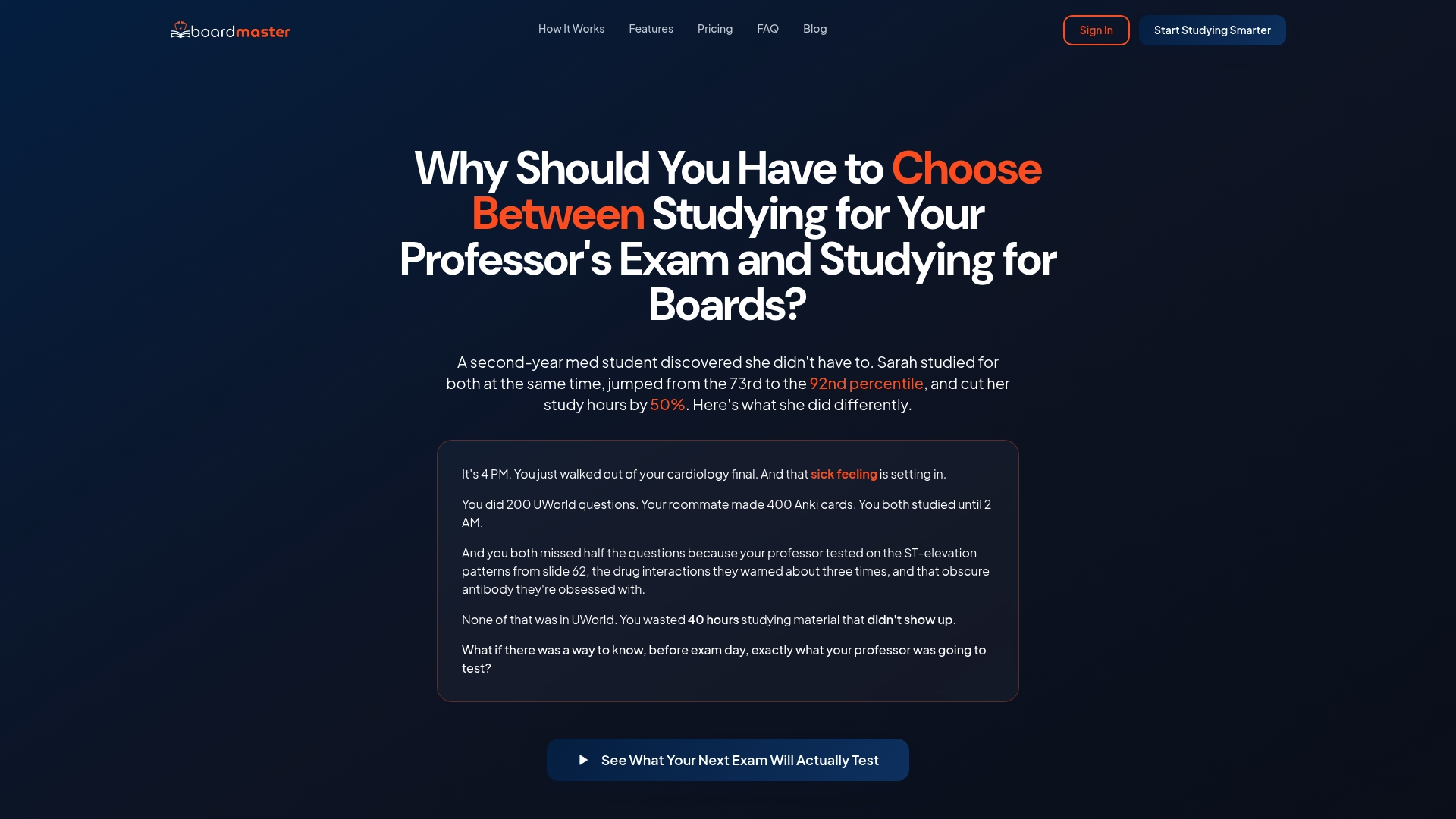
A practical workflow: generate a focused question set from a recent lecture, run it as a timed 50/10 Pomodoro, then route every missed question straight into spaced flashcards for review a few days later.
- AI Question Generator: turns your uploaded lecture notes into USMLE-style practice questions.
- AI Flashcards: builds spaced-repetition decks with medical images for your post-Pomodoro review.
- QBank: gives you 5,000+ physician-written board-style questions for timed practice blocks.
- Cortex AI: answers questions instantly when a miss needs more explanation than a flashcard can give.
See how the question generator works in our AI question generator demo, check the full question library on the QBank page, or start building your first timed set at Boardmaster.
FAQ
What is the best Pomodoro ratio for USMLE studying?
There's no single best ratio: 25/5 suits quick flashcard review, while 50/10 or 60/10 suits full QBank blocks that mirror the length of a real test block. Match the cycle length to the task's cognitive intensity rather than picking one ratio for everything.
How long should breaks be during Pomodoro study sessions?
Short breaks of 5 to 10 minutes work well between standard blocks, while a 30-minute break fits best around midday on longer study days. Active breaks such as stretching or a short walk tend to restore focus better than passive activities like phone scrolling.
Does the Pomodoro technique actually improve study results?
Research comparing Pomodoro, Flowtime, and self-regulated breaks found no clear productivity advantage for any single method, though fatigue and motivation patterns differed, suggesting the right approach depends on the individual. What consistently helps is pairing any timing method with active recall and spaced review rather than passive rereading.
How can I use BoardMaster questions inside a Pomodoro session?
Generate a question set from your own lecture notes before starting the timer, then run that set as a timed block so your practice matches both your course content and board-style format. Missed questions can be sent into spaced flashcards for review a few days later.
How should I build a weekly study schedule around Pomodoro?
Assign each weekday a primary topic and run several Pomodoro blocks against it, then reserve a short block each day for a spaced return to material from several days earlier. This keeps content moving through review cycles instead of being studied once and forgotten.
Sources
- Enhancing academic performance, cognitive functions, and mental well-being through active breaks
- Spacing effect and retention (PMC review)
- Meta-analysis on active learning and time management in medical education
- Investigating Pomodoro and break-taking techniques
- Step 1 | USMLE