
Neither format wins outright: pick video when you need to build a mental model of something visual, and pick podcasts when you need repetition, review, or study time you can squeeze into a commute. The right choice depends on the learning job in front of you, not on a general preference for audio or video. The sections below map the evidence to specific study tasks so you can decide in seconds.
TL;DR:
- Visual content requires video when building mental models of procedures, structures, or complex diagrams, especially for first-time learning scenarios.
- Listening to podcasts is more effective for review, reinforcement, or studying during activities like commutes, where visual engagement is impractical.
- Active engagement tactics such as goal setting, pausing, recalling, and short segments improve retention for both podcasts and videos.
- Poor environment or multitasking habits significantly reduce the effectiveness of both formats, emphasizing the need for structured study routines.
- Learning preferences are secondary to task-specific needs, with content complexity and task fit guiding whether to choose audio or video.
Table of Contents
- What the research shows: systematic reviews, trials, and evaluation studies
- Which format fits each study job
- Tactics: how to study actively with podcasts and with videos
- What commonly goes wrong and how to fix it
- How BoardMaster maps onto these best practices
- Impact of individual learning styles and preferences on effectiveness of podcasts versus videos
- Accessibility considerations for learners with disabilities
- Technological and environmental factors that shape which format works
- Author takeaway: quick rules of thumb
- Try BoardMaster for study podcasts and targeted practice
- Authoritative studies and guidance to read next
- Sources
- FAQ
What the research shows: systematic reviews, trials, and evaluation studies
The strongest signal comes from a systematic review of 105 studies covering 7,776 college students, which found that adding video to existing instruction produced a large learning benefit, while replacing another format with video produced a much smaller gain. That distinction matters: video works best as a supplement, not necessarily as a swap for reading or lecture.
Adding video to instruction produced a significantly larger learning benefit than simply substituting video for another format, according to the same systematic review. That gap suggests the value of video often comes from reinforcement, not from format alone.
A randomized crossover trial in undergraduate medical education tells a more nuanced story. Researchers compared live lectures against video podcasts and found no significant difference in immediate knowledge recall between the two, even though students said they preferred the live lecture format. Students still valued the podcast version for its convenience and the ability to revisit material later.
Separate design and evaluation work on video podcasts used for formative feedback found that students rated them as clear and useful, largely because they could pause, rewind, and replay sections that were confusing the first time through. A 2024 study on podcast integration in a cybersecurity course reported a small improvement in outcomes when the podcast was woven into the curriculum rather than bolted on as an afterthought.
A few caveats apply across all of these evidence:
- Results depend heavily on content type: procedural and visual material behaves differently than narrative or conceptual material.
- The meshing hypothesis, the idea that matching format to individual learning style boosts outcomes, has mixed support and should not override task fit.
- Sample sizes in several studies are moderate, and self-reported preference does not always predict actual recall.
Which format fits each study job
Task fit beats personal preference for anything with a lot of moving visual parts. Use these rules when you are deciding how to spend a study block.
- Building a mental model of a process or diagram: pick video. Lab techniques, anatomical structures, and math derivations all rely on a visual sequence you need to see, pause, and rewind.
- Reviewing material you already learned once: pick podcasts. Spaced review, language listening practice, and concept synthesis work fine without a screen.
- Studying during dead time: pick podcasts. A commute, a walk, or a chore is a poor environment for video but a good one for audio revision.
- Learning something with high visual complexity for the first time: pick video, even if you generally prefer audio. The interaction between modality preference and content complexity suggests that self-described visual learners benefit more from visual formats specifically when the material is complex.
- Reinforcing something you can already picture: either format works, so default to whichever fits your schedule.
Prior exposure changes the calculus. Once you have seen a procedure demonstrated on video, an audio recap of the same material during a second pass is often enough, because your brain can fill in the visual gaps it already stored.
Tactics: how to study actively with podcasts and with videos
Passive listening and passive watching both waste time. Turn each format into an active task with a short routine.
For podcasts:
- Set a specific goal before you press play, such as "identify the three causes of X."
- Listen once straight through without pausing to catch the overall structure.
- Listen again with pauses, reciting key points out loud before the narrator explains them.
- Mark timestamps for anything confusing so you can jump back later.
- Close the episode with five minutes of retrieval practice, writing down what you remember with no notes in front of you.
For videos:
- Preview the visuals first by scrubbing through without sound to see what is coming.
- Watch with sound, pausing at any diagram or demonstration to annotate it in your own words.
- Take screenshots of key frames to turn into flashcards later.
- Run a short set of practice problems immediately after watching, while the visual is still fresh.
Segment length matters more than total time. Aim for 8 to 12 minute chunks for a first pass and shorter, five minute clips for revision passes. A reasonable sequence for hard material is watch, then listen, then test, since each pass reinforces a different memory pathway.
Pro Tip: Use the transcript feature on your video or podcast player to search for a keyword instead of scrubbing blindly for the section you need.
Playback speed, bookmarks, and screenshot-to-flashcard conversion are the three tool habits worth building early, since they compound across every course you take.
What commonly goes wrong and how to fix it
The most common failure mode is multitasking. Research tracking note-taking and multitasking during podcast listening found that students who listen to assigned podcasts are the least likely to take notes and the most likely to multitask, both of which hurt exam performance compared with active note-taking.
- Long audio-only sessions lose your attention fast, so chunk episodes into segments under fifteen minutes and require a written answer before moving to the next one.
- A poorly designed video can overload you with visual noise, so preview a few minutes before committing a full session to it.
- Passive listening without a task rarely sticks, so pair every podcast with a two-minute recall check afterward.
- Studying alone with no deadline invites drift, so use a study partner or a short self-quiz to force accountability.
How BoardMaster maps onto these best practices
BoardMaster builds several of these routines directly into its workflow for medical students. The platform's study podcasts turn uploaded lecture notes into short audio episodes, which pairs naturally with the review-focused podcast tactics above.
- Convert lecture slides into a short study podcast for a first review pass.
- Follow up with AI-generated practice questions built from the same notes for retrieval practice.
- Reinforce weak spots with flashcards that use spaced repetition.
As one illustrative case, a student moved significantly ahead in percentile rank while cutting study hours roughly in half by focusing on questions tied to emphasized material, rather than generic question banks.
Impact of individual learning styles and preferences on effectiveness of podcasts versus videos
Learning style preference is real as a matter of comfort, but it is a weaker predictor of performance than most students assume. The research on modality preference and cognitive load found that self-described visual learners do better with visual formats specifically on complex material, while learners without a strong preference perform similarly across formats.
That means your comfort with audio or video should guide your choice for straightforward review, but it should not override the task-fit rules above for genuinely complex content. Someone who calls themselves an "auditory learner" but is trying to master a surgical technique still needs the video, because the content, not the label, drives the demand for visual detail.
A separate angle worth noting: creating your own audio content, not just consuming it, has its own benefit. A 2025 study of 190 university students found that student-created podcasts improved subject understanding, peer connection, and academic performance, likely because producing an explanation forces a deeper level of processing than simply listening to one.

The practical takeaway is to treat learning style as a tiebreaker, not a rule. When a topic could reasonably go either way, follow your preference. When it cannot, follow the content.
Accessibility considerations for learners with disabilities
Format choice carries real weight for learners with visual or hearing impairments, and the right accommodation depends on the specific need. A student with low vision may rely on podcasts and audio description almost entirely, while a student who is deaf or hard of hearing needs captions or transcripts for every video and cannot use audio-only podcasts without a text alternative.
Teaching-center guidance from Brown University's Sheridan Center points out that podcasts carry equity and inclusion benefits when they are framed clearly as required learning materials, with reminders about how and when to use them, rather than left as an optional extra that some students miss.
Practical steps that help most learners, disability or not:
- Always request or generate a transcript for video content, since it doubles as a searchable study tool.
- Use captions by default on video, since many students benefit from reading along even without a hearing impairment.
- Check that any podcast platform supports variable playback speed and a visual progress bar, which helps learners who process audio more slowly.
None of this requires a different study strategy so much as a different delivery layer on top of the same content. The task-fit and active-study rules above still apply once the material is accessible.
Technological and environmental factors that shape which format works
Video demands more from your environment than audio does. Streaming a lecture video needs a stable internet connection and enough screen space to read diagrams clearly, while a podcast will play on a basic phone with a weak signal or even fully downloaded offline.
That difference matters for where and when you study. A student without reliable internet at home, or one who studies primarily on a commute or during a shift break, will get more consistent value from downloaded audio than from video that buffers or requires a strong connection. Device availability plays a role too: a shared or older laptop may struggle with high-resolution video, while audio has almost no hardware floor.
None of this changes which format is better for a given content type, but it does change which format is realistic for a given student on a given day. The practical fix is to plan around your own constraints: download podcasts before you lose signal, and reserve video sessions for times and places where you have a stable connection and a real screen. Treating format choice as partly a logistics decision, not just a pedagogy decision, avoids the common trap of picking the "better" format for a task and then failing to actually use it because the environment could not support it.

Author takeaway: quick rules of thumb
Go video-first for anything visual, audio-first for spaced review, and always close with active retrieval regardless of format. Personal preference is a fine tiebreaker but should never override task fit. Track what actually helps you remember, and adjust.
— Dr. Ahmed Abuzoor
Try BoardMaster for study podcasts and targeted practice
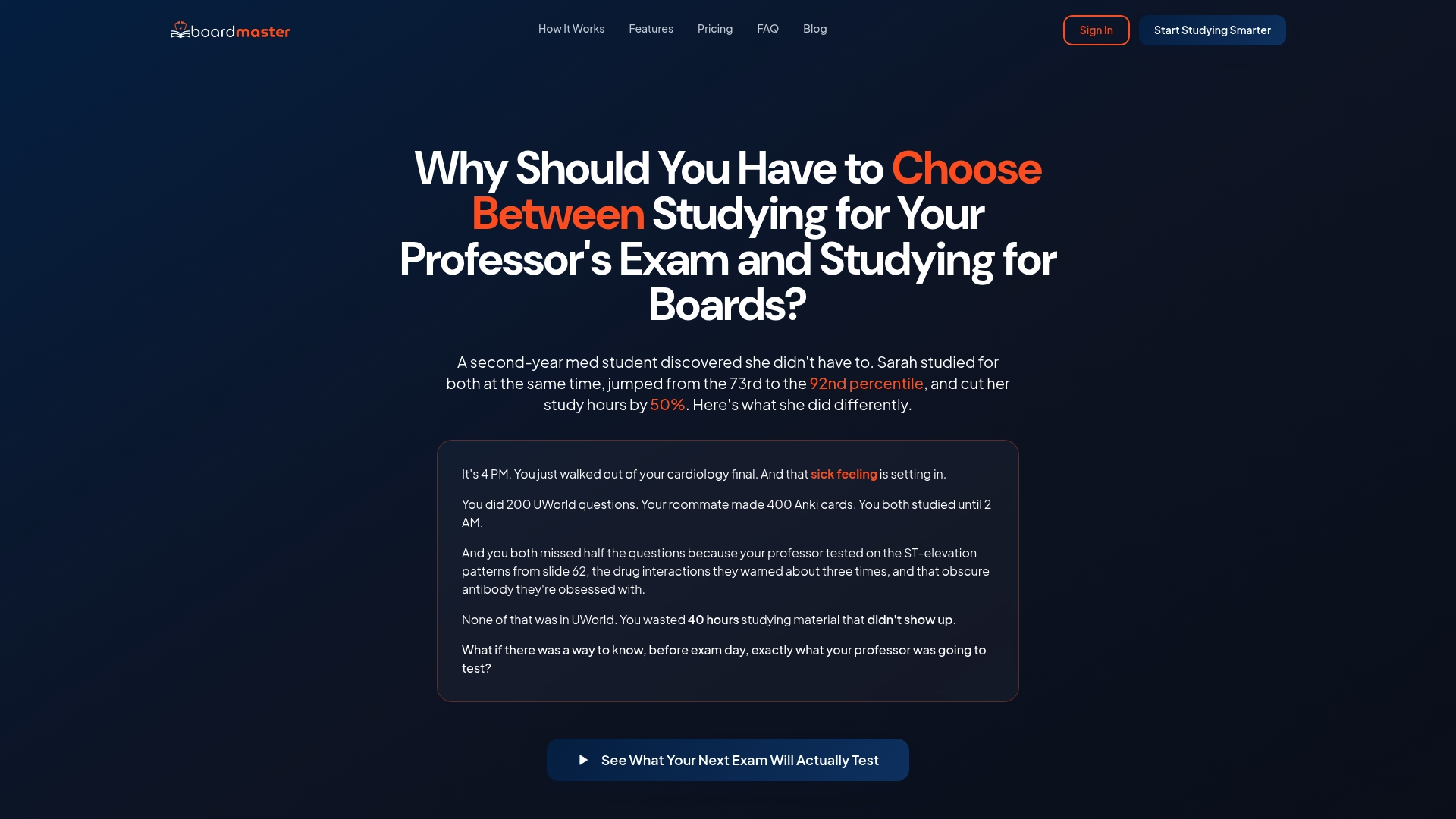
The platform turns lecture notes into short study podcasts, then follows up with targeted practice questions and flashcards built from the same material. It is one option among many for review sessions built around emphasized content. Start with the free tier.
Authoritative studies and guidance to read next
- Live lecture versus video podcast RCT: the crossover trial behind the recall comparison above.
- Video podcast design and evaluation study: student feedback on clarity and reviewability.
- AERA systematic review summary: the pooled evidence on adding versus swapping video.
- Frontiers 2024 podcast integration study: outcomes from a real course.
- Educo case studies: broader context on study coaching alongside digital media.
Sources
- Video improves learning in higher education: A systematic review (AERA newsroom summary)
- Live lecture versus video podcast in undergraduate medical education: A randomized controlled trial
- Frontiers in Education (2024) — podcast integration in a course
- Design and evaluation of video podcasts for providing online feedback on formative pharmaceutical calculations assessments
FAQ
Are podcasts good while studying?
Podcasts work well for review, spaced repetition, and studying during a commute, though a randomized trial found no significant recall difference between video podcasts and live lectures for first-time learning. They work less well for material that depends on visuals, since there is nothing to look at while you listen.
What are the key differences between podcasts and videos?
Video adds a visual channel that helps with procedures, diagrams, and anything requiring a mental model of a process, while podcasts offer more flexibility for listening during commutes or chores. A systematic review of college students found that adding video to instruction produced a stronger benefit than swapping one format for another.
What are the disadvantages of a podcast?
Podcasts make it easy to multitask, and research on note-taking during podcast listening found that students who listen to assigned podcasts are less likely to take notes and more likely to multitask than students using other formats. Without a required task attached, long audio-only sessions also tend to lose attention before they end.
How much does a podcast with 5,000 listeners make?
BoardMaster does not publish audience monetization figures, since it is a study tool rather than a podcast hosting platform. For students creating their own study podcasts as a learning exercise, the goal is comprehension and retention rather than revenue.