
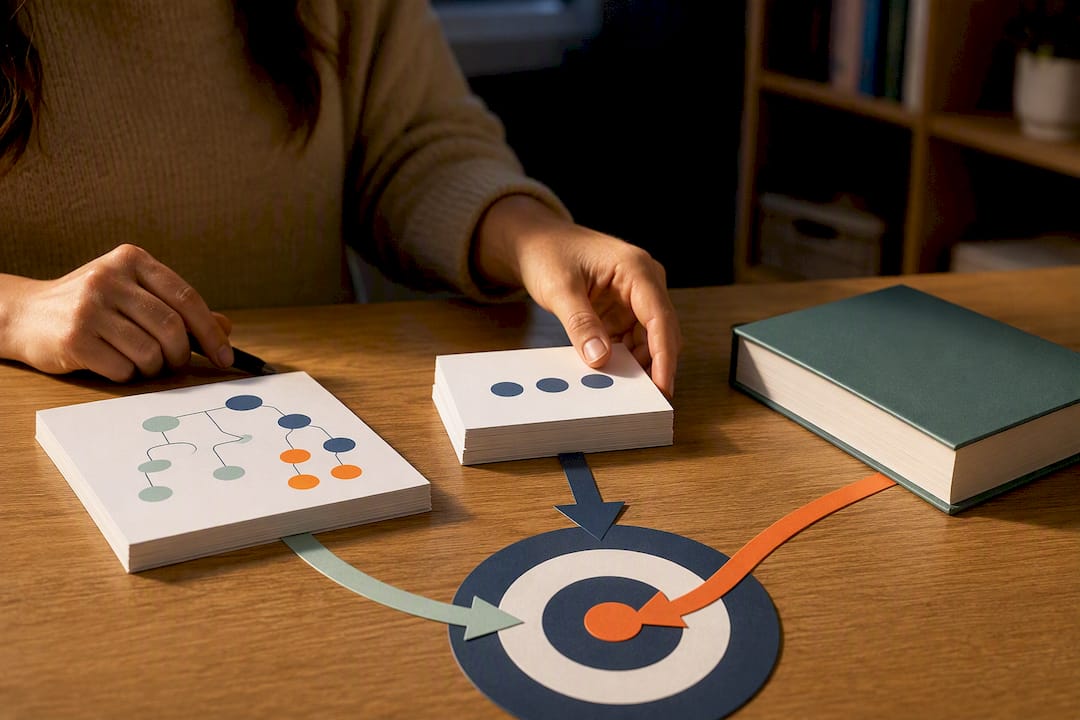
Two resources carry this exam: a high-volume, explanation-rich question bank and official NBME practice forms for calibration. Everything else, including Case Files, OnlineMedEd, AMBOSS, and APGO/uWISE, exists to patch the gaps those two reveal. Start in tutor mode to build reasoning, then shift to timed random blocks in your final two weeks.
TL;DR:
- Question banks should be the primary study resource, with 20 to 30 questions daily in early weeks and increasing to 40 to 60 in later weeks to build reasoning skills.
- Taking at least one official NBME practice form midway and one in the final week provides the most accurate prediction of your shelf score.
- Using case-based resources, quick review guides, and videos helps reinforce clinical patterns and key facts without overloading desk time.
- Active recall with questions entered into Anki and spaced repetition significantly improves long-term retention over passive review methods.
- Uploading lecture slides into BoardMaster creates exam-like questions aligned with your professor’s emphasis, filling gaps ignored by generic question banks.
Table of Contents
- Best Obgyn Shelf Resources by Role: Qbanks, NBMEs, and Books
- A Two-Week-to-Rotation-Length Study Timeline
- How to Turn Question Practice Into Real Learning
- Common Mistakes and Final-Week Priorities
- How BoardMaster Maps Lecture Content to Targeted Practice
- A Clinician-Educator's Note on Realistic Expectations
- Put This Plan Into Practice With BoardMaster
- Where to Verify Official Practice Materials
- Sources
- FAQ
Best Obgyn Shelf Resources by Role: Qbanks, NBMEs, and Books
Not every resource does the same job, and treating them as interchangeable wastes rotation time you don't have. Here's how the major OB/GYN clinical resources break down by function.
Question banks are the engine, not a supplement. UWorld-style qbanks with detailed explanations should be the first thing you open and the last thing you close before the exam. Start day one in tutor mode, answering 20 to 30 questions daily, and increase volume as your foundational knowledge builds. This mirrors what top-ranking student guides consistently recommend: a question-first approach beats chapter-by-chapter reading almost every time on a clinically reasoned exam like OB/GYN.
NBME practice forms are your calibration standard. Nothing else predicts your actual shelf score as reliably as the official NBME subject exam materials. Schedule one at the midpoint of your rotation to expose blind spots, then one or two more in your final week. If you're on a COMLEX track instead, the NBOME COMAT clinical subject exam serves the same calibration role.
For framing and quick review, three resources cover distinct needs:
- Case Files: Obstetrics and Gynecology builds clinical scripting through case-based vignettes, which trains the pattern recognition NBME stems reward.
- First Aid for the Clerkship or a Shelf Notes style guide condenses high-yield facts for rapid pre-exam review.
- OnlineMedEd videos or an OB/GYN podcast work well during commutes or slow clinic afternoons, delivering framework-level understanding without demanding a desk.
Finally, build an active recall layer:
- Pull incorrect questions and key algorithms straight into Anki.
- Tag cards by topic (postpartum hemorrhage, contraception, prenatal screening) so you can filter weak areas fast.
- Run daily reviews rather than batching them, since spacing drives retention more than repetition volume.
A Two-Week-to-Rotation-Length Study Timeline
Your resource list only matters if it's sequenced. Here's a plan you can compress or stretch depending on rotation length.
Weeks 1 and 2: build the framework. Read concise chapters (Case Files or Shelf Notes) covering the topics you'll see in clinic that week. Watch OnlineMedEd videos on the same subjects for reinforcement. Start 20 to 30 tutor-mode questions daily, reviewing every explanation regardless of whether you got the question right.
Weeks 3 and 4: ramp volume, add spacing. Push to 40 to 60 questions per day and start feeding incorrects into Anki. Take your first NBME practice form here, not later. This is the point where you actually learn what you don't know, since your gut feeling about your weak areas is often wrong.
Final two weeks: switch modes entirely. Move to timed, random-format blocks that mix all OB/GYN topics rather than isolated tutor sets. Review every incorrect answer the same day you miss it. Take one NBME roughly seven to ten days before the exam, and a second in the final two or three days if your schedule allows and your score trend shows you need the data. Taper question volume in the final 48 hours.
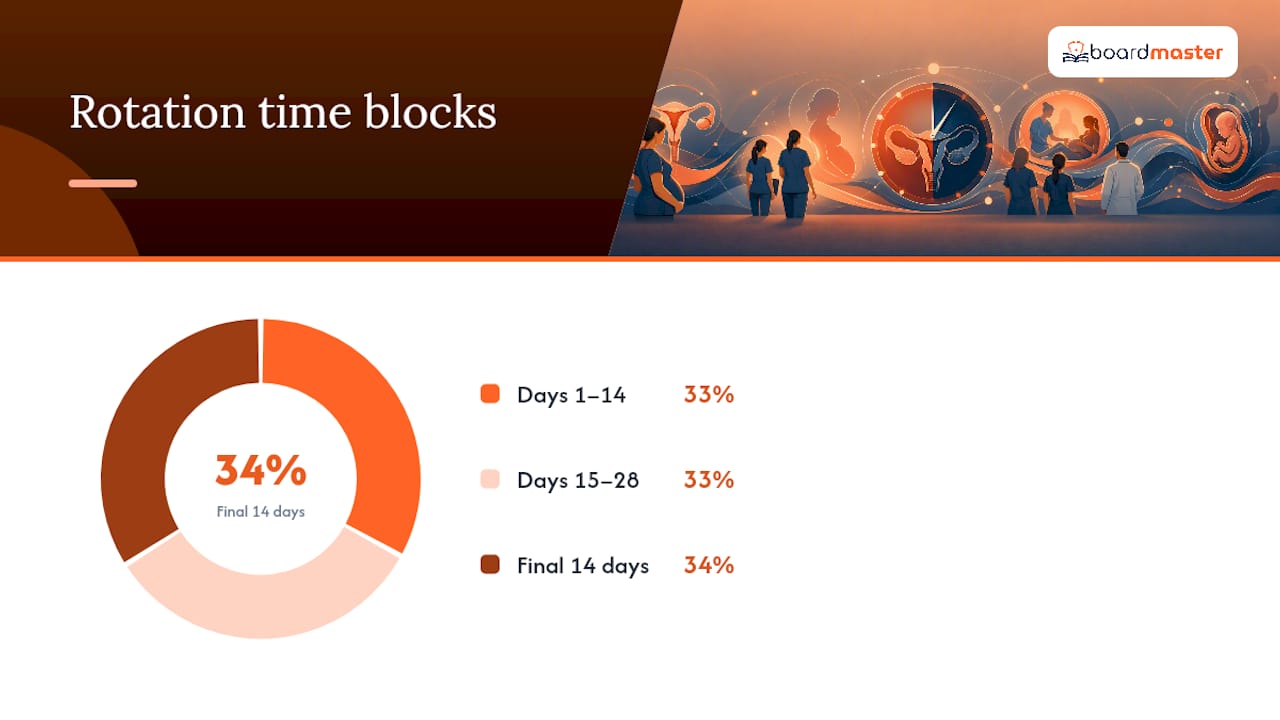
- Days 1 to 14: framework building, low-volume tutor questions.
- Days 15 to 28: high-volume tutor questions, first NBME, start Anki.
- Final 14 days: timed random blocks, incorrect review, calibration NBMEs, taper.
Pro Tip: Keep a running list of "sticky" topics, the ones you keep missing, and review that list in five-minute bursts between patients instead of waiting for a dedicated study block that may never come.
Busy call days don't kill a study plan; unplanned days do. Ten to fifteen minute windows are enough for a podcast segment, ten tutor questions, or a quick Anki pass.
How to Turn Question Practice Into Real Learning
Answering questions correctly isn't the goal. Understanding why the correct answer is correct, and why three other reasonable-sounding choices are wrong, is what actually sticks.
- Start every new topic in tutor mode so you can read the explanation immediately while the reasoning is fresh.
- Write a one to two sentence rationale for each wrong answer choice, not just the right one; this forces you to articulate the distinguishing clinical detail.
- Extract testable facts and decision algorithms straight into Anki cards rather than re-reading the explanation later.
- Shift to timed, random-format blocks of 40 to 60 questions during your final two weeks. Mixing topics under time pressure trains the same cognitive switching you'll face on exam day, which cuts down on hesitation-driven errors when a question doesn't match the order you studied things in.
Pro Tip: If you hit a topic you genuinely haven't covered during a timed block, make your best guess and move on. Stopping to reason through unfamiliar material burns time you need for the questions you actually know.
Common Mistakes and Final-Week Priorities
Passive review is the most common trap in the final stretch. Re-reading a full textbook chapter the night before an exam feels productive but transfers almost nothing at that stage. Evidence on learning technique effectiveness consistently favors active retrieval and spaced practice over rereading, especially this close to test day.
- Don't lean on one resource type. Let NBME practice forms, not your qbank percentage, tell you where you actually stand.
- Skip long passive reading sessions the day before the exam; do rapid-fire review of algorithms instead.
- Protect sleep and a normal meal schedule over one more study hour; fatigue costs more points than an extra hour of review gains.
- The night before, run a light active recall pass on your highest-yield algorithms: postpartum hemorrhage management, hypertensive disorder thresholds, and fetal heart tracing responses.
- If a short timed block calms your nerves more than it exhausts you, do one. If it spikes anxiety, skip it.
How BoardMaster Maps Lecture Content to Targeted Practice
The gap in most OB/GYN prep plans isn't a lack of resources. It's that generic qbanks don't know what your attending actually tested last year. BoardMaster generates USMLE-style questions directly from uploaded lecture slides, aligning practice with what your specific course emphasizes rather than a generic content outline.
- Upload lecture material and get professor-aligned practice questions generated from it, not a one-size-fits-all bank.
- Draw from a large set of physician-written board-style questions when you need broader shelf-level coverage.
- Export incorrects into spaced-repetition flashcards to reinforce learning and improve long-term retention.
- Practice OSCE-style clinical scenarios to develop hands-on reasoning beyond written exams.
A Clinician-Educator's Note on Realistic Expectations
Studying OB/GYN on top of twelve-hour clinical days is genuinely hard, and no resource list changes that math. Set measurable targets instead of vague ones: a daily question count, a weekly NBME check. When your midpoint NBME score disappoints you, that's data, not a verdict. Adjust your plan and keep moving.
— Dr. Ahmed Abuzoor
Put This Plan Into Practice With BoardMaster
Case Files gives you scripting, OnlineMedEd gives you framework, and a strong qbank gives you volume, but none of them know what your specific professor emphasized in Tuesday's lecture on preeclampsia management. BoardMaster closes that gap: upload a lecture or a set of high-yield slides, and it generates a targeted practice set built around what that material actually stressed, then lets you export the incorrects straight into spaced-repetition flashcards.

Try it on one lecture first. Pick your densest OB/GYN topic, upload the slides, generate a question set, and see how it compares to a generic bank's coverage of the same material. BoardMaster works best alongside your physician-written qbank and NBME calibration forms, not instead of them; official practice forms remain the standard for predicting your actual score. Start with a free tier upload at BoardMaster and build your targeted set from there.
Where to Verify Official Practice Materials
- NBME Obstetrics and gynecology subject exam page for official practice forms.
- NBME sample items (PDF) for stem and distractor style.
- NBOME COMAT clinical subject exam page for COMAT-track students.
- AMA guidance on shelf exam preparation for scheduling and study-plan structure.
Sources
- Learning techniques: testing and spaced practice (PMC article)
- NBME subject exams: Obstetrics and gynecology
- NBME Obstetrics & Gynecology sample items (PDF)
- AMA: What I wish I knew about shelf exam prep
FAQ
What are the best obgyn shelf study guides to start with?
A high-volume question bank paired with official NBME practice forms should anchor your plan, with Case Files and OnlineMedEd filling in framework and clinical scripting.
How many practice questions should I do per day for the OB/GYN shelf?
Start at 20 to 30 tutor-mode questions daily in weeks one and two, then increase to 40 to 60 daily by weeks three and four.
When should I take NBME practice forms during my rotation?
Take one at the midpoint of your rotation to identify weak areas, then one or two more in your final week, spacing the last one seven to ten days before the exam.
Should I use AMBOSS or APGO/uWISE alongside a main qbank?
Yes, but as targeted drilling tools for specific weak topics your NBME practice reveals, not as your primary question-practice engine.
Can BoardMaster replace official NBME practice forms?
No. BoardMaster generates targeted practice from your lecture material and complements NBME forms, but official practice forms remain the standard for calibrating your actual shelf readiness.