
TL;DR:
- The NBME exam consists of four timed blocks with 50 questions each, totaling about five hours. Using the standard-paced format provides the most accurate prediction of USMLE performance, while the self-paced format is mainly for content review. Understanding this structure helps students build pacing habits and schedule assessments to improve exam readiness.
The NBME exam format is a standardized, block-based multiple-choice assessment designed to mirror the USMLE testing environment as closely as possible. The National Board of Medical Examiners (NBME) creates both the practice self-assessments and the actual USMLE, which means these exams share question authorship, clinical vignette style, and content blueprints. Understanding what is NBME exam format explained in full gives you a direct advantage: you stop guessing how to study and start practicing in conditions that match the real test. Medical students who treat NBME forms as diagnostic tools rather than just score checks consistently make sharper study decisions.
What is the NBME exam structure in terms of blocks and questions?
The NBME exam structure follows a precise format. Standard NBME self-assessments contain 200 multiple-choice questions divided into 4 blocks of 50 questions each, with 75 minutes allocated per block. That totals roughly 5 hours of active testing time, which matches the endurance demand of the real USMLE.
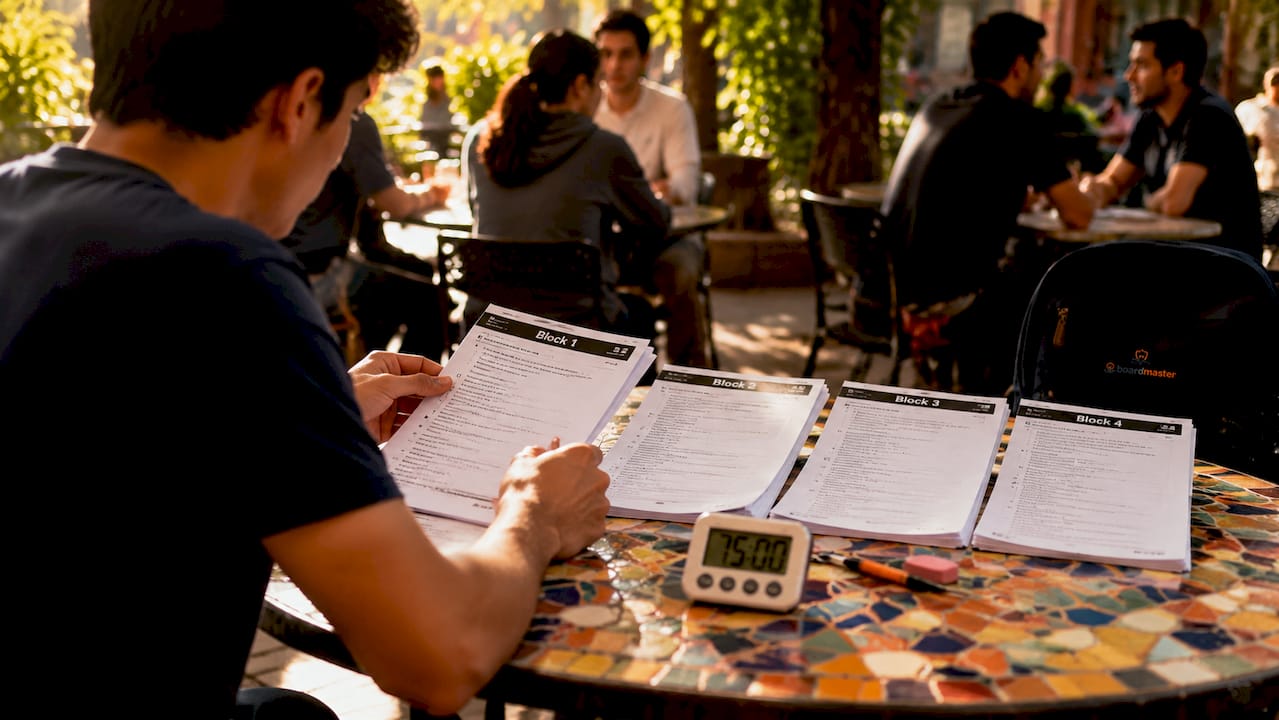
Each block functions as a self-contained unit. You cannot carry unused time from one block to another, and you cannot return to a previous block once you submit it. This structure forces you to develop pacing habits within each 75-minute window, not across the exam as a whole.
NBME questions simulate clinical vignette style, requiring clinical reasoning rather than rote memorization. A typical question presents a patient scenario, lab values, and a clinical decision point. You are not being tested on whether you memorized a fact. You are being tested on whether you can reason through a case under time pressure.
The table below summarizes the core structural details:
| Feature | Details |
|---|---|
| Total questions | 200 multiple-choice questions |
| Block count | 4 blocks |
| Questions per block | 50 questions |
| Time per block | 75 minutes |
| Total testing time | Approximately 5 hours |
Key structural facts to keep in mind:
- You cannot review questions from a completed block.
- Each block resets the timer independently.
- Question distribution aligns with the USMLE content blueprint, covering organ systems and clinical disciplines proportionally.
- NBME forms use retired USMLE questions, so the difficulty and style are authentic.
What are the two NBME exam formats and how do they differ?
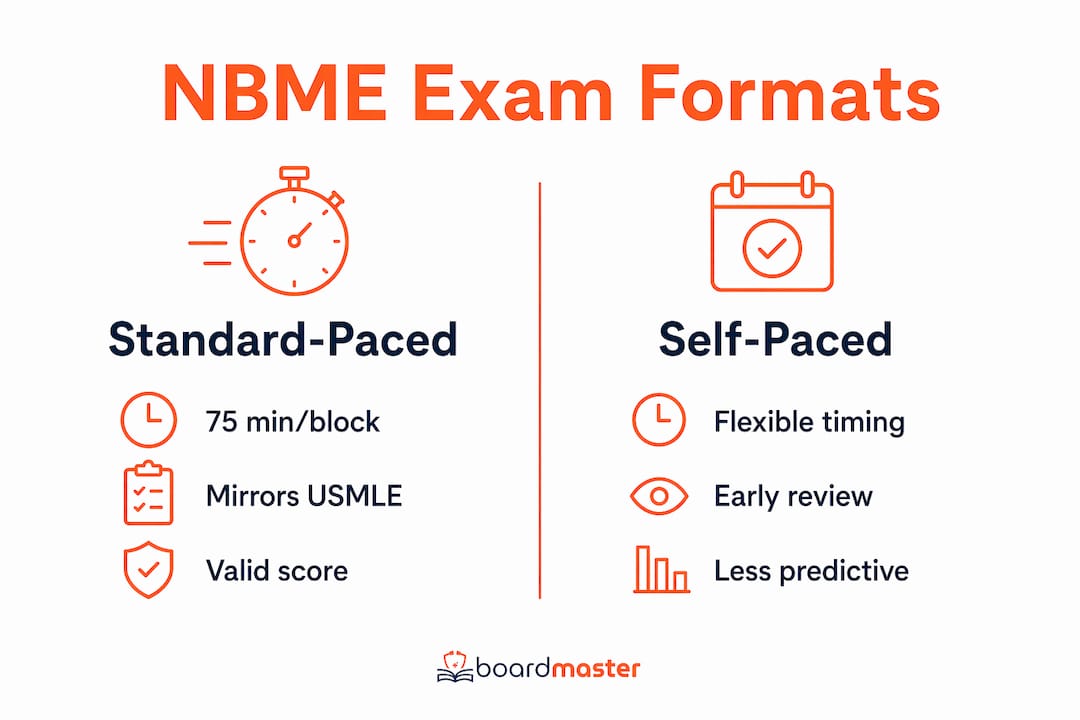
NBME practice exams offer two formats: standard-paced and self-paced. The choice between them affects both your score validity and your learning experience.
Standard-paced format mirrors real USMLE timing exactly. You get 75 minutes per block with no extensions. Scores from standard-paced exams are the only scores that reliably predict your actual USMLE performance. Use this format whenever you need an honest readiness check.
Self-paced format gives you up to 5 hours per block. That extended time lets you pause, review, and think through questions in depth. The tradeoff is significant: using the self-paced format for score prediction is misleading because the extra time changes your pacing and reduces score validity. A self-paced score does not tell you where you stand.
Here is how to choose between the two based on your prep phase:
- Early in dedicated study: Self-paced works well for content review and identifying knowledge gaps without the pressure of the clock.
- Mid-study: Transition to standard-paced to start building real exam stamina.
- Final 2–3 weeks before the exam: Use only standard-paced exams for score prediction.
- Final days before the exam: The Free 120 is for interface practice only and should not be used for score prediction. Take it to get comfortable with the testing interface, not to gauge readiness.
Pro Tip: Never use a self-paced NBME score to decide whether you are ready to test. Only standard-paced scores under real timing conditions give you a valid prediction.
How does NBME exam scoring work?
NBME score reports provide an equated percent and a scaled three-digit score that correlates strongly with actual USMLE performance. The equated percent corrects for slight difficulty variations between forms, so a score of 65% on one form means the same thing as 65% on another. That consistency makes NBME scores a reliable progress tracking tool across your study timeline.
The three-digit scaled score maps directly to the USMLE scoring scale. Score reports also include a pass probability and a breakdown by content domain. That domain breakdown is where your real study intelligence lives. A low score in cardiovascular pathophysiology tells you exactly where to spend the next week.
One critical nuance: Step 2 CK NBME scores tend to underpredict actual exam scores by 10–15 points. Students who panic at a lower-than-expected NBME score and delay their exam date often do so unnecessarily. Focus on the trend across multiple forms, not a single data point.
"NBME exams are diagnostic tools testing reasoning patterns, not just content, because they use retired USMLE questions authored by the same organization."
Pro Tip: When your NBME score feels discouraging, pull up the domain breakdown first. A weak score driven by one or two content areas is a fixable problem, not a sign you are not ready.
Prioritizing NBME self-assessment feedback over third-party question banks when discrepancies appear is the right call. The shared authorship with USMLE makes NBME the gold standard for readiness measurement.
How does knowing the NBME format improve your test-day strategy?
Format knowledge translates directly into performance. Students who understand the NBME exam structure before sitting down to test make better decisions under pressure. Here is a practical framework for using that knowledge:
- Simulate standard-paced conditions from the start of dedicated study. Set a timer for 75 minutes and do not stop the clock. Your brain needs to learn what 90 seconds per question feels like before exam day.
- Schedule NBME forms at regular intervals. Periodic NBME assessments throughout study track knowledge progression and guide study adjustments. Taking a form every 2–3 weeks during dedicated study gives you a clear performance curve.
- Use early forms for baseline, harder forms for final prediction. For Step 1, CBSSA forms 25 and 26 are recommended for baseline assessments because they contain slightly easier questions. Save the harder, more recent forms for the final weeks.
- Schedule your final NBME form 1–2 weeks before your exam date. Optimal NBME study schedules culminate in a final form 1–2 weeks before the exam. This gives you time to address any remaining gaps without the pressure of being days away from testing.
- Review every missed question by block, not by topic. Block-level review mirrors how the exam delivers content and trains you to shift clinical reasoning across disciplines within a single sitting.
Pro Tip: Build your personalized USMLE study plan around NBME form dates, not the other way around. Let the assessment schedule anchor your prep timeline.
Avoiding common exam prep misconceptions about format and timing is just as important as knowing the correct approach. Many students waste weeks practicing under self-paced conditions and then struggle with the real clock on exam day.
Key Takeaways
The NBME exam format consists of 4 timed blocks of 50 questions each, and only standard-paced scores under real timing conditions reliably predict your USMLE performance.
| Point | Details |
|---|---|
| Exam structure | 200 questions across 4 blocks of 50, with 75 minutes per block. |
| Format choice matters | Use standard-paced for score prediction; self-paced only for content review. |
| Score interpretation | Three-digit scores correlate with USMLE outcomes; Step 2 CK scores often underpredict by 10–15 points. |
| Scheduling strategy | Take your final NBME form 1–2 weeks before your exam date for the most useful prediction. |
| Free 120 limitation | The Free 120 is for interface familiarization only, not score prediction. |
What I have learned from watching students misuse the NBME format
Most students I work with understand that NBME exams matter. Fewer understand why the format itself is the lesson. The block structure is not just a logistical detail. It is a training constraint. When you practice under standard-paced conditions consistently, you are not just checking your knowledge. You are conditioning your brain to make decisions at a specific pace, under fatigue, across 200 questions.
The biggest mistake I see is students spending their entire dedicated study period in self-paced mode because it feels more productive. You can pause, look things up, and feel like you are learning. You are learning content, but you are not learning the exam. By the time they sit a standard-paced form two weeks before their test date, the clock feels foreign. That panic is avoidable.
The second mistake is treating a single NBME score as a verdict. One form is a data point. Three forms over six weeks is a trend. The trend tells you whether your study approach is working. A single low score tells you almost nothing except that you had a bad day or hit a content gap. Fix the gap and move on.
My honest advice: take your first NBME form earlier than feels comfortable. A baseline score at the start of dedicated study, even a humbling one, gives you a map. Students who wait until they feel "ready" to take their first form often run out of time to act on what they learn.
— Dr. Ahmed Abuzoor
BoardMaster turns your NBME prep into a targeted study system
Medical students who understand the NBME format still need the right practice material to fill their content gaps. BoardMaster's AI generates USMLE-style practice questions directly from your lecture notes, targeting the exact concepts your professors emphasize. That means every question you practice is relevant to both your course exams and your board prep.

BoardMaster's physician-written question bank contains over 5,000 board-style questions built to match the clinical vignette format you face on NBME self-assessments. Students like Sarah jumped from the 73rd to the 92nd percentile while cutting their study hours in half by focusing on high-yield, targeted content instead of reviewing everything. When your NBME domain breakdown shows a weak area, BoardMaster gives you the exact questions to close that gap fast.
FAQ
What is the NBME exam format in brief?
The NBME exam format consists of 200 multiple-choice questions divided into 4 blocks of 50 questions, with 75 minutes per block and a total testing time of approximately 5 hours.
How does the NBME exam differ from the actual USMLE?
The NBME self-assessment uses retired USMLE questions and mirrors the same block structure, but the actual USMLE has more questions per block and a longer total duration. NBME scores still correlate strongly with USMLE outcomes.
Should I use the self-paced or standard-paced NBME format?
Use standard-paced for any exam where you want a valid score prediction. Self-paced is useful for early content review but produces non-predictive scores because the extended time changes your pacing.
How accurate are NBME scores at predicting my real USMLE score?
NBME scores correlate strongly with USMLE performance, though Step 2 CK scores tend to underpredict actual results by 10–15 points. Focus on score trends across multiple forms rather than any single result.
When should I take my last NBME form before the exam?
Take your final NBME form 1–2 weeks before your exam date. This timing gives you a reliable readiness prediction and enough time to address any remaining content gaps before test day.