
Mark anything your instructor repeats, spends extra time on, or explicitly flags as testable, then connect it to a core exam topic you already know matters. Do this live, in class. Within 24 hours, turn that marked material into one active-recall question. That single habit, repeated across every lecture, is how you identify high yield lectures without needing a crystal ball.
TL;DR:
- Focusing on high-yield lecture content saves time by prioritizing concepts that appear repeatedly, are central to disease mechanisms, and align with exam content.
- During lectures, repetition, slide formatting, explicit cues, and pacing shifts signal which material is most important to capture and convert into exam questions.
- Pre-lecture preparation, such as skimming slides and reviewing objectives, helps recognize emphasis cues and identify high-yield topics more easily.
- Cleaning notes within 24 hours, converting marked items into questions, and scheduling spaced reviews improve long-term retention and exam readiness.
- AI tools can automate the high-yield extraction process, generating tailored practice questions, flashcards, and podcasts to streamline study and improve scores.
Table of Contents
- What Does 'High Yield' Actually Mean for Lectures and Exams?
- How Do You Spot High-Yield Content During the Lecture Itself?
- What Prep Work Before Lecture Makes High-Yield Content Easier to Spot?
- What Should You Do in the First 24 to 72 Hours After Lecture?
- How a Lecture-to-Practice Pipeline Can Shortcut This Whole Process
- Note-Taking Methods: When to Transcribe and When to Summarize
- How to Cross-Check Lecture Content Against Trusted Study Resources
- Beyond Verbal Hints: Reading a Professor's Body Language and Tone
- Turning Messy Lecture Notes Into an Organized Study Summary
- How to Allocate Study Time Once You've Identified High-Yield Lectures
- What to Do When There's No Obvious High-Yield Signal
- A Medical Educator's Take on Triage and Trust
- Let BoardMaster Turn Your Lecture Notes Into Exam-Ready Practice
- Sources
- FAQ
What Does 'High Yield' Actually Mean for Lectures and Exams?
"High yield" gets thrown around so often in medical school that it starts to sound like marketing copy instead of a real filter. It isn't. A working definition looks like this: high-yield lecture content sits at the intersection of three things: how often a concept resurfaces, how central it is to a broader disease process or mechanism, and how closely it lines up with what your exam actually tests.
That last part matters more than most students think, because "high yield" means something different depending on which exam is in front of you. For a class exam, high yield usually means whatever your professor personally emphasized, since they write the test. For board exams like the USMLE or COMLEX, high yield means whatever shows up repeatedly across core resources such as First Aid, regardless of how any one professor presented it. A lecture can be high yield for one and low yield for the other, and confusing the two is how students end up over-studying obscure professor tangents that never appear on the boards.
The fix is a simple mapping exercise. As you sit through lecture, ask which bucket a concept belongs to:
- Class-exam high yield: repeated by the professor, appears on posted objectives, or matches old exam questions from the course
- Board high yield: appears in First Aid, connects to a commonly tested mechanism, or shows up across multiple unrelated lectures
- Both: the rare overlap where a professor's pet topic is also a board classic. Study this first.
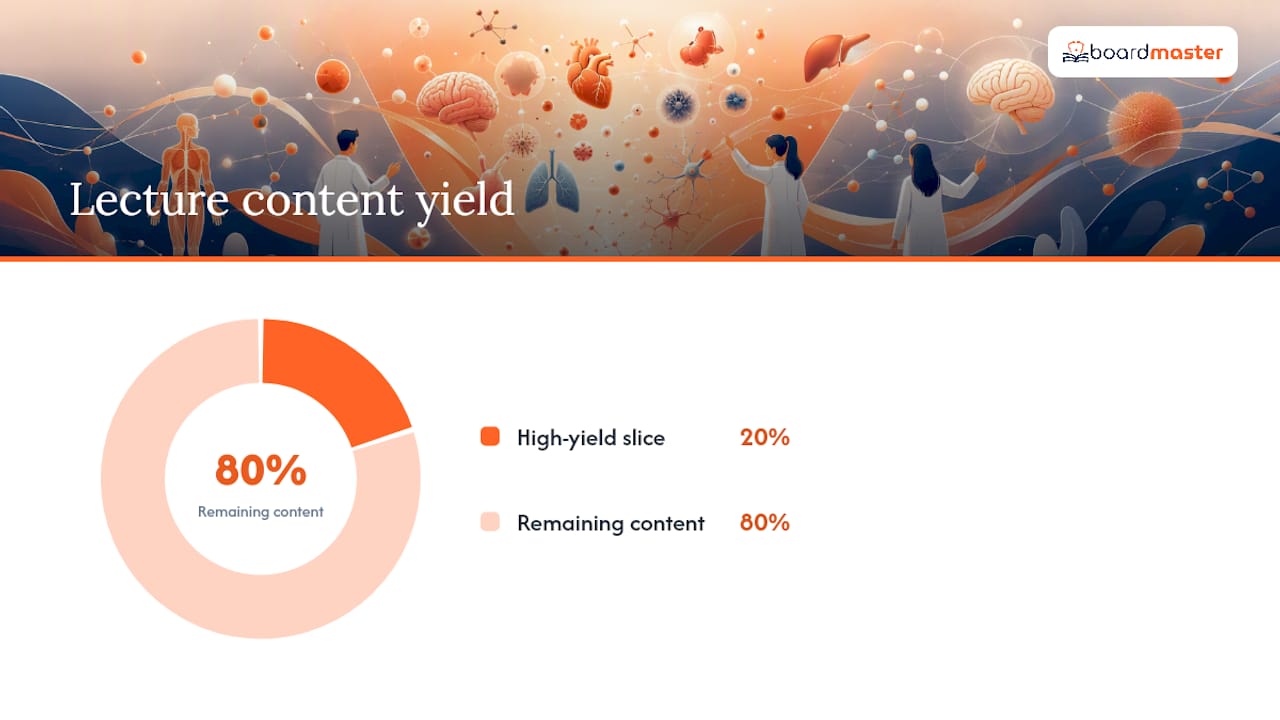
Applying an 80/20 lens here saves real time: a small slice of lecture content typically accounts for most of what actually appears on exams, so your job is finding that slice, not absorbing every slide equally.
How Do You Spot High-Yield Content During the Lecture Itself?
Most of the identification work happens in real time, not after the fact. Professors give away what matters constantly. The problem is that students are usually too busy transcribing slides to notice.
Watch for these signals while the lecture is happening:
- Verbal repetition. If a professor says the same fact, drug, or mechanism more than once in different contexts, it's not filler. Repetition is one of the clearest live cues institutional teaching centers point to when teaching students to catch signal words during lecture.
- Time allocation. A single slide that gets ninety seconds gets skimmed. A single slide that gets six minutes, with the professor circling back to it, is a flag. Time spent is often a better predictor than content density.
- Explicit exam language. Phrases like "this is testable," "know this cold," or "I ask this every year" should trigger an immediate annotation, not a mental note you'll forget by the next slide.
- Slide formatting changes. Bolded text, red font, boxed diagrams, or a slide that breaks from the usual template usually signals the professor built it to be memorable on purpose.
- Summary or "key takeaway" slides. These exist because the professor is telling you, in plain language, what they think matters most. Treat them as a checklist, not a recap you skip past.
Nonverbal cues matter too. A shift in pacing, a longer pause before a point, or a professor putting down their clicker to speak directly to the room, often precede the exact content that ends up on the exam.
The action to pair with each of these: mark it, timestamp it if you're recording, and write a one-line exam-style question about it before the lecture ends. That third step is what actually separates students who notice high-yield content from students who convert it into something usable, as supported by effective alternative note taking solutions that help capture and organize lecture content for later study.
Pro Tip: If a professor says "you'll see this again," write it down verbatim. It's one of the strongest predictors of a recurring exam topic, and it's almost always ignored because it doesn't sound like a fact worth capturing.
What Prep Work Before Lecture Makes High-Yield Content Easier to Spot?
Identifying high-yield material during lecture is much easier when you walk in already knowing roughly what to expect. Skimming slides or assigned readings beforehand primes your attention so you recognize emphasis instead of getting buried by new information, a strategy study guides for pre-lecture preparation consistently recommend.
A short, repeatable prep routine works better than an elaborate one you won't sustain:
- Skim the slide deck 10 to 15 minutes before class and note two or three questions you expect the lecture to answer.
- Cross-check the syllabus or course objectives for topics explicitly listed. Anything on that list is nearly guaranteed to be class-exam high yield.
- Open your note template before the professor starts talking, so you're not fumbling with formatting during the first five minutes, which is often when the professor frames the whole lecture's priorities.
- Set your device to airplane mode or close every tab except your notes. Split attention is the fastest way to miss a verbal cue that only gets said once.
- Glance at your last quiz or exam from the same course for question patterns. Professors are creatures of habit more often than students expect.
None of this needs to take more than ten minutes. The point isn't to pre-learn the material. It's to walk in with a mental filter already switched on, so when the professor lingers on a topic or repeats a phrase, you recognize it as a signal instead of noise. Annotating instructor-provided slides directly, rather than building notes from scratch, is another underused tactic that large-lecture note-taking guidance supports, since it preserves the professor's own structure and emphasis instead of replacing it with yours.
What Should You Do in the First 24 to 72 Hours After Lecture?
The window right after lecture is where most high-yield content quietly dies. You marked it, you noticed the emphasis, and then three days later you can't remember why that slide mattered. Processing notes within a day of the lecture is one of the most well-supported habits in study research, and note-taking guidance from academic learning centers treats the 24-hour window as the point where review does the most good for long-term recall.
Here's a workflow that fits into a busy schedule:
- Clean your notes within 24 hours. Rewrite anything illegible, fill in gaps you left blank during lecture, and flag anything you genuinely don't understand for office hours or a study group.
- Convert marked statements into questions. Don't just highlight "beta-blockers reduce mortality post-MI." Turn it into "Why do beta-blockers reduce mortality after an MI, and what's the mechanism?" A flat fact tests recognition. A question tests recall, which is what the actual exam does.
- Sort facts from concepts. Isolated facts, like a drug dose or a lab value, belong on flashcards. Multi-step processes, like a diagnostic pathway or a mechanism, belong on a concept map or a short written explanation. Mixing the two formats slows both down.
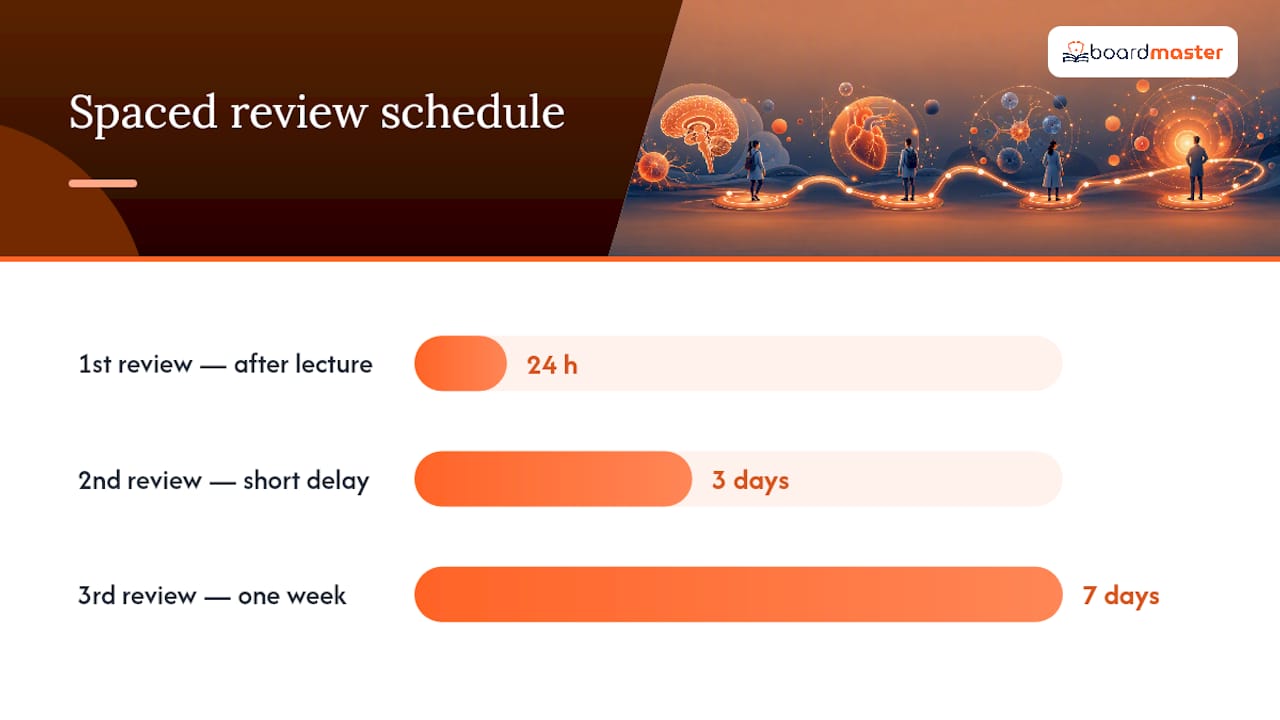
- Schedule spaced review. A simple pattern works well: review again at 24 hours, then 3 days, then 7 days, then once more before the exam. This beats a single all-at-once cram session for retention, which is a pattern study-technique guides describe as one of the more reliable ways to beat the forgetting curve.
The flashcard-writing step deserves extra care. High-yield studying rewards cards that test application, not memorization. A card asking "what causes X" is weaker than a card asking "a patient presents with Y, what's the mechanism connecting it to X," because that's closer to how USMLE-style question guides frame real exam questions. Connection-type cards simply transfer better to test day than isolated fact recall.
How a Lecture-to-Practice Pipeline Can Shortcut This Whole Process
Everything above works. It also takes discipline most students don't have time for during a heavy exam block, which is exactly the gap tools built for this workflow are designed to close.
BoardMaster runs the same sequence the rest of this article describes, just automated. You upload lecture slides or notes, and the platform generates USMLE-style practice questions built around what your specific professor emphasized rather than generic board content. That distinction matters, because a question bank that ignores your actual course misses the class-exam layer entirely.
The pipeline breaks down like this:
- Upload lecture material, and the system flags recurring themes the same way a diligent student would, minus the manual scanning.
- Get tailored practice questions generated from that content, matching the connection-style format that tests application instead of rote recall.
- Convert dense lectures into short study podcasts, useful for review during a commute or a gap between classes.
- Build spaced-repetition flashcards automatically, sorted the way concept-heavy and fact-heavy material should be.
One student, Sarah, used this approach to move from the 73rd to the 92nd percentile while cutting her study hours roughly in half. That's not a claim about magic. It's a claim about what happens when the condense-to-practice loop, the exact loop described in the sections above, stops depending entirely on manual effort. AI-generated summaries in particular reduce the cognitive load of transcription, which frees attention for the harder task: actually connecting concepts.
Note-Taking Methods: When to Transcribe and When to Summarize
Not every lecture deserves the same note-taking approach, and treating them identically wastes effort on both ends. Dense factual content, drug names, lab values, staging criteria, benefits from near-verbatim capture, because you can't reconstruct a precise number from memory later. Conceptual content, disease mechanisms, diagnostic reasoning, benefits from summarizing in your own words while the professor is still talking.
Guidance on lecture note formats draws a useful line here: handwriting tends to support conceptual retention because the slower pace forces you to paraphrase as you go, while typing or digital capture works better for high-volume factual detail you'll need to search later.
A practical split: transcribe numbers, criteria, and drug names close to verbatim. Summarize mechanisms, pathways, and clinical reasoning in your own shorthand. If a professor is walking through a multi-step process, don't try to catch every word. Catch the sequence, then fill in the technical vocabulary during your 24-hour cleanup. Trying to transcribe everything guarantees you'll miss the professor's tone shifts and verbal cues, since your attention is locked on your keyboard instead of the room.
One more distinction worth building into your notes: separate what the professor said from what you inferred. A quick bracket or color code marking "professor's exact words" versus "my interpretation" prevents you from later mistaking your own guess for something that was actually emphasized in lecture.
How to Cross-Check Lecture Content Against Trusted Study Resources
A professor's emphasis is a strong signal, but it isn't infallible. Cross-referencing lecture material against established high-yield resources protects you from over-investing in a topic that matters to one professor and nobody else.
The simplest method: after cleaning your notes, spend five minutes checking whether the concept the professor emphasized also appears in a core board resource like First Aid, a course-specific question bank, or your school's provided objectives list. If it shows up in both places, it's confirmed high yield for both the class exam and boards, and it earns priority review time. If it only appears in lecture and nowhere else, it's probably class-exam specific, still worth learning, but not worth over-investing in for board prep.
This cross-check also works in reverse. If a topic appears repeatedly across First Aid or your question bank but barely got mentioned in lecture, that's a gap your professor didn't cover in depth, and it needs independent study rather than lecture-based review. Missing this step is one of the most common reasons students feel blindsided by board exam content that "wasn't even taught," when it was simply taught briefly and easy to underweight.
Keep this cross-referencing lightweight. A single column in your notes marking "confirmed in First Aid" or "lecture-only" is enough. The goal isn't a research project. It's a fast sanity check that keeps your study time pointed at material with the widest exam relevance.
Beyond Verbal Hints: Reading a Professor's Body Language and Tone
Verbal cues get most of the attention, but professors leak information nonverbally just as often, and these signals are easy to miss if you're staring at your laptop screen instead of the room.
Watch for a change in pacing. A professor who's been moving briskly through slides and suddenly slows down, often without saying anything explicit, is usually signaling that the next point deserves more attention than the last five did. The same goes for a professor who steps away from the podium or puts down their clicker. That small physical shift frequently precedes a point they consider important enough to deliver without a slide competing for attention.
Tone changes matter too. A shift from a flat, reading-off-slides voice to something more conversational or emphatic often means the professor is speaking from clinical experience rather than the textbook, which is exactly the kind of detail that tends to reappear on an exam written by that same professor. Eye contact patterns can be a tell as well. If a professor scans the room and holds eye contact longer while making a specific point, they're often checking whether it's landing, which usually means they expect you to remember it.
None of these cues are as reliable alone as an explicit verbal flag. Stacked together with slide formatting and repetition, though, they build a fuller picture of what a professor actually considers testable, even when they never say the word "exam" out loud.
Turning Messy Lecture Notes Into an Organized Study Summary
Raw lecture notes, even well-marked ones, are rarely exam-ready as written. They follow the professor's pacing, not a logical study structure, and they mix confirmed high-yield material with tangents and asides. The workflow that fixes this happens in three passes, not one.
The first pass is pure cleanup: fix illegible shorthand, fill blanks, and remove content you now recognize as filler. The second pass is reorganization: group related concepts together regardless of the order the professor presented them in, since lecture order almost never matches how an exam question will test the material. A professor might cover a drug's mechanism on slide three and its side effects on slide twenty, but your study summary should put those together.
The third pass is conversion into an active format. This is where marked statements become questions, mechanisms become short flow diagrams, and isolated facts move into flashcard form. A useful test for whether a note is truly "organized": could someone unfamiliar with the lecture study from it and understand why each point matters? If the answer is no, it's still transcription, not a summary.
This is also where automated tools save the most time, since reorganizing scattered notes by hand across a dozen lectures a week is exactly the kind of repetitive task that eats hours without adding much learning value. The thinking happens in deciding what matters. The reorganizing is mechanical, and it doesn't need to be done manually every single time.
How to Allocate Study Time Once You've Identified High-Yield Lectures
Identifying high-yield content is only half the job. The other half is making sure your study calendar actually reflects what you found, instead of defaulting to equal time per lecture regardless of what each one contained.
Start by ranking lectures, not just topics, by how much confirmed high-yield material they contained. A lecture where three concepts cross-referenced against First Aid deserves more review time than a lecture that was mostly institutional logistics or a single professor's tangent. This sounds obvious, but most students still budget study time by "chapters remaining" rather than by yield density, which is why cramming sessions often waste hours on low-value review.
Build your weekly schedule around the spaced-review timeline mentioned earlier: fresh lectures get reviewed at 24 hours and 3 days, older confirmed high-yield material gets a lighter touch at the 7-day mark, and anything flagged as "both class and board relevant" gets folded into your ongoing board-prep review regardless of when it was originally taught. This prevents high-yield material from a lecture in week three getting forgotten by week ten simply because it's no longer recent.
Leave a buffer, too. Ambiguous or overlapping material inevitably needs re-sorting as you learn more, and a rigid schedule with no flexibility tends to break the first time an exam schedule shifts.
What to Do When There's No Obvious High-Yield Signal
Some lectures are quiet. No repetition, no dramatic tone shift, no professor saying "this is testable." That doesn't mean the content is safe to skip. It means the signal is implicit rather than explicit, and implicit signals require a different filter.
Default to structural cues when verbal ones are absent. Content that anchors a broader disease process, a mechanism that shows up as a prerequisite for understanding three other conditions, is usually high yield even if the professor delivered it flatly. Ask yourself: if this concept were removed from the lecture, would the rest of it stop making sense? If yes, it's probably foundational, not filler.
Volume is another proxy. If a professor spent disproportionate lecture time on a topic relative to how often it's mentioned in the syllabus, that imbalance itself is a signal, even without a verbal flag attached to it.
When genuinely stuck, default to your cross-referencing habit from earlier. If a quiet, unemphasized lecture topic still shows up repeatedly in First Aid or a question bank, treat it as high yield regardless of how it was delivered in class. Professors don't always signal well. Board exams don't care whether they did.
A Medical Educator's Take on Triage and Trust
Most students overweight what feels dramatic in the room and underweight what's structurally central but delivered flatly. A printable triage checklist fixes some of that: mark repetition, mark tone shifts, mark anything tied to a diagnostic pathway, and cross-check anything quiet against First Aid before dismissing it.
One thing that rarely gets said out loud: professors write their own class exams to reflect what they personally think matters, and that often diverges from board emphasis on purpose, not by accident. A professor testing their own research niche isn't wrong to do so, and treating every lecture as pure board prep will leave gaps on the class exam that has nothing to do with your USMLE score but everything to do with your GPA. Balance both. Don't let board-exam tunnel vision cost you a class exam grade that has real consequences of its own.
— Dr. Ahmed Abuzoor
Let BoardMaster Turn Your Lecture Notes Into Exam-Ready Practice
Everything in this article describes a manual workflow: mark, condense, question, review. BoardMaster runs that same workflow automatically, starting the moment you upload a lecture.

Upload slides or notes, and BoardMaster generates USMLE-style practice questions built around what your specific professor emphasized, not a generic question bank that ignores your actual course. It also builds spaced-repetition flashcards with medical images and turns dense lectures into short study podcasts you can review between classes. Sarah used this exact pipeline to jump from the 73rd to the 92nd percentile while cutting her study time roughly in half, proof that the condense-to-practice loop works better when it isn't entirely manual.
If you want to see the OSCE and lecture-to-practice pipeline in action, the demo walks through exactly how an uploaded lecture becomes a set of tailored questions. Try uploading your next lecture and see what BoardMaster flags as high yield before your next exam does.
Sources
- How do I take effective notes in a large lecture? | LARC
- Effective note-taking in class | UNC Learning Center
FAQ
What Does "High Yield Study" Mean?
High-yield studying means prioritizing material that is frequently tested, central to understanding broader concepts, and closely aligned with your exam's actual content, rather than spending equal time on every topic covered in class.
What Does a High-Yield Topic Mean?
A high-yield topic is one that shows up repeatedly across lectures, textbooks, and practice questions, and connects to multiple other concepts rather than standing alone as an isolated fact.
What Does High-Yield Information Mean?
High-yield information is any fact, mechanism, or concept with a strong likelihood of appearing on an exam, usually identified through instructor emphasis, repetition, or confirmation against a resource like First Aid.
What Are High-Yield Questions?
High-yield questions are practice questions built around application and connections, such as linking a mechanism to a clinical presentation, rather than testing isolated recall of a single fact. Tools like BoardMaster generate this question style directly from uploaded lecture content, matching what your professor actually emphasized.