
The best way to prepare for a lecture-based exam is to convert every lecture into retrieval prompts the same day, space your review of those prompts over the following weeks, and finish with timed, closed-note practice tests. This works because it's built on the two techniques with the strongest evidence behind them: retrieval practice and distributed practice. Tools like BoardMaster can automate the slide-to-question conversion and handle the spacing schedule for you.
TL;DR:
- Converting lecture content into retrieval prompts on the same day significantly increases exam readiness by reinforcing recall of professor-emphasized material.
- Spacing review sessions over weeks, focusing more on topics repeatedly covered or emphasized, enhances long-term retention better than last-minute cramming.
- Using timed, closed-note practice exams before deep study helps identify specific weak areas aligned with the professor's priorities, guiding more effective revision.
- Automated tools like BoardMaster can streamline the process of question generation, scheduling, and practice testing for multiple classes, saving hours of manual work.
- Prioritizing active retrieval and spaced repetition, rather than rereading or highlighting, produces better scores with less total study time, according to cognitive psychology research.
Table of Contents
- What Is Lecture-Based Exam Prep?
- How Do You Capture Lecture Content Before, During, and After Class?
- How Do You Turn Lecture Slides Into Practice Questions?
- How Should You Schedule Study Sessions for a Lecture-Based Exam?
- How Do You Use Practice Exams to Prepare?
- What Should You Do in the Final 24 to 48 Hours?
- Why Do Retrieval and Spacing Beat Rereading?
- How Do You Add Textbook Readings Without Losing Lecture Focus?
- How BoardMaster Turns This Workflow Into a System
- An Educator's Take on Why This Method Works
- Sources
- FAQ
What Is Lecture-Based Exam Prep?
Lecture-based exam prep means studying primarily from what a professor covers in class and posts in slides, rather than from a textbook or a generic question bank. It's the dominant reality in most college courses and nearly universal in medical school, where exam questions map directly to what an individual professor emphasized on a given Tuesday. Generic study advice doesn't fit this situation because it ignores the single most predictive variable: your professor's personal emphasis, not the field's general body of knowledge.
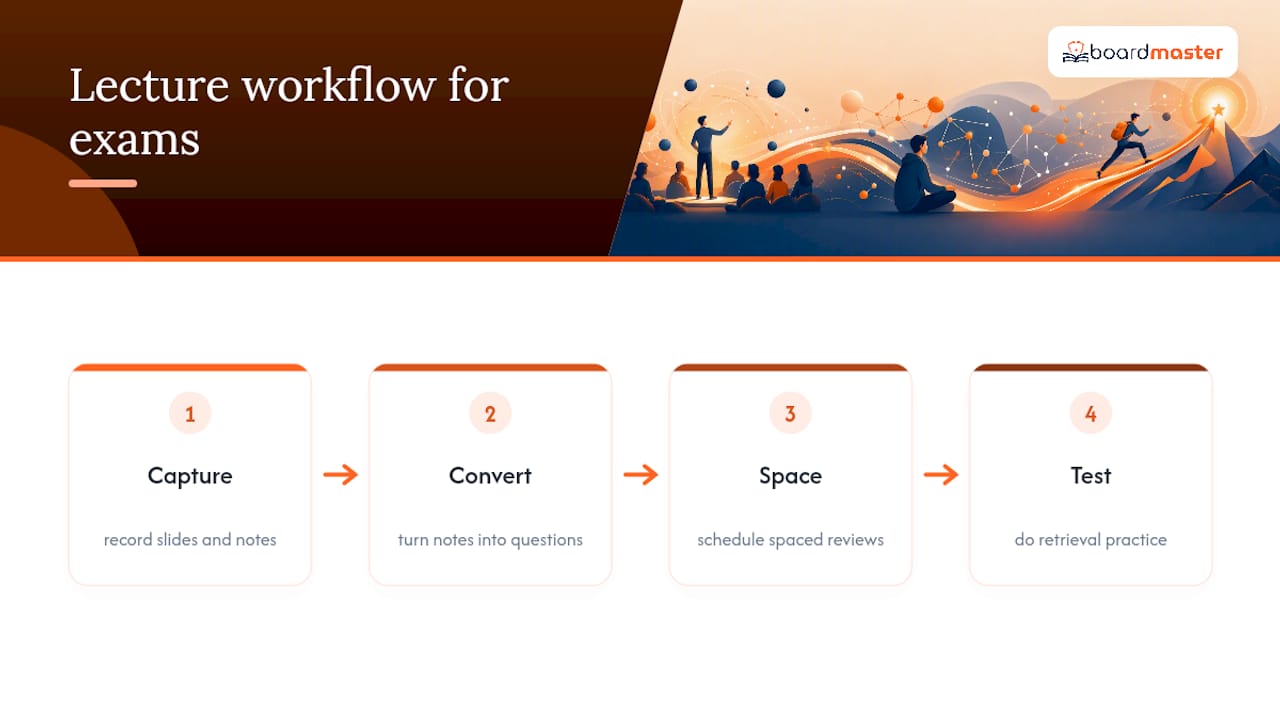
The workflow that works treats every lecture as raw material for four downstream steps: capture, convert, space, and test, following evidence-based study methods. Skip any one of them and the whole system weakens. Reread your notes three times without ever converting them into questions, and you'll recognize the material on exam day without being able to recall it cold. That gap between recognition and recall is where most low scores come from.
How Do You Capture Lecture Content Before, During, and After Class?
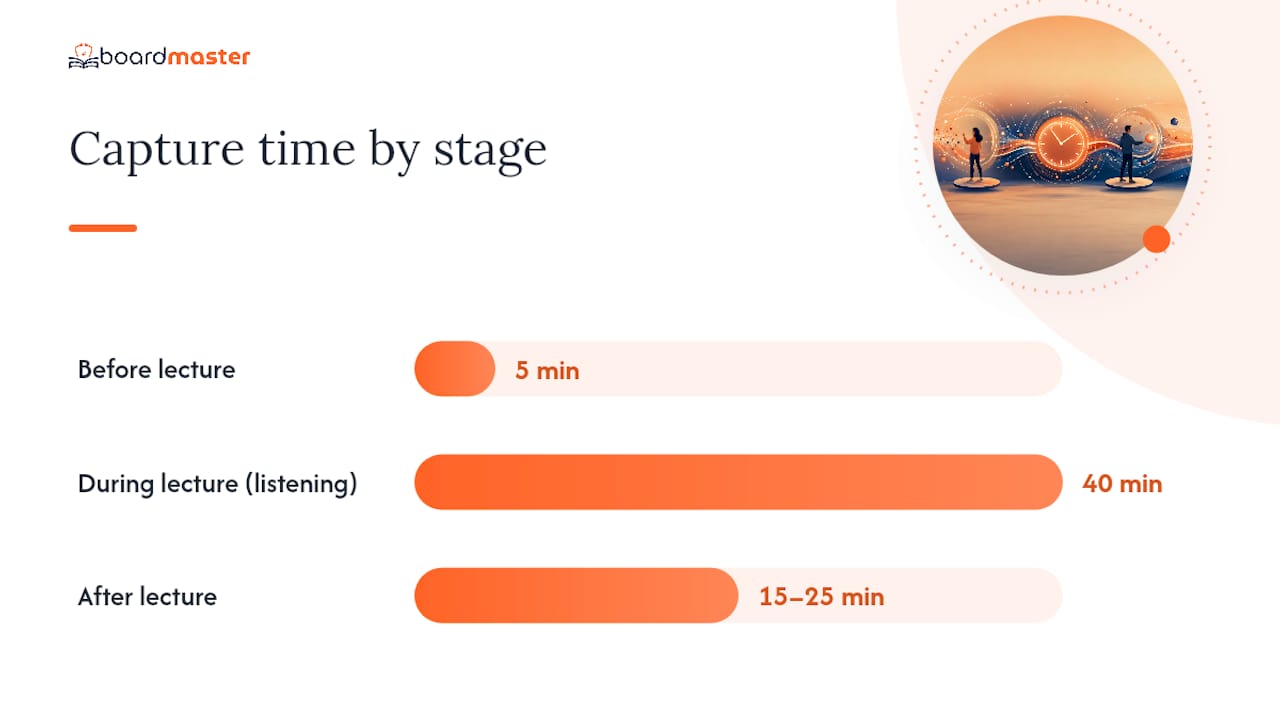
What you write down in the first place determines how good your later study materials can be. A structured capture process, one recommended by university learning centers like the UNC Learning Center, turns forty minutes of listening into usable study fuel instead of a wall of half-remembered bullet points.
Before lecture: spend five minutes skimming the slide deck. You're not trying to learn the material yet. You're building a short mental list of what you don't understand, so you know what to listen for instead of transcribing everything blindly.
During lecture, use a simple active-capture structure:
- Split your page (or digital note) into a cue column and a content column.
- Timestamp anything the professor repeats, slows down for, or says "this will be on the exam" about.
- Mark verbal emphasis separately from slide text. Slides show what exists; tone shows what matters.
- Leave visible gaps rather than guessing. A blank you can fill later beats a wrong note you trust.
After lecture: within the same day, spend 15 to 25 minutes expanding shorthand, filling gaps from a classmate or the recording, and flagging anything the professor emphasized twice as likely-exam material.
Pro Tip: If a professor writes something on the board instead of the slide, treat it as a red flag for the exam. Slides get reused across semesters; board notes are what they're thinking about right now.
How Do You Turn Lecture Slides Into Practice Questions?
A slide deck sitting untouched in a folder does nothing for your grade. The value only shows up once you force each slide to generate a question you have to answer without looking.
- Break the deck into topics. Most lectures cover three to six discrete ideas, even when they look like one continuous stream.
- Extract the learning objective for each topic, usually stated at the start of the slide set or implied by what got repeated.
- Convert each objective into a retrieval question. "Describe the mechanism of X" becomes a blank-page prompt, not a highlighted phrase.
- For dense, data-heavy slides, pull one or two testable facts and pair them with an application question, since factual recall alone rarely matches how exams actually test dense material.
- Build in multiple formats: a cloze-deletion card for isolated facts, a question-and-answer card for mechanisms, and a labeling prompt for any diagram the professor drew from memory.
Doing this conversion the same day the lecture happens is disproportionately valuable. Reviewing fresh material for gaps costs you fifteen minutes; reviewing three-week-old material for the same gaps costs you an hour, because you've also forgotten what you originally understood. Same-day conversion keeps your later study sessions focused on genuine weak spots instead of a general refresh.
Pro Tip: Write the question before you write the answer. If you write the answer first, you'll unconsciously write an easier question to match it.
For students with a heavy course load, manually converting every slide into a card is the single biggest time sink in this entire method. This is the exact bottleneck BoardMaster's AI question generator was built to remove, turning an uploaded deck into testable prompts in minutes instead of hours.
How Should You Schedule Study Sessions for a Lecture-Based Exam?
Spacing isn't a scheduling preference; it's the mechanism that makes retrieval practice stick. Distributed practice and retrieval practice together can produce substantially better long-term retention than cramming, according to research summarized by Kent State psychologists.
A workable spacing rhythm for lecture-heavy courses looks like this:
- Day of lecture: convert slides into retrieval prompts (15 to 25 minutes).
- Next day: quiz yourself cold on those same prompts before glancing at notes.
- Day 3: second retrieval pass, folding in the previous lecture's cards.
- Day 7: full review across the week's lectures, timed if possible.
- Day 14: cumulative pass across everything covered so far, weighted toward topics the professor repeated.
Allocate more session time to whatever got the most airtime in lecture and whatever appeared repeatedly on past exams, if you have access to them. A topic the professor spent twenty minutes on deserves more retrieval reps than one mentioned in a single slide, regardless of how the textbook weights it.
If you're short on time, a basic spaced-repetition tracker, even a simple spreadsheet marking last-reviewed dates, beats no system at all. A weekly schedule that blends lecture attendance with spaced review keeps this from collapsing during exam-heavy weeks, and general productivity frameworks like the ones described at Optio Station can help you block the time without letting other commitments eat into it.
How Do You Use Practice Exams to Prepare?
Timed practice under closed-note conditions should happen before your deep review sessions, not after. Working through even one past exam this way exposes exactly what a professor prioritizes, according to guidance from Duke's Academic Resource Center, and that information should shape the rest of your prep, not confirm it at the end.
- Get past exams from the professor, a course archive, or classmates who took the class previously; ask directly if none are posted.
- Take one under real conditions: timed, closed-note, no interruptions, before you've reviewed the week's material in depth.
- Grade it honestly, then code every wrong answer by cause: forgot the fact, misread the question, or never learned it in the first place.
- Convert every miss into a new retrieval prompt and fold it into your next spaced review cycle.
Match the format to the exam. Multiple-choice courses need distractor-analysis practice; essay-based exams need blank-page retrieval where you write a full response from memory; quantitative courses need timed problem sets, since recognizing a formula and applying it under pressure are different skills entirely.
What Should You Do in the Final 24 to 48 Hours?
The last two days aren't for learning new material. They're for consolidating what you've already built and protecting your ability to recall it under pressure.
- Run light, targeted retrieval on your existing cards, prioritizing topics you've missed before.
- Skip anything you haven't touched until now. Learning it fresh this late adds anxiety without adding retained knowledge.
- Protect sleep over cramming; a rested recall system outperforms a sleep-deprived one that "knows more."
- If you must choose between an all-nighter and eight hours of sleep with less material covered, take the sleep.
- The morning of the exam, run one short warm-up retrieval session, thirty minutes at most, on your highest-yield cards.
Pro Tip: If you feel the urge to open a new chapter the night before, that's usually anxiety talking, not a genuine gap. Trust the schedule you already built.
Why Do Retrieval and Spacing Beat Rereading?
The research consensus on this isn't close. Dunlosky and colleagues reviewed the most common study techniques students actually use and rated only two as high-utility: practice testing and distributed practice. Rereading, highlighting, and summarizing all landed in the low-utility category.
Practice testing and distributed practice consistently outperform passive review techniques across subjects and age groups, while rereading and highlighting, the two most commonly used student strategies, show comparatively weak effects on retention.
That gap comes from something called the testing effect: the act of retrieving information from memory strengthens the pathway to that information more than simply looking at it again does, a pattern confirmed in testing-effect research indexed on PubMed. A "quiz-first" approach, where you attempt to recall before reviewing your notes, makes every subsequent study session more productive, because you already know exactly where the gaps are.
For a time-limited student, the practical takeaway is blunt: two focused, timed retrieval sessions outperform passive rereading sessions of longer duration. Scientific American's synthesis of this literature reaches the same conclusion; the techniques that feel productive, like highlighting a slide deck, are frequently the ones with the weakest payoff.
How Do You Add Textbook Readings Without Losing Lecture Focus?
Supplementary readings can deepen your understanding, but only if you use them to reinforce what the professor emphasized, not to chase a separate curriculum. The mistake most students make is treating the textbook as the primary source and the lecture as a summary of it. For a lecture-based exam, that hierarchy is backwards.
Start every reading session with your lecture notes open. Read the textbook chapter only for the sections that map to what was actually covered in class, and skip sections the professor never mentioned, even if they seem important. If a reading clarifies a mechanism the professor rushed through, convert that clarification into a retrieval prompt tagged to the original lecture, not a separate one. This keeps your card deck organized around exam-relevant material instead of splitting into two competing study systems.
Use outside readings to answer a specific question your lecture notes left open, not to survey a topic broadly. If a professor mentioned a drug's mechanism in one sentence but a textbook devotes six pages to it, extract only the detail that would plausibly appear on an exam built from that lecture. Anything beyond that is a time cost with no matching payoff, and time is the resource you're actually optimizing here.
How BoardMaster Turns This Workflow Into a System
Everything above works. The hard part is doing it consistently across five or six classes a week without burning your entire evening on manual card-making. BoardMaster automates the exact pipeline this article describes: upload your lecture slides, and the AI question generator converts them into testable prompts built around what your specific professor emphasized, not generic textbook content.
From there, the platform schedules spaced review automatically instead of leaving you to track dates on a spreadsheet, and it builds timed practice exams from your own material so the "simulate and analyze" step happens without extra setup. If you're also studying toward boards alongside your class exams, BoardMaster's physician-written question bank and its dedicated USMLE prep tools let you merge both tracks instead of running two separate study systems. A free tier lets you test the conversion workflow on your next lecture before deciding whether to subscribe. Upload one deck and see what a professor-specific question set actually looks like.
An Educator's Take on Why This Method Works
As a physician educator who has watched students burn hours on the wrong material, I keep returning to the same observation: the students who score highest aren't the ones who study longest. They're the ones who convert lecture content into retrieval prompts fastest and space their review most consistently. One student, Sarah, moved from the 73rd to the 92nd percentile while cutting her study time roughly in half, simply by shifting from rereading slides to answering questions built directly from what her professors emphasized. If you take one thing from this article, take this: stop rereading, start quizzing, and space it out. That's the whole method.
— Dr. Ahmed Abuzoor
Sources
- Improving Students’ Learning With Effective Learning Techniques: Promising Directions From Cognitive and Educational Psychology — Dunlosky et al. (2013)
- All study strategies not created equal, according to Kent State researchers
- Retrieval practice produces more learning than elaborative studying with concept mapping — PubMed summary of testing-effect research
- How do I use past exams? — Duke Academic Resource Center
- Psychologists identify the best ways to study — Scientific American
FAQ
What Is the 3-2-1 Rule for Studying?
Versions of this rule vary, but the most common one asks you to identify three things you learned, two questions you still have, and one thing you want to explore further after each study session, which forces active reflection instead of passive review.
Is Three Days Enough to Study for an Exam?
Three days can work for a single lecture-based exam if you've already converted material into retrieval prompts along the way. It's tight but workable for focused review, timed practice, and error correction, though it leaves little room for material you never captured properly the first time.
How Do Top-Performing Students Actually Study?
They convert lecture material into retrieval questions the same day it's taught, space their review of those questions over days and weeks rather than cramming, and test themselves under timed conditions well before the actual exam, a pattern consistent with what Dunlosky et al. found when they identified practice testing and distributed practice as the two highest-utility study techniques.
What Is the 1/2/3 Method for Studying?
This isn't a standard, research-defined framework, so definitions vary by source; if you've encountered a specific version tied to your course, follow your instructor's framing rather than a generic online definition.
Can BoardMaster Help With Class Exams, Not Just Board Exams?
Yes. BoardMaster generates questions directly from uploaded lecture slides and notes, which makes it suited to class-specific exams built around an individual professor's emphasis, in addition to board-style prep.