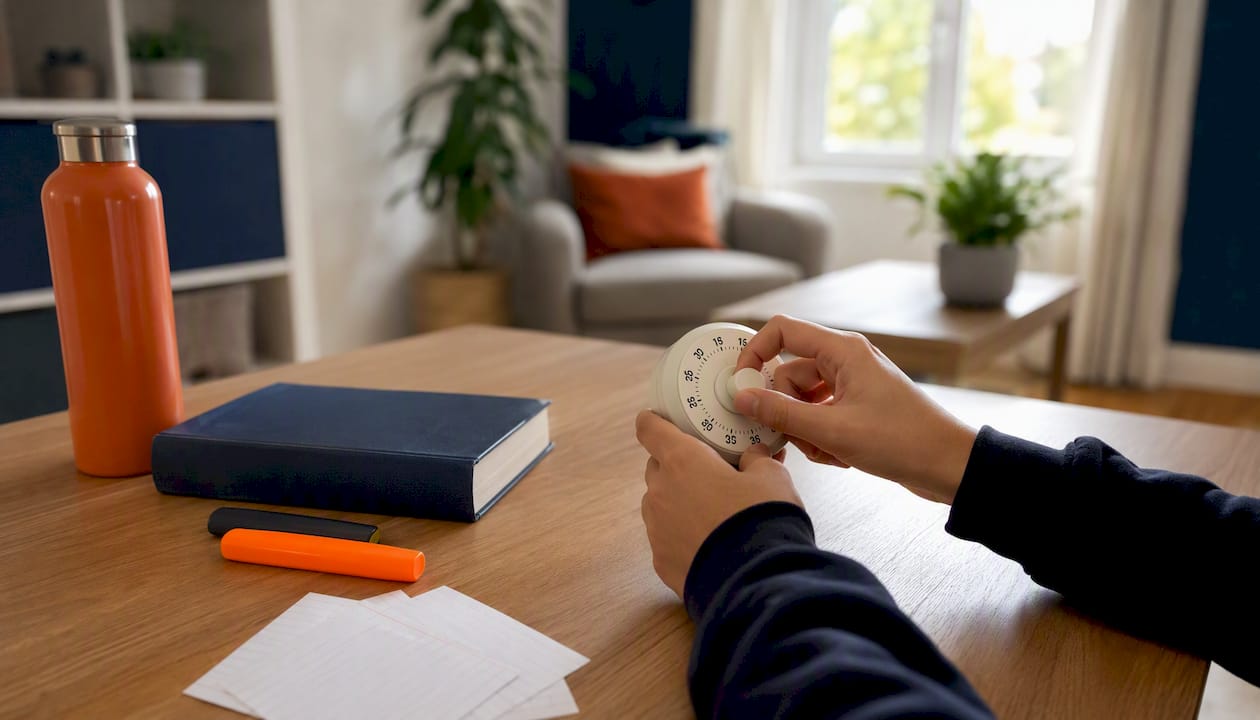
Yes, most medical students can cut total study hours roughly in half by switching from rereading and passive review to retrieval‑first workflows. The mechanism is well documented: Residency Advisor's analysis of study volume and outcomes finds that returns on exam performance flatten above roughly 50 hours a week unless that time gets reallocated toward active recall. Hours alone don't predict scores. What you do with them does.
Start today with three changes:
- Stop rereading slides and notes. Convert every session into questions first, answers second.
- Cap new Anki cards and protect review time instead of piling on fresh material.
- Triage lectures before you watch them. Skim objectives, then decide what's worth full attention.
Key Takeaways
Cutting study hours in medical school works when you replace passive review with retrieval practice, not when you simply study less.
| Point | Details |
|---|---|
| Target 40 to 50 hours weekly | Returns on performance flatten above roughly 50 hours unless time shifts toward active recall. |
| Prioritize retrieval over rereading | Aim for 40 to 50% of study time on practice questions and Anki reviews. |
| Use tiered daily templates | Keep Level 2 and Level 3 backup schedules so a bad day doesn't turn into a lost week. |
| Track four weekly metrics | Log focused hours, Anki reps, question accuracy, and a fatigue rating to catch problems early. |
| Use lecture-aligned questions | BoardMaster generates practice questions from your own lecture uploads to raise retrieval density fast. |
Table of Contents
- How to Halve Medical School Study Hours the Right Way
- What Are Realistic Study‑Hour Targets for Med Students?
- What Determines How Many Hours You Actually Need?
- Signs You're Studying Too Much or Too Little
- Why Retrieval Practice Is the Real Time-Saver
- Which Study Tactics Actually Cut Hours?
- What Do Efficient Daily and Weekly Schedules Look Like?
- How Do You Transition to Fewer Hours Over Six Weeks?
- Why Do Attempts to Cut Study Hours Usually Fail?
- What Evidence Supports This Approach?
- A Perspective on Why This Works in Practice
- Cut Study Hours With Targeted Practice Questions
- Sources
- FAQ
How to Halve Medical School Study Hours the Right Way
The short version: you're not cutting effort, you're cutting waste. A 2021 study on medical student study behaviors found that lower‑GPA students often logged more hours on passive review, while higher‑GPA students studied more efficiently rather than simply longer. Hours and grades don't move in lockstep. Method does the heavy lifting.
This is why "halving your hours" sounds risky but usually isn't. If half your current schedule is rereading slides, re‑watching lectures at normal speed, and copying notes verbatim, you can cut those specific activities and lose almost nothing. The efficient studying for med students conversation isn't about working less hard. It's about redirecting hours toward the two activities that actually build durable recall: practice questions and spaced flashcard review.
Reducing study time in medical school works best as a structural change, not a willpower exercise. You're not trying to study faster through the same bad habits. You're replacing the habits.
What Are Realistic Study‑Hour Targets for Med Students?
Residency Advisor's blueprint for board readiness puts top‑quartile students at roughly 40 to 50 hours per week of total academic activity, with a substantial proportion of that time spent on active recall rather than passive review. That's the ceiling worth aiming for, not the floor you have to hit every single week.
Here's how that breaks down by day type:
- Normal weekday: 5 to 7 focused hours, split between class time and independent study.
- Light weekend day: 3 to 4 hours, mostly review and flashcards, with real time off.
- Exam‑crunch day: 8 to 10 hours, heavier on practice questions than new material.
- Absolute upper limit: Beyond roughly 50 hours a week, added hours stop translating into better scores unless that extra time shifts toward retrieval work.
If your weekday routinely stretches past 8 or 9 hours and you're still cramming on weekends, the problem usually isn't your schedule. It's that too much of that time is passive.
What Determines How Many Hours You Actually Need?
Your target isn't universal. It shifts based on a few concrete factors.
- Curriculum style. Problem‑based learning programs demand more independent synthesis; lecture‑heavy programs front‑load content delivery, which can mean less prep but denser exam material.
- Baseline knowledge. A student coming from a strong undergraduate biology background needs less raw content time than one rebuilding foundations from scratch.
- Exam style. Board‑style, application‑based exams reward question practice heavily. Straight recall‑based class exams reward targeted flashcard review more.
- Method efficiency. Two students with identical schedules can need wildly different hours if one is doing question‑first review and the other is rereading PowerPoint decks.
Pro Tip: Run a two-week time audit before changing anything. Log every study block by activity type (rereading, questions, flashcards, lecture) and you'll usually find 30 to 40% of your hours are pure rereading, which is the easiest place to cut first.
Signs You're Studying Too Much or Too Little
Overstudying and understudying both leave fingerprints. Chronic sleep loss, slower recovery when you skip a day, and flat or declining practice question scores despite more hours all point to burnout dressed up as diligence. Sacrificing sleep for extra study time tends to reduce the efficiency of that study, which means you end up needing even more hours to compensate.

Understudying shows up differently: surprise misses on practice questions covering material you thought you knew, an inability to explain a concept out loud without notes, and a backlog of flagged topics that keeps growing instead of shrinking. If your question accuracy is climbing and your backlog is shrinking, your hours are probably right. If neither is true, don't add hours blindly. Check where those hours are actually going first.
Why Retrieval Practice Is the Real Time-Saver
This is the mechanism that makes halving your hours possible instead of reckless. The American College of Physicians recommends retrieval practice over rereading because pulling information out of memory builds stronger, more durable recall than passively taking it in again. Rereading feels productive. It's mostly recognition, not retrieval, and recognition doesn't hold up under exam pressure.
High‑yield performance correlates with retrieval density, meaning students who spend 40 to 50% of their study time on active recall routinely outperform peers logging equal or greater hours on passive review. That ratio is the actual target, not total hours.
In practice, that means:
- 100 to 150 Anki reviews per day, prioritized ahead of adding new cards.
- 20 to 40 practice questions per day outside dedicated exam blocks, more during review weeks.
- Session lengths of 30 to 90 minutes with real breaks, not marathon four‑hour blocks that quietly lose focus after minute 45.
Structure each session the same way every time: question first, spaced recall second, targeted review of what you missed third. Learning why an answer is wrong takes longer than learning that it's wrong, and that extra minute is where the retention actually happens. Custom, lecture-aligned practice questions shortcut this because you're not wasting reps on content your professor never emphasized.
Pro Tip: If you only have 20 minutes, do questions, not flashcards. Flashcards you already half-know feel productive; missed questions expose exactly what to fix.
Which Study Tactics Actually Cut Hours?
Four changes account for most of the time savings.
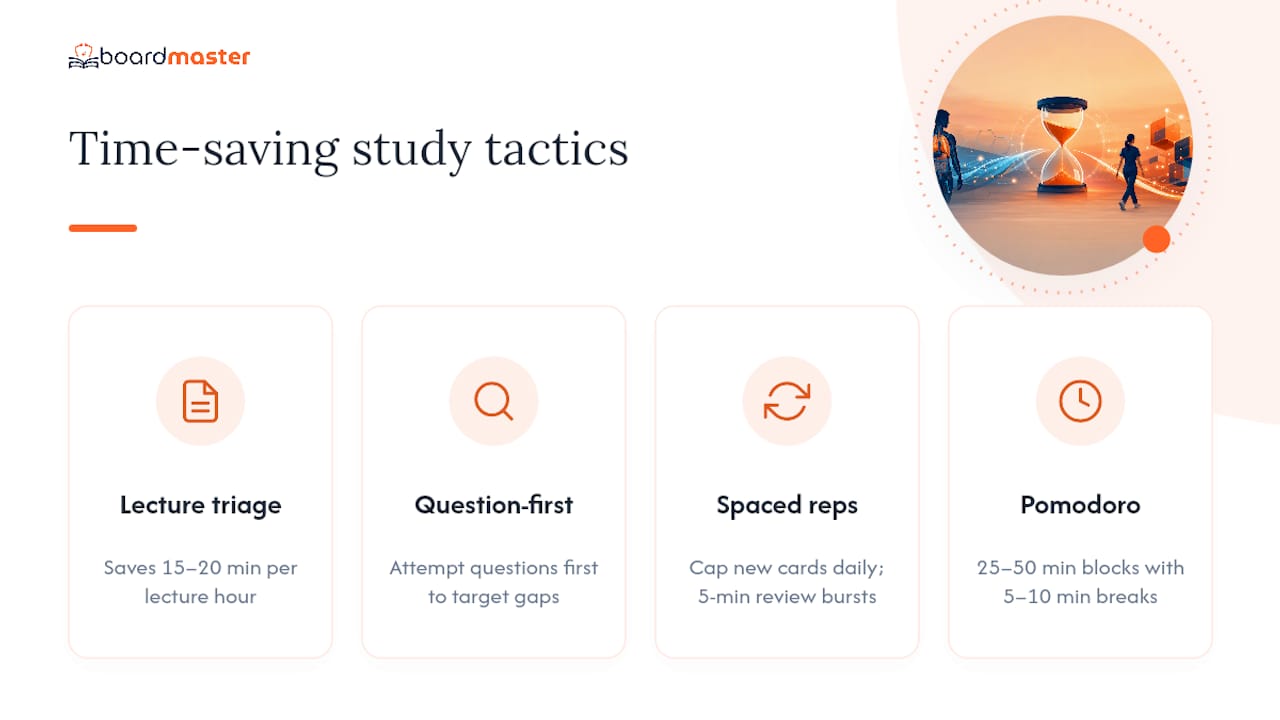
Lecture triage. Skim slide objectives before watching, then decide what deserves full attention versus a 1.5 to 2x speed pass. This alone can save 15 to 20 minutes per lecture hour without dropping coverage, echoing UCSD's guidance on brief pre‑lecture "big picture" prep.
Question‑first learning. Attempt questions on a topic before rereading anything about it. You'll get more wrong at first, and that's the point: each miss shows exactly what needs review instead of you rereading material you already understand.
Spaced repetition discipline. Cap new Anki cards at a fixed daily number and never let reviews pile up past a day or two. Use passive moments, waiting in line, between patients on rotation, for five‑minute review bursts instead of scheduling a dedicated Anki block.
Time‑blocking and Pomodoro. The AMA endorses Pomodoro‑style intervals for managing fatigue, roughly 25 to 50 minute focused blocks with 5 to 10 minute breaks. Regained focus per block often outweighs the lost minutes, since fatigued studying past the hour mark yields diminishing retention anyway.
Swap re‑watching a full lecture for a targeted 10‑minute review of the objectives you missed. Swap transcribing notes verbatim for building five questions from that lecture instead. Same topic, a fraction of the time.
Pro Tip: Track minutes saved per swap for one week. Most students find lecture triage alone recovers 3 to 5 hours weekly, which is nearly the entire gap between a 45‑hour week and a 40‑hour one.
What Do Efficient Daily and Weekly Schedules Look Like?
You don't need one rigid schedule. You need three versions for three kinds of days, plus one for exam week.
- Level 1 (good day): Four 60 to 90 minute blocks. Morning questions (30 to 40), midday Anki reviews (100 to 150 cards), afternoon lecture triage, evening 20‑minute weak‑topic review.
- Level 2 (reduced productivity): Two blocks. Anki reviews only, no new material, 15 to 20 questions on a single weak topic.
- Level 3 (bad day): One 20‑minute block. Anki reviews only. Protect the streak, skip everything else.
- Exam sprint (3 to 5 days): Two 90‑minute question blocks daily, one Anki review block capped at existing cards, no new content, 20‑minute daily weak‑area repair session.
The point of Level 2 and Level 3 templates isn't productivity. It's damage control. A bad day that still includes 20 minutes of review beats a bad day that includes zero, because the backlog that builds during a skipped week is what forces the 12‑hour cram days later.
How Do You Transition to Fewer Hours Over Six Weeks?
Cutting hours abruptly usually backfires, because you haven't yet built the retrieval habits that make fewer hours work. A gradual shift protects both your scores and your sanity.
- Week 1: Run the time audit. Log every hour by activity type, no changes yet.
- Week 2: Replace one rereading session daily with a question‑first session on the same material.
- Week 3: Cap new Anki cards at a fixed daily number and clear any backlog first.
- Week 4: Increase question volume 20% and start tracking accuracy by topic, not just overall.
- Week 5: Cut one full passive block from your week (a re‑watch, a full reread) and protect that time as rest or exercise instead.
- Week 6: Compare total hours against Week 1 and check whether question accuracy held or improved.
Track four numbers weekly: focused hours logged, Anki reviews completed, practice question accuracy by topic, and a simple 1 to 5 fatigue self‑rating. One student using this approach, generating lecture‑specific practice questions instead of generic bank questions, moved from the 73rd to the 92nd percentile while cutting her weekly hours roughly in half, evidence that the ceiling on performance isn't hours, it's what fills them.
Why Do Attempts to Cut Study Hours Usually Fail?
Most failed attempts share one root cause: mistaking passive time for productive time. A student who "cuts hours" by watching lectures at 2x speed instead of doing questions hasn't actually improved efficiency, just compressed the same low‑yield activity.
Two other common breakdowns: under‑tracking retrieval volume (you think you're doing enough questions, but you're not logging it, so you can't tell), and ignoring weakness repair, letting missed topics pile up instead of scheduling dedicated review. Cramming late in the cycle is usually the visible symptom of both problems compounding for weeks.
The fix is almost always the same: reintroduce a short daily review block, push extra questions toward your weakest two or three topics, and revert to a Level 1 template for a week before cutting anything further. Widen your hours again only if practice scores objectively drop or your backlog keeps growing despite the fixes above.
What Evidence Supports This Approach?
This plan leans on peer‑reviewed research and guidance from established medical education sources, not general productivity advice repackaged for students.
- A 2021 PMC study linking study method, not just hours, to GPA outcomes.
- AMA time‑management guidance on Pomodoro intervals and lecture‑to‑study ratios.
- Residency Advisor's data on the point where added hours stop improving scores.
A "focused study hour" here means time spent on a single task with your phone away and a timer running, not hours logged sitting at a desk with your notes open. Some of this guidance extrapolates from broader time‑use and learning science research rather than medical‑student‑specific trials, worth keeping in mind as you calibrate your own numbers.
A Perspective on Why This Works in Practice
Most students overestimate how much of their schedule is genuinely productive. When you actually separate rereading from retrieval, the gap between busy and effective becomes obvious, and closing it is usually less about discipline and more about honest tracking. The students who successfully cut hours aren't the ones who work less. They're the ones who stop confusing time spent with progress made.
Cut Study Hours With Targeted Practice Questions
Everything in this plan depends on one thing: having enough of the right practice questions, aligned to what your actual professors emphasize, not a generic national average. BoardMaster is built around exactly that gap. Upload your lecture notes and it generates USMLE‑style questions tailored to the concepts your specific professor stressed, so every rep counts toward both your class exam and your boards at once instead of splitting your limited hours between two separate prep tracks.

That's the retrieval‑density problem solved directly: the AI question generator turns your own lecture material into targeted questions, the spaced‑repetition flashcards handle the Anki side of your schedule, and the study podcasts convert lecture content into short audio review you can use during commutes or other passive moments. If you want more question volume immediately, the platform's 5,000+ physician‑written board questions cover material beyond your own lecture set. Try the free tier this week, upload one lecture set, and compare how many focused hours a targeted question session saves against your usual reread.
Sources
- PMC article (2021) on medical student study behaviors
- Residency Advisor — Study volume vs outcomes
- AMA — 3 time‑management methods every new medical student must know
- UCSD — Study skills and exam strategies
FAQ
How many hours a day do you study in medical school?
Most students studying efficiently spend 5 to 7 focused hours on a normal weekday, rising to 8 to 10 hours during exam‑crunch periods, according to Residency Advisor's benchmark data.
What is the 32-hour rule in medical school?
There's no widely recognized study-hour rule tied to personal study schedules in the sources behind this plan; study time recommendations vary by source and context.
Is 700 research hours good for a med school application?
That question falls outside study‑time efficiency and into admissions strategy, which depends heavily on program type and specialty goals, not something this plan's evidence base addresses.
Is a 3.5 GPA too low for med school?
GPA competitiveness varies by target program and MCAT score, but study method matters more than raw hours for improving your standing, so shifting toward retrieval practice can move a borderline GPA meaningfully.
Can you really cut study hours in half without hurting your grades?
Yes, for most students, because a large share of typical study time goes to low‑yield passive review; replacing it with question‑first sessions and lecture‑aligned practice, the approach BoardMaster builds around, preserves or improves performance while cutting hours.