
Here's the schedule: Day 0, then 1, 3, 7, 14, 30, and 60. Review a card on each of those days after you first learn it, and you'll hit the retention window that matters for both class exams and boards. If you'd rather not manage the math yourself, an adaptive algorithm like FSRS or SM-2 (built into most modern flashcard software) will adjust those gaps automatically based on how well you actually know each card.
Three rules make this work. Cap new cards at a number you can review daily without slipping (start at 15 to 20). Set two fixed review windows a day, one short morning pass and one longer evening session. Protect that time the same way you protect a clinic shift.
Consistency beats configuration. A mediocre schedule you run every day will outperform a perfect one you run three times a week.
To start in the next 10 minutes:
- Pick one platform and set a daily new-card limit.
- Add today's lecture material as cards before you sleep.
- Set two calendar blocks labeled "reviews" and treat them as fixed appointments.
- If your backlog exceeds 200 cards, pause new cards until it's back under 100.
Pro Tip: Set your new-card limit lower than you think you need. It's far easier to raise it after a week of consistent reviews than to dig out from a backlog that's already crushed your motivation.
Key Takeaways
Consistent daily reviews on a 1, 3, 7, 14, 30, 60 day schedule, backed by an 85 to 90% retention target, outperform any perfectly configured system run inconsistently.
| Point | Details |
|---|---|
| Use the baseline interval sequence | Review at 1, 3, 7, 14, 30, and 60 days, or let an adaptive algorithm adjust automatically. |
| Cap new cards to your workload | Preclinical years can sustain 20 to 40 new cards daily; clinical years usually need 10 to 20. |
| Target 85 to 90% retention | Failing more than 15% of reviews means new cards are outpacing what you can retain. |
| Fix backlog immediately | Stop new cards until the queue drops under 100, then resume at a lower rate. |
| Automate card creation | BoardMaster generates flashcards with spaced repetition directly from lecture uploads, cutting the manual build step out of your daily routine. |
Table of Contents
- What Is a Spaced Repetition Schedule for Med School?
- Why Spaced Repetition Actually Improves Retention
- How to Build Your Spaced Repetition Workflow Step by Step
- Sample Spaced Repetition Schedules You Can Copy
- Common Spaced Repetition Mistakes and How to Fix Them
- How to Integrate Spaced Repetition With Lectures and Question Banks
- What the Research Actually Recommends for Scheduling
- The Schedule Only Works if You Tune It to Yourself
- Let BoardMaster Handle the Card-Building Grind
- Sources
- FAQ
What Is a Spaced Repetition Schedule for Med School?
A spaced repetition schedule is a system of timed reviews, spaced at increasing intervals, that targets the moment you're about to forget something rather than the moment you already know it cold. For a med student staring down thousands of discrete facts, that timing difference is the entire point: you spend review time on material that's actually fading, not material you've already locked in.
It differs from other study habits in two clear ways:
- Versus repeated reading: Rereading notes feels productive but produces weak recall because you're recognizing information, not retrieving it. Spaced repetition forces retrieval, which is a fundamentally different (and harder) cognitive task.
- Versus passive review: It complements active recall and interleaving rather than replacing them. You still need to mix subjects and test yourself; spacing just decides when you revisit each fact.
You'll also see two flavors of scheduling. Fixed schedules (1, 3, 7, 14, 30, 60) work fine on paper or in a simple app. Adaptive algorithms like SM-2 or FSRS track your individual performance per card and stretch or shrink intervals accordingly, which matters once your deck grows past a few thousand cards.
Why Spaced Repetition Actually Improves Retention
The forgetting curve isn't a metaphor. Memory decays predictably after learning, and reviewing right before that decay hits resets the clock more efficiently than reviewing too early or too late. Retrieval practice, the act of pulling an answer from memory rather than rereading it, strengthens the neural pathway more than passive exposure ever does. Over enough repetitions, related facts start forming a schema, a mental scaffold that lets you connect a drug's mechanism to its side effects to its contraindications without memorizing each in isolation.
The evidence backs this up directly. A PubMed-listed study measured learning rates of 58.03% with spaced repetition versus 43.20% with repeated study, a gap large enough that it shows up in board scores, not just quiz results. The same research found that students who completed and reviewed roughly 1,500 practice questions tracked with more competitive board performance.
A peer-reviewed synthesis on PMC reinforces the mechanism: spacing combined with retrieval practice outperforms either technique alone. That combination, not spacing in isolation, is what makes the schedule below worth running daily rather than in bursts before an exam.
- Forgetting is predictable, which means review timing can be engineered rather than guessed.
- Retrieval, not recognition, is what builds durable memory.
- Schema formation compounds over months, which is why early consistency matters more than late intensity.
How to Build Your Spaced Repetition Workflow Step by Step
Getting the schedule right matters less than getting the underlying habits right. Here's the process.
1. Build cards using the Minimum Information Principle. Each card should test one fact, not three. "What is the mechanism of hydrochlorothiazide?" beats a card that also asks about dosing, side effects, and contraindications in the same prompt. Use cloze deletions for lists and sequences (steps of the coagulation cascade), and basic front/back cards for discrete facts (a drug's mechanism). Add a clinical vignette or image where it helps you recall context, not just the fact itself.
2. Tag by course, exam, and clinical relevance. A simple three-tag system works: course tag (Cardio, Renal), exam tag (Midterm 2, Step 1), and clinical tag (high-yield, board-favorite, low-yield-skip). This lets you filter reviews when a shelf exam is closing in and you need to prioritize ruthlessly.
3. Set your new-card ceiling by year and workload. Preclinical years with lighter clinical demands can typically sustain 20 to 40 new cards a day. Clinical years, with rotations eating your hours, usually need that cut to 10 to 20. Push past your sustainable ceiling and you'll build backlog faster than you can clear it.
4. Target 85 to 90% retention, not 100%. If you're getting every card right, your intervals are too short and you're wasting review time. Most flashcard software lets you adjust an "interval modifier" to tune this without rebuilding your deck.
5. Run two fixed review windows daily. A 20 to 30 minute morning session clears overnight reviews before lecture. A 45 to 60 minute evening session handles the bulk of the day's queue plus new cards from that day's material.
6. Do weekly maintenance. Every Sunday, scan for leech cards (ones you keep failing), rewrite or delete them, and check whether your tags still match your current block.
Backlog recovery plan: if reviews pile up past 150 to 200 cards, stop adding new cards immediately. Clear the backlog in oversized sessions for two to three days before resuming new-card intake. This single rule prevents the death spiral known as "ease hell," where cards you keep failing get scheduled so frequently they crowd out everything else.
Pro Tip: If a single card has failed four or more times, stop trying to "fix" it with more reviews. Rewrite it into two simpler cards, or delete it. A card that keeps failing usually has a design problem, not a memory problem.
Sample Spaced Repetition Schedules You Can Copy
The baseline interval sequence, 1, 3, 7, 14, 30, 60 days, maps to how memory actually consolidates: frequent early reviews while the trace is fragile, widening gaps as it stabilizes. University learning centers recommend this exact sequence for students working without adaptive software, with particular emphasis on reviewing within 24 hours of first exposure. Here's how that baseline adjusts across three real scenarios.
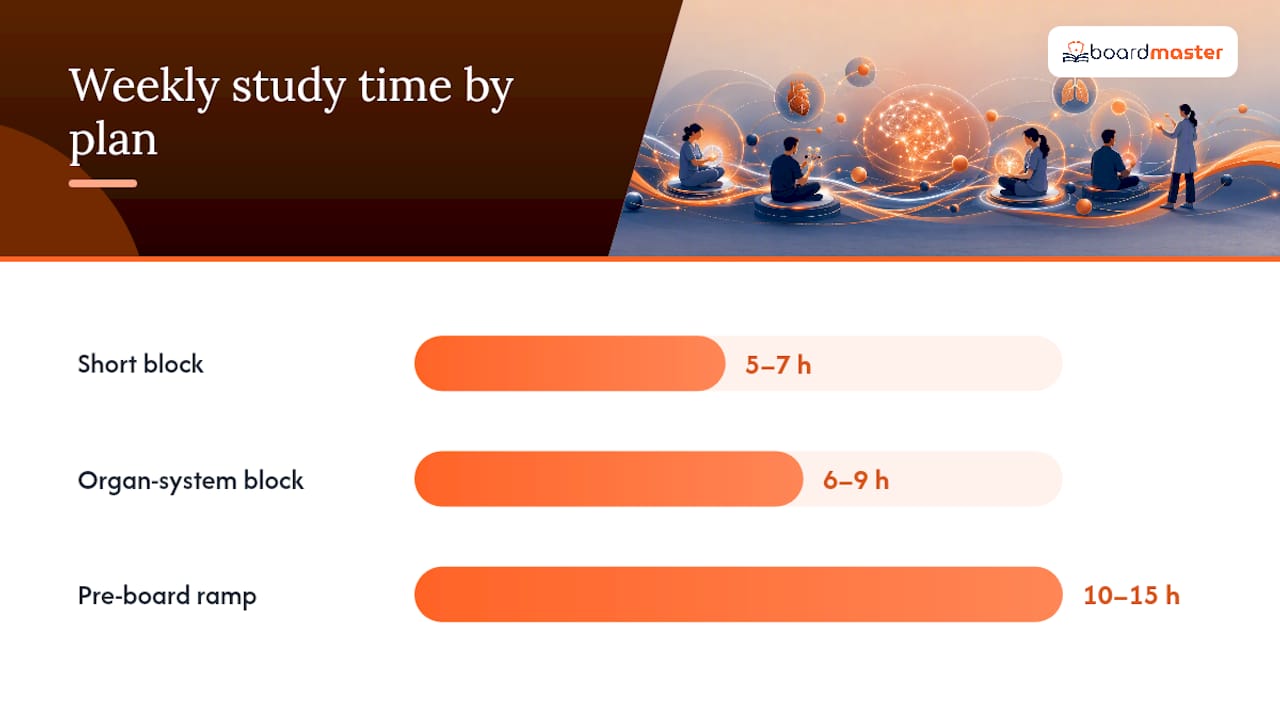
Plan A: short block (3 to 6 weeks, a midterm or unit exam). New-card rate runs higher since the window is short, roughly 25 to 35 cards a day. Cap your maximum interval at 14 days since the exam will hit before longer intervals matter. Weekly time budget: 5 to 7 hours of review split across daily sessions.
Plan B: organ-system block (10 to 12 weeks, standard preclinical curriculum). This is the sustainable long-haul pace. New cards stay around 20 to 30 a day, letting intervals run the full 60-day sequence. Weekly time budget: 6 to 9 hours, growing slightly as the review queue matures around week 4 or 5.
Plan C: pre-board ramp (12 to 20 weeks before Step 1 or Step 2). New-card creation slows since you're consolidating existing material, but review volume climbs sharply as older cards resurface and question-bank work intensifies. Target completing and reviewing close to 1,500 practice questions across the window, phased so the last four weeks emphasize timed blocks over untimed review. Weekly time budget: 10 to 15 hours, split roughly 60/40 between flashcard review and question banks.
| Plan | Duration | New Cards/Day | Weekly Time Budget |
|---|---|---|---|
| Short block | 3 to 6 weeks | 25 to 35 | 5 to 7 hours |
| Organ-system block | 10 to 12 weeks | 20 to 30 | 6 to 9 hours |
| Pre-board ramp | 12 to 20 weeks | 5 to 15 | 10 to 15 hours |
Two knobs control workload regardless of which plan you're running: the new-card cap and the interval modifier. Turn the cap down when clinical duties spike.
- Short blocks favor volume over depth. Organ-system blocks favor sustainability. Pre-board ramps favor question-bank integration over raw card count.
- None of these schedules survive contact with a two-week gap. Build in buffer days before you need them, not after.
Common Spaced Repetition Mistakes and How to Fix Them
The backlog spiral is the single most common failure. Once your review queue exceeds a few hundred cards, the psychological weight of opening the app gets heavier, and skipping becomes easier than catching up. The fix is mechanical, not motivational: cap new cards at zero until the backlog clears, then resume at a lower rate than before.
Over-creation is the second trap. Making too many cards from a single lecture, especially cards that duplicate the same fact from different angles, inflates your review load without improving retention. Fewer, better cards beat more, redundant ones.
Low-quality cards, ones with ambiguous wording or multiple facts crammed into one prompt, show up as chronic leeches. If a card has failed repeatedly, don't keep reviewing it hoping it'll click. Rewrite it smaller or retire it.
- Reduce new cards immediately when review time exceeds your daily budget by more than 20%.
- Rewrite any card you've failed more than three times rather than continuing to review it as-is.
- Schedule one buffer day a week with zero new cards to absorb overflow.
- After missing several days, resume with backlog clearing only, no new cards, for at least 48 hours.
Pro Tip: Once a week, sort your deck by "times failed" and look at the top 10 cards. That short list usually reveals a pattern, often a specific professor's terminology or a topic you never fully understood in lecture, that's worth fixing at the source.
How to Integrate Spaced Repetition With Lectures and Question Banks
The tightest workflow creates cards within two hours of lecture, while context is still fresh enough that you're not just copying slide text verbatim. Tag each card by course and exam, and where possible, link it to the specific question-bank item that tests the same concept, so a missed question sends you straight back to the relevant card.
A practical weekly pipeline looks like this: attend lecture, build 15 to 25 cards same-day, run a question-bank block covering that week's material, then tag any missed questions for card creation that evening. During clinical rotations, prioritize cards tied to your current specialty and shelf exam over general boards review. This keeps your weekly schedule realistic instead of trying to do everything at once.
- Create cards same-day, not on a weekend backlog session.
- Tag cards with a course label, exam label, and question-bank reference where applicable.
- During rotations, weight new cards toward your current specialty over general review.
- Treat shelf prep as a subset of your ongoing schedule, not a separate system you build from scratch.
What the Research Actually Recommends for Scheduling
Four bodies of evidence converge on the same conclusions. A large PubMed study found spaced repetition's 58.03% learning rate significantly outperformed repeated study's 43.20%. A comprehensive review of expanded-retrieval platforms identified schema formation, dual-coding, interleaving, and retrieval practice as the themes that consistently improve retention, and recommended building them directly into review platforms rather than treating them as separate study habits. That same review found expanded-retrieval scheduling more efficient than equal spacing when total repetitions are held constant, which is the core argument for adaptive algorithms over rigid fixed intervals once your card count climbs into the thousands.
Spacing works because it targets the forgetting curve directly. Retrieval practice works because it strengthens the exact pathway you'll need under exam pressure. Combined, they outperform either technique alone.
For students managing large decks, adaptive algorithms like FSRS smooth workload better than fixed schedules because they respond to your actual per-card performance instead of a one-size interval. BoardMaster's flashcard generation builds cards directly from uploaded lecture material with spaced repetition scheduling attached, cutting the manual card-creation step that eats the most time in this whole process. One student profiled by BoardMaster moved from the 73rd to the 92nd percentile while cutting her study hours in half, largely by focusing review time on professor-emphasized content instead of generic question banks.
- Favor adaptive scheduling once your deck exceeds roughly 2,000 to 3,000 cards.
- Stick with fixed intervals for short, single-block prep windows where simplicity beats precision.
- Prioritize question volume alongside flashcard review, the 1,500-question benchmark tracks with stronger board outcomes.
The Schedule Only Works if You Tune It to Yourself
Every rigid schedule eventually meets a rotation, a family emergency, or a week where nothing goes as planned. Students who stick with spaced repetition long-term aren't the ones with the most optimized interval settings. They're the ones who adjust the system instead of abandoning it. One upper-year student I've seen described dropping her new-card cap from 30 to 10 during a surgery rotation, then rebuilding it gradually once her schedule normalized, rather than quitting the habit entirely during the hardest month of the year.

Small, sustainable adjustments beat elaborate schedules you can't maintain. Protect the habit first, optimize the settings second.
Let BoardMaster Handle the Card-Building Grind
The most time-consuming part of this entire system isn't reviewing, it's building good cards in the first place. BoardMaster automates that step by generating flashcards directly from your uploaded lecture notes, complete with spaced repetition scheduling and relevant medical images already attached, so you're reviewing within minutes of lecture instead of spending your evening building decks by hand.

Two features make this especially useful for the schedule above. Instant flashcard generation from lecture PDFs means your same-day card-creation habit takes minutes, not an hour. And for the two-window daily routine, BoardMaster's study podcasts turn your lecture content into short audio episodes you can review passively during a commute or a gap between clinical duties, giving you a second review channel that doesn't compete with your desk time. Check out the study podcast feature page to see how a lecture becomes a review session you can run anywhere.
Sources
- PubMed
- An Evidence-Based Guide for Medical Students: How to Optimize the Use of Expanded-Retrieval Platforms
- Ncbi
- Ncbi
FAQ
What is a good spaced repetition schedule for medical students?
A 1, 3, 7, 14, 30, 60 day fixed schedule works well for most students, though an adaptive algorithm like FSRS adjusts these intervals automatically based on your individual performance per card.
What is the best schedule for spaced repetition?
There's no single best schedule. Fixed intervals work for short study blocks under a few thousand cards, while adaptive algorithms outperform fixed schedules once your deck grows large enough to need per-card personalization.
What is the purpose of spaced repetition in medical school?
It targets review timing to the moment you're about to forget a fact, which produces significantly higher learning rates than repeated study, critical given the sheer volume of material med school requires.
How many days apart should spaced repetition reviews be?
Reviews typically start close together (1 day, then 3 days) and widen as retention strengthens, extending to 7, 14, 30, and eventually 60 days between reviews of the same card.
Should I use a fixed schedule or an adaptive algorithm?
Fixed schedules are simpler and fine for short blocks or smaller decks. Adaptive algorithms, including the flashcard scheduling built into platforms like BoardMaster, handle large card volumes and individual retention differences more efficiently.