
Writing clinical cases means building exam-style vignettes and OSCE prompts that force a test-taker to reason through data the way a real patient encounter would demand it. The deliverable you need is a copy-ready NBME-style stem template, a lead-in and option-writing checklist, a cueing audit, and a workflow for piloting and revising cases once real students start missing (or acing) them for the wrong reasons.
TL;DR:
- Well-constructed stems follow a strict order that mimics real clinical reasoning, starting with demographics and ending with diagnostics, to avoid confusing students.
- Writing a focused, closed lead-in that passes the cover-the-options test ensures students can answer accurately based on reasoning before seeing answer choices.
- Effective distractors match the correct answer in structure and length, while avoiding pattern recognition cues like repeated keywords or absolute qualifiers.
- Incorporating current, evidence-based guidelines and shielding cases from identifiable patient details uphold clinical accuracy and ethical standards.
- Using multimedia and staged-reveal prompts in OSCE stations increases realism and tests practical skills instead of mere textbook knowledge.
Table of Contents
- How Do You Write Clinical Cases in NBME Format?
- What Makes a One-Best-Answer Lead-In Work?
- How Do You Avoid Cueing and Testwise Traps?
- How Do You Adapt a Written Case for an OSCE Station?
- What's the Best Way to Build and Maintain a Case Bank?
- What Types of Clinical Cases Should You Practice by Specialty?
- How Do You Incorporate Evidence-Based Guidelines Into a Case?
- What Ethical Considerations Apply to Clinical Case Writing?
- What Makes a Patient Scenario Feel Realistic Instead of Textbook?
- What Are the Most Common Mistakes in Clinical Case Writing?
- How Does Multimedia Strengthen a Clinical Case?
- An Educator's Take on Writing Cases That Actually Work
- Practice Cases Built From Your Own Lecture Material
- Sources
- FAQ
How Do You Write Clinical Cases in NBME Format?
The NBME structures its vignettes in a specific order, and that order isn't arbitrary. Each piece of data primes the reader for the next, mimicking how a clinician actually gathers information: demographics first, then setting, then the story.
The NBME item-writing guide lays out a consistent structure that most board-style questions follow:
- Age and gender ("A 34-year-old woman")
- Site of care (emergency department, outpatient clinic, inpatient ward)
- Chief complaint, stated in the patient's own words when possible
- Duration of the symptom or complaint
- Focused past medical, surgical, family, and social history relevant to the diagnosis
- Physical exam findings, listed in a logical head-to-toe or system-based order
- Diagnostic study results, including labs and imaging, presented last
Order matters because the sequence controls cognitive load. A stem that front-loads a lab value before establishing the chief complaint forces students to reason backward, which doesn't match how differentials actually get built. It also breaks the cover-the-options rule, a core NBME principle covered in the next section.
Length discipline matters just as much as order. A stem that runs longer than 8 to 10 sentences usually contains filler the diagnosis doesn't need. Every sentence should move the case toward (or plausibly away from) a specific answer. If you can delete a sentence and the correct answer is still obvious to someone who knows the material, delete it.
A usable skeleton looks like this: "A [age]-year-old [gender] presents to the [setting] with [chief complaint] for [duration]. [Two to three lines of pertinent history]. On exam, [focused findings]. [Labs/imaging]." Fill that scaffold with your own clinical content and you're already closer to a defensible item than most first drafts. BoardMaster's guide on the clinical vignette question format walks through several filled-in examples if you want to see the template in action.
What Makes a One-Best-Answer Lead-In Work?
The lead-in is the single sentence or question that comes after the stem, and it's where most weak items fall apart. A well-written lead-in is closed and focused, meaning it asks one specific question with one best answer rather than something vague like "What is the most likely explanation?"
The gold standard test is the cover-the-options rule: a student who has mastered the material should be able to answer the lead-in correctly before ever seeing the answer choices. Question-writing guidance from medical education programs treats this as the defining feature of a well-built stem. If the options are doing the thinking instead of the stem, rewrite the lead-in.
Here's a practical sequence for building the rest of the item:
- Write the lead-in first, then confirm it passes the cover-the-options test on its own.
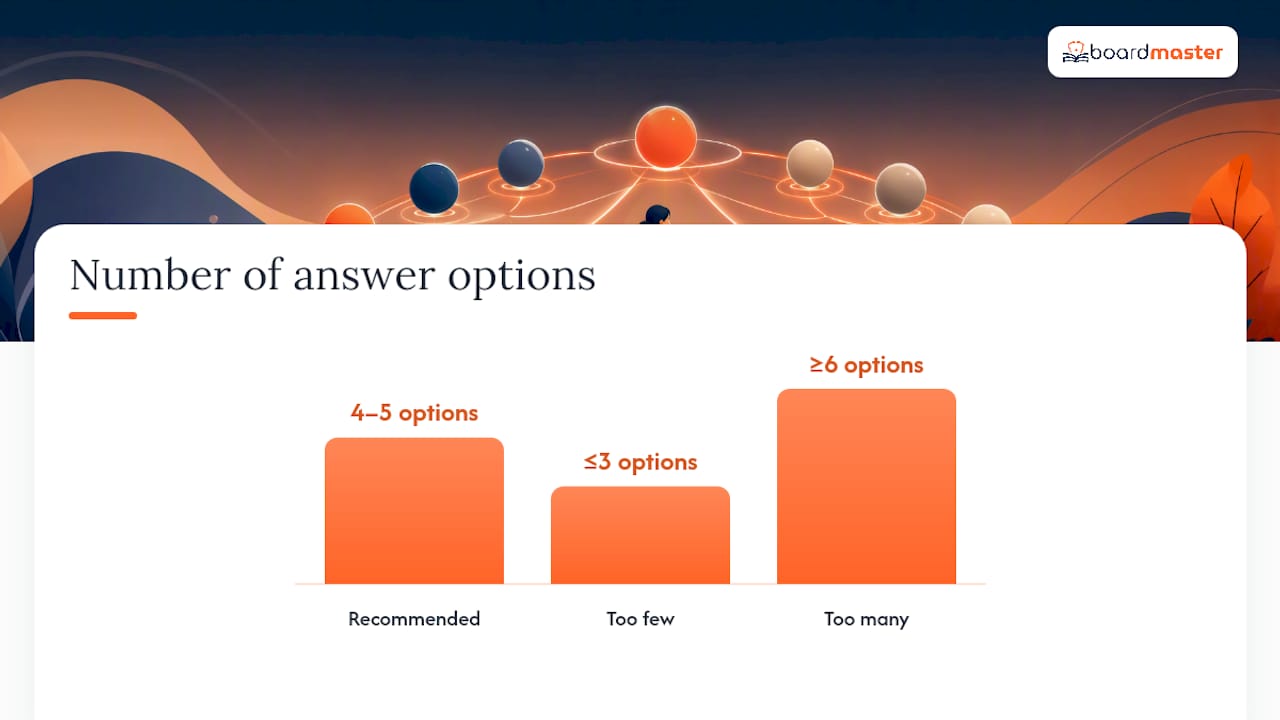
- Draft four to five options for single-best-answer (SBA) items. Three or fewer makes guessing too easy; six or more adds reading time without adding rigor.
- Make every distractor homogeneous with the correct answer. If the answer is a diagnosis, every option should be a diagnosis, not a mix of diagnoses and treatments.
- Match option length and grammatical structure across all choices. A noticeably longer or more specific correct answer is a classic tell.
- For short-answer or very-short-answer formats, keep the question narrow enough that a one-line answer is possible, and avoid compound questions asking for two things at once.
- Reread the finished lead-in for negative phrasing ("Which of the following is NOT...") and cut it unless the clinical context truly demands it.
How Do You Avoid Cueing and Testwise Traps?
Cueing happens when a stem or option set lets a test-taker guess the answer through pattern recognition instead of clinical reasoning, and it's the single most common flaw the NBME identifies in item review. A stem that says "classic presentation" or repeats a buzzword straight from a textbook chapter title is training students to pattern-match rather than think.
Common cueing traps include grammatical mismatches (only one option agrees in tense or number with the lead-in), absolute qualifiers like "always" or "never" that make an option easy to eliminate, and repeating a distinctive word from the stem in only the correct option. Convergence cueing is subtler: when the correct answer is the only option compatible with every clue in the stem, students can eliminate the rest through logic alone rather than diagnosing anything.
Run every finished item through this checklist before it goes anywhere near a student:
- Strip out any phrase that telegraphs the diagnosis instead of describing it.
- Confirm distractors are grammatically and structurally uniform with the answer.
- Check for gender, cultural, or socioeconomic assumptions that aren't clinically necessary.
- Verify pertinent negatives are included when they meaningfully narrow the differential.
- Read the stem cold, without the answer key, and see if you can still solve it in under 90 seconds.
Pro Tip: Hand the finished item to a colleague or study partner who has not seen the answer key. If they solve it in under a minute without reading the options carefully, you have a cueing problem, not a well-calibrated question.
Peer review and small pilot runs with a handful of students catch far more of these issues than solo editing ever will. BoardMaster's breakdown of clinical reasoning in exams covers more of these testwise traps in detail.
How Do You Adapt a Written Case for an OSCE Station?
A summative one-best-answer item and a formative OSCE station serve different purposes, and treating them the same way is a design mistake. The written item resolves to a single correct answer immediately. An OSCE prompt should intentionally withhold information, forcing the learner to ask the right questions, perform the right exam maneuvers, or request the right tests to earn the data. Small-group and OSCE case design research confirms this staged-reveal approach drives more active clinical reasoning than a fully disclosed stem ever could.
Building a station means writing three linked documents, not one:
- A station brief that gives the standardized patient or actor a backstory, affect, and scripted answers to expected questions.
- An examiner checklist listing observable behaviors: did the student wash hands, explain the plan, check orthostatic vitals, ask about red-flag symptoms.
- A staged-reveal sheet specifying what information is available only if the learner asks for it directly, such as a family history or a medication list.
Good station prompts assess more than knowledge of medical forensics. They test whether a student can break bad news calmly, perform a focused neuro exam correctly, or explain a treatment plan in language a patient would actually understand.
What's the Best Way to Build and Maintain a Case Bank?
Start from the curriculum, not the disease. Backward design means writing down the learning objective first ("recognize compensated versus decompensated heart failure on exam") and only then drafting the case that tests it. Cases written without a stated objective tend to drift into testing trivia instead of reasoning, a pattern case-based teaching guidance flags repeatedly among first-time item writers.
Once a case exists, tag it by organ system, cognitive level (recall versus application versus analysis), and known pitfall (a common wrong answer students pick and why). Tagging turns a folder of PDFs into a searchable bank you can pull targeted practice sets from before an exam.
- Write the objective before the stem, not after.
- Tag by topic, cognitive level, and the specific misconception it's designed to expose.
- Pilot every new item with a small group before it counts toward a grade.
- Track percent-correct and discrimination index, and revise items that everyone gets wrong or everyone gets right regardless of preparation.
Validated vignette development research shows that iterative review using expert panels and content validity surveys measurably improves how relevant and well-calibrated items become over time. A case bank isn't a finished product. It's a curriculum component that needs the same revision cycle as a lecture slide deck.
What Types of Clinical Cases Should You Practice by Specialty?
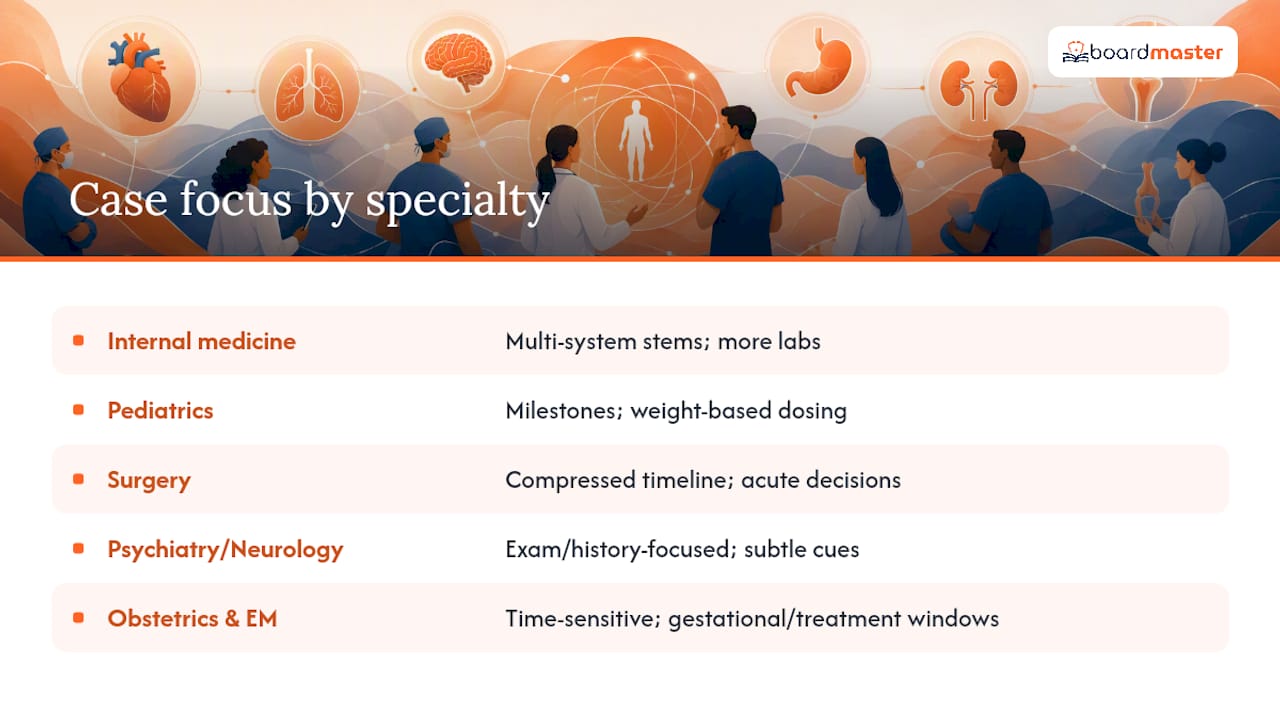
Internal medicine cases tend to reward multi-system reasoning. A single vignette might weave together a medication side effect, a chronic condition, and an acute complaint, because that's how real internal medicine patients present. Expect longer histories and more labs per stem than in other specialties.
Pediatric cases hinge on developmental milestones and weight-based dosing, and the "patient" in the stem often isn't the historian. A well-written pediatric vignette has to account for a parent's description versus the child's own symptoms, plus growth chart or vaccination data that changes the differential.
Surgical cases usually compress the timeline. A surgery stem often needs to test decision-making under acute pressure: when to operate, when to observe, and what a specific exam finding (rebound tenderness, a positive Murphy's sign) rules in or out. Postoperative complication cases are a distinct sub-genre worth practicing separately, since they test a different skill: recognizing a deviation from expected recovery.
Psychiatry and neurology cases lean heavily on history and exam findings rather than labs, which makes distractor design harder. The options often differ by subtle symptom timing or exam localization rather than a clear-cut lab value, so writers need to be especially careful about homogeneity and cueing in these specialties.
Obstetrics and emergency medicine cases share a time-pressure element: gestational age, trimester-specific risk, or door-to-treatment windows change the correct answer depending on when in the stem's timeline the question is asked. Writers building cases across specialties benefit from studying a few worked examples in each area before drafting their own, since the structural conventions shift more than beginners expect.
How Do You Incorporate Evidence-Based Guidelines Into a Case?
A vignette earns its credibility from the guideline behind the correct answer, not from how realistic the prose sounds. If a case tests management of a new atrial fibrillation diagnosis, the correct option should trace directly back to a current, named clinical guideline rather than to what felt right when the case was drafted five years ago.
Practically, this means citing your source when you write the answer key, even if the citation never reaches the student. Keep a running note of which guideline, protocol, or diagnostic criterion each case's correct answer depends on. Guidelines change. A case built on outdated thresholds (an old blood pressure cutoff, a retired staging system) will keep circulating unless someone tracks the source and flags it for revision.
This also protects against a subtler problem: writing an answer that's defensible in theory but contradicts current first-line recommendations. A distractor that used to be correct under an older guideline is a dangerous trap, since a sharp student who studied current material might pick it and get penalized for being right about outdated data written into the item by accident.
When a case tests a screening interval, a diagnostic cutoff, or a first-line drug choice, name the specific criterion or guideline in your internal notes, even in one line. It makes the eventual revision cycle far faster when that guideline updates, and it gives peer reviewers something concrete to check against instead of relying on their memory of what the guideline used to say.
What Ethical Considerations Apply to Clinical Case Writing?
Patient privacy comes first. Cases inspired by a real encounter need enough alteration to make the patient unidentifiable: change the age, setting, and identifying combination of demographic and clinical details rather than just the name. A composite case built from patterns you've seen across multiple patients is safer and usually just as instructive as one lifted from a single chart.
Representation matters too. A case bank that defaults every psychiatric presentation to one gender or every substance-use case to one socioeconomic group teaches a biased pattern-matching heuristic instead of clinical reasoning. Vary demographics deliberately across a case set, and make sure the demographic detail is only present in the stem when it's clinically relevant to the diagnosis, not there by lazy default.
Sensitive topics deserve careful framing rather than avoidance. Cases involving suicide risk, intimate partner violence, or substance use are essential to a well-rounded case bank, but they should be written with clinical precision and without gratuitous detail that serves no diagnostic or educational purpose.
Finally, be transparent about limitations when a case is used for grading. If an item is still being piloted, mark it internally as such and weight it lightly or exclude it from the final score until performance data confirms it behaves the way you intended.
What Makes a Patient Scenario Feel Realistic Instead of Textbook?
Textbook cases fail because they present a disease, not a person. A stem that includes a name, an occupation, or a small non-clinical detail (a truck driver worried about losing his license, a new mother anxious about breastfeeding) does more than add flavor. Research on vignette engagement finds that humanizing details of this kind improve learner engagement precisely because they force students to weigh clinical facts against a real person's context, which is closer to what actually happens in practice.
The trick is restraint. One or two humanizing details are enough. Overloading a stem with backstory buries the clinical signal a test-taker needs to isolate, and it works against the concision goals covered in the template section above.
Realistic scenarios also include noise, not just signal. Real patients mention irrelevant symptoms, downplay important ones, and sometimes contradict themselves. A case that includes one deliberately irrelevant detail (a stable, longstanding symptom unrelated to the current complaint) trains students to filter noise from signal, a skill flat, symptom-only stems never test. BoardMaster's guide to personalizing clinical skills practice with AI covers this balance between realism and clarity in more depth.
What Are the Most Common Mistakes in Clinical Case Writing?
The most frequent mistake is writing the options before the lead-in is finished, which almost guarantees a cueing problem, since the writer starts shaping the stem around answers they already have in mind rather than around genuine clinical logic.
A second common error is stem bloat: cramming in every interesting detail from a real case instead of the details that actually matter to the diagnosis. Students learn to skim long stems for keywords instead of reading closely, which defeats the purpose of the exercise.
Grammatical or length mismatches between the correct option and the distractors are a persistent problem even among experienced writers, since the correct answer is often written first and with more care. Reading finished items aloud, out of order, catches this more reliably than reading them silently in sequence.
Finally, skipping the pilot step is the mistake with the highest cost. An item that seems clear to the person who wrote it can be genuinely ambiguous to a student encountering it cold. Small-group piloting before an item counts toward a grade catches problems no amount of solo editing will find.
How Does Multimedia Strengthen a Clinical Case?
A well-placed image, ECG strip, or short audio clip of a heart murmur does something text alone can't: it tests pattern recognition on real clinical data instead of a described version of it. Radiology, dermatology, and cardiology cases benefit especially from this, since the diagnostic skill being tested is visual or auditory interpretation, not just fact recall.
Supplementary materials work best when they're necessary, not decorative. An image included purely to make the item look more polished, without the correct answer actually depending on reading it, adds test-taking time without adding rigor. If a student could answer correctly with the image removed, the image doesn't belong in that item.
For OSCE stations specifically, supplementary materials extend into props: a mock lab report handed to the student mid-station, a simulated vital signs monitor, or a recorded voicemail from a "family member" the student has to react to. These additions test how a learner integrates new information in real time, which is a different skill from interpreting a static image on a written exam.
An Educator's Take on Writing Cases That Actually Work
My workflow rarely changes: define the objective first, draft against the template, pilot with a small group, then revise using whatever the performance data actually shows rather than my own hunch about what felt hard. Writers who skip the pilot step are the ones whose items get the reputation for being "unfair," when the real problem is usually a cueing flaw nobody caught.
Cases built to mirror the actual emphasis of a course, rather than a generic question bank's idea of what's testable, cut study time dramatically because students stop re-learning material their professor never tested. That's the gap BoardMaster's approach to why clinical vignettes dominate board exams is built to close, and it's the difference between a case bank that feels comprehensive and one that's actually efficient.
— Dr. Ahmed Abuzoor
Practice Cases Built From Your Own Lecture Material
Writing a strong case from scratch takes real time, and most students don't have hours to spare drafting practice vignettes on top of studying for the exam those vignettes are supposed to prepare them for. This gap can be closed by generating USMLE-style questions directly from uploaded lecture notes, so the practice questions match what the professor actually emphasized, not a generic question bank's guess at what's testable.

Beyond notes-based questions, BoardMaster gives you AI-driven OSCE practice sessions to rehearse the staged-reveal, communication-heavy scenarios covered above, plus a library of over 5,000 physician-written board-style questions for broader board review. Everything stays aligned to your actual course content instead of forcing you to guess which generic bank question matches your syllabus. If you want to see how the OSCE simulations work before committing to anything, try an OSCE practice session and run through a station yourself.
Sources
- NBME item-writing guide (NBME)
- PMC article on PBL and case design
- Developing Clinical Case Studies: A Guide for Teaching
- Vignette development and validation study (SAGE journals)
FAQ
What's the difference between a clinical case vignette and a case report?
A clinical case vignette is a short exam-style scenario built to test reasoning through a specific lead-in and answer options. In contrast, a case report is a detailed published account of one patient's full diagnostic and treatment course. This guide focuses on vignette writing for exams and OSCEs.
How long should an NBME-style stem be?
Most well-constructed stems run 6 to 10 sentences, just enough to convey age, setting, complaint, duration, focused history, exam findings, and diagnostics without extra detail that doesn't affect the diagnosis.
How many answer options should a single-best-answer item have?
A moderate number of answer options is standard; too few makes guessing easier, and too many adds reading time without improving the item's ability to test reasoning.
What is the cover-the-options rule?
It's a check where a knowledgeable student should be able to answer the lead-in correctly without seeing the answer choices, confirming the stem itself carries the clinical reasoning rather than the options.
How can I get personalized practice cases instead of generic question banks?
BoardMaster generates USMLE-style practice questions and OSCE simulations directly from your own uploaded lecture notes, so practice stays aligned with what your specific course actually tests.