
TL;DR:
- Exam blueprints specify content, skills, and question formats for medical exams, guiding focused study efforts. Using these blueprints helps students allocate study time effectively, align practice with exam demands, and improve test performance. Regularly updating and following blueprints prevents wasted effort and ensures preparation matches current exam standards.
An exam blueprint is an official document that defines exactly what content, cognitive skills, and question formats appear on a medical exam. Knowing how exam blueprints guide preparation is the difference between studying everything and studying the right things. Exams like the USMLE, ABIM boards, and the CPA Exam each publish blueprints that specify topic weighting, skill levels, and item types. Students who ignore these documents waste hours on low-yield material. Students who use them study with a clear target.
How exam blueprints guide preparation: what they actually contain

Blueprints are not vague syllabi. Each section of a blueprint specifies content areas, skill levels, and item types including multiple-choice questions and simulations, along with score weighting and sample task statements. That structure tells you three things at once: what to study, how deeply to study it, and how you will be tested on it.
The content is organized by subject area, topic group, and subtopic. Each layer carries a percentage weight. A topic worth 20% of the exam deserves roughly 20% of your study time. A topic worth 3% does not deserve three weeks of flashcards.
Blueprints also classify cognitive demand. They use verbs like "recall," "apply," and "analyze" to signal what the exam actually expects. A task statement that says "apply knowledge of cardiac physiology to a clinical scenario" is telling you that memorizing definitions is not enough. You need to practice working through cases.
Pro Tip: Print the blueprint for your next exam and highlight every topic with its percentage weight before you open a single textbook. This one step prevents the most common study mistake: spending equal time on unequal topics.
Blueprint categories in medical education
Medical education blueprints fall into three main structures. Blueprint categories include program-level matrices, process-oriented skills frameworks using Bloom's taxonomy, and content-oriented structures with weighted must-know versus nice-to-know classifications. The must-know category maps directly to board exam questions. The nice-to-know category is context, not core.
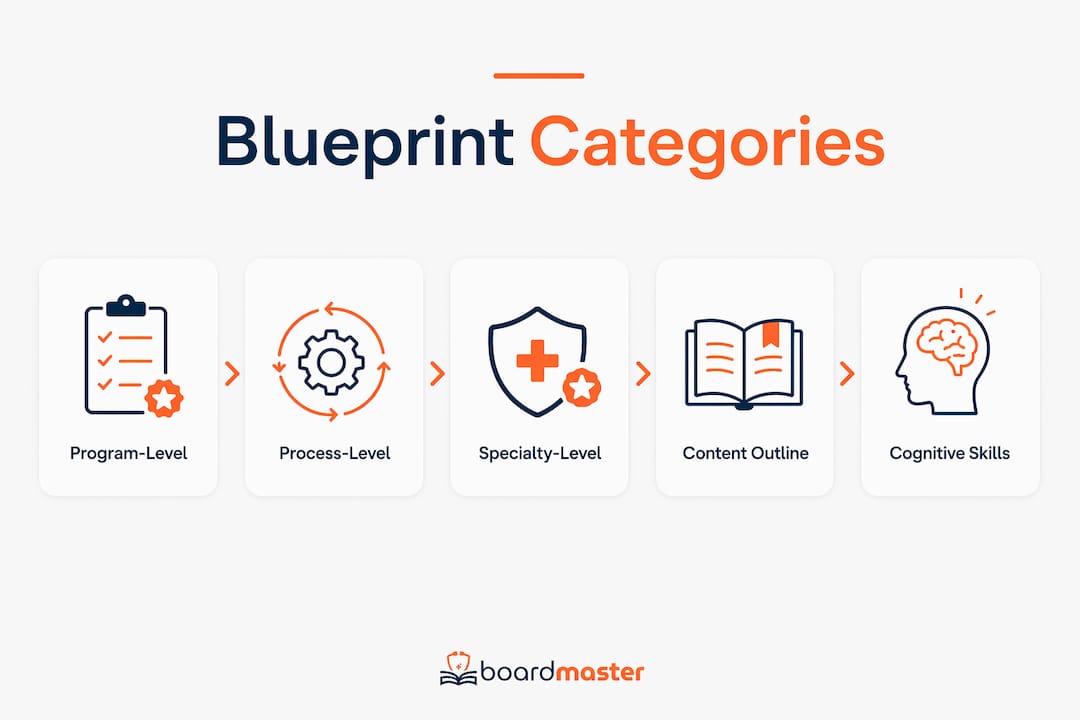
The ABIM blueprint, for example, lists content outlines with approximate percentages for each specialty area. Internal medicine students can see at a glance that cardiovascular disease carries more weight than dermatology. That single data point reshapes a study schedule.
Why does blueprint alignment matter for exam performance?
Studying without a blueprint creates a predictable problem: you cover material that will not appear on the exam while missing material that will. A BMC Medical Education study found 561 flaws in 2,400 MCQs over five years linked to alignment issues between assessments and curriculum goals. That finding shows how misalignment harms both test quality and student preparation.
Assessment alignment protects validity and guides students toward learning outcomes rather than rote memorization. When your study plan matches the blueprint, every hour you spend builds toward a skill the exam will actually test.
The table below shows the difference between blueprint-driven and non-blueprint-driven study approaches.
| Study approach | Outcome |
|---|---|
| Blueprint-driven | Topics studied match exam weighting; cognitive depth matches task demands |
| Non-blueprint-driven | Over-study of low-yield topics; under-study of high-weight areas |
| Rote memorization only | Surface coverage without application skills; fails clinical vignette questions |
| Blueprint plus practice questions | Mastery of both content and cognitive demand; highest exam readiness |
Blueprinting guards against content under-representation and provides standardized competency guidelines. This is why USMLE Step 1 and Step 2 CK both publish detailed content outlines. The exam writers use blueprints to build the test. You should use the same document to prepare for it.
What practical strategies convert blueprints into study plans?
The gap between reading a blueprint and using it effectively is where most students lose ground. The following steps close that gap.
Build a coverage map. Convert blueprint objectives into a tracking grid that links each topic to your study resources and current mastery status. A simple spreadsheet works. Columns might include topic name, blueprint weight, resource used, practice questions completed, and confidence level.
Decode the verbs. Blueprint task statements use specific action words. "Identify" means recall. "Interpret" means analysis. "Manage" means clinical decision-making. Match your practice method to the verb. If the blueprint says "interpret," do not just read about the topic. Work through questions that require interpretation.
Allocate time by weight. Divide your total study hours proportionally across blueprint topics. If cardiology carries 18% of the exam and you have 100 study hours, cardiology gets roughly 18 hours. This feels mechanical at first. It works.
Run study loops. Study a topic, practice questions on that topic, identify weak spots, and return to those weak spots before moving on. Iterative study loops aligned to blueprint objectives prevent the common trap of "I covered it" without actually mastering it.
Track mastery, not coverage. Coverage means you read the chapter. Mastery means you can answer timed questions correctly. Tracking mastery evidence for each blueprint topic links your study activity to actual competency. Use timed question sets and checklists as your evidence.
Pro Tip: When you finish a study loop on a high-weight topic, test yourself with a customized USMLE study plan that mirrors the blueprint's cognitive demands. Confidence from re-reading is not the same as confidence from correct answers under pressure.
Tools like BoardMaster's AI question generator let you upload lecture notes and generate practice questions mapped directly to the concepts your professor emphasizes. That approach connects your course blueprint to your board exam blueprint in one step.
How do blueprint updates change your study plan?
Blueprints are living documents. The CPA Exam Blueprints, for example, are updated 1–2 times annually and serve as the primary scope reference for study. Medical boards follow similar cycles. Using an outdated blueprint means studying for an exam that no longer exists.
Key habits for staying current with blueprint changes:
- Check the source directly. Download blueprints from the official exam body, whether that is the NBME for USMLE, ABIM for internal medicine boards, or your medical school's course office for block exams.
- Review expanded outlines. Some specialty boards publish expanded blueprints with more detailed content breakdowns. ABIM offers these for several subspecialties. They are worth the extra reading time.
- Update your coverage map when blueprints change. If a topic gains weight in a new version, it gets more of your study hours. If a topic drops, reallocate that time.
- Integrate blueprint awareness into clinical training. Third and fourth year students should map clinical rotations to board blueprint topics. Seeing a patient with heart failure is a live study session for a high-weight cardiology topic.
- Avoid burnout by cutting non-blueprint material. The reality of medical exam prep is that studying everything is not possible. Blueprints give you permission to stop studying what does not matter.
Blueprinting serves as a roadmap across time and supports competency guidelines through cyclical review. The students who perform best on boards are not the ones who studied the most hours. They are the ones who studied the most relevant hours.
Key Takeaways
Exam blueprints are the single most reliable tool for aligning study effort with exam requirements, and students who use them consistently outperform those who rely on generic study plans.
| Point | Details |
|---|---|
| Blueprints define exam scope | Official documents specify content areas, skill levels, weighting, and question formats. |
| Weight drives time allocation | Assign study hours proportionally to each topic's blueprint percentage. |
| Cognitive verbs signal depth | Match your practice method to blueprint task verbs like "apply" or "analyze." |
| Coverage maps track mastery | Use timed questions and checklists as evidence of mastery, not just completion. |
| Blueprint updates require action | Check for new versions 1–2 times per year and revise your study plan accordingly. |
Why most students use blueprints wrong
I have worked with medical students at every stage of training, and the pattern is consistent. Students download the blueprint, skim it once, and then return to their usual study habits. They treat the blueprint as a checklist of topics rather than a framework for how to think.
The real value of a blueprint is not the topic list. It is the cognitive map. When the USMLE Step 1 blueprint says a student should "apply basic science principles to clinical scenarios," that verb is the instruction. Students who read that and then spend six hours re-reading First Aid are preparing for the wrong exam. Students who read that and then work through 40 clinical vignettes are preparing for the right one.
The second mistake I see is treating all blueprint topics as equal. They are not. A topic with 15% weighting and a topic with 2% weighting are not the same study commitment. Spending equal time on both is a form of common exam prep misconception that costs students percentile points they cannot afford to lose.
My honest recommendation is to build your coverage map before you buy a single question bank. Know what the exam tests. Then find resources that match. The blueprint is free. The clarity it provides is worth more than any paid resource you will ever use.
— Dr. Ahmed Abuzoor
BoardMaster turns your blueprint into a personalized question bank
Medical students who understand blueprint-based preparation still face one practical problem: finding practice questions that match both their course content and their board exam blueprint at the same time.

BoardMaster solves this directly. You upload your lecture notes, and the platform generates USMLE-style questions focused on the concepts your professor emphasizes, mapped to the same competencies your board exam tests. One student, Sarah, moved from the 73rd to the 92nd percentile while cutting her study hours in half using this approach. BoardMaster's USMLE prep tools and block exam prep platform are built for students who want blueprint-aligned practice without the guesswork of generic question banks.
FAQ
What is an exam blueprint?
An exam blueprint is an official document published by an exam body that specifies content areas, topic weighting, cognitive skill levels, and question formats. It defines the minimum knowledge and skills required for licensure or certification.
How do I use a blueprint to build a study schedule?
Assign study hours proportionally to each topic's percentage weight in the blueprint. A topic worth 20% of the exam should receive roughly 20% of your total study time.
What do blueprint verbs like "apply" or "analyze" mean for my prep?
Blueprint verbs indicate the cognitive depth the exam requires. "Apply" means you need to use knowledge in a new context, not just recall it. Practice with clinical vignettes and case-based questions to match that demand.
How often are medical exam blueprints updated?
Most exam bodies update blueprints one to two times per year. Always download the current version directly from the official exam organization before starting a new study cycle.
Why does blueprint alignment improve exam scores?
Blueprint alignment prevents over-studying low-yield topics and under-studying high-weight areas. Research in medical education shows that misalignment between assessments and curriculum produces measurable flaws in both test quality and student readiness.