
An honors threshold in medicine is the explicit, school-declared criterion — a percentile cutoff, GPA minimum, rubric score, or thesis requirement — that determines whether a student receives an honors-level grade or distinction. The core takeaway: no single standard exists across the U.S.
Common threshold types you'll encounter:
- Percentile-based: honors awarded to students scoring above a fixed percentile (e.g., top 10–25%) on shelf exams or composite clerkship scores
- GPA/score cutoff: a fixed numeric minimum (e.g., 3.70+ GPA or a specific NBME shelf score) that any student can hit
- Rubric/competency grid: faculty rate students on defined behavioral anchors; honors requires meeting a threshold on multiple domains simultaneously
- Thesis or capstone: a completed research project, faculty approval, and sometimes a formal defense, used for degree-level distinctions like "Honors in a Special Field"
Pro Tip: Save the exact wording of your school's honors criteria the moment you find it. Policy language changes between catalog years, and the version in effect when you rotated is the one that governs your grade.
Key Takeaways
An honors threshold is the school-declared criterion that separates honors from high pass, and it varies so widely across U.S.
| Point | Details |
|---|---|
| Definition | An honors threshold is a school-declared cutoff (percentile, GPA, rubric, or thesis) that determines who receives an honors grade. |
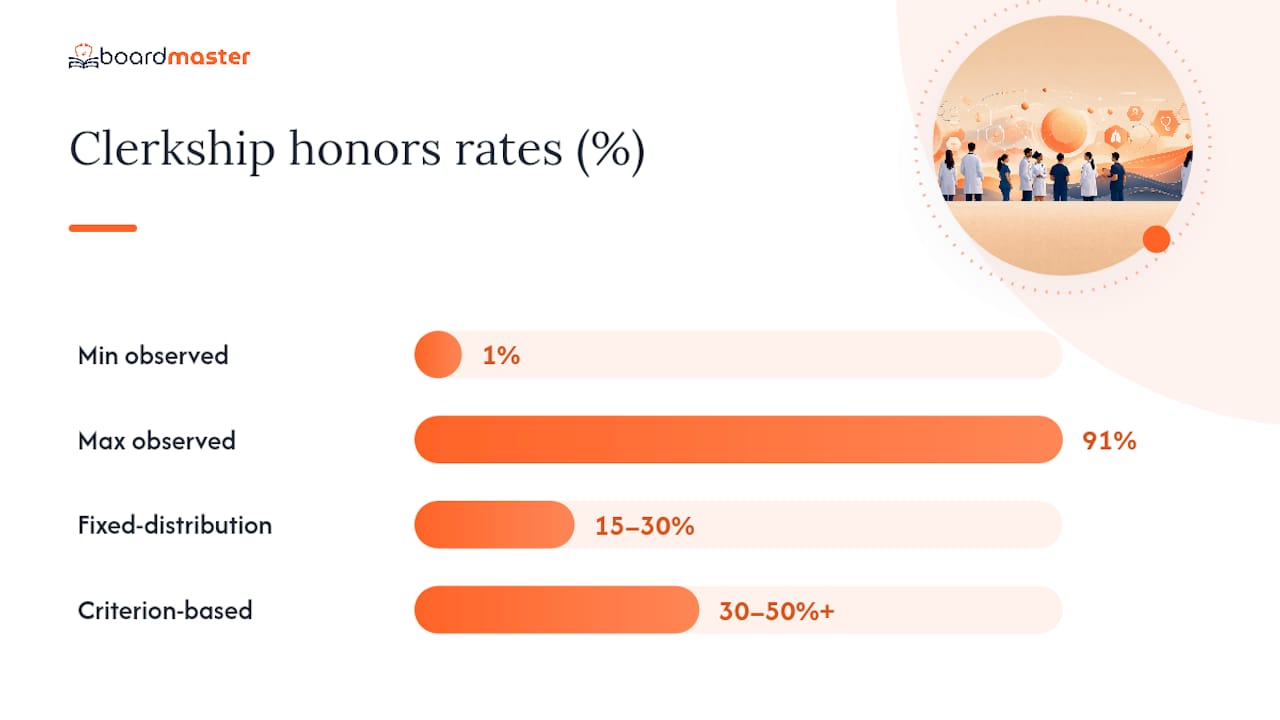
| Massive variability | National data shows honors rates across 122 schools ranged from 1% to 91% in clinical clerkships. |
| Two main systems | Fixed-distribution systems cap honors at a set percentage; criterion-based systems award honors to anyone clearing the bar. |
| Where to find it | Check the academic catalog, clerkship syllabus, and Office of Academic Affairs — in that order. |
| Residency context | Annotate unusual grading schemes in ERAS; honors amplifies strong board scores but does not replace them. |
Table of Contents
- What does the honors threshold mean in medicine, and how do schools set it?
- What real U.S. medical school catalogs say about honors
- How clerkship honors variability affects your MSPE
- How to find your school's exact honors threshold
- Why honors thresholds matter for residency applications
- A note on reading honors thresholds strategically
- Prepare smarter for clerkship thresholds with BoardMaster
- Sources
- FAQ
What does the honors threshold mean in medicine, and how do schools set it?
Schools operationalize honors thresholds through two broad philosophies: fixed-distribution systems and criterion-based systems. Understanding which one your school uses changes how you should study.
Fixed-distribution (norm-referenced): A department decides in advance that only the top X% of students in a cohort will receive honors, regardless of absolute scores. The threshold floats with cohort performance. This approach, common in competitive clerkships, tends to produce honors rates around 15–30% in shelf-heavy rotations.
Criterion-based (threshold): Any student who clears a defined bar earns honors. If everyone scores above the cutoff, everyone gets it. This mirrors the logic behind decision thresholds in clinical medicine, where a probability or criterion triggers an action regardless of how other patients perform.
Here's how the process typically unfolds at a school using a hybrid model:
- Shelf exam score is calculated by the NBME and returned to the clerkship coordinator, usually within two to three weeks of the exam date.
- Clinical evaluation scores are compiled by the clerkship director from attending and resident ratings using a standardized rubric.
- A composite score is generated by weighting shelf and evaluation components (weights vary widely, often 30–50% shelf).
- The honors threshold is applied — either the fixed percentile rank or the criterion cutoff — and a grade is assigned.
- The grade is submitted to the registrar, who records it on the transcript; the MSPE writer then uses the grade distribution to contextualize your performance for residency programs.
Pro Tip: *Ask your clerkship coordinator for the exact shelf weight before the rotation starts.
What real U.S. medical school catalogs say about honors
Two well-documented examples show how different the language can look in practice.
UNMC College of Medicine uses degree-level distinction language in its formal catalog, awarding designations such as "Doctor of Medicine with High Distinction" based on ranking criteria. The catalog specifies the conditions under which each distinction is recorded on the diploma and transcript, giving students a clear, auditable policy to reference.
Harvard Medical School takes a program-pathway approach. Its Honors in a Special Field program awards cum laude, magna cum laude, and summa cum laude distinctions tied to faculty-supervised research, a written thesis, and program-level approval. The threshold here is not a single exam score; it's a portfolio of requirements that a faculty committee evaluates.
For GPA-based degree honors, programs outside medicine often cluster around these cutoffs, which some medical schools adopt when awarding Latin honors:
Clerkship-specific rules add another layer. A shelf-heavy surgery rotation might require a score at or above the 70th national percentile and a clinical evaluation average of 3.5/4.0 to qualify for honors. A conjunctive model — where missing the shelf cutoff disqualifies a student from honors regardless of evaluation scores — is controversial in academic medicine because it can override strong overall performance.

How clerkship honors variability affects your MSPE
The variability in honors rates across U.S. medical schools is not a minor wrinkle. It's a structural feature of the system, and residency programs know it.
A national analysis of 122 medical schools found that the percentage of students awarded honors in clinical clerkships ranged from roughly 1% to 91% across institutions. Top-20 research institutions were less likely to report comparative grade data in the MSPE and more likely to award higher honors rates in several clerkships.
Key figure: In a national study of clerkship grading, honors rates across 122 U.S. medical schools spanned from 1% to 91% — a 90-percentage-point spread for the same word on a transcript.
| Grading system type | Typical honors rate | Shelf weight influence |
|---|---|---|
| Fixed-distribution (norm-referenced) | 15–30% | High shelf weight compresses rates |
| Criterion-based (threshold) | 30–50%+ | Threshold level determines rate |
| Evaluation-heavy rotations | Higher, more variable | Grade inflation risk increases |
Shelf-heavy rotations naturally compress honors rates because NBME scores follow a tighter distribution. Evaluation-heavy rotations are more susceptible to inflation, which is why two students with identical shelf scores can receive different grades depending on which attendings they worked with. The aNGT method for estimating action thresholds illustrates how even formal threshold-setting processes produce different results depending on who sets the weights — a dynamic that plays out in clerkship grading committees too.
How to find your school's exact honors threshold
Don't guess. The policy exists in writing somewhere at your institution. Here's where to look, in order of reliability:
- Academic catalog / registrar website: Search "[your school] MD program grading policy" or navigate to the registrar's academic policies page. The catalog is the binding document.
- Clerkship syllabus or orientation packet: Most clerkship directors distribute a syllabus on day one that states the grading formula, shelf weight, and honors cutoff explicitly.
- Student handbook: Some schools consolidate all grading policies here, including how honors appears on the transcript and MSPE.
- Clerkship coordinator email: If the syllabus is vague, email the coordinator directly. Ask for the shelf weight, the honors cutoff (percentile or score), and whether a conjunctive rule applies.
- Office of Academic Affairs: For degree-level honors (Latin honors, distinction), this office holds the authoritative criteria and can confirm the GPA or ranking threshold.
Pro Tip: When emailing an academic affairs office, be specific: "Could you confirm the honors threshold for the internal medicine clerkship — specifically the shelf weight, the cutoff type (percentile or score), and whether clinical evaluations can override a missed shelf threshold?" A vague question gets a vague answer.
Understanding how grading curves work in medical school helps you interpret the answer you get, especially when a coordinator describes a norm-referenced system.
Why honors thresholds matter for residency applications
Honors on a transcript is a signal, not a substitute for exam scores or strong letters of recommendation. Residency program directors read it in context, and that context is your MSPE.
- Honors amplifies, it doesn't replace: A student with Step 1 in the 90th percentile and multiple clerkship honors reads very differently from one with honors alone. USMLE percentile scores and honors together tell a coherent story; honors without strong board scores raises questions.
- Annotate unusual grading schemes: If your school uses a criterion-based system where 45% of students receive honors, say so briefly in your personal statement or ERAS application. Don't assume program directors know your school's policy.
- CV wording: List clerkship honors as "Honors — [Rotation Name], [School]" rather than a generic "Clinical Honors." Specificity signals you know what you earned.
- Don't overstate degree-level honors: "Doctor of Medicine with High Distinction" belongs on your CV exactly as your diploma states it. Paraphrasing it as "graduated with honors" loses the precision that makes it meaningful.
Pro Tip: If your MSPE includes a comparative data section showing what percentage of students received honors in each clerkship, that number contextualizes your grade for every program director who reads it. Know that number before your interviews.
A note on reading honors thresholds strategically
The conversation about honors thresholds tends to focus on what the cutoff is. The more useful question is what the cutoff measures, and whether that measurement aligns with what residency programs actually value.
A shelf-heavy threshold rewards standardized knowledge recall under time pressure — a skill that correlates with three-digit board scores and predicts performance on licensing exams. An evaluation-heavy threshold rewards clinical presence, communication, and adaptability — skills that letters of recommendation also try to capture, often redundantly. Neither system is wrong, but they measure different things, and a student who earns honors in one system might not in the other.
The practical implication: understand your school's weighting before you rotate, not after. If evaluations dominate, your energy goes toward clinical skills and attending relationships. The clinical reasoning skills that impress attendings and the knowledge base that moves shelf scores are not the same thing, and splitting your preparation without a clear priority is how students miss both thresholds.
Honors thresholds, like clinical decision thresholds, are only useful when you know where they sit and what evidence they respond to. The classic threshold framework from Pauker and Kassirer makes this point for clinical decisions: a threshold is only actionable when you understand the harms and benefits on either side. The same logic applies here. Know your cutoff, know what drives it, and prepare accordingly.
Prepare smarter for clerkship thresholds with BoardMaster

Knowing your honors threshold is step one. Hitting it is where most students struggle, because generic question banks don't align with what your clerkship actually emphasizes. BoardMaster generates USMLE-style and shelf-style practice questions directly from your uploaded lecture notes and clerkship materials, so your preparation targets the concepts your faculty actually test.
BoardMaster also offers AI-generated study podcasts that convert dense lecture content into focused audio episodes — useful for high-volume rotations where reading time is limited. Whether your threshold is shelf-driven or evaluation-driven, BoardMaster helps you build the knowledge base that moves both.
Sources
- What Does Honors Mean? National Analysis of Medical School Clinical Clerkship Grading
- Decision threshold models in medical decision making: a scoping literature review
- Threshold probabilities involved in clinical decision making (Pauker & Kassirer)
- Degrees and Honors - College of Medicine
- Honors in a Special Field
FAQ
What does "honors threshold" mean in a medical clerkship?
It's the minimum score or rating a student must reach to earn an honors grade in a clinical rotation. The threshold can be a percentile rank, a composite score cutoff, a rubric rating, or a combination of all three, depending on the school.
What are the three levels of honors for a medical degree?
The most common degree-level distinctions are cum laude, magna cum laude, and summa cum laude, typically tied to GPA ranges or class rank. Some schools use descriptive language instead, such as "with Distinction" or "with High Distinction," as UNMC does in its formal catalog.
How much do honors rates vary across medical schools?
Significantly. A national analysis of 122 medical schools found that the percentage of students receiving clerkship honors ranged from roughly 1% to 91%, meaning the same word on two transcripts can represent very different levels of achievement.
What percentage of MD programs use pass/fail grading?
Pass/fail adoption has grown, particularly in the preclinical years following the USMLE Step 1 shift to pass/fail scoring, but exact current percentages vary by survey and year. Many schools retain tiered grading (honors, high pass, pass, fail) for clinical clerkships even when preclinical years are pass/fail.
Where should you look to find your school's exact honors criteria?
Start with the academic catalog on your registrar's website, then check the clerkship syllabus distributed at orientation. If neither source gives a clear numeric cutoff, contact the clerkship coordinator or Office of Academic Affairs directly and ask for the shelf weight, cutoff type, and whether a conjunctive rule applies.