
TL;DR:
- Practice test analysis turns exam questions into targeted learning tools that improve long-term retention.
- Spending 6 to 8 hours reviewing each full-length practice test is essential for meaningful score gains.
Practice test analysis is defined as the systematic review of every question on a practice exam to convert raw performance data into a targeted study plan. The role of practice test analysis in prep goes far beyond checking your score. Research shows students who use retrieval practice retain 87% more information after one week compared to those who only re-study. Industry standards recommend spending 6–8 hours analyzing a single full-length practice exam. That time investment is not optional. It is where real score gains happen.
What is the role of practice test analysis in prep?
Analysis transforms a practice test from a performance event into a diagnostic tool. Without it, you repeat the same errors on every test and mistake familiarity for knowledge. The importance of test analysis lies in its ability to separate what you actually know from what you only think you know.
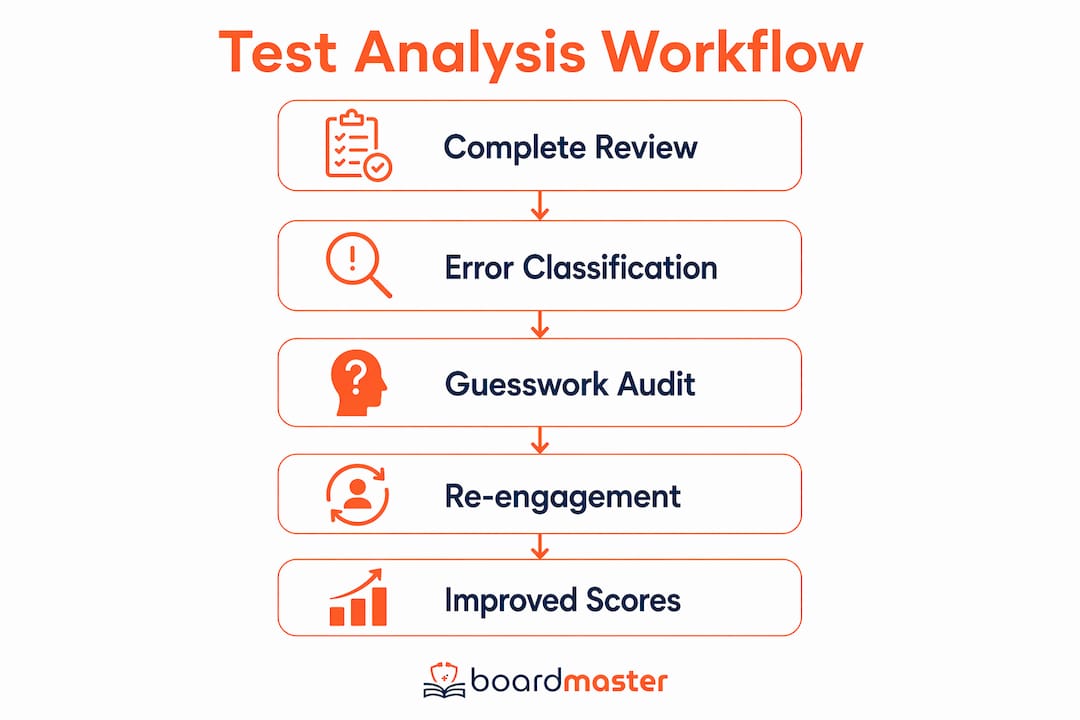
The multi-pass review process is the most reliable framework for thorough analysis. Each pass targets a different layer of your performance.
- Wrong answers. Start here. Every incorrect answer points to a specific gap, whether conceptual, factual, or procedural.
- Shaky correct answers. These are questions you got right but could not fully explain. Reviewing correct answers for fragile knowledge prevents future misses on similar questions.
- Unattempted questions. These reveal avoidance patterns, not just knowledge gaps.
- All answer choices. Read every option, not just the correct one. Understanding why wrong answers are wrong deepens your grasp of the concept.
Error classification: the core of effective review
Classifying errors into conceptual, factual, and careless categories is the single most important step in the review process. Each type demands a different fix.
- Conceptual errors mean you misunderstood a mechanism or relationship. Fix: return to the source material and rebuild the concept from scratch.
- Factual errors mean you lacked a specific piece of information. Fix: add it to a flashcard or spaced repetition deck immediately.
- Careless errors mean you knew the answer but misread the question or rushed. Fix: adjust your test-taking strategy, not your content review.
Labeling every mistake as "careless" is one of the most common traps in test prep. It feels honest but blocks any real fix.
Guesswork audit and error logs

Every question you guessed on deserves a flag. Guesses that land correctly mask real gaps. Track them separately in an error log alongside your wrong answers. Over time, your error log becomes the most accurate map of your weak areas. Tracking patterns across at least five tests separates genuine weak subjects from one-off poor performances.
Pro Tip: Complete your review within 24 hours of finishing the test. Your reasoning in the moment is still accessible, and you can reconstruct exactly why you chose each answer.
Why does detailed post-test analysis outperform taking more tests?
Volume is not the answer. Taking ten practice tests without reviewing them produces far smaller gains than taking five tests with thorough analysis after each one.
The testing effect research by Roediger and Karpicke demonstrates this clearly. Students who only re-read material recalled 81% after five minutes but dropped to 54% after two days. Students who used retrieval practice recalled 68% after two days. The gap widens further over weeks. Re-reading builds short-term confidence. Testing builds durable memory.
Test scores are diagnostic data, not judgments. A score drop signals new content gaps or fatigue. A plateau signals that you are restudying material you already know. Neither outcome is failure. Both are instructions. The student who reads their score as information acts on it. The student who reads it as a grade gets stuck.
The risk of skipping analysis is compounding. Each unreviewed test locks in the same error patterns. You practice the wrong answer until it feels right. Targeted drilling on identified weaknesses, by contrast, accelerates learning because you are spending time exactly where your brain needs it most.
Re-engagement loops with missed questions at 48 hours and two weeks are among the highest-leverage activities in any study plan. Spaced re-engagement forces active recall at the moment forgetting begins, which is precisely when memory consolidation is strongest.
How can medical students integrate test analysis into their study routines?
Effective integration requires treating analysis as a scheduled study block, not an afterthought. Budget more time for review than for the test itself. A 4-hour practice exam warrants at least 6 hours of structured review.
- Schedule analysis blocks immediately. Block the review session before you take the test. If it is not on your calendar, it will not happen.
- Translate every error into a task. "Review renal physiology" is not a task. "Redo the mechanism of loop diuretics using a diagram" is a task.
- Use low-stakes frequent testing. Dr. Nikolai Lee advocates keeping tests low-stakes and frequent to make retrieval a feature of memory, not a high-pressure event.
- Retest after drilling. After targeted review of a weak area, attempt similar questions within 48 hours to confirm the gap is closed.
- Maintain consistent testing conditions. Same time of day, same environment, same time limits. Inconsistent conditions produce unreliable data.
Pro Tip: Keep a single running error log document. After each test, add new entries with the date, question topic, error type, and your fix. Review the full log before every new test block.
The table below shows a practical weekly structure for a student taking one full-length practice test per week.
| Day | Activity | Time |
|---|---|---|
| Saturday | Full-length practice test | 4 hours |
| Sunday | Multi-pass review, error classification | 6–8 hours |
| Monday | Targeted drilling on identified gaps | 2–3 hours |
| Wednesday | Spaced re-engagement with flagged questions | 1–2 hours |
| Friday | Low-stakes topic quiz, update error log | 1 hour |
This structure builds a feedback loop. Each test informs the next week's study focus. Over a month, your error log shows you exactly which subjects keep appearing, and those are the ones worth the most of your time.
What common mistakes do students make in practice test analysis?
Most medical students know they should review their tests. Few do it well. These are the patterns that consistently undermine progress.
- Score obsession. Fixating on the number prevents you from reading the data underneath it. A 62% on a cardiology-heavy test tells you something specific. A 62% with no breakdown tells you nothing.
- Skipping correct answers. Not all right answers reflect secure knowledge. Guesses that land correctly hide fragile understanding. Skipping them leaves those gaps open.
- Vague error labels. Writing "didn't know this" or "careless" in your error log is not analysis. It is avoidance. Every entry needs a specific error type and a specific fix.
- Reviewing for explanation, not change. Reading the explanation and moving on feels productive. It is not. The goal is to change what you do next, not to understand the answer in the moment.
- Ignoring patterns across tests. One bad score on pulmonology could be a fluke. Three weak scores across five tests is a real gap. Students who do not track across tests chase noise instead of signal.
- Retaking the same test too soon. Retaking a test within four to six weeks inflates your score through recall, not real knowledge. That false confidence is dangerous heading into boards.
Pro Tip: After labeling an error, write one sentence describing what you will do differently next time. That single sentence forces you to convert insight into behavior.
The discomfort of getting answers wrong, called "desirable difficulty," actually primes better memory encoding than getting answers right from the start. Leaning into that discomfort during review, rather than rushing past it, is what separates students who plateau from students who climb.
Key Takeaways
Systematic practice test analysis, not test volume, is the primary driver of score improvement for medical students preparing for board exams.
| Point | Details |
|---|---|
| Analysis time equals test time | Budget 6–8 hours of review for every full-length practice exam you take. |
| Classify every error precisely | Label mistakes as conceptual, factual, or careless to target the right fix for each. |
| Review correct answers too | Shaky right answers mask fragile knowledge that will fail you on harder questions. |
| Track patterns across five or more tests | Single-test data is noise; patterns across multiple tests reveal genuine weak areas. |
| Respace your re-engagement | Return to missed questions at 48 hours and two weeks to cement long-term retention. |
Why I think most students are doing practice tests completely wrong
I have worked with medical students at every stage of board prep, and the single most consistent mistake I see is treating the practice test as the work. Students finish a 280-question block, check their score, skim the explanations they got wrong, and move on. They feel productive. They are not.
The test is easy. The review is hard. That is not a motivational statement. It is a structural fact about how memory works. The testing effect research does not say "take more tests." It says retrieval practice, followed by correction and re-engagement, builds durable memory. The test creates the retrieval attempt. The analysis is where the encoding happens.
What I tell every student I work with: your error log is worth more than your score report. A score tells you where you are. An error log tells you why you are there and what to do next. Students who maintain detailed logs across their entire prep cycle consistently outperform students who rely on score trends alone.
The mindset shift that matters most is patience. Analysis takes longer than taking the test. That feels wrong when you are under time pressure. But one well-reviewed test compounds into the next. Six poorly reviewed tests compound into nothing. The students I have seen make the biggest gains, including jumps of 15 to 20 percentile points in a single prep cycle, are almost always the ones who slow down, classify every error, and build a study plan from the data rather than from anxiety.
— Dr. Ahmed Abuzoor
How BoardMaster supports your practice test analysis workflow
Medical students who build strong analysis habits need tools that match that discipline. BoardMaster is built specifically for this workflow. The platform lets you upload your lecture notes and generates USMLE-style practice questions targeted to the concepts your professors emphasize, so your drilling after analysis hits the exact gaps your tests reveal.

BoardMaster tracks your performance across every question set and surfaces error patterns automatically, so you spend less time building your log manually and more time acting on it. One student, Sarah, moved from the 73rd to the 92nd percentile while cutting her study hours in half by using BoardMaster's targeted question generation after each analysis session. The AI question generator converts your specific lecture content into high-yield questions, making every post-analysis drill session precise and course-aligned.
FAQ
What is practice test analysis in medical exam prep?
Practice test analysis is the structured review of every question on a practice exam to classify errors, identify knowledge gaps, and build a targeted study plan. It converts raw scores into specific, actionable study tasks.
How long should I spend analyzing a practice test?
Industry standards recommend 6–8 hours of analysis for a full-length practice exam. Analysis time should equal or exceed the time spent taking the test itself.
Why should I review questions I answered correctly?
Correct answers can reflect guessing rather than solid knowledge. Reviewing right answers for shaky or lucky responses uncovers fragile understanding before it costs you points on the real exam.
How often should I retest missed questions?
Re-engage with missed questions at 48 hours and again at two weeks. Spaced re-engagement loops at these intervals are among the most effective methods for cementing long-term retention.
What is the biggest mistake students make when analyzing practice tests?
The most common mistake is treating the score as the outcome. Scores are diagnostic data points, not grades. A drop signals new gaps or fatigue. A plateau signals inefficient study focus. Both require a change in strategy, not a change in effort.