
This article gives you four practice-ready OSCE role play scenarios, each with a candidate brief, a role-player script, and an examiner-style checklist you can run today. You'll get timing guidance for a typical station lasting several minutes, a scoring rubric for peer feedback, and a workflow that pairs live practice with solo simulation so you walk into the real exam having already made your mistakes somewhere that doesn't count.
TL;DR:
- Clear station briefs specify exact tasks, time limits, and expected outcomes to reduce vagueness and improve focused practice.
- Scripts for role players must limit volunteered information, include scripted emotional cues, and enforce asking the right questions for eliciting history.
- Filming practice runs and reviewing them against checklists help identify pacing, tone, and specific performance mistakes more accurately than memory.
- Running 3 to 4 stations per session, alternating between peer and solo AI practice, enhances skill transfer and accelerates improvement.
- Consistently closing stations with a rehearsed safety net and clear next steps significantly improves performance and examiner impressions.
Table of Contents
- What Goes Into an Effective OSCE Role Play Station?
- Four Role Play Templates You Can Run Today
- How to Turn These Templates Into Real Practice Sessions
- A Compact Scoring Rubric You Can Use Right Now
- How BoardMaster's OSCE Simulations Fit Into Your Practice
- Procedural Stations: IV Cannulation and Catheterization Basics
- Common Challenges in OSCE Role Plays and How to Fix Them
- How to Give and Receive Feedback During Practice
- Using Communication Frameworks Like SPIKES and ICE
- Peer Role Play vs. Formal OSCE: What Changes on Exam Day
- Clinician-Educator Takeaways: Three Fixes That Move Scores Fast
- Try BoardMaster's OSCE Practice: What to Do Next
- Authoritative Sample OSCE Documents Worth Reviewing
- Sources
- FAQ
What Goes Into an Effective OSCE Role Play Station?
A station that actually trains you needs four parts working together, not just a vague clinical prompt. Skip one and your practice session turns into improv rather than exam prep.
The station brief tells the candidate exactly what to do, how long they have, and what "done" looks like. Vague briefs like "take a history" produce vague practice. Good briefs specify the deliverable: "Take a focused history and explain your differential to the patient in the time remaining."
The patient script is where most homemade scenarios fall apart. Official documents recommend giving the role-player exact lines to say, specific emotional cues to display, and a hard rule that information is only released if the candidate asks the right question. That last part matters more than people think. Official OSCE communication station guidance is explicit that scripts should limit what a role-player volunteers, forcing the candidate to actually elicit the history rather than receive it.
The examiner checklist should list 5 to 7 observable behaviors, things a stranger could tick off just by watching, not judging tone or "bedside manner" in the abstract.
Round it out with practical set-up: props, a mock observation chart, whatever the candidate needs to reference versus what they should already know cold.
- Station brief with explicit time limit and deliverable
- Patient script with scripted emotional cues and limited volunteered facts
- Examiner checklist of 5 to 7 observable marking points
- Props or charts needed, and what the candidate must memorize versus ask for
Four Role Play Templates You Can Run Today
Print these, hand one to a role-player, set a timer, and go. Each template below runs on a standard station clock, though your school's format may differ slightly.
1. Communication station: breaking bad news
Candidate task with a typical station duration: You are the on-call doctor. Mrs. Okafor's biopsy results confirm adenocarcinoma. She is waiting in the relatives' room expecting a routine follow-up. Break the news and outline the next steps.
Role-player brief: Start calm and hopeful ("I'm sure it's nothing"). When told the diagnosis, go quiet for a few seconds, then ask "How long do I have?" even though staging isn't known yet. Do not volunteer questions about treatment unless asked directly. This mirrors how FFICM's communication station examples script role-players to be emotionally testing rather than passive, since examiners are grading composure under pressure as much as content.
Examiner checklist:
- Warns before delivering the diagnosis (a "warning shot")
- Delivers the news in plain language, no jargon
- Pauses after the news lands; does not rush to fill silence
- Responds to the emotional cue before returning to facts
- Avoids false reassurance or premature prognosis
- Closes with a clear next step and safety net ("call this number if...")
2. History-taking station: acute chest pain
Candidate task with a typical station duration: Take a focused history from a person presenting with chest pain and formulate an initial differential.
Role-player brief: Central chest pain, started 40 minutes ago, radiates to the left arm. Volunteer nothing about smoking history or family history unless asked directly.
Key points to cover:
- SOCRATES-style pain characterization (site, onset, character, radiation)
- Cardiac risk factors: smoking, diabetes, hypertension, family history
- Red flags: sweating, nausea, breathlessness
- Closes with a working differential and safety netting advice
3. Clinical examination station: cardiovascular exam
Candidate task with a typical station duration: Perform a focused cardiovascular examination and present your findings.
Common examiner traps to watch for: candidates who skip hand and pulse checks before diving straight to auscultation, or who narrate findings without ever stating a differential at the end. A strong candidate exposes the chest properly, checks for peripheral stigmata, palpates before listening, and states findings in a structured summary rather than a list of disconnected observations.
4. Data interpretation station: ECG in chest pain
Candidate task with a typical station duration: Interpret the ECG provided and state your immediate management.
The candidate should state rate, rhythm, axis, and any ST changes out loud, then commit to a differential (STEMI versus NSTEMI versus pericarditis) and name an immediate safety action, such as calling for senior review or starting oxygen and aspirin per protocol.
How to Turn These Templates Into Real Practice Sessions
Templates only work if you run them like the real exam, not like a casual chat with a study partner.
Set your mock circuit at 6 to 8 minutes per station with a strict 1 minute transition, mirroring most UK and US OSCE formats. Rotate roles every round: candidate, role-player, and examiner. Whoever examines should score in real time using the checklist, not from memory afterward, because memory smooths over exactly the details you need to fix.
Filming your run is one of the highest-value habits you can build. Monash's OSCE guidance recommends filming practice runs and reviewing them against the checklist, since candidates consistently misjudge how they sound and pace under pressure compared to how they actually performed on camera.
- Run 3 to 4 stations per session, mixing communication and clinical exam types
- Score live using the checklist, not from memory afterward
- Watch the recording once for content, once for pacing and body language
- Space sessions across the week rather than cramming them into one marathon
Mixing station types in one sitting, rather than drilling one scenario repeatedly, produces better transfer to actual exam performance, according to the same Monash guidance.
Pro Tip: Rotate into the examiner seat at least once a week. Scoring someone else against a checklist teaches you what examiners actually notice, which sharpens your own performance faster than practicing the candidate role alone.
A Compact Scoring Rubric You Can Use Right Now
A workable rubric splits the station into five domains, each scored 0 to 2, so a full station tops out at 10 points. This mirrors how official sample collections structure their mark schemes across communication, safety, technique, and organization, which keeps scoring consistent even when the examiner is a fellow student.
- Communication (0-2): Clear language, checks understanding, uses silence appropriately
- Safety (0-2): Identifies red flags, safety nets, escalates when needed
- Clinical technique (0-2): Correct sequence, no missed steps, proper exposure or positioning
- Reasoning (0-2): States a differential, justifies it, adjusts with new information
- Organization (0-2): Structured opening, logical flow, clear closing summary
A candidate who nails communication but forgets to safety net typically loses one full point in that domain alone, and it's one of the most common small deductions in mock feedback. The fix is almost always mechanical: build a closing line into your script ("If X happens, come back or call this number") and rehearse it until it's automatic, since a compact rubric split across five domains lets examiners score consistently within a short station timeframe.
How BoardMaster's OSCE Simulations Fit Into Your Practice
BoardMaster's AI OSCE practice feature fills that gap with clinical simulations you can run solo, any time, with checklist-style feedback after each attempt.
A practical workflow looks like this: run a template with a peer first, so you get the human read on tone and body language. Then run a similar scenario solo through BoardMaster's simulation to drill it again without needing to schedule anyone. Review the feedback, note which checklist items you missed, and rerun the weak station before moving to a new one. BoardMaster's AI OSCE practice feature fills that gap with clinical simulations you can run solo, any time, with checklist-style feedback after each attempt.
A practical workflow looks like this: run a template with a peer first, so you get the human read on tone and body language. Then run a similar scenario solo through BoardMaster's simulation to drill it again without needing to schedule anyone. Review the feedback, note which checklist items you missed, and rerun the weak station before moving to a new one.
An AI session typically flags the same things a human examiner would: missed safety netting, skipped consent language, or a rushed close. You get that feedback instantly instead of waiting for a study group to reconvene, which means more repetitions per week and faster identification of your specific weak spots. You can see how a session runs in this BoardMaster OSCE demo.
Procedural Stations: IV Cannulation and Catheterization Basics
Procedural stations grade you differently than communication or history stations. Examiners here are watching hands, not just words, and small sequencing errors cost points fast.
For IV cannulation, the checklist usually rewards: correct patient identification and consent, choosing an appropriate vein and gauge, cleaning the site properly and letting it dry, using a tourniquet correctly, confirming flashback before advancing the cannula, and disposing of sharps immediately into the correct bin. Candidates lose marks most often on the small stuff: forgetting to check for allergies to skin prep, not applying a dressing securely, or failing to flush the line to confirm patency.
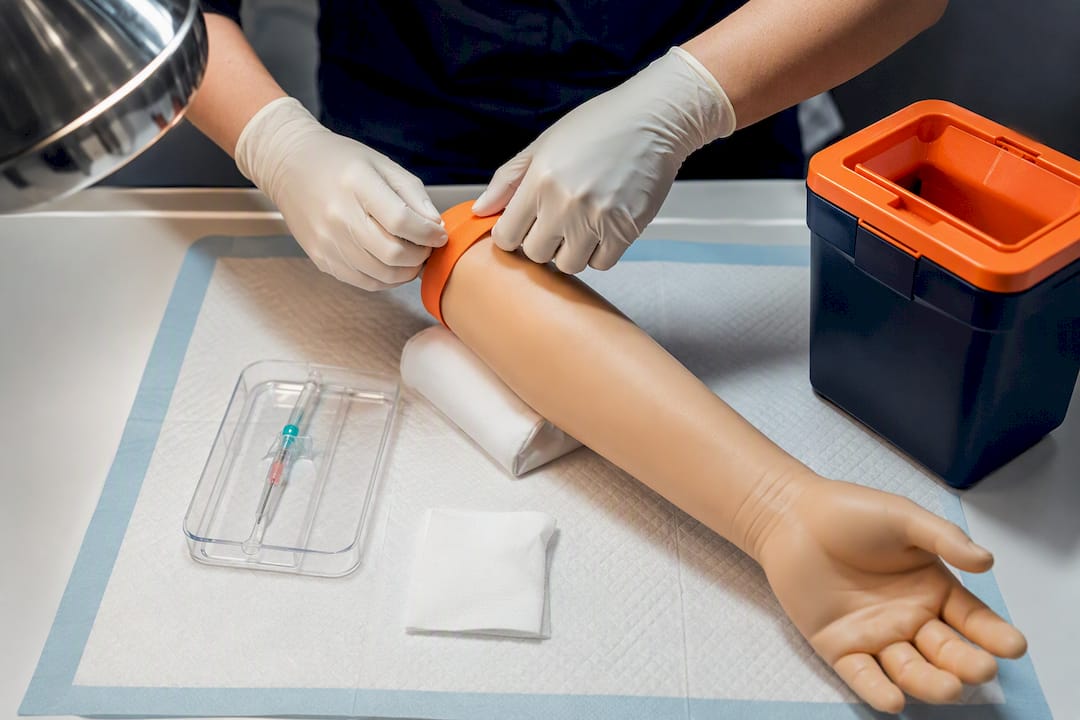
For catheterization basics, examiners typically want you to talk through the procedure as you go, since many stations test verbal explanation rather than a live insertion on a manikin. Cover consent and dignity (offering a chaperone), sterile technique, correct catheter size selection, checking balloon inflation volume against the catheter's own markings, and confirming urine flow before securing the catheter. State your plan for documentation and when you'd escalate, such as failed catheterization requiring urology input.
The pattern across both stations is the same: narrate your safety checks out loud. Examiners can't score a step they didn't hear or see, even if you did it correctly in your head. Practice saying "I'm now checking for allergies" and "I'm confirming flashback" as you go, not just doing the action silently.
Common Challenges in OSCE Role Plays and How to Fix Them
The same handful of problems show up in almost every mock circuit. Recognizing them in advance means you can rehearse the fix rather than discover the problem live.
Freezing when the role-player goes off-script. Real actors sometimes improvise beyond the brief. The fix is to build a mental fallback line: "That's a good question, let me come back to that once I've finished my assessment," which buys time without losing composure.
Running out of time mid-station. This almost always comes from spending too long on rapport-building at the start. Practice with a visible timer and set a personal checkpoint, such as "history complete by minute 5," so you know when to move to closing.
Forgetting to close properly. Candidates often nail the middle of a station and then just stop talking when time is called, leaving out a summary or safety net. Rehearse your closing line as its own separate drill, disconnected from the rest of the scenario, until it becomes reflexive.
Overloading on jargon under pressure. Stress pushes people back toward technical language because it feels precise and safe. Record yourself explaining a diagnosis to a lay role-player and count the jargon words; most students are surprised how often "myocardial infarction" slips out instead of "heart attack."
Losing marks on empathy while focused on content. Trying to remember every clinical fact often crowds out warmth. Scripting one or two empathy phrases in advance, "I can see this is a lot to take in," gives you something automatic to say when your working memory is full.
None of these are knowledge gaps. They're performance habits, and habits only change with repetition under realistic time pressure.
How to Give and Receive Feedback During Practice
Feedback is where most of the actual learning happens, yet it's the part students rush through fastest because everyone wants to run the next station.
When you're the examiner, score against the checklist first, then talk. Giving feedback from memory without the checklist in hand tends to drift toward vague comments like "that was good" or "a bit awkward," neither of which tells the candidate what to change. Point to specific moments: "You didn't pause after telling her the diagnosis, you moved straight to treatment options."
When you're receiving feedback, resist the urge to explain or defend your performance. Write down what you hear before responding. Standardized checklists make peer feedback measurably more reliable, since training your study group to use the same rubric cuts down on the wildly different scores you get when everyone grades by gut feeling instead.
A useful structure for the feedback conversation itself:
- Examiner states the checklist score first, domain by domain
- Candidate names one thing they think went well, unprompted
- Examiner adds one specific behavioral fix, not a personality critique
- Both agree on what to drill differently next round
Keep each feedback round under three minutes. Longer discussions turn into debate rather than actionable correction, and they eat into time you could spend running another station.
Using Communication Frameworks Like SPIKES and ICE
Structure beats improvisation in a timed station, and two frameworks show up constantly across communication scenarios.
SPIKES works for breaking bad news: Setting up the conversation, checking the patient's Perception of the situation, getting Invitation to share information, delivering Knowledge in plain language, addressing Emotions as they arise, and agreeing on a Strategy or summary before closing. Map the breaking bad news template earlier in this article against SPIKES and you'll notice the checklist items line up almost one to one, which isn't a coincidence. Most communication mark schemes are built around this exact skeleton.
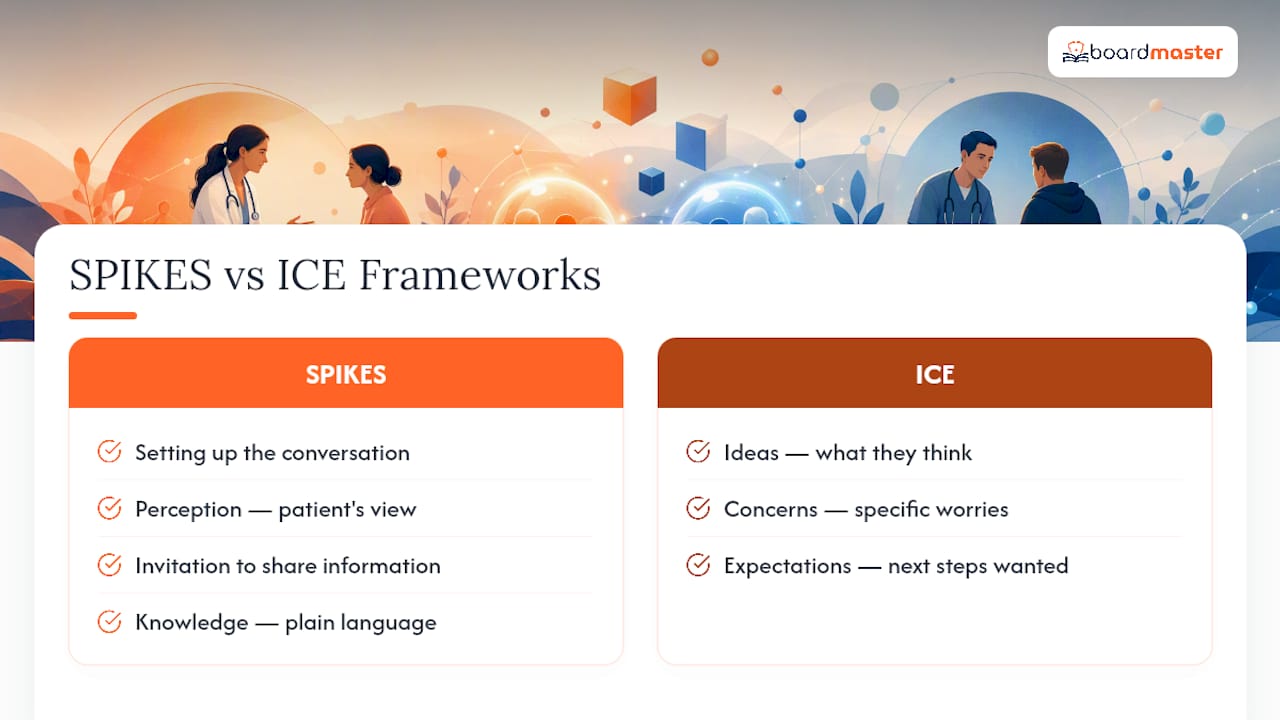
ICE (Ideas, Concerns, Expectations) works well for consultations where you need to understand the patient's perspective before giving advice: what do they think is going on, what are they specifically worried about, and what do they expect to happen next. Skipping ICE is a common reason candidates deliver technically correct advice that still scores poorly on patient-centered communication, because they never actually found out what the patient wanted to know.
You don't need to announce the framework out loud during the station. Use it as your internal scaffold, so if the role-player throws in something unexpected, you have a structure to fall back into rather than losing your thread entirely.
Peer Role Play vs. Formal OSCE: What Changes on Exam Day
Peer practice and the real exam share a format but differ in ways that catch people off guard if they haven't planned for it.
Your study partner knows you, which means they unconsciously soften emotional cues or give you extra time when you pause. A real examiner and a trained role-player won't. They follow a script that's often designed to be mildly uncomfortable on purpose, since official communication stations frequently instruct actors to be emotionally testing specifically to see how you handle pressure.
Timing also gets stricter. Your study group might let a station run 30 seconds over because you're "almost done." Real circuits use a bell or buzzer, and you stop exactly on time, mid sentence if necessary.
Adapt your practice by asking your role-player to play it colder than feels natural, and by using a real countdown timer with an audible alert rather than eyeballing a phone screen. The goal isn't to make practice unpleasant. It's to make the actual exam feel familiar instead of jarring, because you already rehearsed the version that doesn't go smoothly.
Clinician-Educator Takeaways: Three Fixes That Move Scores Fast
Three habits separate solid candidates from struggling ones, and none require more clinical knowledge.
First, open every station with a clear statement of what you're about to do. Second, signpost transitions out loud ("Now I'd like to examine your abdomen") instead of shifting silently. Third, always close with a plan and a safety net, even under a time crunch.
The most common failure I see rehearsed badly is the silent close: a candidate nails the clinical content, then simply stops talking when the bell rings because they never built a closing line into their script. The fix is almost embarrassingly simple. Write one sentence, memorize it, and say it out loud in every single practice run until it's reflexive, not improvised.
— Dr. Ahmed Abuzoor
Try BoardMaster's OSCE Practice: What to Do Next
BoardMaster gives you what a study partner can't: a clinical simulation you can run at midnight, at 6 a.m., or between lectures, with feedback that tells you exactly which checklist items you missed instead of a vague "that felt off."

For your first session, run the breaking bad news template above with a study partner, then immediately follow it with a solo run of a similar scenario through The OSCE practice tool. Compare your peer feedback against the AI feedback and see where the two overlap. Most students find the gap between "what I thought I did" and "what actually got flagged" is where the real improvement happens. Sign up and run your first simulation at BoardMaster.
Authoritative Sample OSCE Documents Worth Reviewing
For scenarios closer to your own exam format, check your institution's own sample stations before relying solely on generic templates. Useful starting points include Dundee's OSCE communication examples and the ABA's public sample stations, both of which pair scripts with real examiner mark schemes.
Sources
- OSCE communication station examples — MBChB Dundee
- FFICM OSCE example questions — communication station
- Public sample OSCE — The ABA (sample stations and instructions)
- OSCE communication guidance — Monash OSCE
FAQ
What are some common OSCE scenarios?
Common scenarios include breaking bad news, obtaining informed consent, focused history-taking for chest pain or abdominal pain, cardiovascular and respiratory examinations, and data interpretation stations covering ECGs or blood results.
Can you provide examples of OSCE nursing scenarios?
Nursing OSCE scenarios often mirror medical ones but emphasize patient safety checks, such as medication administration, wound care communication, and escalating a deteriorating patient, each scored against an observable checklist rather than free-form judgment.
Can you provide examples of clinical case scenarios?
A typical clinical case scenario gives a short vignette, such as a patient with acute chest pain, and asks the candidate to take a history, examine, interpret a test, or explain a diagnosis within a fixed time limit, exactly like the templates above.
What are some common OSCE questions?
Beyond the scenario prompt itself, examiners commonly ask candidates to justify their differential diagnosis, state their next steps, or explain a management plan in plain language to the "patient" role-player.
How is BoardMaster different from practicing with a study partner?
BoardMaster's AI OSCE simulations let you run scenarios solo, any time, with instant checklist-style feedback, complementing peer practice rather than replacing the value of a real human role-player.