Use one skeleton across every station: read the stem for the full time allowed, spend the first 30 to 60 seconds on intro, identity, and consent, hit a hard checkpoint at minute 4 to decide what gets cut, and start your close with 60 to 90 seconds left no matter what. This works because it forces you to prioritize the tasks examiners actually score and guarantees a planned finish instead of a rushed one. If you fall behind, pause for a beat, say out loud what you'd still do, and move to your close.
TL;DR:
- Prioritize the high-yield tasks during the midpoint checkpoint at minute 4 to ensure clinical content and safety measures are covered within the allotted time.
- Practice timing with realistic mock stations multiple times weekly to develop an intuitive sense of when to proceed or cut questions, reducing panic if behind schedule.
- Use a scripted recovery phrase if falling behind or confused to quickly realign focus without losing marks or professionalism.
- Efficiently reset between stations with a brief mental and physical pause to prevent focus drift and optimize transition timing.
- Volunteer early and clear communication if unexpected disruptions occur to demonstrate professionalism and adapt the station plan without derailing performance.
Table of Contents
- Station Timing Templates: Minute-by-Minute Plans for Common Station Types
- What Should You Say in the First 60 Seconds?
- How Do You Use Reading Time Before You Walk In?
- Mid-Station Checkpoints and Recovery Tactics When You Fall Behind
- Practice Strategies That Train Your Internal Clock
- Transitions and Rest-Station Resets: Getting to the Next Door Ready
- Exam-Day Checklist and Final Timing Tips
- Managing Timing Under Unexpected Difficulties or Interruptions During a Station
- Balancing Thoroughness With Speed to Avoid Omissions Without Rushing
- Psychological Techniques to Reduce Time-Related Exam Stress and Maintain Focus
- What One Candidate Learned From a Station That Went Sideways
- Sources
- FAQ
Station Timing Templates: Minute-by-Minute Plans for Common Station Types
Most OSCE circuits run on an eight-minute inside window preceded by two minutes of reading time outside the door, a split. OSCE Revisions documents across published AMC-style timing templates.
For an eight-minute station, that breaks down like this:
- Minutes 0 to 0.5: Intro, identity check, consent, one-line agenda.
- Minutes 0.5 to 5: Core task, whether that's a history, a focused exam, or a counseling conversation.
- Minutes 5 to 6.5: Synthesis: summarize findings, state a working diagnosis or plan, check the patient understands.
- Minutes 6.5 to 8: Close, safety-net, and hand back to the examiner.
The task in the middle block changes by station type, but the ratio doesn't. A history station spends minutes 1 through 5 on presenting complaint, systematic review, and red flags. A focused physical exam trades questions for inspection, palpation, and a called-out set of findings. A communication or counseling station spends more of that block checking understanding and less on data-gathering, since the examiner is scoring rapport and clarity over completeness. A short procedural station (suturing demo, inhaler technique) often needs a tighter core block and a longer synthesis phase, because examiners want you narrating steps as you go, not silently working.
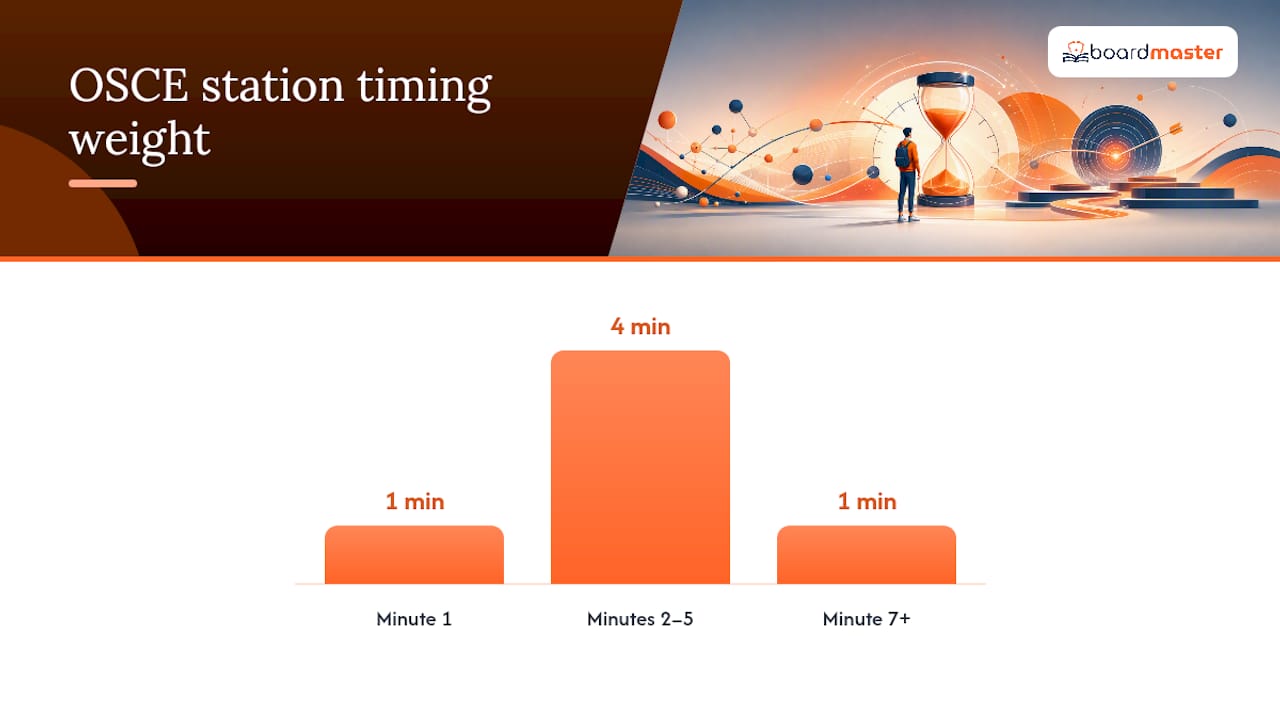
Examiners tend to weight minute 1 for professionalism and consent, minutes 2 through 5 for clinical content and safety behaviors, and minute 7 onward for whether you can wrap up without being told to stop. Geeky Medics recommends building a distinct skeleton for each station type rather than forcing one script onto history, exam, and counseling stations alike.
What Should You Say in the First 60 Seconds?
Your opening either buys you time or costs it. A clean 30 to 60 second start looks like this:
- State your name and role ("Hi, I'm one of the medical students, I'll be examining you today").
- Confirm identity ("Can you confirm your name and date of birth?").
- Get explicit consent for the task ahead.
- Set a one-sentence agenda ("I'm going to ask a few questions and then examine your chest, is that okay?").
Skipping steps here doesn't save time. It costs it, because a fumbled opening usually triggers an examiner prompt or forces you to backtrack once you realize you never confirmed identity. TalkOSCE treats a rehearsed, minute-by-minute opening as one of the highest-leverage things a candidate can practice, precisely because it removes hesitation at the exact moment nerves are highest.
Pro Tip: Say your opening script out loud twenty times before exam day, not just in your head. The version that sounds smooth in your head often stalls the first time your mouth actually has to produce it under pressure.
How Do You Use Reading Time Before You Walk In?
Reading time is where your timing strategy actually gets decided, not just planned. You're extracting four things from the stem: the task verb (assess, counsel, examine, explain), your role (student doctor, on-call registrar), the setting (ED, GP clinic, ward), and any stated constraints (time limit, specific complaint to address).
From those four elements, you allocate your inside minutes before you ever touch the door handle. A stem that says "take a focused history" points toward a longer core block and a short exam if any. A stem that says "explain the diagnosis and management plan" flips that ratio toward counseling and checking understanding.
A fast note layout for the back of your reading card:
- Task + role (one line)
- Time split (three numbers: opening, core, close)
- Two or three must-hit checklist items you can't afford to skip
- One red flag or safety point specific to this presentation
Mid-Station Checkpoints and Recovery Tactics When You Fall Behind
Set a hard check at minute 4. If you're not roughly halfway through your core task by then, stop expanding and start converging on the highest-yield remaining items, the ones examiners are actually scoring, not every checklist line you rehearsed at home. TalkOSCE points out that prioritizing safety, communication, and reasoning in these middle minutes wins marks even when lower-yield questions get dropped entirely.
If you genuinely blank or lose your place, a short scripted line buys you a breath without costing marks:
- "Let me just collect my thoughts, I want to make sure I cover the important parts of this."
- "I'm going to move on to my examination now so I have time to summarize for you."
- "I haven't had time to check X, but that's something I'd want to do next."
That last line matters more than most candidates realize. Verbalizing what you would have done if time allowed is respected by examiners and recovers marks in a station that ran short, according to guidance from TalkOSCE. Silence about a missed step reads as an oversight. Naming it reads as clinical awareness.
Pro Tip: Practice the phrase "I'd also want to check..." until it's automatic. It's the single easiest way to turn a rushed station into a station that still looks complete.
Practice Strategies That Train Your Internal Clock
A timing template only works once your internal sense of "where I should be at minute 4" is actually accurate, and that only comes from repetition under real time pressure, not from reading a template the night before. OSCE Revisions makes this point directly: candidates who memorize a minute-by-minute skeleton but never rehearse it under a running clock tend to panic the moment they fall even 30 seconds behind, because they have no lived sense of what "behind" actually feels like.
Build that internal clock with a mix of practice formats:
- Single-station drills: Run one station type five times in a row with a visible timer, focusing only on hitting your minute-4 checkpoint accurately.
- Mixed circuits: Rotate through history, exam, and communication stations back to back to simulate the fatigue and context-switching of exam day.
- Spaced repetition: Revisit station types you struggled with a week later, not the next day, so the timing habit actually sticks.
- Structured feedback: Record yourself or use a peer with a checklist, then review specifically for where minutes were lost, not just what content was missed.
Geeky Medics and other revision resources converge on the same core recommendation: simulating exam conditions with timed mock stations and structured feedback is the most reliable way to avoid running out of time on the actual day. AI-driven OSCE practice simulations give you a version of this without needing a study partner every time, running realistic station scenarios on demand so you can drill your minute-4 checkpoint at 9 PM on a Tuesday instead of waiting for a scheduled mock circuit.
A workable weekly schedule: 20 to 30 minutes of timed single-station drills four days a week, plus one full timed circuit (four to six stations back to back) once a week to rehearse transitions and fatigue management together.
Transitions and Rest-Station Resets: Getting to the Next Door Ready
The station you just left will steal focus from the one you're about to enter if you let it. A 30-second reset between stations protects your next timing plan before it even starts:
- Let go of the last station, good or bad, it's already scored.
- Take one deliberate breath to lower your heart rate.
- Glance at your next stem card and reset your mental clock to zero.
- Note your opening line and time split for the upcoming station.
Some circuits include a genuine rest station with no task attached. Use it for a quick checklist review, not rumination on what you might have gotten wrong two doors back. Ruminating costs you the same 60 seconds a proper reset would have spent preparing for what's next.
Exam-Day Checklist and Final Timing Tips
Keep a mental (or literal) pocket card with three things: your opening script, your minute-4 and minute-7 check triggers, and two or three recovery phrases for going blank. Rehearsing these until they're automatic matters more than any last-minute content review.
A few habits that protect your clock on the day itself:
- Glance at the clock at your minute checkpoints, not continuously. Constant clock-watching pulls focus from the patient and reads as anxious.
- Never talk over the buzzer. Finish your sentence, stop, and let the examiner move you along. Talking past time signals poor time awareness, the exact thing you're trying to demonstrate control over.
- Control your breathing between stations rather than during them. A held breath before you walk in beats a shaky voice once you're inside.
- Stay hydrated but don't overdo it. A rushed bathroom break between stations costs minutes you don't have.
Pro Tip: Do a 10-minute warm-up drill an hour before your exam start time; run through one full station out loud. It primes your internal clock the same way athletes warm up muscles before a race.
Managing Timing Under Unexpected Difficulties or Interruptions During a Station
Real stations don't always run clean. A confused actor, a broken mannequin, an examiner interruption to clarify a question, all of these eat time you didn't budget for, and none of them are your fault. The mistake most candidates make is treating an interruption as a reason to speed up everything that follows, which usually causes more errors than the interruption itself did.
Instead, treat an unexpected disruption as a trigger to re-run your minute-4 rule early. If something derails you at minute 2, don't try to cram the original plan into the remaining six minutes. Reassess immediately: what are the two or three highest-yield things left to demonstrate, and how much time do you actually have for them? A short acknowledgment helps too, something like "I want to come back to that, let me just finish this assessment first" keeps the station moving without losing the examiner's confidence in your control of the situation.
If a station genuinely breaks down, a stuck door, a technical failure, an actor who goes off-script, most exam bodies have a process for flagging it, and staying composed while you do that is itself part of what's being assessed. Panic reads as poor professionalism; a calm "I think there might be an issue, could someone assist?" reads as exactly the kind of composure you'd want from a working clinician.
The broader habit worth building: your timing plan should have built-in slack, not just a fixed sequence. Practicing stations with a peer who deliberately throws in odd questions or pauses trains you to absorb small disruptions without losing your place entirely.
Balancing Thoroughness With Speed to Avoid Omissions Without Rushing
The tension every candidate feels is real: go too slowly and you run out of time before covering safety-critical items; go too fast and you skip the depth that shows genuine clinical reasoning. The fix isn't picking a universal pace. It's deciding, station by station, which items are load-bearing and which are optional detail.
Load-bearing items are the ones tied to patient safety, differential diagnosis, or the specific task verb in the stem. Optional detail is everything that adds polish but wouldn't sink the station if it were missing. A focused history station on chest pain has to cover red flags like radiation, associated symptoms, and cardiac risk factors; it doesn't strictly need a full social history if time runs short.
Practicing with a timer trains this instinct better than reading a checklist ever will, because it forces you to feel the actual cost of lingering on a low-yield question. Candidates who drill under time pressure tend to develop an almost automatic sense of when a question has run its course and it's time to move on, without needing to consciously calculate it mid-station.
One useful mental model: ask yourself "would skipping this get someone hurt or miss the diagnosis?" If the answer is no, it's a candidate for trimming when time gets tight. This isn't about rushing through content. It's about knowing in advance which content earns its place in a compressed station and which was only ever going to be there if time allowed.
Psychological Techniques to Reduce Time-Related Exam Stress and Maintain Focus
Clock-anxiety compounds itself. The moment you notice you're behind, the stress response itself starts eating processing power you need for the clinical task in front of you, which then makes you fall further behind. Breaking that loop matters as much as any content review.
A short composed pause, roughly 10 seconds of deliberate breathing before speaking again, is a genuinely effective reset when panic starts to creep in mid-station. Saying something like "let me just collect my thoughts, I'll prioritize the chest exam and then present my findings" out loud does two things at once: it buys you the pause you need, and it signals control to the examiner rather than distress.

Reframing the clock itself helps too. Instead of treating the timer as an adversary counting down, treat your minute checkpoints as decision points you've already rehearsed, not moments of judgment. That shift, from "I'm running out of time" to "this is my minute-4 check, time to converge," turns a stress trigger into a cue you've practiced responding to.
Physical grounding techniques carry over from the exam-day checklist here too: controlled breathing between stations, a fixed physical anchor (planting both feet, unclenching your hands) at the start of each new station, and a brief mental script for restarting focus. None of this replaces content knowledge. It just protects your ability to use the content knowledge you already have when the clock starts working against you.
What One Candidate Learned From a Station That Went Sideways
A candidate walks into a respiratory station expecting a straightforward focused exam. Thirty seconds in, the patient actor mishears the consent question and starts answering as if it's a history station. Two minutes gone before the exam even properly starts.
The fix isn't panic, it's the minute-4 rule kicking in early. Recognizing the derailment fast, redirecting with one clear sentence ("Thank you, let me just move into examining your chest now"), and mentally resetting the clock to treat minute 2 as the new minute 0. The core exam gets compressed into three and a half minutes instead of five, which means dropping palpation of the back in favor of the higher-yield auscultation and inspection findings examiners are actually scoring.
At minute 7, closing anyway: summarizing findings, stating a likely diagnosis, and adding one line, "I wasn't able to fully assess the back given time, but I'd want to do that next." That single sentence is what turns a truncated station into one that still reads as clinically complete.
The lesson worth rehearsing isn't the recovery line itself. It's the instinct to check the clock early and often enough that a two-minute setback never turns into a five-minute one. Templates only work when they've been drilled past the point of conscious thought, which is exactly why rehearsal matters more than any last read-through the night before.
Sources
- AMC Clinical Exam Time Management: 8-Minute System | OSCE Revisions
- How to Pass Your OSCE: The Complete Exam Strategy Guide | TalkOSCE
- Top tips for OSCEs — Geeky Medics
- LCME
FAQ
How Can You Pass the OSCE Exam More Easily?
Rehearse a minute-by-minute template for each station type until your timing checkpoints are automatic, and practice recovery phrases so a rough station never turns into a failed one. Consistent timed mock practice, not last-minute content review, is what most consistently separates candidates who pass comfortably from those who scrape by.
What Happens if You Fail the OSCE Multiple Times?
Policies on repeat attempts and remediation vary by school and licensing body, so check your specific institution's academic policy rather than relying on general advice. Standards bodies like LCME set broad competency expectations, but the exact consequences of repeated failures are set at the institutional or licensing-board level.
Is the OSCE Harder Than the NCLEX?
They test different things and can't be ranked on a single difficulty scale: the NCLEX is a computerized knowledge and clinical judgment exam, while the OSCE tests live, timed clinical performance in front of an examiner. Many candidates find OSCE stress harder to manage precisely because it's live and time-boxed, which is exactly why a rehearsed timing strategy matters so much.
How Much Time Do You Get for Each OSCE Station?
Station length varies by program, but an eight-minute performance window preceded by two minutes of reading time outside the room is a common structure, as documented in published AMC-style timing templates. Always confirm your own program's exact timing, since some circuits run different station lengths.