
TL;DR:
- Question banks are the most effective USMLE study resource because they promote active recall and mirror exam question formats.
- Using one primary question bank, annotating the "First Aid" textbook, and practicing with official NBME exams late in preparation lead to better scores.
Question banks are the single most effective USMLE study resource type, outperforming passive reading, video lectures, and flashcards when measured by exam score impact. The types of USMLE study resources ranked by performance impact follow a clear hierarchy: active recall tools at the top, foundational texts in the middle, and supplementary visual aids supporting both. Understanding this hierarchy lets you build a study stack that cuts wasted hours and targets the concepts that actually appear on exam day. BoardMaster's approach, generating USMLE-style questions directly from your lecture notes, reflects exactly this evidence-based priority.

1. Why question banks are the top-ranked USMLE resource
Question banks sit at the top of every credible USMLE prep ranking because they force active recall, the learning mechanism most strongly linked to long-term retention. Passive reading lets you recognize information. Questions make you retrieve it, which is exactly what the exam demands.
Over 90% of medical students preparing for Step 1 use a primary question bank as their core study tool. That near-universal adoption reflects a consensus built on years of student performance data.
The best question banks share four features that drive results:
- Detailed answer explanations that teach the reasoning behind each answer choice, not just the correct one
- Performance analytics that track your accuracy by organ system, subject, and question type
- NBME-style question logic that mirrors the clinical vignette format used on the actual exam
- Adaptive learning modes that surface your weakest topics more frequently
Pro Tip: Avoid running multiple question banks simultaneously. Students who do this dilute their review focus and make performance tracking nearly impossible. Use one primary question bank for foundational learning, then add a supplementary bank only in a targeted phase closer to your exam date.
2. Foundational review books as your study spine
A foundational review book like First Aid for the USMLE Step 1 is non-negotiable, but only when used actively. Passive reading of any review text produces minimal retention. The book becomes powerful when you treat it as a living document.
Top-scoring students annotate First Aid by consolidating notes from question bank explanations, video lectures, and flashcard reviews directly into its margins and pages. This turns one book into a personalized, high-yield reference that reflects exactly what you have learned and where you have struggled.
Key principles for using foundational texts effectively:
- Annotate every question bank explanation that adds detail beyond what the book already covers
- Cross-reference systems so that a cardiology question bank miss gets noted in the cardiology chapter
- Review your annotations regularly rather than re-reading clean pages you already know
- Avoid re-reading passively as a substitute for active recall practice
"First Aid is not a book you read. It is a book you build. Every annotation you add is a gap you have closed." This distinction separates students who plateau from those who keep climbing.
The limitation of foundational texts is clear: reading alone does not simulate exam conditions. Books must work alongside question banks and active recall tools, not replace them.
3. Visual learning tools and video lectures for conceptual depth
Visual learning tools and video lectures rank third because they build the mechanistic understanding that question banks test. Knowing that a drug causes a side effect is not enough. You need to know why, and visual tools deliver that efficiently.
Pathoma's concise video lectures connect disease mechanisms to clinical presentations in a way that text alone rarely achieves. Students who understand pathology mechanistically answer clinical vignettes faster and with greater confidence.
Sketchy uses visual mnemonics to encode microbiology and pharmacology content into memorable scenes. The method works because the brain retains images and stories more reliably than isolated facts.
How to integrate visual tools without wasting time:
- Watch with a pen in hand. Pause and annotate your foundational text after each video segment.
- Prioritize mechanism-heavy subjects like pathology, pharmacology, and physiology for video content.
- Skip re-watching videos you already understand. Use your question bank analytics to identify which topics need visual reinforcement.
- Treat video as a complement to questions, not a replacement for them.
Pro Tip: Passive video watching is the most common time sink in USMLE prep. If you finish a lecture and cannot explain the core mechanism in two sentences, watch it again with your notes open.
4. Spaced repetition and flashcard systems for long-term retention
Spaced repetition is the most scientifically supported method for moving information from short-term to long-term memory. The system works by showing you a card at increasing intervals, testing recall just before you would naturally forget the information.
Anki, particularly the community-curated AnKing deck, is the dominant flashcard tool in USMLE prep. The AnKing deck covers high-yield Step 1 content and integrates well with First Aid and Pathoma. It is free, which makes it one of the highest-value tools available.
Practical strategies for flashcard success:
- Do not skip daily reviews. Spaced repetition breaks down when you let cards pile up. Consistency matters more than volume.
- Create custom cards from question bank misses. Pre-made decks cover broad content; your personal cards target your specific weak points.
- Integrate cards with annotation. When you add a card, add the same fact to your foundational text so both systems reinforce each other.
- Use pre-made decks as a starting point, then suspend cards covering topics you have already mastered to keep your daily review manageable.
Effective self-study stacks built around Anki and free resources can cost as little as $100–$300 while still producing strong exam performance. Budget is not a barrier to high-quality prep.
5. Official NBME practice exams for performance benchmarking
Official NBME practice exams occupy a unique position in the ranked USMLE prep hierarchy. They are not teaching tools. They are diagnostic tools, and that distinction changes how and when you use them.
NBME self-assessments and the Free 120 are most valuable in the final two weeks before your exam. Using them earlier wastes their diagnostic power on gaps you have not yet had time to address.
| Resource | Best use timing | Primary purpose |
|---|---|---|
| NBME self-assessments | Final 4–6 weeks | Score prediction and weak area diagnosis |
| USMLE Free 120 | Final 2 weeks | Official question style calibration |
| Question bank timed blocks | Throughout dedicated study | Active learning and performance tracking |
| Question bank practice mode | Early dedicated study | Conceptual learning and explanation review |
Key principles for using official practice exams:
- Simulate real conditions. Take NBME exams in one sitting, timed, without interruptions.
- Review every wrong answer against your annotated foundational text, not just the answer explanation.
- Track score trends across multiple NBME forms to identify whether your weak areas are improving.
- Do not use Free 120 questions as a question bank. They are a calibration tool, not a teaching resource.
6. Integrated study platforms that combine multiple resource types
The highest-rated Step 1 study resources comparison consistently shows that students who integrate resource types outperform those who use each tool in isolation. An integrated platform connects question bank performance data to flashcard review and annotation in one workflow.
BoardMaster takes this integration further by generating USMLE-style questions directly from your uploaded lecture notes. This means your question bank practice aligns with what your professors emphasize, not just what a generic bank covers. A student named Sarah used this approach to move from the 73rd to the 92nd percentile while cutting her study hours in half.
The advantage of top integrated class and USMLE study platforms is that they eliminate the gap between class exam prep and board prep. You study the same material for both, which compounds your efficiency rather than splitting your time.
7. Free and low-cost resources that punch above their weight
Free resources are not second-tier options. Several of the most effective USMLE prep tools cost nothing or close to it, and knowing which ones to use is part of building a smart study stack.
The USMLE Free 120 is an official resource published by the NBME. It contains real exam-style questions and gives you direct exposure to the reasoning patterns the exam rewards. Pair it with the AnKing Anki deck and high-quality YouTube content covering pathophysiology and pharmacology, and you have a foundation that rivals paid resources in content quality.
The high-yield topics by system that appear most frequently on Step 1 are well-documented. Free resources cover these topics thoroughly. The gap between free and paid tools is not content coverage. It is analytics, adaptivity, and personalization.
Pro Tip: Use free resources to cover content you already understand at a surface level. Invest in paid tools for the subjects where your question bank analytics show the largest performance gaps.
Key Takeaways
The most effective USMLE prep strategy combines a primary question bank, one annotated foundational text, and spaced repetition tools, used deeply rather than spread thin across many resources.
| Point | Details |
|---|---|
| Question banks rank first | Active recall and NBME-style logic make question banks the highest-impact resource type. |
| Annotate your foundational text | Treat First Aid as a living document by adding question bank and video insights directly to it. |
| One question bank at a time | Using multiple question banks simultaneously dilutes focus and complicates performance tracking. |
| Use official exams late | NBME self-assessments and Free 120 are most valuable in the final two to six weeks before your exam. |
| Depth beats breadth | Mastering four core resources deeply outperforms skimming ten different materials. |
What I have learned about building a real USMLE resource stack
The most damaging myth in USMLE prep is that more resources equal better preparation. I have seen students collect every high-yield book, subscribe to three question banks, and download every Anki deck available, then score below their potential because they never went deep on any of it.
The students who perform best do something counterintuitive. They pick fewer tools and use them obsessively. They do every question in their primary bank, annotate every miss into First Aid, and review their Anki cards every single day without skipping. That discipline, applied to a small stack, beats a scattered approach every time.
What I find most underused is tailoring prep to individual NBME error patterns rather than following a generic sequential plan. Your analytics tell you exactly where your score is leaking. Most students glance at that data and keep studying the same way. The ones who adjust their plan based on what the data actually shows are the ones who close the gap fastest.
My honest advice: take one NBME self-assessment early in your dedicated period, not to predict your score, but to identify your three weakest systems. Build your entire study plan around closing those gaps first. Everything else is maintenance.
— Dr. Ahmed Abuzoor
BoardMaster brings your study stack together
Medical students who use BoardMaster get USMLE-style questions generated directly from their own lecture notes, which means every practice question targets the concepts their professors actually test.
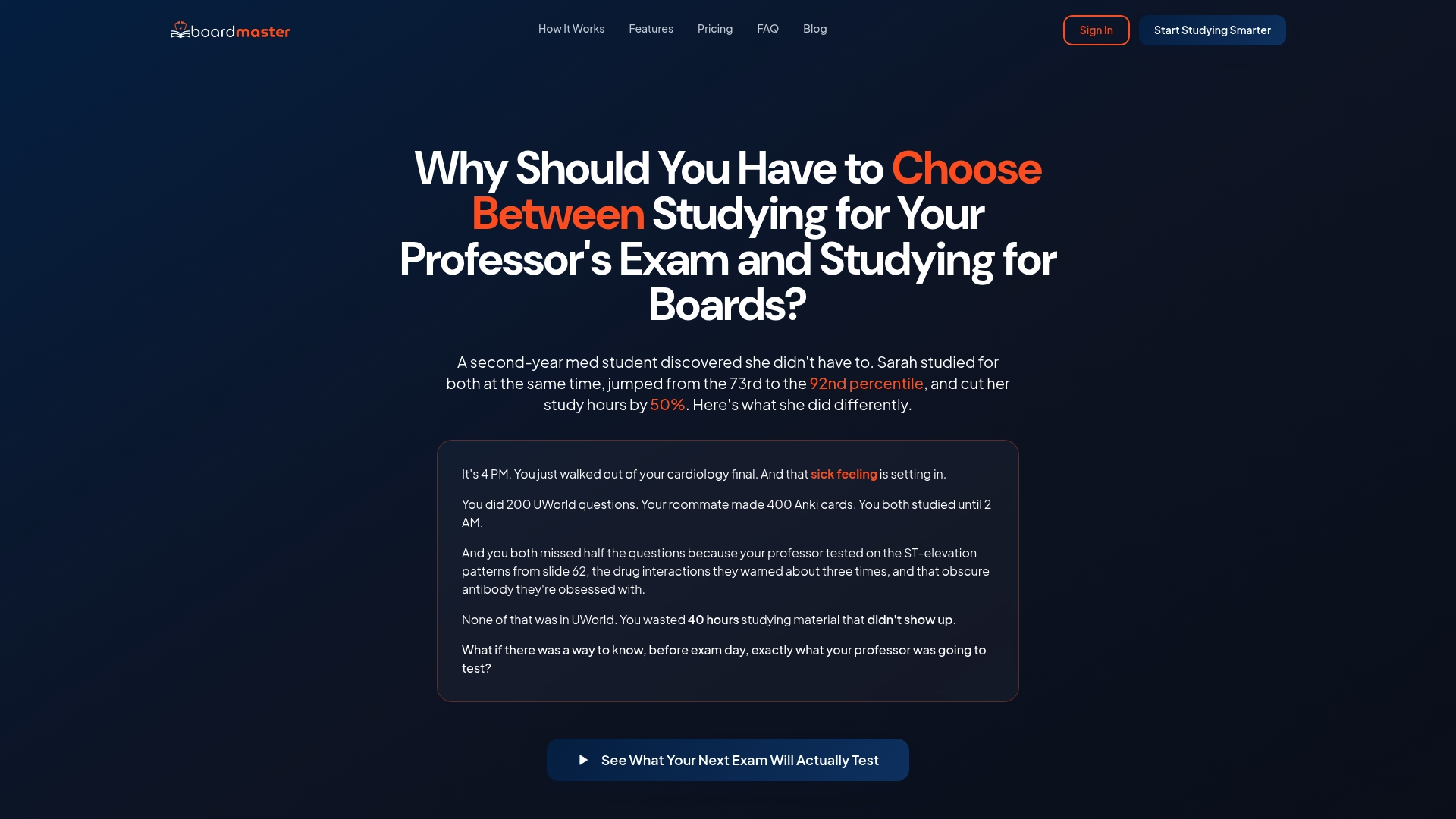
That approach closes the gap between class exams and board prep in one step. BoardMaster's AI-powered USMLE prep combines question generation, performance tracking, and personalized study scheduling in one platform. You upload your notes, and the system builds a question bank calibrated to your course. Students like Sarah have used this method to jump nearly 20 percentile points while cutting study time in half. If you want a study tool that works with your actual curriculum, BoardMaster's QBank is built for exactly that.
FAQ
What is the most effective USMLE study resource type?
Question banks are the most effective resource type because they force active recall and mirror the clinical vignette format of the actual exam. Over 90% of Step 1 students use a primary question bank as their core study tool.
How many question banks should I use for Step 1?
Use one primary question bank for foundational learning, then add a supplementary bank only during a targeted phase closer to your exam. Running multiple banks simultaneously dilutes focus and makes performance tracking unreliable.
When should I take NBME practice exams?
NBME self-assessments are most valuable in the final four to six weeks of dedicated study, with the Free 120 reserved for the final two weeks. Using them earlier wastes their diagnostic value before you have addressed the gaps they reveal.
Are free USMLE study resources good enough?
Free resources like the AnKing Anki deck and USMLE Free 120 are genuinely high quality and can support strong exam performance. Effective self-study stacks built primarily on free tools have produced competitive scores at a fraction of the cost of full paid programs.
How do I use *First Aid* most effectively?
Treat First Aid as a living document by annotating it with insights from every question bank explanation and video lecture. Active annotation converts passive reading into a personalized, high-yield reference that reflects your specific knowledge gaps.