
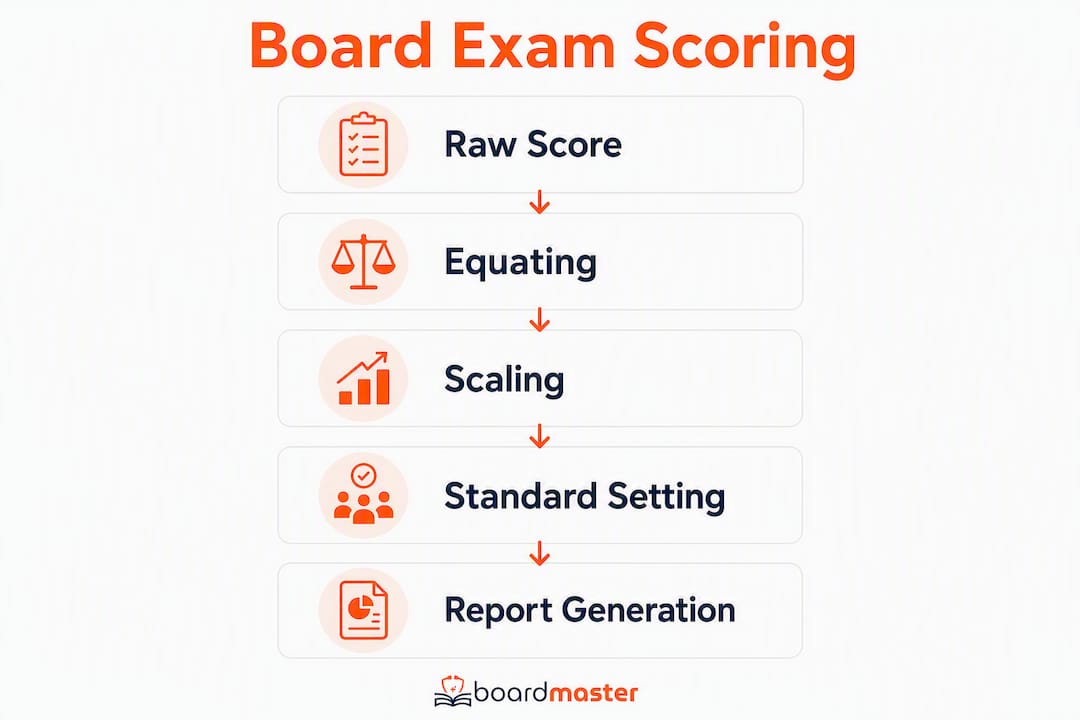
Board exams convert your raw correct answers into a reported score through three linked steps: equating (adjusting for test-form difficulty), scaling (mapping raw performance to a consistent reported scale), and standard setting (applying a passing threshold set by expert panels). The key mechanisms are:
- Raw score: the count of questions you answered correctly
- Equating and scaling: adjusting raw counts so scores mean the same thing across different test forms
- Standard setting: determining the cut score that separates pass from fail
- Score reports: delivering your result with diagnostic breakdowns, percentiles, and a pass/fail flag
Major U.S. boards covered here include the College Board (AP exams), USMLE/NBME (medical licensing), NCEES (engineering licensure), and NBOME/COMLEX (osteopathic licensing).
Table of Contents
- How does board exam scoring convert raw answers to scaled scores?
- How do major U.S. boards report scores?
- How are passing thresholds set on board exams?
- What does your score report actually tell you?
- Common misconceptions about how board exams are graded
- How scoring knowledge should change the way you study
- Key Takeaways
- Why scoring transparency matters more than students realize
- BoardMaster helps you study what your score report flags
- Official sources and further reading
- FAQ
How does board exam scoring convert raw answers to scaled scores?
Your raw score is simply the number of questions you got right. On a 200-question multiple-choice exam, getting 140 correct gives you a raw score of 140. Simple enough. The problem is that no two test forms are identical in difficulty, even when they cover the same content blueprint. One administration's questions might run slightly harder; another's might be slightly more forgiving. If raw scores were reported directly, a 140 on the harder form would be unfairly penalized compared to a 140 on the easier one.

Equating solves this. Psychometricians use anchor items, questions that appear on multiple test forms and have known difficulty values, to statistically link the forms. Once the relationship between forms is established, raw scores get mapped to a consistent reported scale. Think of it like converting temperatures: 100°C and 212°F describe the same physical state. A raw 140 on the hard form might map to a scaled 220; a raw 140 on the easier form might map to a scaled 215. The scaled score is the number that actually appears on your report.
Scaling is not the same as grading on a curve. A curve adjusts scores relative to how your classmates performed. Equating adjusts scores relative to the difficulty of the specific test form you sat, using pre-established psychometric data, not the performance of your cohort on that day.
Pro Tip: When you take a practice test, your raw score is a useful signal, but don't treat it as a direct preview of your scaled score. Practice tests vary in difficulty calibration, and unless the publisher explicitly states the raw-to-scaled conversion table for that form, the raw number alone won't tell you where you'd land on the real exam. Focus on which content areas you missed, not just the total count.
How do major U.S. boards report scores?
The table below compares four representative U.S. boards on the dimensions that matter most for interpreting your result.
| Board | Scale type | How raw maps to reported score | Diagnostic/subject breakdowns | Typical score release timeline | How passing standards are set |
|---|---|---|---|---|---|
| College Board (AP) | Ordinal 1–5 | Section scores weighted and combined into composite; composite mapped to 1–5 | Subject-area performance feedback included | Mid-July for May exams | Research-based standard setting; expert panels review annually |
| USMLE / NBME (Step exams) | Scaled numeric (Step 1 now pass/fail; Step 2 CK numeric) | Raw performance equated across forms; mapped to reported scale | Diagnostic performance profiles available via NBME portal | Approximately 3–4 weeks post-exam | Expert panels using psychometric methods; USMLE publishes methodology |
| NCEES (engineering licensure) | Scaled score + pass/fail | Psychometric equating across forms; scaled score reported alongside pass/fail decision | Limited diagnostic detail; pass/fail is primary output | Typically within 7–10 days for CBT exams | Passing standard set by subject-matter expert panels; reviewed periodically |
| NBOME / COMLEX | Scaled numeric + pass/fail | Raw performance equated and mapped to a three-digit scale | Diagnostic performance profiles by content area included | Approximately 4–6 weeks post-exam | Standard-setting panels of osteopathic physicians and educators |
A few things worth noting. AP's 1–5 scale is ordinal, meaning the distance between a 3 and a 4 is not mathematically equal to the distance between a 4 and a 5. It's a ranking system, not a linear measurement. USMLE's shift of Step 1 to pass/fail was a deliberate policy decision to reduce score-driven competition in residency matching, not a change in the underlying psychometric process. NCEES releases results faster than most medical boards because its computer-based testing infrastructure allows near-real-time equating.
For AP exam study strategies that align with how the 1–5 scale actually works, the AP exam study guide at David TC Tutoring Services covers score-targeting approaches worth reviewing.
How are passing thresholds set on board exams?
The cut score, the minimum scaled score required to pass, is not chosen arbitrarily. Standard-setting panels made up of subject-matter experts apply structured psychometric methods to determine where the pass/fail line should fall.

The most widely used method is the modified Angoff procedure. Each panelist reviews every exam question and estimates the probability that a minimally competent candidate (someone who just barely deserves to pass) would answer it correctly. Those estimates are averaged across panelists and summed to produce a recommended cut score. The panel then reviews the data, discusses outliers, and may adjust before finalizing.
Other methods include:
- Bookmark method: panelists work through an ordered item booklet and mark where a minimally competent candidate's performance would transition from likely-fail to likely-pass
- Borderline-group method: used in clinical assessments; raters identify candidates at the borderline of competence and their scores anchor the cut point
- Contrasting-groups method: compares score distributions of known-competent and known-incompetent groups to find the optimal cut
Exam authorities publish their methodology. USMLE's score reporting and methodology pages describe how passing standards are established and communicated. NCEES similarly documents its equating and standard-setting practices. These aren't marketing documents; they're the technical record of how your pass/fail decision was made.
Practical effects of standard-setting that students should understand:
- Cut scores can shift between administrations if the expert panel revises the standard
- A passing score from one year may not equal the same raw performance in another year, because equating and standard-setting interact
- Retake policies are tied to the cut score in effect at the time of your attempt, not the one in effect when you first registered
- Boards communicate cut-score changes in advance through candidate bulletins and official websites
Quality checks including seeding, where known-score responses are inserted into examiner workloads to catch grader drift, add another layer of defensibility before scores ever reach standard-setting panels.
What does your score report actually tell you?
Score reports contain more information than most students use. Here's what to look for.
Common score-report elements:
| Report element | What it tells you |
|---|---|
| Reported (scaled) score | Your performance on the exam's consistent scale |
| Pass/fail flag | Whether you met the cut score for this administration |
| Percentile rank | How your score compares to the reference cohort |
| Subject/content-area breakdown | Which topic domains you performed strongest and weakest in |
| Diagnostic performance profile | Relative performance (e.g., above/below average) by content category |
Percentile ranks are the most misread element. A 75th percentile score means you outperformed 75% of the reference group, but that reference group is defined by the board, not by your class. USMLE percentiles are calculated against a multi-year reference cohort, so a 75th percentile today means the same thing it meant three years ago. Your raw score could increase year over year while your percentile stays flat if the overall candidate pool is also improving.
Typical score release sequence:
- Exam administration closes; raw responses are collected and verified
- Automated quality checks run (seeding, cross-checking, flagging anomalies)
- Equating algorithms map raw scores to the reported scale
- Standard-setting thresholds are applied to generate pass/fail decisions
- Psychometric review and final validation
- Score release to candidates (timelines vary: 7–10 days for NCEES CBT; 3–4 weeks for USMLE; mid-July for AP May exams)
Pro Tip: If your score lands near the cut score, don't just look at the total. Pull up the diagnostic breakdown immediately. Most boards show content-area performance, and a borderline result almost always has a clear weak domain hiding inside it. That's your retake roadmap. Also confirm the score validity period for your specific board before you plan a retake, since NCEES and medical licensing boards have different retention windows.
Common misconceptions about how board exams are graded
Myth: "70% correct = AP 5." False. AP scores from 1 to 5 are derived from a weighted composite of section scores, then mapped through a research-based conversion. The raw percentage needed for a 5 varies by subject and by year. On some AP exams, 65% correct earns a 5; on others, it takes closer to 75%.
Myth: "The same raw score always produces the same reported score." Not across different test forms. Equating exists precisely because form difficulty varies. A raw 150 on one administration might map to a scaled 230; on a harder form, the same raw 150 might map to 235. The scaled score is the comparable unit, not the raw count.
Myth: "Percentile rank and scaled score move together." They don't have to. Your scaled score reflects your absolute performance against the exam's standard. Your percentile reflects your relative position in the cohort. Both can move independently.
Myth: "Partial credit doesn't exist on standardized exams." Some board exams, particularly those with constructed-response or clinical documentation components, do award step-wise partial credit for correct reasoning even when the final answer is wrong. Always show your work on any free-response or written section.
Myth: "Pass/fail means there's no useful score information." USMLE Step 1's shift to pass/fail still produces a diagnostic performance profile. The numeric score isn't reported to residency programs, but you still receive content-area feedback you can use for targeted remediation.
Myth: "Boards set the passing score to fail a fixed percentage of candidates." Standard setting is criterion-referenced, not norm-referenced. The cut score represents a defined level of competence, not a quota. In theory, everyone could pass (or fail) in a given administration.
Myth: "Score reports are released as soon as grading is done." Psychometric validation, equating, and quality checks run after raw marking. Psychometricians validate results before any score is released, which is why timelines extend beyond the exam date.
For a deeper look at how these misconceptions affect study behavior, the BoardMaster blog covers common exam prep misconceptions for med students with specific examples from USMLE prep.
How scoring knowledge should change the way you study
Understanding equating and standard setting has a direct practical payoff. If cut scores are set by expert panels defining minimum competence, your goal isn't to memorize everything; it's to demonstrate solid command of the core content blueprint. That reframes how you should allocate study time.
Diagnostic reports are the most underused tool in exam prep. Section-level feedback from boards like College Board and NBME shows exactly which content domains are dragging your score. Students who review diagnostic data after each practice test and redirect study time to weak domains consistently outperform those who simply repeat full-length tests without analysis.
The role of question exposure in board prep matters here too. Varied question formats across content areas reduce the surprise factor on test day and help you internalize how the exam's blueprint distributes difficulty.
One documented example: a medical student, Sarah, moved from the 73rd to the 92nd percentile on her board practice assessments while cutting her study hours in half. The shift came from switching to lecture-aligned, targeted questions rather than working through a generic question bank. When your practice questions match the content your professors emphasize and the blueprint your board tests, every study hour does more work.
Pro Tip: Design your practice sessions to mirror the exam's structure. If your board uses timed blocks of 40 questions, practice in 40-question timed blocks, not open-ended review sessions. Pacing under realistic conditions is itself a scoreable skill, and it's one that generic study habits rarely train.
For a structured approach to improving your score, the board exam score improvement checklist on the BoardMaster blog walks through the diagnostic-to-remediation cycle step by step.
Key Takeaways
Board exam scoring converts raw correct answers into defensible, comparable reported scores through equating, scaling, and expert-driven standard setting, and your diagnostic report is the most actionable output of that entire process.
| Point | Details |
|---|---|
| Raw score ≠ reported score | Equating adjusts for form difficulty, so the same raw count can map to different scaled scores across administrations. |
| Standard setting is expert-driven | Panels of subject-matter experts use methods like modified Angoff to set cut scores, not arbitrary percentages. |
| Percentiles are relative, not absolute | Your percentile reflects your rank in the reference cohort, not your absolute command of the content. |
| Diagnostic reports are your roadmap | Content-area breakdowns show exactly where to focus remediation after a borderline or failed attempt. |
| BoardMaster targets your weak domains | By generating USMLE and COMLEX-style questions from your own lecture notes, BoardMaster aligns practice with the content blueprint your score report flags as weak. |
Why scoring transparency matters more than students realize
Most students treat the score report as a verdict. Pass or fail, number on a page, end of story. That framing misses something important.
The psychometric machinery behind board scoring, equating, standard setting, seeding, diagnostic profiling, exists because the stakes are real. A physician who passes Step 2 CK, an engineer who clears the PE exam, a nurse who passes the NCLEX: these aren't just academic achievements. They're signals to the public that a defined level of competence has been verified. The rigor of the scoring process is what makes that signal credible.
What I find underappreciated is how much this transparency is meant to serve the examinee, not just the licensing board. When USMLE publishes its methodology, when NCEES documents its equating practices, when College Board explains how AP composites are built, they're giving you the tools to understand your own result. A borderline fail isn't a random outcome; it's a specific gap in a specific content domain, documented in a diagnostic report, addressable with targeted study.
Students who understand the scoring process stop catastrophizing about a single number and start asking the right question: which content area, and what do I do about it? That shift in framing, from "I failed" to "here's where and here's the plan," is where better outcomes actually start.
BoardMaster helps you study what your score report flags

If your diagnostic report shows a weak content domain, the next step is targeted practice in exactly that area, not another full-length test. BoardMaster generates USMLE and COMLEX-style questions directly from your uploaded lecture notes, so the questions you practice reflect both the board's content blueprint and the material your professors actually emphasized. That alignment is what generic question banks miss.
Sarah's jump from the 73rd to the 92nd percentile while halving her study hours came from this kind of targeted, lecture-aligned practice. When every question you answer maps to a high-yield concept your board actually tests, you stop wasting hours on low-probability material.
You can see how the AI question generator works with your own lecture materials, or explore the full BoardMaster platform to see how diagnostic-style feedback, spaced-repetition flashcards, and physician-written questions work together for USMLE and COMLEX prep.
Official sources and further reading
These are the primary sources to consult for board-specific scoring rules, timelines, and methodology documents.
- About AP Scores, College Board: explains the 1–5 scale, how section scores combine into composites, and links to score-setting methodology.
- NCEES Exam Scoring: documents scaled score reporting, equating practices, and passing standards for PE and FE exams.
FAQ
Is a 70% correct score always an AP 5?
No. The raw percentage needed for each AP score level varies by subject and by year, based on research-driven standard setting. On some AP exams, a 5 requires closer to 65% correct; on others, it may require 75% or more.
How do exam scores work on a scaled system?
Raw correct answers are equated across test forms to account for difficulty differences, then mapped to a consistent reported scale. The scaled score, not the raw count, is what appears on your report and what boards use for pass/fail decisions.
What does the College Board score between 1 and 5 mean?
AP scores from 1 to 5 represent increasing levels of qualification: 1 means no recommendation, 3 means qualified, and 5 means extremely well qualified. The score is derived from a weighted composite of section scores, not a simple percentage of questions correct.
How do you score the highest marks on a board exam?
Focus your study on the content domains your diagnostic reports flag as weak, practice in timed blocks that mirror the real exam's structure, and use question sets aligned to the exam's content blueprint. BoardMaster's lecture-based question generation is built specifically for this kind of targeted preparation.
Do board exam passing scores ever change?
Yes. Standard-setting panels review cut scores when content blueprints are updated or when psychometric data warrants a revision. Always check the official candidate bulletin for your specific board before your exam date to confirm the current passing standard.